1What is the current market size of ceramic cores for investment casting?
The global ceramic core for investment casting market is valued at US$ 184 million in 2025, according to our proprietary research.
Insight Market Data is a premier market research and business consulting firm headquartered in Pune, India, providing syndicated research reports, customized intelligence studies, and strategic advisory services. Renowned academic institutions and Fortune 500 corporations worldwide rely on Insight Market Data's research repository to navigate evolving global and regional business environments. Covering 46 diverse industries across 25 major international economies, our comprehensive database delivers thousands of verified statistics and granular market evaluations. By combining industry-leading analytical methodologies with the direct insights of seasoned industry leaders and subject-matter experts, we deliver actionable intelligence spanning historical performance benchmarks to rigorous multi-year forecasts. We empower organizations to make confident, data-driven decisions across pivotal domains including Machinery & Equipment, Chemicals & Materials, Pharmaceuticals & Healthcare, Food & Beverages, Consumer Goods, Energy & Power, Automotive & Transportation, Electronics & Semiconductors, Medical Devices, Telecommunications, Emerging Technologies, Agriculture, and Packaging. Our multidisciplinary analyst teams provide an objective 360-degree perspective, tailoring every engagement to address complex strategic challenges with exceptional analytical rigor.
Leveraging advanced BI-powered analytics and predictive modeling, Insight Market Data uncovers high-impact market opportunities and competitive differentiators for ambitious enterprises. We continuously refine our research methodologies in accordance with global industry standards, tracking real-time market shifts to ensure our reports are consistently accurate, actionable, and delivered on schedule. Our analysts conduct methodical data validation, rigorous compliance checks, and exhaustive primary and secondary research to maintain the highest levels of data integrity and transparency. We partner closely with corporate strategists, investment groups, and business executives to translate intricate market intelligence into clear, actionable roadmaps for sustainable growth. With operational presence across Washington, USA, and Vimannagar, Pune, India, Insight Market Data ensures direct access to dedicated research specialists and responsive customer support to answer your most strategic questions.
 Ceramic Core for Investment Casting Market
 by Type (Medium-Pressure Injection Molding, High-Pressure Injection Molding), by Application (Aerospace, Gas Turbine, Automotive, Others), by Material (Silica-Based, Zirconia-Based, Alumina-Based, Others), by Sourcing (Outsourcing, In-House), by North America (USA, Canada, Mexico), by Europe (Germany, France, UK, Italy, Russia, Rest of Europe), by Asia Pacific (China, Japan, Korea, Southeast Asia, India, Australia, Rest of Asia Pacific), by Middle East & Africa (Egypt, South Africa, Israel, Turkey, GCC Countries, Rest of MEA), by Latin America (Brazil, Rest of Latin America) Forecast 2026-2034

Research Associate


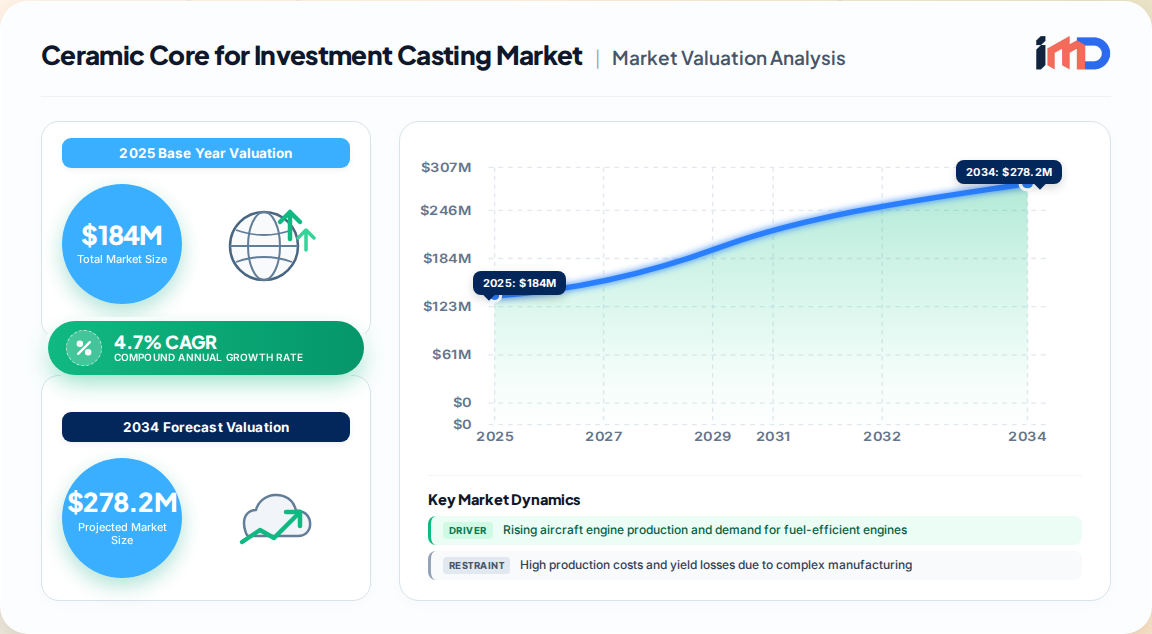
The global ceramic core for investment casting market is estimated at US$ 184 million in 2025 and is projected to reach US$ 253.8 million by 2032, growing at a CAGR of 4.7% from 2026 to 2032. This growth trajectory is underpinned by escalating demand for complex internal geometries in high-performance metal components across aerospace, gas turbine, and automotive sectors.
Ceramic cores are sacrificial components essential for creating intricate internal cavities during precision investment casting. Their unique combination of thermal stability, chemical inertness, and dimensional accuracy enables the production of turbine blades, fuel injectors, and structural parts with cooling passages that are otherwise impossible to manufacture.
Our proprietary research indicates that the market's value growth is being driven not merely by volume expansion but by a qualitative shift toward higher-complexity castings. The increasing adoption of additive manufacturing for core production and the development of advanced ceramic materials are enabling casters to achieve precise repeatability and reduce lead times, particularly for aerospace-grade components.
The ceramic core value chain comprises several distinct stages, each contributing to the final product's performance and cost.
| Stage | Key Activities | Key Participants | Value Addition |
|---|---|---|---|
| Raw Material Supply | Mining and processing of silica, zirconia, alumina | Mining companies, chemical processors | Material purity and consistency |
| Core Manufacturing | Mixing, molding, sintering, finishing | Ceramic core manufacturers (e.g., Morgan Advanced Materials, CeramTec) | Precision and complexity of core design |
| Investment Casting | Wax pattern assembly, shell building, casting, core removal | Investment casting foundries (e.g., PCC, Chromalloy) | Integration of core into final casting |
| End-Use | Assembly into engines, turbines, vehicles | OEMs and tier suppliers in aerospace, automotive, energy | Performance and reliability |
Our analysis reveals that the core manufacturing stage captures the highest value, driven by proprietary material formulations and precision engineering. Outsourcing remains the dominant sourcing model, with over 60% of aerospace OEMs relying on specialized core manufacturers for their expertise and certified processes.
Trade data from UN Comtrade and national customs agencies indicate that ceramic cores, classified under HS code 6914.10 (ceramic wares for technical uses), are primarily traded within North America, Europe, and Asia-Pacific. The United States and Germany are major exporters, while China and India are emerging as significant importers due to their expanding aerospace and automotive manufacturing bases.
Supply chain risks are concentrated in the raw material segment, particularly for high-purity zirconia and alumina, where supply is geographically constrained. The COVID-19 pandemic exposed vulnerabilities in global logistics and raw material availability, prompting manufacturers to diversify sourcing and increase inventory buffers.
North America is projected to maintain the largest market share (27%), driven by its robust aerospace and defense industry. The U.S. alone accounts for the majority of regional demand, fueled by major aircraft engine manufacturers and defense spending.
Asia-Pacific is expected to grow at the fastest CAGR of 5.7%, propelled by rapid industrialization, increasing aerospace manufacturing in China and India, and government initiatives to boost domestic production. China's 'Made in China 2025' initiative and India's 'Make in India' campaign are significant catalysts.
Europe, with a 24% market share, remains a key market due to its strong automotive and industrial gas turbine sectors. Germany and France are the leading markets, supported by companies like CeramTec and European aerospace OEMs.
The market is moderately consolidated, with key players including Morgan Advanced Materials, CeramTec, CoorsTek, Chromalloy, NORITAKE, Lanik, Imerys, CERadvance, and INDO-MIM. These companies compete on technology, quality, and customer relationships.
Our analysis identifies several white spaces with significant growth potential:
For OEMs, sourcing ceramic cores involves a trade-off between cost and quality. Key considerations include:
Our procurement analysis suggests that leading OEMs are shifting toward collaborative relationships with core suppliers, involving early supplier involvement (ESI) in design phases to optimize castability and reduce costs.
| Strategy | Description | Examples |
|---|---|---|
| Market Penetration | Increase share in existing markets through competitive pricing and quality | Expanding aerospace core sales in North America |
| Market Development | Enter new geographic or application markets | Targeting automotive sector in Asia-Pacific |
| Product Development | Innovate new core materials or manufacturing processes | Developing zirconia-based cores for higher temperature applications |
| Diversification | Enter new business areas | Offering core design software or simulation services |
Trade flows of ceramic cores are influenced by the location of aerospace and industrial gas turbine manufacturing hubs. The U.S. is a net exporter of high-value ceramic cores, particularly to Europe and Asia. China is a net importer of advanced cores, although its domestic production is growing.
Key suppliers like Morgan Advanced Materials and CeramTec have global manufacturing footprints, with plants in North America, Europe, and Asia to serve local customers. This localization strategy reduces logistics costs and lead times, enhancing supply chain resilience.
The ceramic core for investment casting market is on a steady growth path, driven by technological advancements and increasing demand from aerospace and energy sectors. To capitalize on opportunities, stakeholders must invest in innovation, strengthen supply chain resilience, and foster strategic partnerships. Our proprietary research indicates that the market will continue to evolve toward higher complexity and performance, with Asia-Pacific emerging as a key growth engine.
| Aspects | Details |
|---|---|
| Study Period | 2020-2034 |
| Base Year | 2025 |
| Estimated Year | 2026 |
| Forecast Period | 2026-2034 |
| Historical Period | 2020-2025 |
| Growth Rate | CAGR of 4.7% from 2020-2034 |
| Segmentation |
|
By Material
By Sourcing
| By Geography |
|
The global ceramic core for investment casting market is valued at US$ 184 million in 2025, according to our proprietary research.
North America holds the largest market share at 27%, driven by its advanced aerospace and defense industry.
Key drivers include rising aircraft engine production, growing demand for industrial gas turbines, and the need for complex internal cooling passages in high-performance components.
Leading players include Morgan Advanced Materials, CeramTec, CoorsTek, Chromalloy, and NORITAKE, among others.
The market is projected to grow at a CAGR of 4.7% from 2026 to 2032, reaching US$ 253.8 million by 2032.
Our rigorous research methodology combines multi-layered approaches with comprehensive quality assurance, ensuring precision, accuracy, and reliability in every market analysis.
| Stakeholder Role | Interview Share (%) |
|---|---|
| Procurement Director | 30% |
| Chief Technology Officer | 25% |
| Manufacturing Engineer | 25% |
| Supply Chain Manager | 20% |
| Company Type | Representation (%) |
|---|---|
| Ceramic Core Manufacturers | 40% |
| Investment Casting Foundries | 30% |
| OEMs (Aerospace & Automotive) | 20% |
| Raw Material Suppliers | 10% |
 Related Reports
