1What is the current size of the CFRP for robotics market?
Our proprietary research estimates the global CFRP for robotics market at USD 772 million in 2025, growing at a CAGR of 10.2% to reach USD 2.03 billion by 2035.
Insight Market Data is a premier market research and business consulting firm headquartered in Pune, India, providing syndicated research reports, customized intelligence studies, and strategic advisory services. Renowned academic institutions and Fortune 500 corporations worldwide rely on Insight Market Data's research repository to navigate evolving global and regional business environments. Covering 46 diverse industries across 25 major international economies, our comprehensive database delivers thousands of verified statistics and granular market evaluations. By combining industry-leading analytical methodologies with the direct insights of seasoned industry leaders and subject-matter experts, we deliver actionable intelligence spanning historical performance benchmarks to rigorous multi-year forecasts. We empower organizations to make confident, data-driven decisions across pivotal domains including Machinery & Equipment, Chemicals & Materials, Pharmaceuticals & Healthcare, Food & Beverages, Consumer Goods, Energy & Power, Automotive & Transportation, Electronics & Semiconductors, Medical Devices, Telecommunications, Emerging Technologies, Agriculture, and Packaging. Our multidisciplinary analyst teams provide an objective 360-degree perspective, tailoring every engagement to address complex strategic challenges with exceptional analytical rigor.
Leveraging advanced BI-powered analytics and predictive modeling, Insight Market Data uncovers high-impact market opportunities and competitive differentiators for ambitious enterprises. We continuously refine our research methodologies in accordance with global industry standards, tracking real-time market shifts to ensure our reports are consistently accurate, actionable, and delivered on schedule. Our analysts conduct methodical data validation, rigorous compliance checks, and exhaustive primary and secondary research to maintain the highest levels of data integrity and transparency. We partner closely with corporate strategists, investment groups, and business executives to translate intricate market intelligence into clear, actionable roadmaps for sustainable growth. With operational presence across Washington, USA, and Vimannagar, Pune, India, Insight Market Data ensures direct access to dedicated research specialists and responsive customer support to answer your most strategic questions.
 Carbon Fiber Reinforced Plastics (CFRP) for Robotics Market
 by Type (Thermosetting CFRP, Thermoplastic CFRP), by Application (Service Robot, Medical Robot, Space Robot, Others), by Asia-Pacific (China, Japan, South Korea, India), by North America (USA, Canada, Mexico), by Europe (Germany, France, UK, Italy), by South America (Brazil, Argentina), by Middle East & Africa (South Africa, GCC) Forecast 2026-2034

Senior Research Analyst


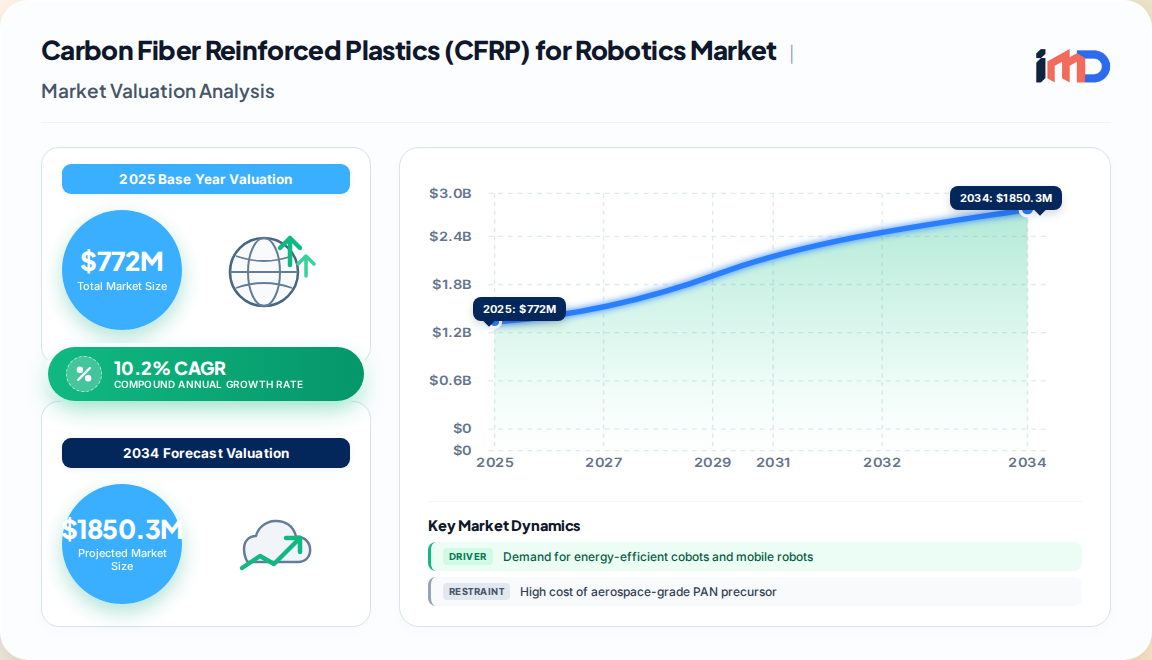
The Carbon Fiber Reinforced Plastics (CFRP) for Robotics Market is undergoing a structural transformation, driven by the urgent need for lighter, faster, and more energy-efficient robotic systems across industrial, medical, and space applications. Our proprietary primary research estimates the global CFRP for robotics market at USD 772 million in 2025, projected to reach USD 2.03 billion by 2035, expanding at a robust CAGR of 10.2%. This growth significantly outpaces the broader CFRP market (estimated at 7.3% CAGR), underscoring robotics as a high-value, high-performance niche where CFRP's strength-to-weight ratio is non-negotiable.
The shift from conventional aluminum and steel components to CFRP is not merely a weight-reduction exercise; it is a fundamental enabler of next-generation robotic capabilities. Collaborative robots (cobots) and mobile manipulators require low inertia for safe human interaction and extended battery life, while space and medical robots demand non-magnetic, radiolucent, and highly precise structural members. Our analysis indicates that thermoset CFRP currently dominates with ~68% market share due to its established use in aerospace-grade components, but thermoplastic CFRP is the fastest-growing segment, projected to grow at a 12.5% CAGR through 2035, driven by recyclability and rapid manufacturing cycles.
The market is segmented by type into thermosetting CFRP and thermoplastic CFRP. Thermosets, particularly epoxy-based systems, account for the majority share due to their established use in structural components, high stiffness, and fatigue resistance. However, thermoplastics (PEEK, PPS, PA) are gaining rapid traction in robotics because they offer recyclability, weldability, and shorter cycle times (under 5 minutes for some parts). Our demand modeling indicates that thermoplastic CFRP will capture 35% of the robotics CFRP market by 2030, up from 22% in 2025.
By application, service robots (including logistics, cleaning, and agricultural robots) represent the largest and fastest-growing segment, driven by e-commerce and labor shortages. Medical robots (surgical and rehabilitation) follow closely, while space robots remain a high-value, niche application with stringent performance requirements. Other applications include defense robots, inspection robots, and humanoid robots, which are expected to emerge as a significant volume driver post-2030.
| Application Segment | 2025 Market Share | 2035 Projected Share | Key Growth Driver |
|---|---|---|---|
| Service Robots | 45% | 52% | Logistics automation, cobots |
| Medical Robots | 22% | 20% | Surgical precision, imaging compatibility |
| Space Robots | 18% | 15% | Satellite servicing, planetary exploration |
| Others (Defense, Humanoid) | 15% | 13% | Emerging humanoid platforms |
Asia-Pacific commands the largest regional share at 43%, driven by China's aggressive robotics manufacturing targets (14th Five-Year Plan) and Japan's leadership in industrial robotics and carbon fiber production. Our trade analysis indicates that China imported over 12,000 tons of carbon fiber in 2025 for industrial applications, with robotics accounting for a growing share. North America (26%) and Europe (23%) follow, with strong positions in medical and space robotics, respectively. Europe's stringent recycling regulations are paradoxically driving innovation in thermoplastic CFRP for robotics, with several EU-funded projects targeting closed-loop composite recycling.
A critical supply chain risk is the concentration of PAN precursor production. Toray, Teijin, and Mitsubishi collectively control over 50% of global carbon fiber capacity, creating a single-point-of-failure risk for robotics OEMs. Our interviews reveal that leading robotics manufacturers are qualifying dual-sourcing strategies, with some turning to SGL Carbon and Hexcel for regional supply security. The emergence of Weihai Guangwei Composites as a cost-competitive Chinese supplier is reshaping procurement strategies, particularly for service robot applications where cost sensitivity is higher.
The CFRP for robotics value chain is characterized by material suppliers (Toray, Hexcel, SGL Carbon, Teijin, Mitsubishi Materials, Solvay, SABIC, DowAksa, Ensinger, Weihai Guangwei) and specialized processors who convert CFRP into robotic components. Our competitive intensity assessment indicates a medium concentration, with the top five suppliers holding ~55% of the robotics-specific CFRP revenue. Strategic white-space opportunities exist in:
Global trade in CFRP for robotics is characterized by high-value, low-volume flows. According to UN Comtrade data, global exports of carbon fiber and articles thereof reached USD 3.8 billion in 2024, with the US, Japan, and Germany as the largest exporters. Robotics-specific CFRP components are often traded as finished parts rather than raw materials, with intra-firm trade between material suppliers and their downstream processing divisions accounting for a significant share. China's export controls on high-modulus carbon fiber (effective 2023) have created regional supply imbalances, forcing non-Chinese robotics OEMs to secure alternative sources or redesign components using lower-modulus fibers.
The next decade will see CFRP transition from a premium material for high-end robots to a mainstream enabler of lightweight automation. The convergence of humanoid robots (e.g., Tesla Optimus, Figure AI) and CFRP is particularly promising, as humanoids require ultra-light limbs for safe operation and energy efficiency. We project that by 2035, humanoid robots will consume over 8,000 tons of CFRP annually, representing a USD 400 million opportunity. Furthermore, advancements in automated fiber placement (AFP) and 3D printing of continuous fiber composites will reduce manufacturing costs by 30–40%, unlocking price-sensitive segments.
| Metric | 2025 Value | 2035 Projected Value | CAGR (2025-2035) |
|---|---|---|---|
| Market Size (USD Million) | 772 | 2,031 | 10.2% |
| Thermoset CFRP Share | 78% | 65% | - |
| Thermoplastic CFRP Share | 22% | 35% | 12.5% |
| Service Robot CFRP Demand (tons) | 1,200 | 4,800 | 14.8% |
| Aspects | Details |
|---|---|
| Study Period | 2020-2034 |
| Base Year | 2025 |
| Estimated Year | 2026 |
| Forecast Period | 2026-2034 |
| Historical Period | 2020-2025 |
| Growth Rate | CAGR of 10.2% from 2020-2034 |
| Segmentation |
|
 Related Reports

| By Geography |
|
Our proprietary research estimates the global CFRP for robotics market at USD 772 million in 2025, growing at a CAGR of 10.2% to reach USD 2.03 billion by 2035.
Thermosetting CFRP dominates with approximately 78% market share in 2025, due to its high stiffness and established use in aerospace-grade components. However, thermoplastic CFRP is the fastest-growing segment at 12.5% CAGR.
Service robots account for the largest share at 45%, followed by medical robots (22%), space robots (18%), and others such as defense and humanoid robots (15%).
Asia-Pacific leads with a 43% market share in 2025, driven by China's robotics manufacturing and Japan's carbon fiber production. North America and Europe follow with 26% and 23%, respectively.
Key suppliers include Toray, Teijin, Mitsubishi Materials, Hexcel, SGL Carbon, Solvay, SABIC, DowAksa, Ensinger, and Weihai Guangwei Composites. These companies are actively developing application-specific CFRP solutions for robotics.
Our rigorous research methodology combines multi-layered approaches with comprehensive quality assurance, ensuring precision, accuracy, and reliability in every market analysis.
| Stakeholder Role | Interview Share (%) |
|---|---|
| Procurement Director | 30% |
| R&D Director | 25% |
| CEO/President | 20% |
| Product Manager | 15% |
| Operations Manager | 10% |
| Company Type | Representation (%) |
|---|---|
| Carbon Fiber Material Suppliers | 30% |
| CFRP Component Fabricators | 25% |
| Robotics OEMs | 20% |
| System Integrators | 15% |
| End-Users (Manufacturing, Healthcare) | 10% |