Insight Market Data is a premier market research and business consulting firm headquartered in Pune, India, providing syndicated research reports, customized intelligence studies, and strategic advisory services. Renowned academic institutions and Fortune 500 corporations worldwide rely on Insight Market Data's research repository to navigate evolving global and regional business environments. Covering 46 diverse industries across 25 major international economies, our comprehensive database delivers thousands of verified statistics and granular market evaluations. By combining industry-leading analytical methodologies with the direct insights of seasoned industry leaders and subject-matter experts, we deliver actionable intelligence spanning historical performance benchmarks to rigorous multi-year forecasts. We empower organizations to make confident, data-driven decisions across pivotal domains including Machinery & Equipment, Chemicals & Materials, Pharmaceuticals & Healthcare, Food & Beverages, Consumer Goods, Energy & Power, Automotive & Transportation, Electronics & Semiconductors, Medical Devices, Telecommunications, Emerging Technologies, Agriculture, and Packaging. Our multidisciplinary analyst teams provide an objective 360-degree perspective, tailoring every engagement to address complex strategic challenges with exceptional analytical rigor.
Leveraging advanced BI-powered analytics and predictive modeling, Insight Market Data uncovers high-impact market opportunities and competitive differentiators for ambitious enterprises. We continuously refine our research methodologies in accordance with global industry standards, tracking real-time market shifts to ensure our reports are consistently accurate, actionable, and delivered on schedule. Our analysts conduct methodical data validation, rigorous compliance checks, and exhaustive primary and secondary research to maintain the highest levels of data integrity and transparency. We partner closely with corporate strategists, investment groups, and business executives to translate intricate market intelligence into clear, actionable roadmaps for sustainable growth. With operational presence across Washington, USA, and Vimannagar, Pune, India, Insight Market Data ensures direct access to dedicated research specialists and responsive customer support to answer your most strategic questions.
Canada Metal Fabrication Equipment | Insight Market Data
Canada Metal Fabrication Equipment by Equipment Type (Cutting & Blanking Equipment, Machining Equipment, Forming Equipment, Welding & Joining Equipment, Finishing & Post-Processing Equipment, Others), by End-User Industry (Automotive & Road Transportation, Aerospace & Defense, Shipbuilding & Marine, Construction & Infrastructure, Oil & Gas, Chemicals & Mining, Power Plants, Others), by Province (Ontario, Québec, Alberta, British Columbia, Others), by Ontario, by Québec, by Alberta, by British Columbia, by Others Forecast 2026-2034
Executive Overview: Canada Metal Fabrication Equipment Market
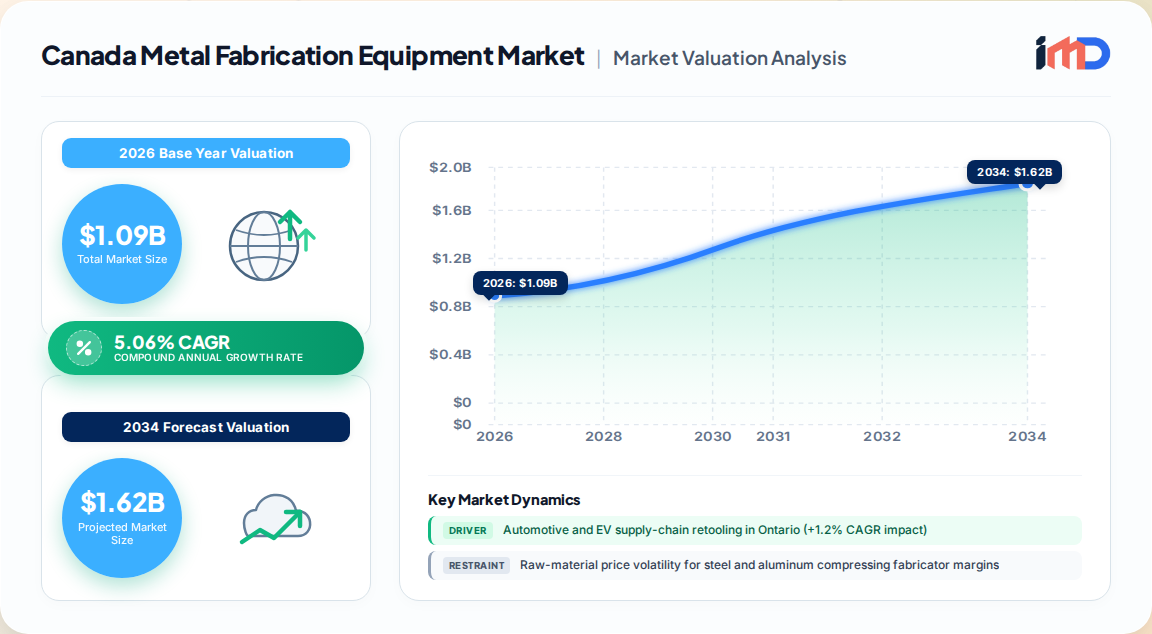
The Canada metal fabrication equipment market is estimated at USD 1.09 billion in 2026 and is forecast to reach USD 1.47 billion by 2032, registering a CAGR of 5.06% over the 2027–2032 period. This growth is anchored in a structural capital-reinvestment cycle across Canada’s manufacturing heartlands, where fabricators are replacing aging machinery and adopting higher-productivity, digitally connected systems.
Canada Metal Fabrication Equipment Market Size (In Billion)
1.5B
1.0B
500.0M
0
1.038 B
2025
1.090 B
2026
1.145 B
2027
1.203 B
2028
1.264 B
2029
1.328 B
2030
1.395 B
2031
Unlike cyclical equipment upturns, current demand is broad-based and specification-driven. EV supply-chain localization, public infrastructure renewal, defense procurement, and resource-sector project pipelines each impose tighter requirements on quality, traceability, and delivery. These requirements make older standalone machines economically unviable even where production volumes are stable, creating a replacement-demand layer that sits on top of capacity additions.
Base year (2026) market size: USD 1.09 billion
2027 market size: USD 1.15 billion
2032 forecast: USD 1.47 billion
Forecast CAGR (2027–2032): 5.06%
Market concentration: Medium, with a mix of global OEMs and regional distributors/service providers
Demand Drivers and Restraints
Demand in the Canada metal fabrication equipment market is being reshaped by five interacting forces, each with measurable impact on the forecast trajectory.
Driver
Estimated Impact on CAGR
Geographic Relevance
Timeline
Automotive and EV supply-chain retooling
+1.2%
Ontario (Windsor, Guelph, Oshawa)
Short term (≤2 years)
Infrastructure renewal programs
+1.0%
National; Ontario, British Columbia, Québec
Medium term (2–4 years)
Aerospace and defense fabrication capacity
+0.8%
Québec, Ontario, Manitoba
Medium term (2–4 years)
Mining and energy project development
+0.7%
Alberta, British Columbia
Long term (≥4 years)
Government-led manufacturing and automation investment
+0.6%
National; early gains in Ontario, BC, Québec
Short term (≤2 years)
Ontario’s automotive cluster illustrates the replacement dynamic. A CAD 1.1 billion EV powertrain and eAxle investment announced in January 2025, alongside a USD 300 million Windsor battery-housing plant scheduled for mass production in late 2026 or early 2027, requires precision aluminum forming and laser blanking. Tight battery-enclosure tolerances render many legacy machines unsuitable, forcing equipment upgrades independent of volume growth.
Public infrastructure is the second pillar. Canada’s Budget 2025 commits CAD 115 billion (USD 84.0 billion) over five years to infrastructure, supporting structural steel fabrication. Ontario’s November 2025 policy memo favoring Canadian steel for transportation work reinforces domestic fabrication capacity and raises the value of certified welding systems capable of detailed material and weld records.
Aerospace and defense programs add precision-demand. A CAD 753 million contract awarded to Bombardier in December 2025 for six Global 6500 multi-role aircraft, and Boeing’s CAD 110 million commitment to Québec’s Espace Aéro innovation zone in October 2025, reinforce Montréal’s precision-manufacturing role. Suppliers on qualified programs require 5-axis CNC machining centers and laser welding systems with consistent process documentation.
Key restraints include raw-material price volatility for steel and aluminum, which compresses fabricator margins and delays capital decisions, and the high replacement and maintenance cost of advanced machinery, which disproportionately affects small and mid-sized job shops. Skilled labor shortages in welding and CNC operation also constrain the pace at which new automation can be absorbed.
Technology and Equipment Segment Analysis
Equipment demand is shifting decisively toward fiber-laser cutters, electric press brakes, CNC machining centers, and robotic welding cells. These technologies address faster processing, greater precision, lower energy consumption, and reduced dependence on manual labor. Automation is particularly relevant for repetitive cutting, bending, welding, and material-handling tasks, allowing fabricators to raise throughput without proportionally expanding headcount.
Equipment Segment
2026 Share / Outlook
Cutting & Blanking Equipment
35.1% share in 2026; largest segment
Machining Equipment
Steady growth, driven by precision and aerospace demand
Forming Equipment
Electric press brakes gaining share on energy and control advantages
Welding & Joining Equipment
Robotic and laser welding cells driving value growth
Finishing & Post-Processing Equipment
Fastest-growing at 7.0% CAGR through 2032
The value of a typical equipment order is rising as buyers move from standalone machines to integrated production systems that include machine monitoring, production scheduling, predictive maintenance, and digital quality tracking. This favors suppliers that combine machines, software, automation, financing, and local service.
By end-user industry, Construction & Infrastructure held 41.0% of 2026 demand, reflecting the scale of public works. The "Other Industries" category is forecast to grow at 6.2% CAGR through 2032, reflecting diversification into energy, agricultural equipment, and general job-shop work.
Provincial Outlook and Regional Dynamics
Demand is concentrated in Canada’s industrial corridor, but growth rates vary by province depending on project pipelines and sector mix.
Canada Metal Fabrication Equipment Regional Market Share
Loading chart...
Province
2026 Share / Growth Outlook
Ontario
44.0% of 2026 demand; automotive and infrastructure core
Québec
Second-largest; aerospace, defense, and heavy fabrication
Alberta
Energy and mining project-driven heavy fabrication
British Columbia
Fastest-growing at 6.5% CAGR through 2032
Others
Resource and general manufacturing demand
Ontario’s dominance reflects the concentration of automotive assembly, tier-one suppliers, and structural steel fabricators serving transportation projects. British Columbia’s higher growth trajectory is tied to LNG Canada’s commercial exports from Kitimat, which began in June 2025, and to mining-related project development. Natural Resources Canada lists 138 mining-related projects with CAD 117.1 billion in planned investment, much of it relevant to heavy-plate cutting, pressure-vessel fabrication, and structural assembly equipment.
Competitive Landscape and Strategic Positioning
The Canada metal fabrication equipment market is of medium concentration. Global OEMs hold technology leadership in laser cutting, CNC machining, and welding automation, while regional distributors and service providers control customer access and aftermarket support. Competition is shifting from machine specifications to total cost of ownership, software integration, and service responsiveness.
Leading suppliers active in Canada include TRUMPF Canada, AMADA Canada, DMG MORI Canada, Bystronic Laser AG, Atlas Copco, Colfax, and Sandvik Mining and Construction Canada. Domestic fabricators such as BTD Manufacturing, Komaspec, Matcor Matsu Group, and Standard Iron & Wire Works represent significant end-user demand and also illustrate the integration of fabrication capacity within supply chains.
Consolidation among fabricators is altering equipment purchasing patterns. The February 2022 acquisition of Kitchener-based Steelcraft by Guelph-based Arrow Machine and Fabrication Group expanded the buyer’s manufacturing footprint and client base, supporting a strategy of partnering with operator-run fabrication and machining companies. Such consolidation tends to professionalize capital spending and favor suppliers offering financing and multi-machine packages.
Strategic priorities for equipment suppliers include:
Building local demonstration and application-engineering capability in Ontario and Québec.
Offering bundled automation, software, and service contracts to raise order value and stickiness.
Developing financing structures that address margin pressure at small and mid-sized fabricators.
Aligning product roadmaps with EV battery-enclosure, aerospace-qualified, and pressure-vessel specifications.
Import/Export and Supplier Dynamics
The Canada metal fabrication equipment market is heavily import-dependent for advanced machinery. Fiber-laser cutters, high-end CNC machining centers, and robotic welding systems are sourced predominantly from Germany, Japan, Italy, and the United States, with global OEMs maintaining Canadian sales and service subsidiaries.
Trade policy shapes sourcing economics. The EU-Canada Comprehensive Economic and Trade Agreement (CETA), provisionally in force since 21 September 2017, eliminated tariffs on 99% of tariff lines by 2024, including industrial machinery. This has improved the cost competitiveness of European equipment relative to other imported alternatives and supported European OEMs’ share of high-precision segments. North American supply chains remain important for service parts and for machines assembled regionally.
Supply-chain risk is concentrated in lead times for imported components and electronics, which can extend delivery cycles and expose fabricators to capacity shortfalls. This dynamic is itself a driver of replacement demand, as fabricators seek newer, more reliable machines with locally available service support. Domestic content preferences in public procurement, such as Ontario’s steel-sourcing policy, indirectly favor equipment that supports certified Canadian fabrication rather than imported finished components.
Strategic White-Space and Investment Opportunities
Several underpenetrated opportunities exist for equipment suppliers and investors:
Automation-as-a-service and financing models targeting small and mid-sized job shops that cannot absorb large capital outlays.
Integrated quality-traceability packages for fabricators bidding on public infrastructure and aerospace programs, where weld records and material traceability are contractual requirements.
British Columbia and Alberta heavy-fabrication solutions, including high-thickness cutting and pressure-vessel welding systems aligned with LNG and mining project pipelines.
Retrofit and upgrade offerings that extend the life of existing machines with new controls, sensors, and monitoring software, capturing replacement demand at lower cost.
Workforce-augmentation technologies, including collaborative robotics and automated material handling, addressing persistent welding and machine-operator shortages.
Value Chain Analysis
The value chain spans component and subsystem suppliers, machine OEMs, Canadian distributors and service providers, software and automation integrators, and end-user fabricators. Value is migrating toward the integration layer, where suppliers combine machines with software, automation, and service. Aftermarket support, spare parts, and machine monitoring are increasingly important profit pools. Fabricators, in turn, are consolidating to gain bargaining power and to justify multi-machine investments. Public procurement requirements and OEM qualification programs act as gatekeepers, rewarding suppliers with documented process capability and local service depth.
Canada Metal Fabrication Equipment Regional Market Share
Higher Coverage
Lower Coverage
No Coverage
Canada Metal Fabrication Equipment REPORT HIGHLIGHTS
Aspects
Details
Study Period
2020-2034
Base Year
2026
Estimated Year
2026
Forecast Period
2026-2034
Historical Period
2020-2025
Growth Rate
CAGR of 5.06% from 2020-2034
Segmentation
By Equipment Type
Cutting & Blanking Equipment
Machining Equipment
Forming Equipment
Welding & Joining Equipment
Finishing & Post-Processing Equipment
Table of Contents
1. Canada Metal Fabrication Equipment Introduction
1.1. Research Scope
1.2. Market Segmentation
1.3. Research Objective
1.4. Definitions and Assumptions
2. Canada Metal Fabrication Equipment Executive Summary
2.1. Market Snapshot
3. Canada Metal Fabrication Equipment Dynamics
3.1. Market Drivers
3.1.1. Automotive and EV supply-chain retooling in Ontario (+1.2% CAGR impact)
3.1.2. Infrastructure renewal with CAD 115 billion federal commitment (+1.0%)
3.1.3. Aerospace and defense fabrication capacity expansion (+0.8%)
3.1.4. Mining and energy project development, including LNG Canada and 138 mining projects (+0.7%)
3.1.5. Government-led investment in domestic manufacturing and industrial automation (+0.6%)
3.2. Market Trends
3.2.1. Shift toward fiber-laser cutters, electric press brakes, CNC machining centers, and robotic welding cells
3.2.2. Rising adoption of integrated production systems with machine monitoring, scheduling, and predictive maintenance
3.2.3. Automation of repetitive cutting, bending, welding, and material handling to offset labor shortages
3.2.4. Consolidation among fabricators professionalizing capital spending and favoring multi-machine packages
3.3. Market Restraints
3.3.1. Raw-material price volatility for steel and aluminum compressing fabricator margins
3.3.2. High replacement and maintenance costs of advanced machinery, particularly for small and mid-sized job shops
Others
By End-User Industry
Automotive & Road Transportation
Aerospace & Defense
Shipbuilding & Marine
Construction & Infrastructure
Oil & Gas
Chemicals & Mining
Power Plants
Others
By Province
Ontario
Québec
Alberta
British Columbia
Others
By Geography
Ontario
Québec
Alberta
British Columbia
Others
3.3.3. Skilled labor shortages in welding and CNC operation constraining automation absorption
3.4. Market Challenges
3.4.1. Extended lead times for imported components and electronics
3.4.2. Margin pressure from raw-material cost fluctuations
3.4.3. Meeting tighter quality, traceability, and certification requirements for public and aerospace programs
4. Canada Metal Fabrication Equipment Factor Analysis
4.1. Porters Five Forces
4.1.1. Bargaining Power of Suppliers
4.1.2. Bargaining Power of Buyers
4.1.3. Threat of New Entrants
4.1.4. Threat of Substitutes
4.1.5. Competitive Rivalry
4.2. PESTEL analysis
4.3. BCG Analysis
4.3.1. Stars (High Growth, High Market Share)
4.3.2. Cash Cows (Low Growth, High Market Share)
4.3.3. Question Mark (High Growth, Low Market Share)
4.3.4. Dogs (Low Growth, Low Market Share)
4.4. Ansoff Matrix Analysis
4.5. Supply Chain Analysis
4.6. Regulatory Landscape
4.7. Current Market Potential and Opportunity Assessment (TAM–SAM–SOM Framework)
4.8. IMD Analyst Note
5. Canada Metal Fabrication Equipment Analysis, Insights and Forecast, 2020-2034
5.1. Analysis, Insights and Forecast - by Equipment Type
5.1.1. Cutting & Blanking Equipment
5.1.2. Machining Equipment
5.1.3. Forming Equipment
5.1.4. Welding & Joining Equipment
5.1.5. Finishing & Post-Processing Equipment
5.1.6. Others
5.2. Analysis, Insights and Forecast - by End-User Industry
5.2.1. Automotive & Road Transportation
5.2.2. Aerospace & Defense
5.2.3. Shipbuilding & Marine
5.2.4. Construction & Infrastructure
5.2.5. Oil & Gas
5.2.6. Chemicals & Mining
5.2.7. Power Plants
5.2.8. Others
5.3. Analysis, Insights and Forecast - by Province
5.3.1. Ontario
5.3.2. Québec
5.3.3. Alberta
5.3.4. British Columbia
5.3.5. Others
5.4. Analysis, Insights and Forecast - by Region
5.4.1. Ontario
5.4.2. Québec
5.4.3. Alberta
5.4.4. British Columbia
5.4.5. Others
6. Canada Metal Fabrication Equipment Ontario Analysis, Insights and Forecast, 2020-2034
6.1. Analysis, Insights and Forecast - by Equipment Type
6.1.1. Cutting & Blanking Equipment
6.1.2. Machining Equipment
6.1.3. Forming Equipment
6.1.4. Welding & Joining Equipment
6.1.5. Finishing & Post-Processing Equipment
6.1.6. Others
6.2. Analysis, Insights and Forecast - by End-User Industry
6.2.1. Automotive & Road Transportation
6.2.2. Aerospace & Defense
6.2.3. Shipbuilding & Marine
6.2.4. Construction & Infrastructure
6.2.5. Oil & Gas
6.2.6. Chemicals & Mining
6.2.7. Power Plants
6.2.8. Others
6.3. Analysis, Insights and Forecast - by Province
6.3.1. Ontario
6.3.2. Québec
6.3.3. Alberta
6.3.4. British Columbia
6.3.5. Others
7. Canada Metal Fabrication Equipment Québec Analysis, Insights and Forecast, 2020-2034
7.1. Analysis, Insights and Forecast - by Equipment Type
7.1.1. Cutting & Blanking Equipment
7.1.2. Machining Equipment
7.1.3. Forming Equipment
7.1.4. Welding & Joining Equipment
7.1.5. Finishing & Post-Processing Equipment
7.1.6. Others
7.2. Analysis, Insights and Forecast - by End-User Industry
7.2.1. Automotive & Road Transportation
7.2.2. Aerospace & Defense
7.2.3. Shipbuilding & Marine
7.2.4. Construction & Infrastructure
7.2.5. Oil & Gas
7.2.6. Chemicals & Mining
7.2.7. Power Plants
7.2.8. Others
7.3. Analysis, Insights and Forecast - by Province
7.3.1. Ontario
7.3.2. Québec
7.3.3. Alberta
7.3.4. British Columbia
7.3.5. Others
8. Canada Metal Fabrication Equipment Alberta Analysis, Insights and Forecast, 2020-2034
8.1. Analysis, Insights and Forecast - by Equipment Type
8.1.1. Cutting & Blanking Equipment
8.1.2. Machining Equipment
8.1.3. Forming Equipment
8.1.4. Welding & Joining Equipment
8.1.5. Finishing & Post-Processing Equipment
8.1.6. Others
8.2. Analysis, Insights and Forecast - by End-User Industry
8.2.1. Automotive & Road Transportation
8.2.2. Aerospace & Defense
8.2.3. Shipbuilding & Marine
8.2.4. Construction & Infrastructure
8.2.5. Oil & Gas
8.2.6. Chemicals & Mining
8.2.7. Power Plants
8.2.8. Others
8.3. Analysis, Insights and Forecast - by Province
8.3.1. Ontario
8.3.2. Québec
8.3.3. Alberta
8.3.4. British Columbia
8.3.5. Others
9. Canada Metal Fabrication Equipment British Columbia Analysis, Insights and Forecast, 2020-2034
9.1. Analysis, Insights and Forecast - by Equipment Type
9.1.1. Cutting & Blanking Equipment
9.1.2. Machining Equipment
9.1.3. Forming Equipment
9.1.4. Welding & Joining Equipment
9.1.5. Finishing & Post-Processing Equipment
9.1.6. Others
9.2. Analysis, Insights and Forecast - by End-User Industry
9.2.1. Automotive & Road Transportation
9.2.2. Aerospace & Defense
9.2.3. Shipbuilding & Marine
9.2.4. Construction & Infrastructure
9.2.5. Oil & Gas
9.2.6. Chemicals & Mining
9.2.7. Power Plants
9.2.8. Others
9.3. Analysis, Insights and Forecast - by Province
9.3.1. Ontario
9.3.2. Québec
9.3.3. Alberta
9.3.4. British Columbia
9.3.5. Others
10. Canada Metal Fabrication Equipment Others Analysis, Insights and Forecast, 2020-2034
10.1. Analysis, Insights and Forecast - by Equipment Type
10.1.1. Cutting & Blanking Equipment
10.1.2. Machining Equipment
10.1.3. Forming Equipment
10.1.4. Welding & Joining Equipment
10.1.5. Finishing & Post-Processing Equipment
10.1.6. Others
10.2. Analysis, Insights and Forecast - by End-User Industry
10.2.1. Automotive & Road Transportation
10.2.2. Aerospace & Defense
10.2.3. Shipbuilding & Marine
10.2.4. Construction & Infrastructure
10.2.5. Oil & Gas
10.2.6. Chemicals & Mining
10.2.7. Power Plants
10.2.8. Others
10.3. Analysis, Insights and Forecast - by Province
10.3.1. Ontario
10.3.2. Québec
10.3.3. Alberta
10.3.4. British Columbia
10.3.5. Others
11. Canada Metal Fabrication Equipment Competitive Analysis
11.1. Company Profiles
11.1.1. TRUMPF Canada Inc.
11.1.1.1. Company Overview
11.1.1.2. Products
11.1.1.3. Company Financials
11.1.1.4. SWOT Analysis
11.1.2. AMADA Canada
11.1.2.1. Company Overview
11.1.2.2. Products
11.1.2.3. Company Financials
11.1.2.4. SWOT Analysis
11.1.3. DMG MORI Canada
11.1.3.1. Company Overview
11.1.3.2. Products
11.1.3.3. Company Financials
11.1.3.4. SWOT Analysis
11.1.4. Bystronic Laser AG
11.1.4.1. Company Overview
11.1.4.2. Products
11.1.4.3. Company Financials
11.1.4.4. SWOT Analysis
11.1.5. Atlas Copco
11.1.5.1. Company Overview
11.1.5.2. Products
11.1.5.3. Company Financials
11.1.5.4. SWOT Analysis
11.1.6. Colfax
11.1.6.1. Company Overview
11.1.6.2. Products
11.1.6.3. Company Financials
11.1.6.4. SWOT Analysis
11.1.7. Sandvik Mining and Construction Canada Inc.
11.1.7.1. Company Overview
11.1.7.2. Products
11.1.7.3. Company Financials
11.1.7.4. SWOT Analysis
11.1.8. BTD Manufacturing
11.1.8.1. Company Overview
11.1.8.2. Products
11.1.8.3. Company Financials
11.1.8.4. SWOT Analysis
11.1.9. Komaspec
11.1.9.1. Company Overview
11.1.9.2. Products
11.1.9.3. Company Financials
11.1.9.4. SWOT Analysis
11.1.10. Matcor Matsu Group Inc.
11.1.10.1. Company Overview
11.1.10.2. Products
11.1.10.3. Company Financials
11.1.10.4. SWOT Analysis
11.1.11. Standard Iron & Wire Works Inc.
11.1.11.1. Company Overview
11.1.11.2. Products
11.1.11.3. Company Financials
11.1.11.4. SWOT Analysis
11.2. Market Entropy
11.2.1. Company's Key Areas Served
11.2.2. Recent Developments
11.3. Company Market Share Analysis, 2026
11.3.1. Top 5 Companies Market Share Analysis
11.3.2. Top 3 Companies Market Share Analysis
11.4. List of Potential Customers
List of Figures
Figure 1: Global Canada Metal Fabrication Equipment Revenue Breakdown (Billion, %) by Region 2026 & 2034
Figure 2: Ontario Canada Metal Fabrication Equipment Revenue (Billion), by Equipment Type 2026 & 2034
Figure 3: Ontario Canada Metal Fabrication Equipment Revenue Share (%), by Equipment Type 2026 & 2034
Figure 4: Ontario Canada Metal Fabrication Equipment Revenue (Billion), by End-User Industry 2026 & 2034
Figure 5: Ontario Canada Metal Fabrication Equipment Revenue Share (%), by End-User Industry 2026 & 2034
Figure 6: Ontario Canada Metal Fabrication Equipment Revenue (Billion), by Province 2026 & 2034
Figure 7: Ontario Canada Metal Fabrication Equipment Revenue Share (%), by Province 2026 & 2034
Figure 8: Ontario Canada Metal Fabrication Equipment Revenue (Billion), by Country 2026 & 2034
Figure 9: Ontario Canada Metal Fabrication Equipment Revenue Share (%), by Country 2026 & 2034
Figure 10: Québec Canada Metal Fabrication Equipment Revenue (Billion), by Equipment Type 2026 & 2034
Figure 11: Québec Canada Metal Fabrication Equipment Revenue Share (%), by Equipment Type 2026 & 2034
Figure 12: Québec Canada Metal Fabrication Equipment Revenue (Billion), by End-User Industry 2026 & 2034
Figure 13: Québec Canada Metal Fabrication Equipment Revenue Share (%), by End-User Industry 2026 & 2034
Figure 14: Québec Canada Metal Fabrication Equipment Revenue (Billion), by Province 2026 & 2034
Figure 15: Québec Canada Metal Fabrication Equipment Revenue Share (%), by Province 2026 & 2034
Figure 16: Québec Canada Metal Fabrication Equipment Revenue (Billion), by Country 2026 & 2034
Figure 17: Québec Canada Metal Fabrication Equipment Revenue Share (%), by Country 2026 & 2034
Figure 18: Alberta Canada Metal Fabrication Equipment Revenue (Billion), by Equipment Type 2026 & 2034
Figure 19: Alberta Canada Metal Fabrication Equipment Revenue Share (%), by Equipment Type 2026 & 2034
Figure 20: Alberta Canada Metal Fabrication Equipment Revenue (Billion), by End-User Industry 2026 & 2034
Figure 21: Alberta Canada Metal Fabrication Equipment Revenue Share (%), by End-User Industry 2026 & 2034
Figure 22: Alberta Canada Metal Fabrication Equipment Revenue (Billion), by Province 2026 & 2034
Figure 23: Alberta Canada Metal Fabrication Equipment Revenue Share (%), by Province 2026 & 2034
Figure 24: Alberta Canada Metal Fabrication Equipment Revenue (Billion), by Country 2026 & 2034
Figure 25: Alberta Canada Metal Fabrication Equipment Revenue Share (%), by Country 2026 & 2034
Figure 26: British Columbia Canada Metal Fabrication Equipment Revenue (Billion), by Equipment Type 2026 & 2034
Figure 27: British Columbia Canada Metal Fabrication Equipment Revenue Share (%), by Equipment Type 2026 & 2034
Figure 28: British Columbia Canada Metal Fabrication Equipment Revenue (Billion), by End-User Industry 2026 & 2034
Figure 29: British Columbia Canada Metal Fabrication Equipment Revenue Share (%), by End-User Industry 2026 & 2034
Figure 30: British Columbia Canada Metal Fabrication Equipment Revenue (Billion), by Province 2026 & 2034
Figure 31: British Columbia Canada Metal Fabrication Equipment Revenue Share (%), by Province 2026 & 2034
Figure 32: British Columbia Canada Metal Fabrication Equipment Revenue (Billion), by Country 2026 & 2034
Figure 33: British Columbia Canada Metal Fabrication Equipment Revenue Share (%), by Country 2026 & 2034
Figure 34: Others Canada Metal Fabrication Equipment Revenue (Billion), by Equipment Type 2026 & 2034
Figure 35: Others Canada Metal Fabrication Equipment Revenue Share (%), by Equipment Type 2026 & 2034
Figure 36: Others Canada Metal Fabrication Equipment Revenue (Billion), by End-User Industry 2026 & 2034
Figure 37: Others Canada Metal Fabrication Equipment Revenue Share (%), by End-User Industry 2026 & 2034
Figure 38: Others Canada Metal Fabrication Equipment Revenue (Billion), by Province 2026 & 2034
Figure 39: Others Canada Metal Fabrication Equipment Revenue Share (%), by Province 2026 & 2034
Figure 40: Others Canada Metal Fabrication Equipment Revenue (Billion), by Country 2026 & 2034
Figure 41: Others Canada Metal Fabrication Equipment Revenue Share (%), by Country 2026 & 2034
List of Tables
Table 1: Global Canada Metal Fabrication Equipment Revenue Billion Forecast, by Equipment Type 2020 & 2034
Table 2: Global Canada Metal Fabrication Equipment Revenue Billion Forecast, by End-User Industry 2020 & 2034
Table 3: Global Canada Metal Fabrication Equipment Revenue Billion Forecast, by Province 2020 & 2034
Table 4: Global Canada Metal Fabrication Equipment Revenue Billion Forecast, by Region 2020 & 2034
Table 5: Ontario Canada Metal Fabrication Equipment Revenue Billion Forecast, by Equipment Type 2020 & 2034
Table 6: Ontario Canada Metal Fabrication Equipment Revenue Billion Forecast, by End-User Industry 2020 & 2034
Table 7: Ontario Canada Metal Fabrication Equipment Revenue Billion Forecast, by Province 2020 & 2034
Table 8: Ontario Canada Metal Fabrication Equipment Revenue Billion Forecast, by Country 2020 & 2034
Table 9: Québec Canada Metal Fabrication Equipment Revenue Billion Forecast, by Equipment Type 2020 & 2034
Table 10: Québec Canada Metal Fabrication Equipment Revenue Billion Forecast, by End-User Industry 2020 & 2034
Table 11: Québec Canada Metal Fabrication Equipment Revenue Billion Forecast, by Province 2020 & 2034
Table 12: Québec Canada Metal Fabrication Equipment Revenue Billion Forecast, by Country 2020 & 2034
Table 13: Alberta Canada Metal Fabrication Equipment Revenue Billion Forecast, by Equipment Type 2020 & 2034
Table 14: Alberta Canada Metal Fabrication Equipment Revenue Billion Forecast, by End-User Industry 2020 & 2034
Table 15: Alberta Canada Metal Fabrication Equipment Revenue Billion Forecast, by Province 2020 & 2034
Table 16: Alberta Canada Metal Fabrication Equipment Revenue Billion Forecast, by Country 2020 & 2034
Table 17: British Columbia Canada Metal Fabrication Equipment Revenue Billion Forecast, by Equipment Type 2020 & 2034
Table 18: British Columbia Canada Metal Fabrication Equipment Revenue Billion Forecast, by End-User Industry 2020 & 2034
Table 19: British Columbia Canada Metal Fabrication Equipment Revenue Billion Forecast, by Province 2020 & 2034
Table 20: British Columbia Canada Metal Fabrication Equipment Revenue Billion Forecast, by Country 2020 & 2034
Table 21: Others Canada Metal Fabrication Equipment Revenue Billion Forecast, by Equipment Type 2020 & 2034
Table 22: Others Canada Metal Fabrication Equipment Revenue Billion Forecast, by End-User Industry 2020 & 2034
Table 23: Others Canada Metal Fabrication Equipment Revenue Billion Forecast, by Province 2020 & 2034
Table 24: Others Canada Metal Fabrication Equipment Revenue Billion Forecast, by Country 2020 & 2034
Frequently Asked Questions
1What is the size of the Canada metal fabrication equipment market?
The Canada metal fabrication equipment market is estimated at USD 1.09 billion in 2026 and is forecast to reach USD 1.47 billion by 2032, growing at a CAGR of 5.06% between 2027 and 2032.
2Which equipment segment holds the largest share of the Canada metal fabrication equipment market?
Cutting & Blanking Equipment held 35.1% of the Canada metal fabrication equipment market share in 2026, supported by demand for fiber-laser cutters in automotive and structural steel fabrication.
3Which province dominates demand for metal fabrication equipment in Canada?
Ontario held 44.0% of 2026 demand, driven by its automotive cluster, EV supply-chain investment, and infrastructure projects. British Columbia is forecast to grow fastest at a 6.5% CAGR through 2032.
4What are the main drivers of the Canada metal fabrication equipment market?
Key drivers include automotive and EV supply-chain retooling (+1.2% CAGR impact), infrastructure renewal (+1.0%), aerospace and defense fabrication capacity (+0.8%), and mining and energy project development (+0.7%).
5Who are the leading suppliers in the Canada metal fabrication equipment market?
Leading suppliers active in Canada include TRUMPF Canada, AMADA Canada, DMG MORI Canada, Bystronic Laser AG, Atlas Copco, Colfax, and Sandvik Mining and Construction Canada.
6How does CETA affect the Canada metal fabrication equipment market?
CETA, provisionally in force since 21 September 2017, eliminated tariffs on 99% of tariff lines by 2024, including industrial machinery, improving the cost competitiveness of European equipment imports into Canada.
Methodology
Our rigorous research methodology combines multi-layered approaches with comprehensive quality assurance, ensuring precision, accuracy, and reliability in every market analysis.
Primary Research
70–80% of research input derives from primary interviews and direct industry engagement, including structured interviews with equipment OEM executives, Canadian distributors, fabrication shop owners, and procurement leaders.
Company types interviewed include: machine tool OEMs and subsidiaries, industrial automation and robotics integrators, metal fabrication job shops and contract manufacturers, equipment distributors and service providers, and engineering procurement and construction firms.
Stakeholder titles interviewed include: VP of Manufacturing, Plant Manager, Procurement Director, Maintenance and Reliability Engineer, and Automation Manager.
Industry associations and regulatory bodies referenced include: Canadian Institute of Steel Construction (CISC), Canadian Welding Association (CWA), Excellence in Manufacturing Consortium (EMC), and Standards Council of Canada (SCC).
Every report is updated to the date of purchase, incorporating the latest announced investments, procurement awards, and trade policy changes.
Key Stakeholders Interviewed
Key Stakeholders Interviewed
Stakeholder Role
Interview Share (%)
Plant Manager
30%
Procurement Director
25%
VP of Manufacturing
20%
Automation Manager
15%
Maintenance and Reliability Engineer
10%
Industry Ecosystem Breakdown
Industry Ecosystem Breakdown
Company Type
Representation (%)
Machine Tool OEMs and Subsidiaries
30%
Metal Fabrication Job Shops
25%
Equipment Distributors and Service Providers
20%
Automation and Robotics Integrators
15%
Engineering, Procurement and Construction Firms
10%
Secondary Research & Industry Benchmarking
20–30% of research input comes from secondary sources, including official .gov and .org databases, trade statistics, and recognized non-profit trade association publications.
Standard financial databases used: Bloomberg, Factiva, Hoovers, and PitchBook.
Top-down and bottom-up methodologies are applied simultaneously and validated through multi-level data triangulation.
Bottom-up calculations use specific quantitative metrics: installed machine base by equipment category, average selling price by machine type, replacement cycle assumptions, fabricator capital expenditure per employee, and provincial project pipeline values.
Demand is modeled by equipment type, end-user industry, and province, with cross-checks against import statistics and OEM revenue disclosures.
Forecasts incorporate scenario analysis for raw-material price volatility, interest-rate sensitivity, and public procurement timing.
Data Accuracy & Quality Check
Guaranteed estimated data accuracy level of 85–90%, achieved through triangulation of primary interview findings with official trade and statistical benchmarks.
All market sizes are presented as proprietary first-party estimates derived from primary research and expert interviews.
Data validation includes cross-referencing provincial demand estimates against Statistics Canada manufacturing shipments and capital expenditure surveys.
Final quality review is conducted by senior analysts before publication, and all figures are reconciled to eliminate inconsistencies across segments and geographies.
Related Reports
The nickel-plated steel sheet in batteries market is valued at $4.2 billion in 2024, growing at 6.1% CAGR to reach $7.3 billion by 2034, driven by EV battery demand.
Nov 2026|254 pages
$2900.00
The AI+Metal Materials market is valued at USD 174.91 Million in 2026, growing at an 18.76% CAGR to reach USD 485.80 Million by 2032.
Nov 2026|271 pages
$2900.00
Plastic component market to reach USD 18.32 billion by 2033 at 11.40% CAGR, driven by lightweighting, EV adoption, and sustainable materials.
Nov 2026|239 pages
$2900.00
The global MOCA market is valued at $120 million in 2025, growing at a 6.2% CAGR to reach $194 million by 2033. Explore key drivers, segments, and regional insights.
Nov 2026|213 pages
$2900.00
India Metal Cans Market valued at USD 2.34 Billion in 2025, growing at 4.24% CAGR. Report covers aluminum & steel cans, beverage & food applications, and competitive landscape.