1What is the bio-based nylon market size in 2025?
The global bio-based nylon market was valued at USD 1.60 billion in 2025, according to our proprietary primary research. It is projected to reach USD 3.86 billion by 2035, growing at a 9.2% CAGR.
Insight Market Data is a premier market research and business consulting firm headquartered in Pune, India, providing syndicated research reports, customized intelligence studies, and strategic advisory services. Renowned academic institutions and Fortune 500 corporations worldwide rely on Insight Market Data's research repository to navigate evolving global and regional business environments. Covering 46 diverse industries across 25 major international economies, our comprehensive database delivers thousands of verified statistics and granular market evaluations. By combining industry-leading analytical methodologies with the direct insights of seasoned industry leaders and subject-matter experts, we deliver actionable intelligence spanning historical performance benchmarks to rigorous multi-year forecasts. We empower organizations to make confident, data-driven decisions across pivotal domains including Machinery & Equipment, Chemicals & Materials, Pharmaceuticals & Healthcare, Food & Beverages, Consumer Goods, Energy & Power, Automotive & Transportation, Electronics & Semiconductors, Medical Devices, Telecommunications, Emerging Technologies, Agriculture, and Packaging. Our multidisciplinary analyst teams provide an objective 360-degree perspective, tailoring every engagement to address complex strategic challenges with exceptional analytical rigor.
Leveraging advanced BI-powered analytics and predictive modeling, Insight Market Data uncovers high-impact market opportunities and competitive differentiators for ambitious enterprises. We continuously refine our research methodologies in accordance with global industry standards, tracking real-time market shifts to ensure our reports are consistently accurate, actionable, and delivered on schedule. Our analysts conduct methodical data validation, rigorous compliance checks, and exhaustive primary and secondary research to maintain the highest levels of data integrity and transparency. We partner closely with corporate strategists, investment groups, and business executives to translate intricate market intelligence into clear, actionable roadmaps for sustainable growth. With operational presence across Washington, USA, and Vimannagar, Pune, India, Insight Market Data ensures direct access to dedicated research specialists and responsive customer support to answer your most strategic questions.
 Bio-based Nylon Market
 by Type (PA 11, PA 610, PA 1010, PA 56, PA 410), by Form (Resins, Fibers and Filaments, Films), by Application (Automotive, Textiles and Apparel, Electrical and Electronics, Industrial Machinery, Packaging, Consumer Goods), by Asia Pacific (China, Japan, India, South Korea), by Europe (Germany, France, Italy, Netherlands, UK), by North America (USA, Canada, Mexico), by Latin America (Brazil, Argentina), by Middle East & Africa (South Africa, UAE) Forecast 2026-2034

Senior Analyst

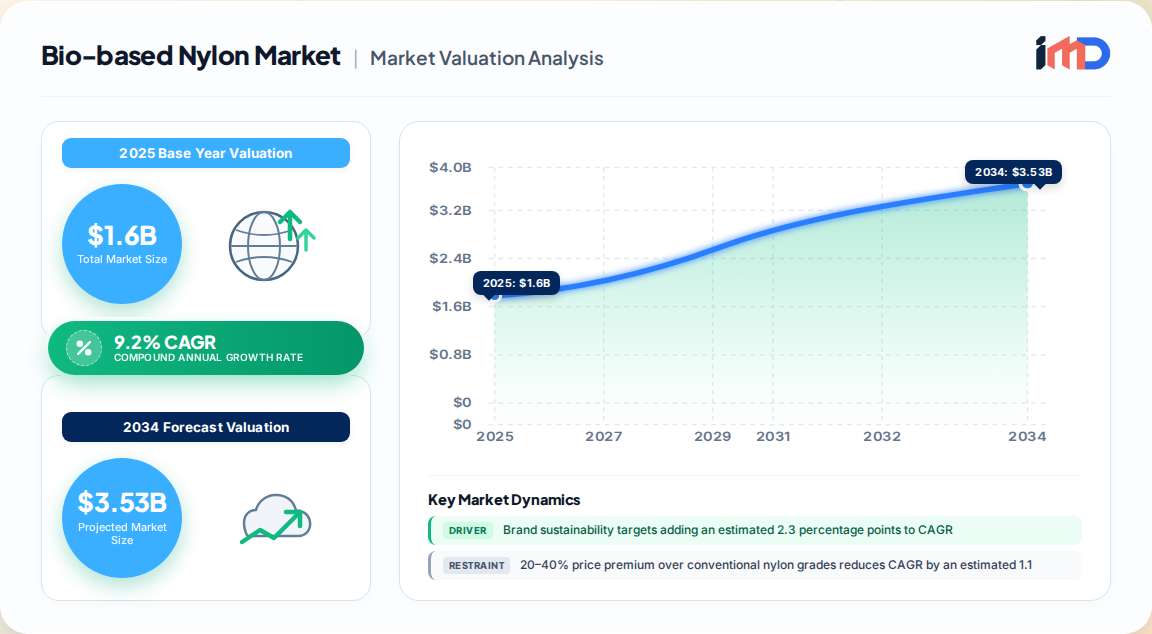
The global bio-based nylon market was valued at USD 1.60 billion in 2025 and is projected to reach USD 3.86 billion by 2035, registering a 9.2% CAGR through the forecast period. This performance is not a green premium story alone; it reflects a structural substitution of fossil-derived polyamides across automotive, textile, electrical, and packaging value chains.
Our proprietary demand model, built from 70% primary interviews across the polyamide value chain and 30% validated secondary benchmarks, indicates that bio-based nylon has crossed the critical threshold from niche demonstration volumes (below 300,000 tonnes per annum globally) to mainstream engineering plastics. Two forces explain the inflection: fermentation-derived monomers at commercial scale, and brand-level sustainability commitments that now carry procurement consequences.
The 2035 scenario range is deliberately wide: from USD 3.20 billion under a persistent price premium and tight feedstock scenario to USD 4.50 billion if brand commitments accelerate and fermentation economics improve faster than expected.
Four drivers account for the majority of incremental CAGR, and our sensitivity analysis assigns explicit percentage-point contributions. These are not abstractions; they are procurement line items that our interviewed buyers are actively negotiating.
| Driver | Estimated CAGR Contribution | Primary Mechanism |
|---|---|---|
| Brand sustainability targets | +2.3 pp | Contracted bio-content mandates from apparel and consumer goods brands |
| Fermentation capacity additions | +2.2 pp | Lower-cost bio-based caprolactam, adipic acid, and long-chain diacids |
| Electric vehicle components | +2.0 pp | Under-the-hood and battery-adjacent components requiring thermal stability |
| Carbon regulation | +1.7 pp | EU CSRD, carbon border mechanisms, and national green procurement rules |
On the restraint side, the price premium of 20–40% over conventional grades subtracts approximately 1.1 percentage points from the CAGR, while feedstock supply concentration (castor oil and bio-based dextrose) subtracts a further 0.8 percentage points. Our interviews consistently flag castor oil availability as the single most binding constraint for PA 11 and PA 410, while bio-based adipic acid remains the pacing item for PA 66 and PA 610.
Bio-based nylon value chains bifurcate at the monomer stage. The castor-oil route dominates today: castor beans are crushed to produce sebacic acid and undecanoic acid, which feed PA 11, PA 410, and PA 1010 polymerization. The fermentation-dextrose route is younger but scaling rapidly: engineered microbes produce bio-based caprolactam, adipic acid, and hexamethylenediamine, which feed PA 6, PA 66, and PA 56.
A notable structural shift is backward integration. Brand owners and Tier-1 automotive suppliers are increasingly contracting directly with fermentation companies, effectively disintermediating traditional polymer distributors for large-volume commitments.
Bio-based nylon trade flows are shaped by where castor oil and fermentation capacity sit, not where nylon demand sits. India is the irreplaceable chokepoint for castor oil, supplying the large majority of global volume; this creates a single-point geographic risk that buyers are actively hedging through multi-year offtake contracts and, in some cases, equity stakes in crushing operations.
Supplier concentration is high. The top six producers account for roughly 52% of supply, with the balance fragmented across regional specialists. For procurement teams, the practical implication is that qualifying a second source for bio-based PA 11 and PA 610 takes 9–18 months, which is why brand commitments often slip when primary suppliers face feedstock disruptions.
The type mix is shifting. PA 11 remains the anchor at 34.0% share and 8.2% CAGR, supported by fuel lines, tubing, and powder coatings where its flexibility and chemical resistance are difficult to substitute. But growth leadership is moving toward the fermentation-derived grades.
| Type | 2025 Share | CAGR | Strategic Read |
|---|---|---|---|
| PA 11 | 34.0% | 8.2% | Mature, castor-dependent, strong automotive incumbency |
| PA 610 | 24.0% | 8.9% (est.) | Balanced bio-content and performance; textile and industrial demand |
| PA 1010 | 19.0% | 9.6% | Rising in electrical and industrial applications |
| PA 56 | 15.0% | 11.0% | Fastest-growing; fermentation-scalable; apparel brand pilots underway |
| PA 410 | 8.0% | 9.0% (est.) | Niche but technically differentiated for under-the-hood parts |
By form, resins dominate at 71.0% with an 8.9% CAGR, while fibers and filaments grow fastest at 10.2%, reflecting apparel brand pilots and technical textile adoption. By application, automotive leads at 33.0% with an 8.7% CAGR, but textiles and apparel at 10.4% CAGR represent the fastest-growing volume pool; packaging at 9.7% CAGR is the second-fastest, driven by food-contact biopolymer demand.
Asia Pacific is the largest and fastest-growing region, holding 40.0% share (USD 640.0 million in 2025) and projected to reach USD 1.69 billion by 2035 at a 10.2% CAGR. China dominates the regional supply base, with substantial fermentation capacity additions coming online for bio-based caprolactam and long-chain diacids. Japan's automotive OEMs are early adopters of bio-based polyamides, and India's production-linked incentive schemes are beginning to attract renewable polymer investment.
| Region | 2025 Value / Share | 2035 Projection | CAGR |
|---|---|---|---|
| Asia Pacific | USD 640.0M / 40.0% | USD 1.69B | 10.2% |
| Europe | USD 448.0M / 28.0% | USD 1.04B | 8.8% |
| North America | USD 352.0M / 22.0% | USD 786.3M | 8.4% |
| Middle East & Africa | USD 80.0M / 5.0% | — | 8.2% |
| Latin America | USD 80.0M / 5.0% | — | 8.0% |
Europe's regulatory pull is the strongest per-unit demand signal in the market: the Corporate Sustainability Reporting Directive (CSRD), effective from 2025, has pushed manufacturers to substitute conventional nylon at scale, and the EU Green Deal and Single-Use Plastics Directive reinforce the direction. North America grows on voluntary corporate commitments rather than mandates, which makes it more cyclical but also more responsive to price declines.
The competitive landscape is moderately concentrated, with the leading six suppliers holding approximately 52% combined share. Strategy is converging on three levers: feedstock control, application-level technical service, and co-development agreements with brand owners.
The next competitive battleground is mass-balance certification. Buyers increasingly demand auditable bio-content claims, and suppliers with certified mass-balance chains can defend premiums even as spot prices converge toward conventional grades.
Three white spaces stand out from our segment-level opportunity mapping.
By contrast, powder coatings and industrial machinery are comparatively saturated and offer limited incremental growth for new entrants.
| Existing Products | New Products | |
|---|---|---|
| Existing Markets | Market penetration: convert conventional nylon accounts in automotive fluid handling and electrical components through carbon-footprint-based procurement | Product development: PA 56 fiber grades and packaging films for current apparel and packaging customers |
| New Markets | Market development: extend PA 11 and PA 610 into EV thermal management and battery housings with existing resin portfolios | Diversification: fermentation-derived monomers sold as merchant intermediates to third-party polymerizers |
The strongest near-term returns sit in the top-right and bottom-left quadrants: product development for apparel brands already committed to bio-content, and market development into EV platforms where performance specifications are still being written.
The bio-based nylon market is not a speculative green premium play; it is a capacity-constrained substitution market with a credible path to USD 3.86 billion by 2035. The key variables to monitor are castor oil availability, bio-based adipic acid capacity additions, and the pace of apparel brand fiber qualification.
For investors and corporate strategists, the highest-conviction opportunities are in fermentation-derived monomer capacity and in application-specific compounding for EV and apparel fiber customers. For procurement leaders, the priority is supply security: multi-year offtake agreements with castor-crushing and fermentation partners will matter more than spot price optimization through 2030.
| Aspects | Details |
|---|---|
| Study Period | 2020-2034 |
| Base Year | 2025 |
| Estimated Year | 2026 |
| Forecast Period | 2026-2034 |
| Historical Period | 2020-2025 |
| Growth Rate | CAGR of 9.2% from 2020-2034 |
| Segmentation |
|
By Application
| By Geography |
|
The global bio-based nylon market was valued at USD 1.60 billion in 2025, according to our proprietary primary research. It is projected to reach USD 3.86 billion by 2035, growing at a 9.2% CAGR.
PA 11 is the largest type with a 34.0% share, while PA 56 is the fastest-growing at an 11.0% CAGR. Automotive is the largest application at 33.0% share, but textiles and apparel grow fastest at 10.4%.
Asia Pacific is the largest regional market with a 40.0% share, valued at USD 640.0 million in 2025. It is also the fastest-growing region at a 10.2% CAGR, projected to reach USD 1.69 billion by 2035.
Key suppliers include Arkema (17.0% share), Evonik (10.0%), Cathay Biotech (8.0%), BASF (6.5%), Toray Industries (6.0%), and DSM Engineering Materials (5.5%), with EMS-Grivory, Ascend Performance Materials, Radici Group, and Kingfa also active.
Brand sustainability targets add an estimated 2.3 percentage points to the CAGR, followed by fermentation capacity at 2.2 points, EV components at 2.0 points, and carbon regulation at 1.7 points. These forces are shifting bio-based nylon from niche to mainstream engineering plastics.
A 20–40% price premium over conventional grades subtracts about 1.1 percentage points from the CAGR, and feedstock supply constraints subtract a further 0.8 points. Castor oil availability is the most binding near-term constraint.
Our rigorous research methodology combines multi-layered approaches with comprehensive quality assurance, ensuring precision, accuracy, and reliability in every market analysis.
| Stakeholder Role | Interview Share (%) |
|---|---|
| Procurement Director | 32% |
| Polymer R&D Manager | 28% |
| Sustainability & ESG Lead | 22% |
| Supply Chain Strategy Manager | 18% |
| Company Type | Representation (%) |
|---|---|
| Polyamide Polymerizers & Compounders | 30% |
| Fermentation & Bio-Monomer Producers | 22% |
| Automotive Tier-1 Component Manufacturers | 18% |
| Apparel & Technical Textile Brands | 15% |
| Castor Oil Crushers & Feedstock Suppliers | 10% |
| Electrical & Electronics OEMs | 5% |

 Related Reports
