1What is the current market size of the autologous conditioned plasma therapy market?
Our proprietary research estimates the global ACP therapy market at $2.14 Billion in 2025, projected to reach $4.88 Billion by 2034, growing at a CAGR of 8.6%.
Insight Market Data is a premier market research and business consulting firm headquartered in Pune, India, providing syndicated research reports, customized intelligence studies, and strategic advisory services. Renowned academic institutions and Fortune 500 corporations worldwide rely on Insight Market Data's research repository to navigate evolving global and regional business environments. Covering 46 diverse industries across 25 major international economies, our comprehensive database delivers thousands of verified statistics and granular market evaluations. By combining industry-leading analytical methodologies with the direct insights of seasoned industry leaders and subject-matter experts, we deliver actionable intelligence spanning historical performance benchmarks to rigorous multi-year forecasts. We empower organizations to make confident, data-driven decisions across pivotal domains including Machinery & Equipment, Chemicals & Materials, Pharmaceuticals & Healthcare, Food & Beverages, Consumer Goods, Energy & Power, Automotive & Transportation, Electronics & Semiconductors, Medical Devices, Telecommunications, Emerging Technologies, Agriculture, and Packaging. Our multidisciplinary analyst teams provide an objective 360-degree perspective, tailoring every engagement to address complex strategic challenges with exceptional analytical rigor.
Leveraging advanced BI-powered analytics and predictive modeling, Insight Market Data uncovers high-impact market opportunities and competitive differentiators for ambitious enterprises. We continuously refine our research methodologies in accordance with global industry standards, tracking real-time market shifts to ensure our reports are consistently accurate, actionable, and delivered on schedule. Our analysts conduct methodical data validation, rigorous compliance checks, and exhaustive primary and secondary research to maintain the highest levels of data integrity and transparency. We partner closely with corporate strategists, investment groups, and business executives to translate intricate market intelligence into clear, actionable roadmaps for sustainable growth. With operational presence across Washington, USA, and Vimannagar, Pune, India, Insight Market Data ensures direct access to dedicated research specialists and responsive customer support to answer your most strategic questions.
 Autologous Conditioned Plasma Therapy Market
 by Product Type (Pure PRP Systems, Leukocyte-Rich PRP Systems, Leukocyte- and Platelet-Rich Fibrin (L-PRF)), by Application (Orthopedics & Sports Medicine, Dermatology & Aesthetics, Wound Healing, Dental Surgery, Veterinary), by End-User (Hospitals, Specialty Clinics, Ambulatory Surgical Centers, Research Institutes, Homecare), by North America (USA, Canada, Mexico), by Europe (Germany, UK, France, Italy, Spain, Switzerland), by Asia-Pacific (China, Japan, South Korea, India, Australia), by South America (Brazil, Argentina, Colombia), by Middle East & Africa (UAE, Saudi Arabia, South Africa) Forecast 2026-2034

Research Analyst


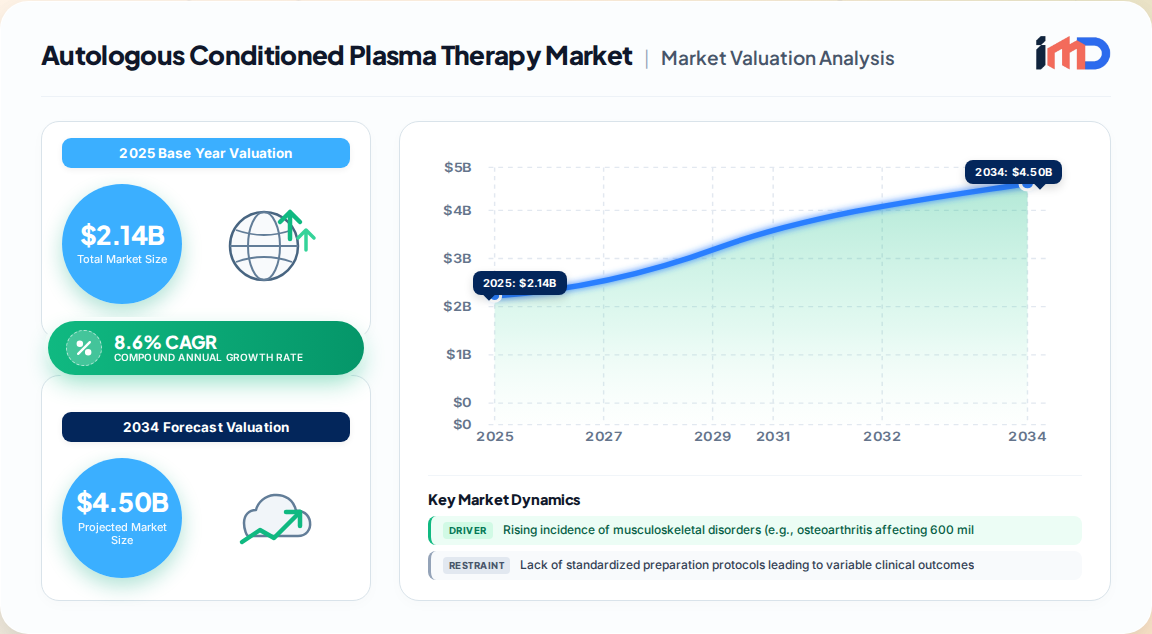
The global autologous conditioned plasma (ACP) therapy market represents a high-growth frontier within regenerative medicine, defined by the point-of-care processing of a patient's own blood to concentrate platelets and growth factors for therapeutic use. Our proprietary primary research estimates the market at $2.14 Billion in 2025, projected to reach $4.88 Billion by 2034, expanding at a robust CAGR of 8.6%. This growth is underpinned by a structural shift toward minimally invasive, biologics-based treatment pathways across orthopedics, sports medicine, and aesthetic dermatology.
Key Growth Drivers:
Primary Market Restraints:
The ACP therapy value chain is a multi-tiered ecosystem spanning device manufacturing, clinical service delivery, and patient care. Upstream, medical device OEMs and specialty biotech firms design and manufacture centrifugation systems, closed-loop kits, and separation technologies. Midstream, distributors and point-of-care system providers supply hospitals, specialty clinics, and research institutes. Downstream, clinicians—orthopedic surgeons, dermatologists, and sports medicine physicians—administer ACP therapies, often bundling them with complementary procedures. The value chain is characterized by moderate barriers to entry, with long-term growth dependent on device reliability, regulatory navigation, and published clinical outcomes.
The ACP market is segmented by Product Type, Application, and End-User, with distinct growth trajectories across each.
| Segment | Dominant Category | Share (2025) | Fastest-Growing Category |
|---|---|---|---|
| Product Type | Centrifuge-based ACP Systems | 63% | Automated Closed-System Devices |
| Application | Orthopedics & Sports Medicine | 48% | Dermatology & Aesthetics |
| End-User | Specialty Clinics | 55% | Ambulatory Surgical Centers |
Product Type Insights: Pure PRP systems (leukocyte-poor) command approximately 62% of market value, favored for aesthetic and outpatient procedures. However, leukocyte-rich systems are gaining ground in trauma and sports medicine due to their stronger inflammatory response for wound healing.
Application Insights: Orthopedics and sports medicine remain the largest application, driven by high treatment volumes for osteoarthritis, ligament injuries, and chronic tendinopathies. Aesthetic applications are the fastest-growing, particularly in urban clinics across North America, South Korea, and the UAE.
End-User Insights: Specialty clinics are the power users of ACP, thriving on efficiency and procedure bundling. Hospitals and surgical centers integrate ACP for post-surgical healing protocols, while research institutes drive protocol development for combination therapies.
North America dominates the global ACP market, holding 39.4% of revenue share, supported by high orthopedic procedure volumes, advanced dermatology networks, and a cash-pay treatment model. Europe follows with 27%, characterized by regulatory clarity under CE marking and balanced adoption across orthopedics and aesthetics. Asia-Pacific is the fastest-growing region, expanding at a rapid pace driven by rising aesthetic demand, sports injury treatments, and cost-effective manufacturing in China, India, and South Korea. South America and the Middle East & Africa represent emerging white-space opportunities, with Brazil and the UAE leading adoption in dental and aesthetic clinics, respectively.
Investment Plans: Capital deployment is increasing across automation and closed-system technologies, with hospitals and clinic chains allocating an estimated 10–12% annual budget growth toward regenerative equipment, digital workflow integrations, and contamination-control upgrades.
The competitive landscape is defined by innovation at the equipment and procedural level. Key players are pursuing strategies of clinical validation, device miniaturization, and application-specific formulations to differentiate their offerings.
Recent Developments (2023–2025):
Significant untapped potential exists in three key areas: Homecare Settings (physician-supervised, mobile ACP delivery for concierge medicine), Veterinary Medicine (equine joint injuries and tendonitis represent a niche but high-value application), and Combination Therapies (ACP with hyaluronic acid, microfracture techniques, or stem cell extracts for enhanced orthopedic outcomes). Vendors that crack cost-effective training models for emerging markets and standardize dosing protocols will be well-positioned to capture these white spaces.
While ACP is not a traded commodity, the underlying centrifugation systems and separation kits are subject to cross-border trade flows. North America and Europe are net exporters of advanced ACP devices, while Asia-Pacific is emerging as a cost-effective manufacturing hub. The supply chain is moderately concentrated, with key component suppliers including specialized biotech firms and medical device OEMs. Trade policies affecting medical device regulations and tariffs are a watch factor, particularly for emerging markets reliant on imported systems.
| Aspects | Details |
|---|---|
| Study Period | 2020-2034 |
| Base Year | 2025 |
| Estimated Year | 2026 |
| Forecast Period | 2026-2034 |
| Historical Period | 2020-2025 |
| Growth Rate | CAGR of 8.6% from 2020-2034 |
| Segmentation |
|
By Application
By End-User
| By Geography |
|
Our proprietary research estimates the global ACP therapy market at $2.14 Billion in 2025, projected to reach $4.88 Billion by 2034, growing at a CAGR of 8.6%.
North America holds the largest regional share at approximately 39.4%, driven by high orthopedic procedure volumes and strong adoption of regenerative therapies in both orthopedics and dermatology.
Key drivers include the rising incidence of musculoskeletal disorders (over 600 million osteoarthritis cases globally), growing adoption of minimally invasive procedures, and expanding applications in aesthetic medicine, particularly hair restoration and facial rejuvenation.
Dermatology and aesthetics is the fastest-growing application segment, expanding at a 12% annual rate, driven by demand for non-surgical rejuvenation and combination protocols with microneedling and laser therapies.
The market faces challenges from variability in clinical outcomes due to lack of standardized preparation protocols, limited reimbursement coverage in many regions, and high out-of-pocket treatment costs that constrain accessibility.
Our rigorous research methodology combines multi-layered approaches with comprehensive quality assurance, ensuring precision, accuracy, and reliability in every market analysis.
| Stakeholder Role | Interview Share (%) |
|---|---|
| Chief of Orthopedic Surgery | 30% |
| Dermatology Clinic Director | 25% |
| Sports Medicine Physician | 25% |
| Procurement Director | 20% |
| Company Type | Representation (%) |
|---|---|
| Centrifuge and Device OEMs | 35% |
| Point-of-Care Kit Manufacturers | 25% |
| Specialty Clinic Chains | 20% |
| Hospital Procurement Teams | 15% |
| Regenerative Medicine Biotech Firms | 5% |
 Related Reports
