1What is the airport lounges market size in 2026?
The global airport lounges market is estimated at USD 10.53 billion in 2026 and is projected to reach USD 13.95 billion by 2031, reflecting a 5.79% CAGR over the forecast period.
Insight Market Data is a premier market research and business consulting firm headquartered in Pune, India, providing syndicated research reports, customized intelligence studies, and strategic advisory services. Renowned academic institutions and Fortune 500 corporations worldwide rely on Insight Market Data's research repository to navigate evolving global and regional business environments. Covering 46 diverse industries across 25 major international economies, our comprehensive database delivers thousands of verified statistics and granular market evaluations. By combining industry-leading analytical methodologies with the direct insights of seasoned industry leaders and subject-matter experts, we deliver actionable intelligence spanning historical performance benchmarks to rigorous multi-year forecasts. We empower organizations to make confident, data-driven decisions across pivotal domains including Machinery & Equipment, Chemicals & Materials, Pharmaceuticals & Healthcare, Food & Beverages, Consumer Goods, Energy & Power, Automotive & Transportation, Electronics & Semiconductors, Medical Devices, Telecommunications, Emerging Technologies, Agriculture, and Packaging. Our multidisciplinary analyst teams provide an objective 360-degree perspective, tailoring every engagement to address complex strategic challenges with exceptional analytical rigor.
Leveraging advanced BI-powered analytics and predictive modeling, Insight Market Data uncovers high-impact market opportunities and competitive differentiators for ambitious enterprises. We continuously refine our research methodologies in accordance with global industry standards, tracking real-time market shifts to ensure our reports are consistently accurate, actionable, and delivered on schedule. Our analysts conduct methodical data validation, rigorous compliance checks, and exhaustive primary and secondary research to maintain the highest levels of data integrity and transparency. We partner closely with corporate strategists, investment groups, and business executives to translate intricate market intelligence into clear, actionable roadmaps for sustainable growth. With operational presence across Washington, USA, and Vimannagar, Pune, India, Insight Market Data ensures direct access to dedicated research specialists and responsive customer support to answer your most strategic questions.
 Airport Lounges Market
 by Service Type (Food and Beverage, Connectivity and Entertainment, Passenger Services), by Lounge Ownership (Airline, Airport, and Government-operated, Privately Owned), by Lounge Class (Economy Lounge, Premium Lounge), by Access Type (Membership Access, Pay-Per-Use, Airline Ticket Access, Credit Card and Third-Party Access), by End User (Business Travelers, Leisure Travelers), by North America (United States, Canada, Mexico), by Europe (United Kingdom, France, Germany, Italy, Rest of Europe), by Asia-Pacific (China, India, Japan, South Korea, Rest of Asia-Pacific), by South America (Brazil, Rest of South America), by Middle East & Africa (United Arab Emirates, Saudi Arabia, Qatar, South Africa, Rest of Middle East & Africa) Forecast 2026-2034

Research Associate


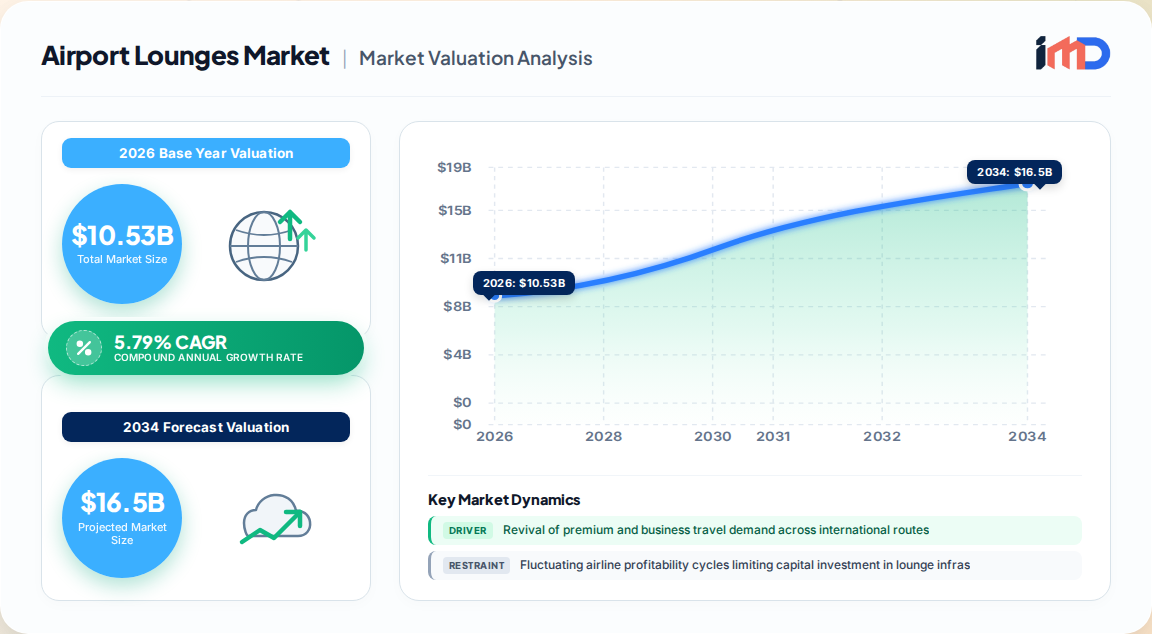
The global airport lounges market is undergoing a structural reinvention. Once a quiet perk reserved for top-tier frequent flyers, lounges are now strategic assets at the center of airport non-aeronautical revenue programs, airline premium-yield strategies and financial-services loyalty economics. Our proprietary primary research estimates the market at USD 10.53 billion in 2026, projected to reach USD 13.95 billion by 2031, expanding at a CAGR of 5.79%.
The market has moved decisively beyond the "free snack and a quiet seat" model. Operators are being judged on culinary quality, biometric throughput, wellness amenities and sustainability credentials. In 2026, business travel has fully normalized, and lounge access has become an explicit component of premium cabin value, especially on long-haul connecting itineraries. At the same time, access models have proliferated — day passes, credit-card entitlements, membership subscriptions and third-party aggregation — turning lounges from an airline cost center into a broadly distributed hospitality product.
Two forces dominate the 2026–2031 expansion story: the revival of high-yield business travel and the deliberate commercialization of airport real estate.
Revival of premium and business travel (+1.2% impact on CAGR). Corporate travel momentum has returned, and airlines in North America and Asia-Pacific are upgrading clubs to pair premium cabins with consistent ground experiences. Lounge access is now a yield-management tool, helping carriers defend premium fares against low-cost competitors. In Asia-Pacific, intra-regional corporate travel is supporting steady lounge footfall, with visits up 18% year-on-year between January and November 2025 across top destinations such as India, China, Thailand, Japan and Singapore.
Airport commercialization initiatives (+0.9% impact on CAGR). Airport authorities increasingly treat lounges as anchors of non-aeronautical revenue. Chicago Midway's first common-use lounge opened as part of a USD 75 million concessions overhaul, and the Omaha Airport Authority announced Escape Lounges at Eppley Airfield for 2027. Gulf and Turkish gateways are scaling premium hospitality with differentiated F&B and upgraded amenities, raising the service-quality benchmark globally.
Other material drivers include:
The 5.79% CAGR conceals a set of real operational and financial frictions that limit upside.
Revenue composition reveals a market where experiential spending dominates, but the fastest growth sits in services and economy-class access.
| Segment | 2025 Share / Metric | Fastest-Growing Sub-Segment | Growth Outlook |
|---|---|---|---|
| Service type | F&B: 52.44% of revenue | Passenger services | 5.87% CAGR to 2031 |
| Lounge ownership | Airline, airport & government: 63.12% | Airline, airport & government | 6.83% CAGR to 2031 |
| Lounge class | Premium: 56.47% of demand | Economy lounge | 6.17% CAGR to 2031 |
| Geography | APAC: 31.14% share | Asia-Pacific | 7.26% CAGR to 2031 |
Food & beverage remains the core value driver at 52.44% of revenue. Chef-led initiatives, local sourcing and curated beverage lists are now standard competitive tools. Passenger services — showers, sleep pods, spa add-ons, wellness zones and concierge support — are the fastest-growing service line at 5.87% CAGR, reflecting passenger prioritization of health and productivity during travel.
By ownership, airline, airport and government-operated facilities held 63.12% of 2025 revenue and are projected to grow fastest at 6.83% CAGR. Privately owned and independent lounges, however, are rapidly expanding through flexible membership and third-party access models, making them a key competitive force.
By class, premium lounges captured 56.47% of 2025 demand, but economy lounges are growing faster at 6.17% CAGR as pay-per-use and credit-card access democratize the category.
Asia-Pacific is the market's center of gravity. The region accounted for 31.14% of global value in 2025 and is forecast to grow at 7.26% CAGR through 2031, driven by infrastructure upgrades, rising affluence and intra-regional travel. India, China, Thailand, Japan and Singapore are the top lounge destinations, and operators are enlarging footprints in key hubs such as Hong Kong, where a second premium lounge opened in Terminal 1 West Hall.
North America remains a high-value, mature market anchored by deep loyalty ecosystems and a broad installed base of carrier and independent lounges. Airlines continue to invest in large-format clubs and top-tier concepts at major hubs, including new facilities at Salt Lake City. The region's growth is steady rather than explosive, focused on refresh and capacity expansion.
Europe is characterized by high early adoption of biometric and contactless access, alongside strict GDPR-driven consent and data-retention practices. The Middle East and South America are investment-led growth markets, with Gulf gateways and Latin American governments positioning airports as global or regional hubs.
Competition is intensifying across three strategic axes: global network expansion, hospitality-concept innovation and access-model flexibility. Market concentration is low, and no single operator dominates globally.
The competitive field spans independent lounge networks (Plaza Premium Group, Collinson Group's Priority Pass, Swissport International), airline-owned and operated lounges (Lufthansa Group, Delta Air Lines, United Airlines, American Airlines, Qatar Airways, Emirates Group, Etihad Airways, Singapore Airlines, Cathay Pacific, Japan Airlines, Turkish Airlines, Qantas, Air France–KLM, British Airways, Oman Air, Virgin Atlantic) and financial-services entrants (American Express Centurion Lounges).
Key strategic moves include:
Several underpenetrated opportunities stand out for 2026–2031:
The airport lounges value chain is a multi-party system in which real estate, hospitality operations and access distribution are distinct but interdependent layers.
| Layer | Key Activities | Primary Participants |
|---|---|---|
| Space provision | Terminal allocation, concessions programs, lease structuring | Airport authorities, government operators |
| Lounge operations | F&B, staffing, wellness, housekeeping, design | Airline-owned operators, independent operators |
| Access distribution | Memberships, day passes, credit-card entitlements, aggregation | Loyalty programs, card networks, aggregators |
| Technology enablement | Biometric entry, capacity management, AI personalization | Airport IT vendors, identity providers |
| Supply inputs | Food sourcing, furnishings, sustainability-certified materials | Foodservice distributors, LEED suppliers |
Value is increasingly captured at the access distribution and technology enablement layers, where flexible monetization and data-driven personalization drive margin expansion. Operators that control both the physical experience and the access ecosystem are best positioned to defend pricing.
While airport lounges are a service market rather than a tradable commodity, cross-border supply dynamics materially affect cost structure and quality consistency.
Operators are responding with dual-sourcing strategies, modular furniture designs and local culinary partnerships to reduce exposure to global supply-chain disruption.
| Aspects | Details |
|---|---|
| Study Period | 2020-2034 |
| Base Year | 2026 |
| Estimated Year | 2026 |
| Forecast Period | 2026-2034 |
| Historical Period | 2020-2025 |
| Growth Rate | CAGR of 5.79% from 2020-2034 |
| Segmentation |
|
By Lounge Class
By Access Type
By End User
| By Geography |
|
The global airport lounges market is estimated at USD 10.53 billion in 2026 and is projected to reach USD 13.95 billion by 2031, reflecting a 5.79% CAGR over the forecast period.
Asia-Pacific is the largest and fastest-growing region, accounting for 31.14% of global market value in 2025 and forecast to grow at a 7.26% CAGR through 2031, driven by infrastructure upgrades and rising intra-regional travel.
Passenger services such as showers, sleep pods, spa add-ons and wellness zones are the fastest-growing service segment at a 5.87% CAGR, while economy lounges are growing at 6.17% CAGR and airline/airport/government-owned facilities at 6.83% CAGR.
Key drivers include the revival of premium and business travel (+1.2% CAGR impact), airport commercialization initiatives (+0.9%), contactless and biometric throughput solutions (+1.1%), curated food menus (+0.8%) and growing secondary hubs in emerging aviation markets (+0.7%).
Food and beverage is the largest service segment, capturing 52.44% of revenue in 2025, as operators invest in chef-led menus, local sourcing and premium dining to differentiate their offerings.
Leading players include Plaza Premium Group, Collinson Group (Priority Pass), Swissport International, Lufthansa Group, American Express (Centurion Lounges), Delta Air Lines, United Airlines, American Airlines, Qatar Airways, Emirates Group, Etihad Airways, Singapore Airlines, Cathay Pacific, Japan Airlines, Turkish Airlines, Qantas, Air France–KLM, British Airways, Oman Air and Virgin Atlantic.
Our rigorous research methodology combines multi-layered approaches with comprehensive quality assurance, ensuring precision, accuracy, and reliability in every market analysis.
| Stakeholder Role | Interview Share (%) |
|---|---|
| Director of Airport Concessions | 26% |
| VP of Ground Experience / Premium Product | 24% |
| Lounge Operations Director | 22% |
| Head of Loyalty Partnerships | 16% |
| Airport Commercial Manager | 12% |
| Company Type | Representation (%) |
|---|---|
| Airport authorities and concession operators | 22% |
| Airline lounge operators and premium product teams | 26% |
| Independent lounge networks and aggregators | 20% |
| Financial services and loyalty program providers | 14% |
| Technology, identity and FF&E suppliers | 10% |
| Foodservice and hospitality distributors | 8% |
 Related Reports
