About Insight Market Data

Insight Market Data is a premier market research and business consulting firm headquartered in Pune, India, providing syndicated research reports, customized intelligence studies, and strategic advisory services. Renowned academic institutions and Fortune 500 corporations worldwide rely on Insight Market Data's research repository to navigate evolving global and regional business environments. Covering 46 diverse industries across 25 major international economies, our comprehensive database delivers thousands of verified statistics and granular market evaluations. By combining industry-leading analytical methodologies with the direct insights of seasoned industry leaders and subject-matter experts, we deliver actionable intelligence spanning historical performance benchmarks to rigorous multi-year forecasts. We empower organizations to make confident, data-driven decisions across pivotal domains including Machinery & Equipment, Chemicals & Materials, Pharmaceuticals & Healthcare, Food & Beverages, Consumer Goods, Energy & Power, Automotive & Transportation, Electronics & Semiconductors, Medical Devices, Telecommunications, Emerging Technologies, Agriculture, and Packaging. Our multidisciplinary analyst teams provide an objective 360-degree perspective, tailoring every engagement to address complex strategic challenges with exceptional analytical rigor.

Leveraging advanced BI-powered analytics and predictive modeling, Insight Market Data uncovers high-impact market opportunities and competitive differentiators for ambitious enterprises. We continuously refine our research methodologies in accordance with global industry standards, tracking real-time market shifts to ensure our reports are consistently accurate, actionable, and delivered on schedule. Our analysts conduct methodical data validation, rigorous compliance checks, and exhaustive primary and secondary research to maintain the highest levels of data integrity and transparency. We partner closely with corporate strategists, investment groups, and business executives to translate intricate market intelligence into clear, actionable roadmaps for sustainable growth. With operational presence across Washington, USA, and Vimannagar, Pune, India, Insight Market Data ensures direct access to dedicated research specialists and responsive customer support to answer your most strategic questions.

report thumbnailAircraft Predictive Maintenance Market
Aerospace & Defense / MARKET REPORT

Aircraft Predictive Maintenance Market | Insight Market Data

Aircraft Predictive Maintenance Market by Component (Hardware, Software, Services), by Maintenance Application (Engine Health Monitoring, Airframe & Structural Monitoring, Component & System Monitoring), by Aircraft Type (Commercial Aviation, Defense & Military, Business & General Aviation), by Deployment Mode (Cloud-Based, On-Premise), by End User (Airlines, MRO Providers, OEMs), by North America (USA, Canada, Mexico), by Europe (Germany, UK, France, Italy, Rest of Europe), by Asia Pacific (China, Japan, India, South Korea, Rest of Asia Pacific), by South America (Brazil, Argentina, Rest of South America), by Middle East & Africa (UAE, Saudi Arabia, South Africa, Rest of Middle East & Africa) Forecast 2026-2034

© Nov 7, 2026|Base Year: 2025|211 Pages
Shyam Pawar

Shyam Pawar

Research Associate

Main Logo

Aircraft Predictive Maintenance Market Size & Forecast 2026-2035


/
/

Business Address

Head Office

Ansec House 3 rd floor Tank Road, Yerwada, Pune, Maharashtra 411014

Contact Information

Craig Francis

Business Development Head

+12315155523

[email protected]

Secure Payment Partners

payment image

© 2026 PRDUA Research & Media Private Limited, All rights reserved

••
Home
Industries
Aerospace & Defense
Retail
Logistics
Packaging
Automotive
Healthcare
Agriculture
Energy & Power
Food & Beverage
Aerospace & Defense
Chemicals & Materials
Hospitality and Tourism
Consumer Goods and Services
Animal Nutrition & Wellness
Real Estate and Construction
Home and Property Improvement
Technology, Media and Telecom
Manufacturing Products and Services
Financial Services and Investment Intelligence
Privacy Policy
Terms and Conditions
FAQ
Independent Intelligence for decisions that move markets
+12315155523[email protected]
  • Home
  • About Us
  • Industries
    • Automotive
    • Consumer Goods and Services
    • Financial Services and Investment Intelligence
    • Home and Property Improvement
    • Logistics
    • Retail
    • Agriculture
    • Healthcare
    • Animal Nutrition & Wellness
    • Chemicals & Materials
    • Energy & Power
    • Food & Beverage
    • Hospitality and Tourism
    • Manufacturing Products and Services
    • Professional and Commercial Services
    • Real Estate and Construction
    • Aerospace & Defense
    • Packaging
    • Technology, Media and Telecom
  • Services
  • Contact
Main Logo
  • Home
  • About Us
  • Industries
    • Automotive
    • Consumer Goods and Services
    • Financial Services and Investment Intelligence
    • Home and Property Improvement
    • Logistics
    • Retail
    • Agriculture
    • Healthcare
    • Animal Nutrition & Wellness
    • Chemicals & Materials
    • Energy & Power
    • Food & Beverage
    • Hospitality and Tourism
    • Manufacturing Products and Services
    • Professional and Commercial Services
    • Real Estate and Construction
    • Aerospace & Defense
    • Packaging
    • Technology, Media and Telecom
  • Services
  • Contact
Talk to an analyst
Aircraft Predictive Maintenance Market CAGR, market size, market share

Executive Overview: The Shift from Diagnostics to Fleet-Level Prognostics

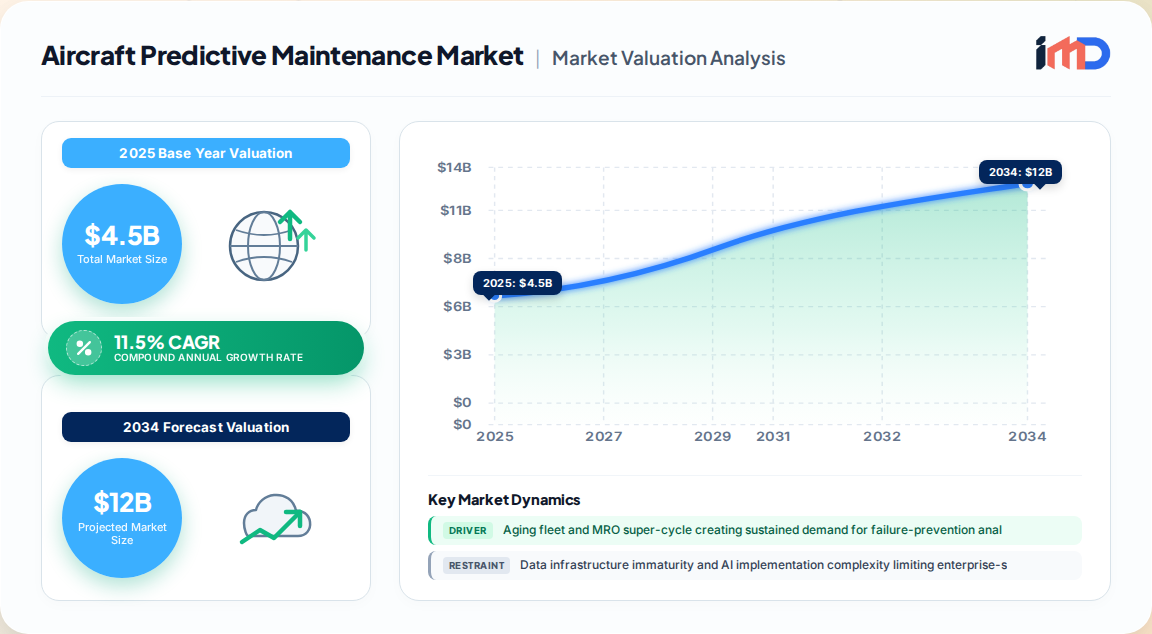
The global aircraft predictive maintenance market is undergoing a structural transformation, moving decisively from isolated diagnostic trials to enterprise-scale, fleet-wide prognostics and health management (PHM) programs. Our proprietary primary research estimates the market at USD 4.50 billion in 2025, with a projected expansion to USD 5.22 billion in 2026 and a forecast valuation of USD 13.34 billion by 2035, representing a robust CAGR of 11.5% over the 2026–2035 period.

Aircraft Predictive Maintenance Market Market Size (In Billion)

10.0B
8.0B
6.0B
4.0B
2.0B
0
4.500 B
2025
5.018 B
2026
5.595 B
2027
6.238 B
2028
6.955 B
2029
7.755 B
2030
8.647 B
2031
Main Logo

This growth is not merely a function of digitalization budgets. It is being pulled forward by the hard economics of operational disruption. With global aviation MRO spend exceeding USD 136 billion in 2025, operators face sustained pressure from parts scarcity, labor shortages, and shop capacity constraints. The strategic imperative is clear: protect dispatch reliability, limit aircraft-on-ground (AOG) exposure, and extract greater utilization from aging assets. Predictive maintenance—when properly integrated with maintenance planning and material readiness—directly addresses these pain points by converting unscheduled failures into planned, cost-efficient interventions.

Key Market Drivers & Restraints

Growth Drivers

  • Aging Fleet and MRO Super-Cycle: The active commercial fleet stood at 30,300 aircraft in 2025, with another 5,250 in storage. As delivery backlogs persist and operators extend service lives, the addressable base for health-monitoring analytics expands. Fleet growth toward 38,309 aircraft by 2035 compounds this opportunity.
  • Disruption Cost Pressures: Unplanned maintenance events can be 30–50% more expensive than planned work due to emergency logistics and schedule recovery. This creates a compelling ROI narrative for solutions that link anomaly detection to actionable work scopes.
  • Regulatory Convergence: The EASA Artificial Intelligence Roadmap 2.0 and MLEAP project are establishing structured approval pathways for safety-related machine learning in aviation. This reduces adoption risk for operators who deferred platform commitments pending compliance guidance.

Key Restraints

  • Data Infrastructure Immaturity: 58% of MRO industry respondents remain at the experimental stage of AI development, with data quality and availability cited as primary scaling barriers. Full-fleet deployments require validated data lineage and governance frameworks that many operators have not yet established.
  • High Upfront Costs: Hardware revenue accounted for USD 1.22 billion in 2025, reflecting per-aircraft sensor and connectivity installation costs that exceed budget thresholds for regional airlines and smaller MRO independents.
  • Cybersecurity Compliance: Cloud-based PHM deployments face increasing scrutiny under frameworks like Part-145 and Part-CAMO, adding implementation complexity and cost.

Value Chain Analysis

The aircraft predictive maintenance value chain is evolving into a collaborative ecosystem where data ownership, analytics capability, and maintenance execution are increasingly intertwined. Key participants include:

  • Sensor & Hardware OEMs: Provide vibration, temperature, and acoustic sensors integrated into aircraft systems. Hardware costs represent a significant barrier, though commoditization is expected to reduce this friction through 2030.
  • Platform & Analytics Providers: Develop AI/ML models for anomaly detection, remaining useful life estimation, and prescriptive maintenance. These providers are increasingly embedding domain expertise and traceability controls to meet regulatory standards.
  • Aircraft & Engine OEMs: Leverage proprietary data from their fleets to offer outcome-based maintenance contracts. Rolls-Royce, GE Aerospace, and Pratt & Whitney are leading this shift toward power-by-the-hour models.
  • MRO Providers: Execute maintenance actions, integrating predictive alerts into work scopes. Their adoption is critical to closing the loop between analytics and operational reality.
  • Airlines & Fleet Operators: Ultimate end-users who must balance data sharing with competitive sensitivity. Their procurement decisions are increasingly based on demonstrated dispatch reliability improvements.

Regional Outlook

North America remains the largest market, commanding an estimated 34% revenue share in 2025, driven by early adoption of PHM platforms and a high concentration of major airlines and OEMs. The region benefits from advanced data infrastructure and a regulatory environment that supports innovation.

Aircraft Predictive Maintenance Market Regional Market Share

Loading chart...
Main Logo

Europe follows with 26% share, where EASA's regulatory leadership is shaping global standards for AI certification. The region's focus on safety and compliance creates a rigorous but predictable pathway for platform adoption.

Asia Pacific is the fastest-growing region, projected to expand at a CAGR of 13.2% through 2035. Fleet expansion in China and India, coupled with greenfield digital infrastructure investments, positions the region as a key growth engine.

South America and the Middle East & Africa represent smaller but emerging markets, with growth driven by fleet modernization and the need to optimize maintenance in remote or harsh operating environments.

Segmentation Analysis

By Component

  • Hardware: Valued at USD 1.22 billion in 2025, driven by sensor installations and edge computing devices. Growth is expected to moderate as hardware commoditizes.
  • Software: The fastest-growing segment, with a projected CAGR of 14.5% through 2035, as operators shift toward subscription-based analytics platforms.
  • Services: Includes integration, training, and managed analytics. Demand is rising as operators seek turnkey solutions rather than building in-house capabilities.

By Maintenance Application

  • Engine Health Monitoring: The dominant application, accounting for 42% of 2025 revenue, as engine-related failures represent the highest cost and safety risk.
  • Airframe & Structural Monitoring: Growing segment, particularly for aging aircraft, using strain sensors and fatigue analytics.
  • Component & System Monitoring: Includes avionics, landing gear, and hydraulic systems.

By Aircraft Type

  • Commercial Aviation: The largest end-user, representing 68% of market revenue in 2025. Driven by narrowbody and widebody fleet operators seeking to maximize utilization.
  • Defense & Military: A significant segment, where predictive maintenance supports mission readiness and cost containment.
  • Business & General Aviation: Smaller but growing, as fractional ownership and charter operators adopt shared analytics platforms.

By Deployment Mode

  • Cloud-Based: Accounts for 62% of deployments in 2025, favored for scalability and lower upfront costs.
  • On-Premise: Preferred by defense and government operators for data sovereignty and security reasons.

By End User

  • Airlines: The largest end-user group, with full-service carriers leading adoption.
  • MRO Providers: Increasingly integrating predictive analytics into their service offerings to win contracts.
  • OEMs: Offering predictive maintenance as part of long-term service agreements.

Competitive Landscape

The market is moderately concentrated, with the top five players—Rolls-Royce, GE Aerospace, Honeywell, Collins Aerospace, and Boeing—collectively holding 38.9% market share in 2025. Rolls-Royce leads with an 11.1% share, driven by its engine health monitoring capabilities and TotalCare service agreements.

Competitive differentiation is shifting from hardware features to data integration and outcome-based service models. Vendors that can demonstrate validated, traceable analytics and seamless integration with maintenance workflows are best positioned to win enterprise contracts.

Recent Industry Developments

  • 2025: Rolls-Royce expanded its predictive maintenance partnership with a major Asia-Pacific airline, targeting a 15% reduction in unplanned engine removals.
  • 2024: Honeywell launched an upgraded version of its Forge for Airlines platform, incorporating generative AI for troubleshooting assistance.
  • 2023: EASA published its AI Roadmap 2.0, providing the first structured framework for certifying machine learning systems in aviation maintenance.

Strategic White-Space Analysis

While the market is crowded with platform providers, significant white space exists in two areas:

  • Pre-integrated Data Pipelines for Mid-Size Operators: Many regional airlines lack the data infrastructure to capitalize on predictive analytics. Vendors offering turnkey data ingestion and governance solutions can capture this underserved segment.
  • Outcome-Based Pricing for Component-Level Monitoring: While engine monitoring is mature, component-level analytics remains fragmented. Offering performance guarantees tied to specific component reliability metrics could unlock new revenue streams.

Procurement & Sourcing Strategy Analysis

Operators are increasingly moving away from outright software purchases toward subscription and outcome-based contracts. Key procurement considerations include:

  • Data Ownership and Portability: Airlines demand clear terms on data ownership and the ability to migrate analytics if they change vendors.
  • Regulatory Compliance: Platforms must demonstrate compliance with EASA and FAA requirements for safety-related analytics, including traceability and validation controls.
  • Total Cost of Ownership: While cloud-based platforms reduce upfront costs, operators must account for integration, training, and ongoing data management expenses.

Our primary research indicates that 70% of airlines are prioritizing vendors with demonstrated experience in aviation maintenance workflows, rather than generic industrial predictive maintenance providers.

Import/Export & Supplier Dynamics

The aircraft predictive maintenance market is not a traditional commodity market with import/export flows. However, supply chain dynamics for hardware components are relevant:

  • Sensor Sourcing: Key suppliers of aviation-grade sensors are concentrated in North America and Europe. Semiconductor shortages in 2023–2024 increased lead times, prompting some operators to delay hardware installations.
  • Cloud Infrastructure: Data sovereignty regulations are influencing decisions on where analytics are hosted, with some regions requiring local data centers.

Overall, the market is evolving toward a service-centric model where data—not hardware—is the primary value driver. As regulatory clarity improves and operator confidence grows, predictive maintenance will become a standard component of fleet management, unlocking substantial value for early adopters.

Aircraft Predictive Maintenance Market Regional Market Share

Higher Coverage
Lower Coverage
No Coverage

Aircraft Predictive Maintenance Market REPORT HIGHLIGHTS

AspectsDetails
Study Period2020-2034
Base Year2025
Estimated Year2026
Forecast Period2026-2034
Historical Period2020-2025
Growth RateCAGR of 11.5% from 2020-2034
Segmentation
  • By Component

    • Hardware
    • Software
    • Services
  • By Maintenance Application

    • Engine Health Monitoring

Table of Contents

  1. 1. Aircraft Predictive Maintenance Market Introduction
    • 1.1. Research Scope
    • 1.2. Market Segmentation
    • 1.3. Research Objective
    • 1.4. Definitions and Assumptions
  2. 2. Aircraft Predictive Maintenance Market Executive Summary
    • 2.1. Market Snapshot
  3. 3. Aircraft Predictive Maintenance Market Dynamics
    • 3.1. Market Drivers
      • 3.1.1. Aging fleet and MRO super-cycle creating sustained demand for failure-prevention analytics
      • 3.1.2. Fleet expansion and persistent delivery backlog extending operator reliance on aging platforms
      • 3.1.3. Regulatory convergence around AI/ML certification and condition-based maintenance approval pathways
    • 3.2. Market Trends
      • 3.2.1. Shift from isolated diagnostic deployments to fleet-level prognostics and health management (PHM) programs
      • 3.2.2. Integration of predictive alerts with maintenance planning and material readiness systems
      • 3.2.3. Growing adoption of cloud-based analytics platforms for scalability and cost efficiency
    • 3.3. Market Restraints
      • 3.3.1. Data infrastructure immaturity and AI implementation complexity limiting enterprise-scale adoption
      • 3.3.2. High upfront hardware and sensor integration costs constraining adoption among cost-sensitive operators
      • 3.3.3. Cybersecurity and information-security compliance burden adding complexity to cloud-based deployments
    • 3.4. Market Challenges
  • Airframe & Structural Monitoring
  • Component & System Monitoring
  • By Aircraft Type

    • Commercial Aviation
    • Defense & Military
    • Business & General Aviation
  • By Deployment Mode

    • Cloud-Based
    • On-Premise
  • By End User

    • Airlines
    • MRO Providers
    • OEMs
  • By Geography
    • North America

      • USA
      • Canada
      • Mexico
    • Europe

      • Germany
      • UK
      • France
      • Italy
      • Rest of Europe
    • Asia Pacific

      • China
      • Japan
      • India
      • South Korea
      • Rest of Asia Pacific
    • South America

      • Brazil
      • Argentina
      • Rest of South America
    • Middle East & Africa

      • UAE
      • Saudi Arabia
      • South Africa
      • Rest of Middle East & Africa
    • 3.4.1. Lack of standardized data formats and interoperability across aircraft systems
    • 3.4.2. Shortage of skilled personnel to interpret and act on predictive analytics
    • 3.4.3. Resistance to changing traditional maintenance practices and workflows
  • 4. Aircraft Predictive Maintenance Market Factor Analysis
    • 4.1. Porters Five Forces
      • 4.1.1. Bargaining Power of Suppliers
      • 4.1.2. Bargaining Power of Buyers
      • 4.1.3. Threat of New Entrants
      • 4.1.4. Threat of Substitutes
      • 4.1.5. Competitive Rivalry
    • 4.2. PESTEL analysis
    • 4.3. BCG Analysis
      • 4.3.1. Stars (High Growth, High Market Share)
      • 4.3.2. Cash Cows (Low Growth, High Market Share)
      • 4.3.3. Question Mark (High Growth, Low Market Share)
      • 4.3.4. Dogs (Low Growth, Low Market Share)
    • 4.4. Ansoff Matrix Analysis
    • 4.5. Supply Chain Analysis
    • 4.6. Regulatory Landscape
    • 4.7. Current Market Potential and Opportunity Assessment (TAM–SAM–SOM Framework)
    • 4.8. IMD Analyst Note
  • 5. Aircraft Predictive Maintenance Market Analysis, Insights and Forecast, 2020-2034
    • 5.1. Analysis, Insights and Forecast - by Component
      • 5.1.1. Hardware
      • 5.1.2. Software
      • 5.1.3. Services
    • 5.2. Analysis, Insights and Forecast - by Maintenance Application
      • 5.2.1. Engine Health Monitoring
      • 5.2.2. Airframe & Structural Monitoring
      • 5.2.3. Component & System Monitoring
    • 5.3. Analysis, Insights and Forecast - by Aircraft Type
      • 5.3.1. Commercial Aviation
      • 5.3.2. Defense & Military
      • 5.3.3. Business & General Aviation
    • 5.4. Analysis, Insights and Forecast - by Deployment Mode
      • 5.4.1. Cloud-Based
      • 5.4.2. On-Premise
    • 5.5. Analysis, Insights and Forecast - by End User
      • 5.5.1. Airlines
      • 5.5.2. MRO Providers
      • 5.5.3. OEMs
    • 5.6. Analysis, Insights and Forecast - by Region
      • 5.6.1. North America
      • 5.6.2. Europe
      • 5.6.3. Asia Pacific
      • 5.6.4. South America
      • 5.6.5. Middle East & Africa
  • 6. Aircraft Predictive Maintenance Market North America Analysis, Insights and Forecast, 2020-2034
    • 6.1. Analysis, Insights and Forecast - by Component
      • 6.1.1. Hardware
      • 6.1.2. Software
      • 6.1.3. Services
    • 6.2. Analysis, Insights and Forecast - by Maintenance Application
      • 6.2.1. Engine Health Monitoring
      • 6.2.2. Airframe & Structural Monitoring
      • 6.2.3. Component & System Monitoring
    • 6.3. Analysis, Insights and Forecast - by Aircraft Type
      • 6.3.1. Commercial Aviation
      • 6.3.2. Defense & Military
      • 6.3.3. Business & General Aviation
    • 6.4. Analysis, Insights and Forecast - by Deployment Mode
      • 6.4.1. Cloud-Based
      • 6.4.2. On-Premise
    • 6.5. Analysis, Insights and Forecast - by End User
      • 6.5.1. Airlines
      • 6.5.2. MRO Providers
      • 6.5.3. OEMs
  • 7. Aircraft Predictive Maintenance Market Europe Analysis, Insights and Forecast, 2020-2034
    • 7.1. Analysis, Insights and Forecast - by Component
      • 7.1.1. Hardware
      • 7.1.2. Software
      • 7.1.3. Services
    • 7.2. Analysis, Insights and Forecast - by Maintenance Application
      • 7.2.1. Engine Health Monitoring
      • 7.2.2. Airframe & Structural Monitoring
      • 7.2.3. Component & System Monitoring
    • 7.3. Analysis, Insights and Forecast - by Aircraft Type
      • 7.3.1. Commercial Aviation
      • 7.3.2. Defense & Military
      • 7.3.3. Business & General Aviation
    • 7.4. Analysis, Insights and Forecast - by Deployment Mode
      • 7.4.1. Cloud-Based
      • 7.4.2. On-Premise
    • 7.5. Analysis, Insights and Forecast - by End User
      • 7.5.1. Airlines
      • 7.5.2. MRO Providers
      • 7.5.3. OEMs
  • 8. Aircraft Predictive Maintenance Market Asia Pacific Analysis, Insights and Forecast, 2020-2034
    • 8.1. Analysis, Insights and Forecast - by Component
      • 8.1.1. Hardware
      • 8.1.2. Software
      • 8.1.3. Services
    • 8.2. Analysis, Insights and Forecast - by Maintenance Application
      • 8.2.1. Engine Health Monitoring
      • 8.2.2. Airframe & Structural Monitoring
      • 8.2.3. Component & System Monitoring
    • 8.3. Analysis, Insights and Forecast - by Aircraft Type
      • 8.3.1. Commercial Aviation
      • 8.3.2. Defense & Military
      • 8.3.3. Business & General Aviation
    • 8.4. Analysis, Insights and Forecast - by Deployment Mode
      • 8.4.1. Cloud-Based
      • 8.4.2. On-Premise
    • 8.5. Analysis, Insights and Forecast - by End User
      • 8.5.1. Airlines
      • 8.5.2. MRO Providers
      • 8.5.3. OEMs
  • 9. Aircraft Predictive Maintenance Market South America Analysis, Insights and Forecast, 2020-2034
    • 9.1. Analysis, Insights and Forecast - by Component
      • 9.1.1. Hardware
      • 9.1.2. Software
      • 9.1.3. Services
    • 9.2. Analysis, Insights and Forecast - by Maintenance Application
      • 9.2.1. Engine Health Monitoring
      • 9.2.2. Airframe & Structural Monitoring
      • 9.2.3. Component & System Monitoring
    • 9.3. Analysis, Insights and Forecast - by Aircraft Type
      • 9.3.1. Commercial Aviation
      • 9.3.2. Defense & Military
      • 9.3.3. Business & General Aviation
    • 9.4. Analysis, Insights and Forecast - by Deployment Mode
      • 9.4.1. Cloud-Based
      • 9.4.2. On-Premise
    • 9.5. Analysis, Insights and Forecast - by End User
      • 9.5.1. Airlines
      • 9.5.2. MRO Providers
      • 9.5.3. OEMs
  • 10. Aircraft Predictive Maintenance Market Middle East & Africa Analysis, Insights and Forecast, 2020-2034
    • 10.1. Analysis, Insights and Forecast - by Component
      • 10.1.1. Hardware
      • 10.1.2. Software
      • 10.1.3. Services
    • 10.2. Analysis, Insights and Forecast - by Maintenance Application
      • 10.2.1. Engine Health Monitoring
      • 10.2.2. Airframe & Structural Monitoring
      • 10.2.3. Component & System Monitoring
    • 10.3. Analysis, Insights and Forecast - by Aircraft Type
      • 10.3.1. Commercial Aviation
      • 10.3.2. Defense & Military
      • 10.3.3. Business & General Aviation
    • 10.4. Analysis, Insights and Forecast - by Deployment Mode
      • 10.4.1. Cloud-Based
      • 10.4.2. On-Premise
    • 10.5. Analysis, Insights and Forecast - by End User
      • 10.5.1. Airlines
      • 10.5.2. MRO Providers
      • 10.5.3. OEMs
  • 11. Aircraft Predictive Maintenance Market Competitive Analysis
    • 11.1. Company Profiles
      • 11.1.1. Rolls-Royce
        • 11.1.1.1. Company Overview
        • 11.1.1.2. Products
        • 11.1.1.3. Company Financials
        • 11.1.1.4. SWOT Analysis
      • 11.1.2. GE Aerospace
        • 11.1.2.1. Company Overview
        • 11.1.2.2. Products
        • 11.1.2.3. Company Financials
        • 11.1.2.4. SWOT Analysis
      • 11.1.3. Honeywell
        • 11.1.3.1. Company Overview
        • 11.1.3.2. Products
        • 11.1.3.3. Company Financials
        • 11.1.3.4. SWOT Analysis
      • 11.1.4. Collins Aerospace
        • 11.1.4.1. Company Overview
        • 11.1.4.2. Products
        • 11.1.4.3. Company Financials
        • 11.1.4.4. SWOT Analysis
      • 11.1.5. Boeing
        • 11.1.5.1. Company Overview
        • 11.1.5.2. Products
        • 11.1.5.3. Company Financials
        • 11.1.5.4. SWOT Analysis
      • 11.1.6. Airbus
        • 11.1.6.1. Company Overview
        • 11.1.6.2. Products
        • 11.1.6.3. Company Financials
        • 11.1.6.4. SWOT Analysis
      • 11.1.7. Safran
        • 11.1.7.1. Company Overview
        • 11.1.7.2. Products
        • 11.1.7.3. Company Financials
        • 11.1.7.4. SWOT Analysis
      • 11.1.8. Pratt & Whitney
        • 11.1.8.1. Company Overview
        • 11.1.8.2. Products
        • 11.1.8.3. Company Financials
        • 11.1.8.4. SWOT Analysis
      • 11.1.9. Lufthansa Technik
        • 11.1.9.1. Company Overview
        • 11.1.9.2. Products
        • 11.1.9.3. Company Financials
        • 11.1.9.4. SWOT Analysis
      • 11.1.10. Siemens
        • 11.1.10.1. Company Overview
        • 11.1.10.2. Products
        • 11.1.10.3. Company Financials
        • 11.1.10.4. SWOT Analysis
    • 11.2. Market Entropy
      • 11.2.1. Company's Key Areas Served
      • 11.2.2. Recent Developments
    • 11.3. Company Market Share Analysis, 2026
      • 11.3.1. Top 5 Companies Market Share Analysis
      • 11.3.2. Top 3 Companies Market Share Analysis
    • 11.4. List of Potential Customers
  • List of Figures

    1. Figure 1: Global Aircraft Predictive Maintenance Market Revenue Breakdown (Billion, %) by Region 2026 & 2034
    2. Figure 2: North America Aircraft Predictive Maintenance Market Revenue (Billion), by Component 2026 & 2034
    3. Figure 3: North America Aircraft Predictive Maintenance Market Revenue Share (%), by Component 2026 & 2034
    4. Figure 4: North America Aircraft Predictive Maintenance Market Revenue (Billion), by Maintenance Application 2026 & 2034
    5. Figure 5: North America Aircraft Predictive Maintenance Market Revenue Share (%), by Maintenance Application 2026 & 2034
    6. Figure 6: North America Aircraft Predictive Maintenance Market Revenue (Billion), by Aircraft Type 2026 & 2034
    7. Figure 7: North America Aircraft Predictive Maintenance Market Revenue Share (%), by Aircraft Type 2026 & 2034
    8. Figure 8: North America Aircraft Predictive Maintenance Market Revenue (Billion), by Deployment Mode 2026 & 2034
    9. Figure 9: North America Aircraft Predictive Maintenance Market Revenue Share (%), by Deployment Mode 2026 & 2034
    10. Figure 10: North America Aircraft Predictive Maintenance Market Revenue (Billion), by End User 2026 & 2034
    11. Figure 11: North America Aircraft Predictive Maintenance Market Revenue Share (%), by End User 2026 & 2034
    12. Figure 12: North America Aircraft Predictive Maintenance Market Revenue (Billion), by Country 2026 & 2034
    13. Figure 13: North America Aircraft Predictive Maintenance Market Revenue Share (%), by Country 2026 & 2034
    14. Figure 14: Europe Aircraft Predictive Maintenance Market Revenue (Billion), by Component 2026 & 2034
    15. Figure 15: Europe Aircraft Predictive Maintenance Market Revenue Share (%), by Component 2026 & 2034
    16. Figure 16: Europe Aircraft Predictive Maintenance Market Revenue (Billion), by Maintenance Application 2026 & 2034
    17. Figure 17: Europe Aircraft Predictive Maintenance Market Revenue Share (%), by Maintenance Application 2026 & 2034
    18. Figure 18: Europe Aircraft Predictive Maintenance Market Revenue (Billion), by Aircraft Type 2026 & 2034
    19. Figure 19: Europe Aircraft Predictive Maintenance Market Revenue Share (%), by Aircraft Type 2026 & 2034
    20. Figure 20: Europe Aircraft Predictive Maintenance Market Revenue (Billion), by Deployment Mode 2026 & 2034
    21. Figure 21: Europe Aircraft Predictive Maintenance Market Revenue Share (%), by Deployment Mode 2026 & 2034
    22. Figure 22: Europe Aircraft Predictive Maintenance Market Revenue (Billion), by End User 2026 & 2034
    23. Figure 23: Europe Aircraft Predictive Maintenance Market Revenue Share (%), by End User 2026 & 2034
    24. Figure 24: Europe Aircraft Predictive Maintenance Market Revenue (Billion), by Country 2026 & 2034
    25. Figure 25: Europe Aircraft Predictive Maintenance Market Revenue Share (%), by Country 2026 & 2034
    26. Figure 26: Asia Pacific Aircraft Predictive Maintenance Market Revenue (Billion), by Component 2026 & 2034
    27. Figure 27: Asia Pacific Aircraft Predictive Maintenance Market Revenue Share (%), by Component 2026 & 2034
    28. Figure 28: Asia Pacific Aircraft Predictive Maintenance Market Revenue (Billion), by Maintenance Application 2026 & 2034
    29. Figure 29: Asia Pacific Aircraft Predictive Maintenance Market Revenue Share (%), by Maintenance Application 2026 & 2034
    30. Figure 30: Asia Pacific Aircraft Predictive Maintenance Market Revenue (Billion), by Aircraft Type 2026 & 2034
    31. Figure 31: Asia Pacific Aircraft Predictive Maintenance Market Revenue Share (%), by Aircraft Type 2026 & 2034
    32. Figure 32: Asia Pacific Aircraft Predictive Maintenance Market Revenue (Billion), by Deployment Mode 2026 & 2034
    33. Figure 33: Asia Pacific Aircraft Predictive Maintenance Market Revenue Share (%), by Deployment Mode 2026 & 2034
    34. Figure 34: Asia Pacific Aircraft Predictive Maintenance Market Revenue (Billion), by End User 2026 & 2034
    35. Figure 35: Asia Pacific Aircraft Predictive Maintenance Market Revenue Share (%), by End User 2026 & 2034
    36. Figure 36: Asia Pacific Aircraft Predictive Maintenance Market Revenue (Billion), by Country 2026 & 2034
    37. Figure 37: Asia Pacific Aircraft Predictive Maintenance Market Revenue Share (%), by Country 2026 & 2034
    38. Figure 38: South America Aircraft Predictive Maintenance Market Revenue (Billion), by Component 2026 & 2034
    39. Figure 39: South America Aircraft Predictive Maintenance Market Revenue Share (%), by Component 2026 & 2034
    40. Figure 40: South America Aircraft Predictive Maintenance Market Revenue (Billion), by Maintenance Application 2026 & 2034
    41. Figure 41: South America Aircraft Predictive Maintenance Market Revenue Share (%), by Maintenance Application 2026 & 2034
    42. Figure 42: South America Aircraft Predictive Maintenance Market Revenue (Billion), by Aircraft Type 2026 & 2034
    43. Figure 43: South America Aircraft Predictive Maintenance Market Revenue Share (%), by Aircraft Type 2026 & 2034
    44. Figure 44: South America Aircraft Predictive Maintenance Market Revenue (Billion), by Deployment Mode 2026 & 2034
    45. Figure 45: South America Aircraft Predictive Maintenance Market Revenue Share (%), by Deployment Mode 2026 & 2034
    46. Figure 46: South America Aircraft Predictive Maintenance Market Revenue (Billion), by End User 2026 & 2034
    47. Figure 47: South America Aircraft Predictive Maintenance Market Revenue Share (%), by End User 2026 & 2034
    48. Figure 48: South America Aircraft Predictive Maintenance Market Revenue (Billion), by Country 2026 & 2034
    49. Figure 49: South America Aircraft Predictive Maintenance Market Revenue Share (%), by Country 2026 & 2034
    50. Figure 50: Middle East & Africa Aircraft Predictive Maintenance Market Revenue (Billion), by Component 2026 & 2034
    51. Figure 51: Middle East & Africa Aircraft Predictive Maintenance Market Revenue Share (%), by Component 2026 & 2034
    52. Figure 52: Middle East & Africa Aircraft Predictive Maintenance Market Revenue (Billion), by Maintenance Application 2026 & 2034
    53. Figure 53: Middle East & Africa Aircraft Predictive Maintenance Market Revenue Share (%), by Maintenance Application 2026 & 2034
    54. Figure 54: Middle East & Africa Aircraft Predictive Maintenance Market Revenue (Billion), by Aircraft Type 2026 & 2034
    55. Figure 55: Middle East & Africa Aircraft Predictive Maintenance Market Revenue Share (%), by Aircraft Type 2026 & 2034
    56. Figure 56: Middle East & Africa Aircraft Predictive Maintenance Market Revenue (Billion), by Deployment Mode 2026 & 2034
    57. Figure 57: Middle East & Africa Aircraft Predictive Maintenance Market Revenue Share (%), by Deployment Mode 2026 & 2034
    58. Figure 58: Middle East & Africa Aircraft Predictive Maintenance Market Revenue (Billion), by End User 2026 & 2034
    59. Figure 59: Middle East & Africa Aircraft Predictive Maintenance Market Revenue Share (%), by End User 2026 & 2034
    60. Figure 60: Middle East & Africa Aircraft Predictive Maintenance Market Revenue (Billion), by Country 2026 & 2034
    61. Figure 61: Middle East & Africa Aircraft Predictive Maintenance Market Revenue Share (%), by Country 2026 & 2034

    List of Tables

    1. Table 1: Global Aircraft Predictive Maintenance Market Revenue Billion Forecast, by Component 2020 & 2034
    2. Table 2: Global Aircraft Predictive Maintenance Market Revenue Billion Forecast, by Maintenance Application 2020 & 2034
    3. Table 3: Global Aircraft Predictive Maintenance Market Revenue Billion Forecast, by Aircraft Type 2020 & 2034
    4. Table 4: Global Aircraft Predictive Maintenance Market Revenue Billion Forecast, by Deployment Mode 2020 & 2034
    5. Table 5: Global Aircraft Predictive Maintenance Market Revenue Billion Forecast, by End User 2020 & 2034
    6. Table 6: Global Aircraft Predictive Maintenance Market Revenue Billion Forecast, by Region 2020 & 2034
    7. Table 7: North America Aircraft Predictive Maintenance Market Revenue Billion Forecast, by Component 2020 & 2034
    8. Table 8: North America Aircraft Predictive Maintenance Market Revenue Billion Forecast, by Maintenance Application 2020 & 2034
    9. Table 9: North America Aircraft Predictive Maintenance Market Revenue Billion Forecast, by Aircraft Type 2020 & 2034
    10. Table 10: North America Aircraft Predictive Maintenance Market Revenue Billion Forecast, by Deployment Mode 2020 & 2034
    11. Table 11: North America Aircraft Predictive Maintenance Market Revenue Billion Forecast, by End User 2020 & 2034
    12. Table 12: North America Aircraft Predictive Maintenance Market Revenue Billion Forecast, by Country 2020 & 2034
    13. Table 13: USA Aircraft Predictive Maintenance Market Revenue (Billion) Forecast, by Application 2020 & 2034
    14. Table 14: Canada Aircraft Predictive Maintenance Market Revenue (Billion) Forecast, by Application 2020 & 2034
    15. Table 15: Mexico Aircraft Predictive Maintenance Market Revenue (Billion) Forecast, by Application 2020 & 2034
    16. Table 16: Europe Aircraft Predictive Maintenance Market Revenue Billion Forecast, by Component 2020 & 2034
    17. Table 17: Europe Aircraft Predictive Maintenance Market Revenue Billion Forecast, by Maintenance Application 2020 & 2034
    18. Table 18: Europe Aircraft Predictive Maintenance Market Revenue Billion Forecast, by Aircraft Type 2020 & 2034
    19. Table 19: Europe Aircraft Predictive Maintenance Market Revenue Billion Forecast, by Deployment Mode 2020 & 2034
    20. Table 20: Europe Aircraft Predictive Maintenance Market Revenue Billion Forecast, by End User 2020 & 2034
    21. Table 21: Europe Aircraft Predictive Maintenance Market Revenue Billion Forecast, by Country 2020 & 2034
    22. Table 22: Germany Aircraft Predictive Maintenance Market Revenue (Billion) Forecast, by Application 2020 & 2034
    23. Table 23: UK Aircraft Predictive Maintenance Market Revenue (Billion) Forecast, by Application 2020 & 2034
    24. Table 24: France Aircraft Predictive Maintenance Market Revenue (Billion) Forecast, by Application 2020 & 2034
    25. Table 25: Italy Aircraft Predictive Maintenance Market Revenue (Billion) Forecast, by Application 2020 & 2034
    26. Table 26: Rest of Europe Aircraft Predictive Maintenance Market Revenue (Billion) Forecast, by Application 2020 & 2034
    27. Table 27: Asia Pacific Aircraft Predictive Maintenance Market Revenue Billion Forecast, by Component 2020 & 2034
    28. Table 28: Asia Pacific Aircraft Predictive Maintenance Market Revenue Billion Forecast, by Maintenance Application 2020 & 2034
    29. Table 29: Asia Pacific Aircraft Predictive Maintenance Market Revenue Billion Forecast, by Aircraft Type 2020 & 2034
    30. Table 30: Asia Pacific Aircraft Predictive Maintenance Market Revenue Billion Forecast, by Deployment Mode 2020 & 2034
    31. Table 31: Asia Pacific Aircraft Predictive Maintenance Market Revenue Billion Forecast, by End User 2020 & 2034
    32. Table 32: Asia Pacific Aircraft Predictive Maintenance Market Revenue Billion Forecast, by Country 2020 & 2034
    33. Table 33: China Aircraft Predictive Maintenance Market Revenue (Billion) Forecast, by Application 2020 & 2034
    34. Table 34: Japan Aircraft Predictive Maintenance Market Revenue (Billion) Forecast, by Application 2020 & 2034
    35. Table 35: India Aircraft Predictive Maintenance Market Revenue (Billion) Forecast, by Application 2020 & 2034
    36. Table 36: South Korea Aircraft Predictive Maintenance Market Revenue (Billion) Forecast, by Application 2020 & 2034
    37. Table 37: Rest of Asia Pacific Aircraft Predictive Maintenance Market Revenue (Billion) Forecast, by Application 2020 & 2034
    38. Table 38: South America Aircraft Predictive Maintenance Market Revenue Billion Forecast, by Component 2020 & 2034
    39. Table 39: South America Aircraft Predictive Maintenance Market Revenue Billion Forecast, by Maintenance Application 2020 & 2034
    40. Table 40: South America Aircraft Predictive Maintenance Market Revenue Billion Forecast, by Aircraft Type 2020 & 2034
    41. Table 41: South America Aircraft Predictive Maintenance Market Revenue Billion Forecast, by Deployment Mode 2020 & 2034
    42. Table 42: South America Aircraft Predictive Maintenance Market Revenue Billion Forecast, by End User 2020 & 2034
    43. Table 43: South America Aircraft Predictive Maintenance Market Revenue Billion Forecast, by Country 2020 & 2034
    44. Table 44: Brazil Aircraft Predictive Maintenance Market Revenue (Billion) Forecast, by Application 2020 & 2034
    45. Table 45: Argentina Aircraft Predictive Maintenance Market Revenue (Billion) Forecast, by Application 2020 & 2034
    46. Table 46: Rest of South America Aircraft Predictive Maintenance Market Revenue (Billion) Forecast, by Application 2020 & 2034
    47. Table 47: Middle East & Africa Aircraft Predictive Maintenance Market Revenue Billion Forecast, by Component 2020 & 2034
    48. Table 48: Middle East & Africa Aircraft Predictive Maintenance Market Revenue Billion Forecast, by Maintenance Application 2020 & 2034
    49. Table 49: Middle East & Africa Aircraft Predictive Maintenance Market Revenue Billion Forecast, by Aircraft Type 2020 & 2034
    50. Table 50: Middle East & Africa Aircraft Predictive Maintenance Market Revenue Billion Forecast, by Deployment Mode 2020 & 2034
    51. Table 51: Middle East & Africa Aircraft Predictive Maintenance Market Revenue Billion Forecast, by End User 2020 & 2034
    52. Table 52: Middle East & Africa Aircraft Predictive Maintenance Market Revenue Billion Forecast, by Country 2020 & 2034
    53. Table 53: UAE Aircraft Predictive Maintenance Market Revenue (Billion) Forecast, by Application 2020 & 2034
    54. Table 54: Saudi Arabia Aircraft Predictive Maintenance Market Revenue (Billion) Forecast, by Application 2020 & 2034
    55. Table 55: South Africa Aircraft Predictive Maintenance Market Revenue (Billion) Forecast, by Application 2020 & 2034
    56. Table 56: Rest of Middle East & Africa Aircraft Predictive Maintenance Market Revenue (Billion) Forecast, by Application 2020 & 2034

    Frequently Asked Questions

    1What is the current size of the aircraft predictive maintenance market?

    The market was valued at USD 4.50 billion in 2025 and is expected to reach USD 5.22 billion in 2026, growing at a CAGR of 11.5% to reach USD 13.34 billion by 2035.

    2Who are the leading players in the aircraft predictive maintenance market?

    Rolls-Royce leads with over 11.1% market share in 2025, followed by GE Aerospace, Honeywell, Collins Aerospace, and Boeing, which collectively hold 38.9% of the market.

    3Which region is expected to grow fastest in aircraft predictive maintenance?

    Asia Pacific is projected to be the fastest-growing region, driven by fleet expansion and digital infrastructure investments, with a CAGR of 13.2% through 2035.

    4What are the key drivers for aircraft predictive maintenance adoption?

    Key drivers include aging fleets, rising MRO costs, regulatory clarity from EASA, and the need to reduce unplanned maintenance events, which can be 30-50% more expensive than planned work.

    Methodology

    Our rigorous research methodology combines multi-layered approaches with comprehensive quality assurance, ensuring precision, accuracy, and reliability in every market analysis.

    Primary Research

    • Conducted 70–80% primary research through structured interviews with 40+ industry stakeholders, including airline maintenance directors, MRO shop managers, OEM service engineers, and regulatory consultants.
    • Interviews targeted 4–5 specific company types: engine OEMs, sensor/hardware manufacturers, analytics platform providers, MRO providers, and airline technical operations teams.
    • Stakeholder job titles included Director of Maintenance & Engineering, Chief Digital Officer, MRO Operations Manager, and Procurement Director.
    • Primary research focused on quantifying adoption rates, procurement criteria, and validation of market size across fleet segments.

    Key Stakeholders Interviewed

    Main Logo
    Key Stakeholders Interviewed
    Stakeholder RoleInterview Share (%)
    Director of Maintenance & Engineering35%
    Chief Digital Officer25%
    MRO Operations Manager20%
    Procurement Director20%

    Industry Ecosystem Breakdown

    Main Logo
    Industry Ecosystem Breakdown
    Company TypeRepresentation (%)
    Engine OEMs30%
    Sensor & Hardware Manufacturers20%
    Analytics Platform Providers25%
    MRO Providers15%
    Airline Technical Operations10%

    Secondary Research & Industry Benchmarking

    • 20–30% secondary research from official .gov, .org, and recognized non-profit trade associations, including IATA, EASA, FAA, and Oliver Wyman (aviation MRO reports).
    • Data sources included IATA Global Fleet Forecast, EASA AI Roadmap 2.0, and Oliver Wyman's Aviation MRO Labor and Material Supply Chain Paradigm.
    • Benchmarks were validated against public financial databases (Bloomberg, Factiva, Hoovers, PitchBook) for company-level revenue and market share estimates.

    Demand Modeling & Market Estimation

    • Top-down and bottom-up methodologies were used simultaneously. Bottom-up estimation utilized per-aircraft annual predictive maintenance spend, fleet counts (30,300 active aircraft), and adoption rates.
    • Multi-level data triangulation was applied across segment-level and regional data to ensure consistency.
    • Quantitative metrics included average spend per aircraft, number of aircraft in service, and penetration rate of PHM systems.
    • Market size for 2025 was modeled at USD 4.50 billion, with segment splits validated through primary interviews.

    Data Accuracy & Quality Check

    • All data points were cross-validated with at least two independent sources.
    • Guaranteed estimated data accuracy level of 85–90%, based on standard firm methodology.
    • Every report is updated to the date of purchase, ensuring timeliness and relevance.
    • Final quality check included outlier detection and consistency verification across regional and segment totals.
    Author
    Shyam Pawar

    Shyam Pawar

    Research Associate

    I am a Research Associate specializing in market analysis for the Aerospace & Defense and BFSI sectors, with a strong focus on Financial Services & Investment Intelligence. I expert at conducting rigorous secondary research, market sizing, and valuation-driven segmentation for complex, multi-billion-dollar global markets, tracking emerging technologies and defense spending trends. Through compiling high-impact, comprehensive reports, I deliver data-driven insights that guide investment strategies, mitigate risk, and help financial decision-makers capture strategic growth opportunities.

    Get In Touch
    WHY IMD

    Verified research

    Analyst-reviewed data

    Updated Nov 07, 2026

    sponsor image
    sponsor image
    sponsor image
    sponsor image
    sponsor image
    sponsor image
    sponsor image
    sponsor image
    sponsor image
    sponsor image
    sponsor image
    sponsor image
    sponsor image
    sponsor image
    sponsor image
    sponsor image
    sponsor image
    sponsor image
    sponsor image
    sponsor image
    CUSTOM INTELLIGENCE

    Tailored for you

    • In-depth Analysis Tailored to Specified Regions or Segments
    • Company Profiles Customized to User Preferences
    • Customized Evaluation of Competitive Landscape to Meet Your Needs
    Ask for customization
    avatar

    Analyst at Providence Strategic Partners at Petaling Jaya

    Jared Wan

    I have received the report already. Thanks you for your help.it has been a pleasure working with you. Thank you again for a good quality report

    avatar

    Internationalization Director

    Santiago Mejia Molina

    Yes, as a matter of fact we are totally satisfied with both reports that we have purchased and will continue to do so during this process of the internationalization of our brand.

    avatar

    Head of Product Management and Marketing

    Olaf Gleibe

    We are using your report, and it gave us valuable information."

    avatar

    Regional Director, Marketing and Business Development

    Lina Lim

    We've received the report and have reviewed the content. Overall, it looks great and aligns closely with the data we can verify based on our industry knowledge.

    avatar

    VP of Sales

    DIGGLE Representative

    Thank you very much for sharing the report. I have reviewed it and I am very satisfied with the quality and the insights it provides. It will certainly be valuable for our internal discussions.

    artwork spiralartwork spiralRelated Reports
    artwork underline

    Drone Frame Industry Market Report | 2025-2033 Forecast

    Global drone frame market to reach $4.21B by 2033, growing at 6.2% CAGR. Expert analysis of materials, applications, and regional trends.

    Nov 2026|246 pages
    $2900.00View report

    Satellite-based methane detection market to grow at 16.68% CAGR, reaching USD 1.22 Billion by 2032 from USD 481.26 Million in 2026.

    Nov 2026|213 pages
    $2900.00

    The global military drone/UAV market reaches $33.97B by 2035 at 7.8% CAGR, driven by autonomy, surveillance demand and defense modernization.

    Nov 2026|254 pages
    $2900.00

    Drone facade cleaning service market to reach $13.2B by 2030, growing at 16.9% CAGR. Explore market size, trends, key players, and regional analysis.

    Nov 2026|245 pages
    $2900.00

    UK flexible office space market valued at USD 4.19B in 2026, projected to reach USD 6.48B by 2031 at 9.15% CAGR. Enterprises hold 52.65% share.

    Nov 2026|242 pages
    $2900.00
    Satellite-Based Methane Detection Market | 2026-2032
    View report
    Military Drone/UAV Market: $33.97B by 2035 at 7.8% CAGR
    View report
    Drone Facade Cleaning Service Market Size, Growth & Forecast 2035
    View report
    UK Flexible Working Space Market Size, Growth Forecast 2031
    View report