1What is the market size of AI in drone in 2025?
The global AI in drone market was valued at $13.2 billion in 2025 and is projected to reach $51.3 billion by 2033, growing at a CAGR of 20.1%.
Insight Market Data is a premier market research and business consulting firm headquartered in Pune, India, providing syndicated research reports, customized intelligence studies, and strategic advisory services. Renowned academic institutions and Fortune 500 corporations worldwide rely on Insight Market Data's research repository to navigate evolving global and regional business environments. Covering 46 diverse industries across 25 major international economies, our comprehensive database delivers thousands of verified statistics and granular market evaluations. By combining industry-leading analytical methodologies with the direct insights of seasoned industry leaders and subject-matter experts, we deliver actionable intelligence spanning historical performance benchmarks to rigorous multi-year forecasts. We empower organizations to make confident, data-driven decisions across pivotal domains including Machinery & Equipment, Chemicals & Materials, Pharmaceuticals & Healthcare, Food & Beverages, Consumer Goods, Energy & Power, Automotive & Transportation, Electronics & Semiconductors, Medical Devices, Telecommunications, Emerging Technologies, Agriculture, and Packaging. Our multidisciplinary analyst teams provide an objective 360-degree perspective, tailoring every engagement to address complex strategic challenges with exceptional analytical rigor.
Leveraging advanced BI-powered analytics and predictive modeling, Insight Market Data uncovers high-impact market opportunities and competitive differentiators for ambitious enterprises. We continuously refine our research methodologies in accordance with global industry standards, tracking real-time market shifts to ensure our reports are consistently accurate, actionable, and delivered on schedule. Our analysts conduct methodical data validation, rigorous compliance checks, and exhaustive primary and secondary research to maintain the highest levels of data integrity and transparency. We partner closely with corporate strategists, investment groups, and business executives to translate intricate market intelligence into clear, actionable roadmaps for sustainable growth. With operational presence across Washington, USA, and Vimannagar, Pune, India, Insight Market Data ensures direct access to dedicated research specialists and responsive customer support to answer your most strategic questions.
 AI in Drone’s Market
 by Type (Station Based, Cloud Based), by Component (Hardware, Software, Services), by Application (Security & Surveillance, Inspection, Mapping, Agriculture, Others), by End Use (Military, Commercial, Government, Consumer), by North America (USA, Canada, Mexico), by Europe (Germany, UK, France, Italy, Spain, Rest of Europe), by Asia Pacific (China, Japan, India, South Korea, Australia, Rest of APAC), by South America (Brazil, Argentina, Rest of South America), by Middle East & Africa (UAE, Saudi Arabia, South Africa, Rest of MEA) Forecast 2026-2034

Research Associate


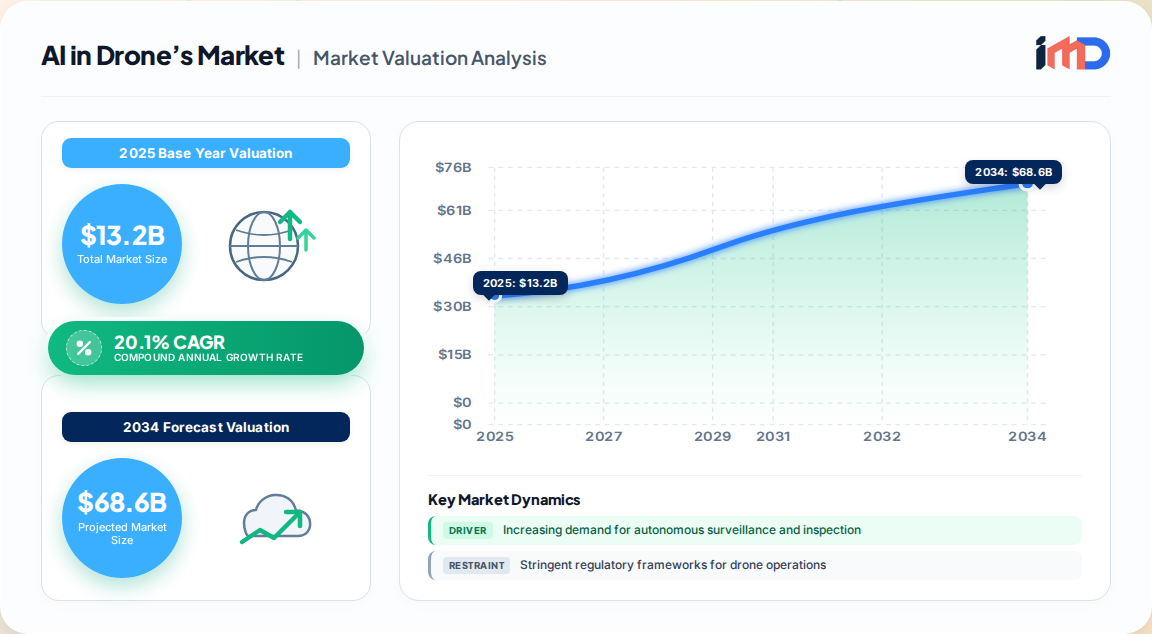
The global AI in drone market represents one of the most dynamic intersections of robotics, edge computing, and autonomous systems. Our proprietary primary research estimates the market at $13.2 billion in 2025, with projections indicating a robust expansion to $51.3 billion by 2033, reflecting a CAGR of 20.1% during the forecast period. This growth is underpinned by the accelerating deployment of drones equipped with computer vision, real-time decision-making algorithms, and autonomous navigation capabilities across military, commercial, and environmental applications.
Unlike conventional UAVs, AI-enabled drones leverage onboard processing to interpret sensor data in real time, enabling obstacle avoidance, target tracking, and adaptive flight path planning. This intelligence layer transforms drones from remotely piloted vehicles into autonomous data-gathering platforms, unlocking new use cases in precision agriculture, infrastructure inspection, search and rescue, and logistics. North America currently dominates the market with a 35.3% revenue share in 2025, driven by defense modernization programs and favorable regulatory frameworks. However, Asia Pacific is poised to register the fastest growth, fueled by rapid industrialization, government investments in smart city infrastructure, and expanding military budgets.
The proliferation of AI in drones is propelled by several structural forces. The increasing demand for autonomous surveillance and inspection in critical infrastructure (energy grids, pipelines, transportation networks) is a primary driver. AI-powered drones can perform scheduled patrols, detect anomalies using thermal and visual sensors, and transmit actionable intelligence to operators, reducing human exposure to hazardous environments.
However, the market faces notable restraints. Regulatory hurdles, particularly around beyond-visual-line-of-sight (BVLOS) operations and airspace integration, continue to slow widespread commercial adoption. Additionally, concerns regarding data security, privacy, and the potential for misuse in military contexts pose ethical and legal challenges. High initial costs and the need for specialized training further limit adoption among small and medium enterprises.
The AI in drone market is segmented by type, component, application, end use, and region, each revealing distinct growth trajectories.
By Type: Station-based (drone-in-a-box) solutions accounted for the largest share at 54.2% in 2025, as they enable automated, continuous monitoring from fixed locations. Cloud-based solutions are expected to witness the fastest CAGR, driven by the need for scalable data processing and fleet management.
By Component: Hardware dominated with 45.0% share in 2025, primarily due to the integration of advanced onboard processors, sensors, and communication modules. Software and services are anticipated to grow rapidly as enterprises seek AI algorithms for object detection, predictive maintenance, and mission planning.
By Application: Security and surveillance led with 30.0% share in 2025, followed by inspection, mapping, and agriculture. The security segment benefits from rising demand for border control, critical infrastructure protection, and public safety.
By End Use: The military segment held the largest share at 39.0% in 2025, reflecting heavy investments in autonomous systems for ISR (intelligence, surveillance, reconnaissance) missions. The commercial segment, including agriculture, construction, and logistics, is forecast to grow at a faster pace.
| Segment | Dominant Sub-segment (2025) | Share (%) | Fastest-Growing Sub-segment |
|---|---|---|---|
| Type | Station-based | 54.2 | Cloud-based |
| Component | Hardware | 45.0 | Software & Services |
| Application | Security & Surveillance | 30.0 | Agriculture & Inspection |
| End Use | Military | 39.0 | Commercial |
North America's leadership is anchored in its advanced technological ecosystem, substantial defense spending, and progressive regulatory environment. The U.S. Federal Aviation Administration (FAA) has been gradually expanding BVLOS approvals, enabling commercial drone operations. Europe follows closely, with countries like Germany, the UK, and France investing in drone-based border security and infrastructure monitoring. The European Union's regulatory framework (EASA) is evolving to support urban air mobility, creating opportunities for AI drone deployment in delivery and surveillance.
Asia Pacific is the fastest-growing region, projected to exhibit the highest CAGR from 2026 to 2033. China's dominance in drone manufacturing and its ambitious military modernization programs, coupled with India's push for indigenous defense technologies, are key growth catalysts. Japan and South Korea are also advancing drone regulations to enable commercial operations in logistics and agriculture.
South America and the Middle East & Africa represent emerging markets, with increasing adoption of drones for security, agriculture, and environmental monitoring. However, infrastructure limitations and regulatory gaps may temper growth in these regions.
The AI in drone market is characterized by intense competition among established aerospace and defense contractors, specialized drone manufacturers, and AI software providers. Key players are pursuing strategies such as product innovation, partnerships, and acquisitions to strengthen their market position.
The AI drone value chain encompasses raw material suppliers, component manufacturers, drone OEMs, AI software developers, system integrators, and end users. Critical components include flight controllers, sensors (LiDAR, thermal, RGB cameras), communication modules, and AI processors. The supply chain is heavily reliant on semiconductor foundries and specialized electronics, with geopolitical tensions affecting sourcing strategies.
Supply chain risks include component shortages, export controls on advanced semiconductors, and regulatory hurdles in cross-border trade. To mitigate these risks, OEMs are diversifying suppliers and investing in vertical integration.
Several untapped opportunities exist for investors and market participants. The development of modular autonomy systems that can be retrofitted onto existing drones is a high-growth area. Additionally, managed services for drone fleet operations, including data analytics and predictive maintenance, present recurring revenue models. The integration of AI drones with smart city infrastructure and 5G networks is another promising avenue. Furthermore, emerging applications such as drone-based package delivery and air taxis are expected to gain traction as regulations mature.
Investments in edge AI and sensor fusion technologies are critical to enable autonomous operations in GPS-denied environments. Companies that can provide robust, secure, and scalable AI solutions will be well-positioned to capture market share.
| Existing Markets | New Markets | |
|---|---|---|
| Existing Products | Market Penetration: Expand AI drone adoption in military and security sectors through upgrades and fleet modernization. | Market Development: Introduce station-based drone solutions to new geographic regions (e.g., Southeast Asia, Latin America). |
| New Products | Product Development: Develop cloud-based AI platforms for real-time data analytics and fleet management. | Diversification: Enter adjacent markets such as urban air mobility (air taxis) and drone delivery networks. |
Global trade in AI drones and components is subject to export controls, particularly for military-grade technologies. The U.S. International Traffic in Arms Regulations (ITAR) and the Wassenaar Arrangement restrict the export of advanced drones and AI-enabled systems to certain countries. China, a major exporter of commercial drones, faces scrutiny from Western governments over data security concerns. Key suppliers of AI chips and sensors are concentrated in the U.S., Taiwan, and South Korea, making the supply chain vulnerable to geopolitical disruptions. Companies are increasingly sourcing components from multiple regions to ensure resilience.
The AI in drone market is poised for transformative growth, driven by technological advancements and expanding use cases. By 2033, we expect AI drones to become integral to defense, security, and commercial operations, with autonomy levels reaching new heights. The convergence of AI, 5G, and edge computing will enable real-time collaborative operations among drone swarms, further enhancing their utility. However, regulatory harmonization and ethical considerations will remain critical to sustainable growth. Stakeholders should focus on innovation, partnerships, and compliance to capitalize on the opportunities ahead.
| Aspects | Details |
|---|---|
| Study Period | 2020-2034 |
| Base Year | 2025 |
| Estimated Year | 2026 |
| Forecast Period | 2026-2034 |
| Historical Period | 2020-2025 |
| Growth Rate | CAGR of 20.1% from 2020-2034 |
| Segmentation |
|
By Application
By End Use
| By Geography |
|
The global AI in drone market was valued at $13.2 billion in 2025 and is projected to reach $51.3 billion by 2033, growing at a CAGR of 20.1%.
North America held the largest revenue share of 35.3% in 2025, driven by high defense spending and advanced technological adoption.
Key drivers include rising demand for autonomous surveillance, advancements in edge AI and sensor fusion, and expanding commercial applications in agriculture, logistics, and inspection.
The cloud-based segment is projected to witness the fastest CAGR from 2026 to 2033, fueled by scalable data processing and real-time analytics.
Major players include DJI, Skydio, Shield AI, AeroVironment, Kespry, and Terra Drone, among others, focusing on AI integration and autonomous capabilities.
Our rigorous research methodology combines multi-layered approaches with comprehensive quality assurance, ensuring precision, accuracy, and reliability in every market analysis.
| Stakeholder Role | Interview Share (%) |
|---|---|
| Chief Technology Officer | 30% |
| Procurement Director | 25% |
| R&D Manager | 25% |
| Operations Head | 20% |
| Company Type | Representation (%) |
|---|---|
| Drone OEMs | 35% |
| AI Software Developers | 25% |
| Component Suppliers | 20% |
| System Integrators | 15% |
| End Users | 5% |
 Related Reports
