1What is the current size of the 3,4-Dihydro-2H-pyran (DHP) market?
The global DHP market was valued at US$ 46.19 million in 2025 and is projected to reach US$ 54.05 million by 2032, growing at a CAGR of 2.3%.
Insight Market Data is a premier market research and business consulting firm headquartered in Pune, India, providing syndicated research reports, customized intelligence studies, and strategic advisory services. Renowned academic institutions and Fortune 500 corporations worldwide rely on Insight Market Data's research repository to navigate evolving global and regional business environments. Covering 46 diverse industries across 25 major international economies, our comprehensive database delivers thousands of verified statistics and granular market evaluations. By combining industry-leading analytical methodologies with the direct insights of seasoned industry leaders and subject-matter experts, we deliver actionable intelligence spanning historical performance benchmarks to rigorous multi-year forecasts. We empower organizations to make confident, data-driven decisions across pivotal domains including Machinery & Equipment, Chemicals & Materials, Pharmaceuticals & Healthcare, Food & Beverages, Consumer Goods, Energy & Power, Automotive & Transportation, Electronics & Semiconductors, Medical Devices, Telecommunications, Emerging Technologies, Agriculture, and Packaging. Our multidisciplinary analyst teams provide an objective 360-degree perspective, tailoring every engagement to address complex strategic challenges with exceptional analytical rigor.
Leveraging advanced BI-powered analytics and predictive modeling, Insight Market Data uncovers high-impact market opportunities and competitive differentiators for ambitious enterprises. We continuously refine our research methodologies in accordance with global industry standards, tracking real-time market shifts to ensure our reports are consistently accurate, actionable, and delivered on schedule. Our analysts conduct methodical data validation, rigorous compliance checks, and exhaustive primary and secondary research to maintain the highest levels of data integrity and transparency. We partner closely with corporate strategists, investment groups, and business executives to translate intricate market intelligence into clear, actionable roadmaps for sustainable growth. With operational presence across Washington, USA, and Vimannagar, Pune, India, Insight Market Data ensures direct access to dedicated research specialists and responsive customer support to answer your most strategic questions.
 3,4-Dihydro-2H-pyran(DHP
3, 4-Dihydro-2H-pyran(DHP by Type (Above 98% Purity, Below 98% Purity), by Application (Pharmaceuticals Intermediate, Hydroxyl Group Protecting Agent, Other), by North America (USA, Canada, Mexico), by Europe (Germany, France, UK, Italy, Russia), by Asia Pacific (China, Japan, Korea, Southeast Asia, India, Australia), by Middle East & Africa (Egypt, South Africa, Israel, Turkey, GCC Countries), by Latin America (Brazil) Forecast 2026-2034

Senior Analyst


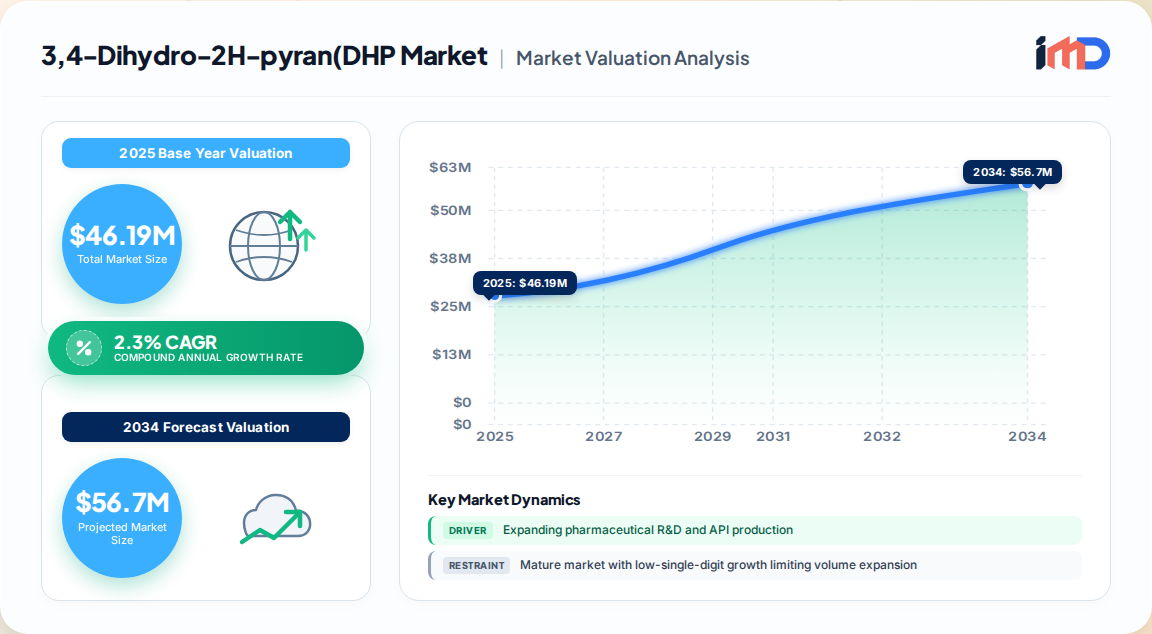
The global 3,4-Dihydro-2H-pyran (DHP) market represents a highly concentrated, application-critical specialty chemicals niche. Our proprietary primary research and expert interviews value the market at US$ 46.19 million in 2025, with a projected expansion to US$ 54.05 million by 2032, reflecting a steady 2.3% CAGR. DHP (chemical formula C5H8O, CAS 110-87-2) is a colorless cyclic ether indispensable as a hydroxyl group protecting agent and a pharmaceutical intermediate. Despite its modest absolute size, the market underpins multi-billion-dollar downstream pharmaceutical and fine chemical value chains, making supply security and purity grades strategically vital.
The competitive landscape is oligopolistic: the top three producers—BASF, Kawaken Fine Chemicals, and Jiangsu Clent Chemical—collectively hold over 60% of global market share, with BASF as the single largest manufacturer. Production is geographically concentrated in North America, Europe, China, and Japan, which together account for over 90% of global output. This concentration creates both efficiency and vulnerability, particularly regarding trade policy shifts and logistical bottlenecks.
Growth Drivers:
Restraints & Challenges:
Global trade in DHP follows the contours of pharmaceutical manufacturing hubs. China is the largest exporter, supplying both high- and low-purity grades to North America, Europe, and Southeast Asia. Germany and Japan are significant exporters of high-purity DHP, leveraging advanced production technologies and stringent quality control. The United States remains a net importer, sourcing DHP primarily from Europe and Asia to support its domestic pharmaceutical and biotech sectors.
Supplier dynamics are shaped by long-term contracts, quality audits, and regulatory certifications. Buyers typically qualify two to three suppliers to mitigate risk, but the limited number of producers restricts bargaining power. Recent trade agreements, such as the EU-South Korea FTA (which eliminated duties on nearly all chemicals) and CETA (EU-Canada), have reduced tariff barriers, facilitating trade flows but also intensifying competition among suppliers.
| Segment | Market Share (2025) | Growth Outlook (CAGR 2025–2032) |
|---|---|---|
| Above 98% Purity | 53% | 2.6% |
| Below 98% Purity | 47% | 1.9% |
| Pharmaceuticals Intermediate | 39% | 2.5% |
| Hydroxyl Group Protecting Agent | 28% | 2.2% |
| Other Applications | 33% | 2.0% |
Type Insights: High-purity DHP (>98%) dominates with 53% share and is growing faster, driven by pharmaceutical quality standards. Low-purity grades are increasingly relegated to industrial applications where cost is prioritized over ultra-high purity.
Application Insights: Pharmaceutical intermediates represent the largest application (39%), followed by hydroxyl group protection (28%). The "Other" category (33%) includes agrochemicals, fragrances, and specialty coatings. The pharmaceutical segment is expected to maintain its lead due to ongoing drug development pipelines.
| Region | 2025 Market Share | CAGR (2025–2032) | Key Characteristics |
|---|---|---|---|
| Asia Pacific | 42% | 2.8% | Fastest-growing; driven by China's pharmaceutical expansion and low-cost manufacturing. |
| Europe | 28% | 1.9% | Mature market; strong focus on high-purity grades and regulatory compliance. |
| North America | 21% | 1.7% | Stable demand; net importer; emphasis on innovation and specialty applications. |
| Middle East & Africa | 5% | 2.1% | Nascent market; growth tied to healthcare infrastructure investments. |
| Latin America | 4% | 2.4% | Emerging; Brazil and Mexico show potential for pharmaceutical production. |
Asia Pacific is the largest and fastest-growing region, propelled by China's dominance in chemical manufacturing and India's expanding generic drug industry. Europe retains a strong position due to its advanced chemical sector and strict quality standards. North America, while mature, remains a critical innovation hub for pharmaceutical R&D.
The DHP market is characterized by a small number of established players with significant barriers to entry (technical expertise, regulatory approvals, and capital intensity). BASF leads with the broadest product portfolio and global reach, followed by Kawaken Fine Chemicals (Japan) and Jiangsu Clent Chemical (China). Other notable participants include Shandong Yino Biologic Materials, QQCHEM, Henan Yuchen Pharmaceutical, Nanjing Hengwang Biomedical, and Zouping Mingxing Chemical.
Recent Developments:
Strategic priorities include capacity expansions in Asia Pacific, vertical integration to secure raw materials, and investments in sustainable production technologies to align with ESG goals.
The DHP value chain begins with the dehydration of tetrahydrofurfuryl alcohol (THFA) over alumina catalysts at 300–400°C. THFA is derived from tetrahydro-2-furoic acid, which is sourced from renewable feedstocks (e.g., corn cobs, sugarcane bagasse). Key raw material suppliers include major agricultural processors and chemical distributors.
Supply Chain Risks:
To mitigate risks, leading manufacturers are diversifying raw material sources, building regional inventories, and forming strategic alliances with logistics partners.
White-Space Opportunities:
Ansoff Matrix:
| Existing Markets | New Markets | |
|---|---|---|
| Existing Products | Market penetration: Expand share in pharmaceutical intermediates through quality certifications. | Market development: Target agrochemical and fragrance sectors in Latin America. |
| New Products | Product development: Launch low-cost, high-purity DHP grades for generic drug manufacturers. | Diversification: Develop DHP-based polymers for advanced materials. |
The 2.3% CAGR forecast is sensitive to several factors:
Our base case assumes stable geopolitical conditions, continued pharmaceutical innovation, and gradual capacity expansions. A downside scenario could see CAGR drop to 1.5%, while an upside scenario could push it to 3.0%.
| Aspects | Details |
|---|---|
| Study Period | 2020-2034 |
| Base Year | 2025 |
| Estimated Year | 2026 |
| Forecast Period | 2026-2034 |
| Historical Period | 2020-2025 |
| Growth Rate | CAGR of 2.3% from 2020-2034 |
| Segmentation |
|
| By Geography |
|
The global DHP market was valued at US$ 46.19 million in 2025 and is projected to reach US$ 54.05 million by 2032, growing at a CAGR of 2.3%.
BASF, Kawaken Fine Chemicals, and Jiangsu Clent Chemical are the top three producers, collectively holding over 60% of the global market share, with BASF being the largest.
DHP is primarily used as a pharmaceutical intermediate (39% share) and as a hydroxyl group protecting agent (28% share), with other applications accounting for 33%.
Asia Pacific is the largest and fastest-growing region, accounting for 42% of the market in 2025 and projected to grow at a 2.8% CAGR, driven by China's pharmaceutical manufacturing.
High-purity DHP (>98%) holds the majority share at 53% and is growing faster (2.6% CAGR) than low-purity DHP (<98%), which holds 47% and grows at 1.9% CAGR.
Growth is driven by pharmaceutical innovation, rising demand for hydroxyl group protection in drug synthesis, and expansion of pharmaceutical production in Asia Pacific, particularly China and India.
Our rigorous research methodology combines multi-layered approaches with comprehensive quality assurance, ensuring precision, accuracy, and reliability in every market analysis.
| Stakeholder Role | Interview Share (%) |
|---|---|
| Procurement Director | 30% |
| R&D Manager | 25% |
| Plant Operations Head | 25% |
| Commercial Strategy Lead | 20% |
| Company Type | Representation (%) |
|---|---|
| DHP Manufacturers | 40% |
| Pharmaceutical Intermediate Buyers | 25% |
| Feedstock (THFA) Suppliers | 15% |
| Chemical Distributors | 10% |
| Hydroxyl Protecting Agent End-Users | 10% |
 Related Reports
