1What is the current size of the global 2-Ethylhexanol market?
The global 2-ethylhexanol market was valued at USD 6.7 billion in 2025 and is projected to reach USD 8.3 billion by 2033, growing at a CAGR of 2.7%.
Insight Market Data is a premier market research and business consulting firm headquartered in Pune, India, providing syndicated research reports, customized intelligence studies, and strategic advisory services. Renowned academic institutions and Fortune 500 corporations worldwide rely on Insight Market Data's research repository to navigate evolving global and regional business environments. Covering 46 diverse industries across 25 major international economies, our comprehensive database delivers thousands of verified statistics and granular market evaluations. By combining industry-leading analytical methodologies with the direct insights of seasoned industry leaders and subject-matter experts, we deliver actionable intelligence spanning historical performance benchmarks to rigorous multi-year forecasts. We empower organizations to make confident, data-driven decisions across pivotal domains including Machinery & Equipment, Chemicals & Materials, Pharmaceuticals & Healthcare, Food & Beverages, Consumer Goods, Energy & Power, Automotive & Transportation, Electronics & Semiconductors, Medical Devices, Telecommunications, Emerging Technologies, Agriculture, and Packaging. Our multidisciplinary analyst teams provide an objective 360-degree perspective, tailoring every engagement to address complex strategic challenges with exceptional analytical rigor.
Leveraging advanced BI-powered analytics and predictive modeling, Insight Market Data uncovers high-impact market opportunities and competitive differentiators for ambitious enterprises. We continuously refine our research methodologies in accordance with global industry standards, tracking real-time market shifts to ensure our reports are consistently accurate, actionable, and delivered on schedule. Our analysts conduct methodical data validation, rigorous compliance checks, and exhaustive primary and secondary research to maintain the highest levels of data integrity and transparency. We partner closely with corporate strategists, investment groups, and business executives to translate intricate market intelligence into clear, actionable roadmaps for sustainable growth. With operational presence across Washington, USA, and Vimannagar, Pune, India, Insight Market Data ensures direct access to dedicated research specialists and responsive customer support to answer your most strategic questions.
 2-Ethyl Hexanol (2EH Market
 by Plasticizers (Phthalate, Non-Phthalate), by 2-EH Acrylate, by 2-EH Nitrate, by Others (Multiple Solvents), by North America (USA, Canada, Mexico), by Europe (Germany, UK, France, Italy, Spain, Rest of Europe), by Asia Pacific (China, Japan, India, Australia, South Korea, Rest of Asia Pacific), by Latin America (Brazil, Argentina, Rest of Latin America), by Middle East & Africa (Saudi Arabia, UAE, Egypt, Kuwait, South Africa, Rest of Middle East & Africa) Forecast 2026-2034

Senior Analyst


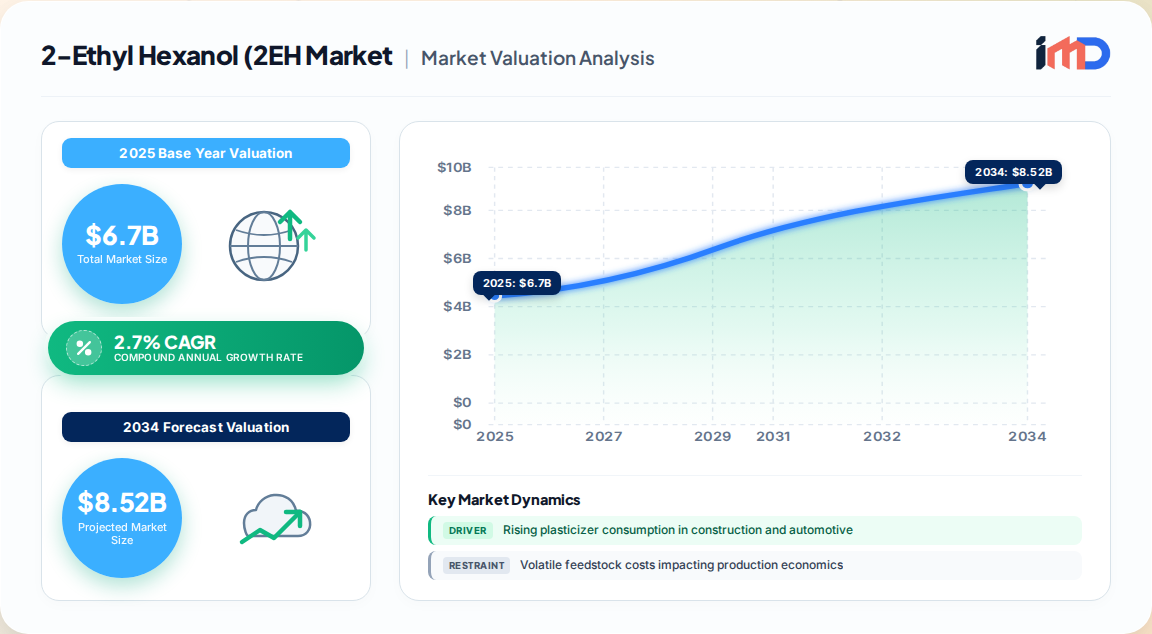
The global 2-Ethylhexanol (2EH) market is a mature, high-volume petrochemical derivative with a well-established demand base across multiple industrial verticals. Our proprietary primary research and expert interview findings indicate the global market was valued at USD 6.7 billion in 2025. It is projected to grow from USD 6.9 billion in 2026 to USD 8.3 billion by 2033, exhibiting a CAGR of 2.7% during the forecast period. In volume terms, the market is estimated at roughly 4,450 kilotons in 2025, with global capacity estimated at 5,800 kilotons.
This growth trajectory reflects a market that is neither surging nor stagnating; rather, it is being reshaped by structural shifts in application demand, regional production economics, and tightening environmental regulations in mature economies. The Asia Pacific region dominates, accounting for 58.6% of global revenue in 2025, with China alone representing roughly 50% of global production capacity (approximately 3,000 kilotons). This concentration of capacity and demand in Asia creates a strategic pivot point for the entire value chain.
From an application standpoint, plasticizers remain the anchor segment, commanding 53.2% of total revenue in 2025. However, the fastest-growing application is 2-EH acrylate, driven by paints, coatings, and adhesive demand in developing economies. The market is fragmented but leans toward consolidation among top-tier chemical manufacturers, with cost efficiency and feedstock integration defining competitive advantage.
The 2-ethylhexanol market is navigating a complex interplay of steady demand, raw material volatility, and evolving regulatory frameworks. Our primary research with industry stakeholders reveals several defining trends:
The 2-EH value chain is characterized by significant integration among leading producers, from feedstock to end-use applications.
| Value Chain Stage | Key Activities | Key Stakeholders | Strategic Implications |
|---|---|---|---|
| Upstream Feedstock | Propylene, syngas production from naphtha or natural gas | Refiners, petrochemical companies | Integration secures supply and mitigates volatility |
| 2-EH Production | Oxo process (hydroformylation of propylene followed by hydrogenation) | Chemical manufacturers (e.g., BASF, LG Chem, SABIC) | Scale, feedstock access, and process efficiency drive margins |
| Downstream Derivatives | Plasticizers (DOP, DOTP, DOA), 2-EH acrylate, 2-EH nitrate | Plasticizer and acrylate producers | Product mix flexibility and regulatory compliance |
| End-Use Applications | Flexible PVC, paints, coatings, adhesives, lubricants, herbicides | Construction, automotive, packaging, consumer goods | Demand cyclicality tied to macro trends |
Critical Insight: The most profitable players are those with backward integration into propylene and forward integration into plasticizers or acrylates. Standalone 2-EH producers face margin compression during feedstock price spikes.
The 2-EH market exhibits significant and growing regional imbalances between production and demand, creating robust international trade flows.
Asia Pacific as the Primary Export Hub: With 70% of global capacity located in Asia Pacific (led by China's ~50% share), the region is the primary exporter of 2-EH. China alone holds approximately 3,000 kilotons of capacity, with production often exceeding domestic demand, leading to export pressure on global markets. South Korea, Japan, and Taiwan are also major exporters.
Major Demand Centers: While Asia Pacific accounts for 58.6% of global revenue, North America and Western Europe together represent a significant share of demand (roughly 9% and 7% of global demand, respectively) but are structurally short of local production.
Trade Flow Dynamics:
Supply Chain Risks:
Asia Pacific is the undisputed center of gravity for the 2-EH market, commanding 58.6% of global revenue in 2025. The region's dominance is underpinned by China's massive production base and the rapid expansion of downstream industries in India and Southeast Asia. China's 2-EH demand is closely tied to its plasticizer and coatings sectors, which are recovering from a period of slow growth. India is emerging as a bright spot, with forecast CAGR of 6.9% for 2-EH demand (2026-2035), driven by construction, automotive, and consumer goods expansion. Japan and South Korea are mature markets with stable demand.
North America represents a mature, stable market with a strong domestic production base, particularly in the U.S., leveraging shale gas-derived propylene. The region is a moderate net exporter but faces regulatory pressure on phthalate plasticizers, which is constraining demand growth. The shift toward non-phthalate plasticizers and specialty acrylates is reshaping the product mix.
Europe is a comparatively small and slow-growing market, heavily influenced by environmental regulations. Countries like Germany, France, and Italy have a strong industrial base, but phthalate restrictions have led to a decline in demand for DOP, partially offset by growth in non-phthalate alternatives and 2-EH acrylate. European producers are under pressure to innovate and adopt greener processes.
Latin America and the Middle East & Africa are emerging markets with growing demand for construction materials and consumer goods. Brazil and Argentina are key markets, while Saudi Arabia and UAE are major producers for export. Infrastructure spending in the Middle East is a key driver.
The 2-EH market is moderately concentrated, with major chemical companies leveraging vertical integration and scale.
| Company | Headquarters | Strategic Position & Recent Developments |
|---|---|---|
| BASF SE | Germany | Integrated oxo-alcohols producer; strong position in Europe and global ethylhexanol derivatives. Focus on non-phthalate plasticizers and specialty acrylates. |
| Eastman Chemical Company | USA | Integrated producer with a focus on specialty plasticizers and 2-EH acrylates. |
| LG Chem | South Korea | Major Asian producer with integrated feedstock and significant export capacity. |
| China National Petroleum Corporation (CNPC) | China | State-owned giant with substantial 2-EH capacity, primarily serving domestic market and export. |
| SABIC | Saudi Arabia | Cost-advantaged producer leveraging cheap feedstock; exports to Europe and Asia. |
| Formosa Plastic Group | Taiwan | Integrated producer with a strong position in Asia. |
| China Petroleum & Chemical Corporation (Sinopec) | China | Major Chinese producer with significant capacity and domestic distribution. |
| Grupa Azoty | Poland | Leading European producer of oxo-alcohols, including 2-EH. |
| Elekeiroz S.A. | Brazil | Key Latin American producer. |
Recent Developments:
Strategic White-Space Opportunities:
Given the volatility in feedstock prices and regional supply imbalances, a robust procurement strategy is essential for downstream buyers.
Key Procurement Considerations:
Sourcing Recommendations:
| Strategy | Description | Application to 2-EH Market |
|---|---|---|
| Market Penetration | Increase sales of existing 2-EH in existing markets | Expand sales of plasticizers in Asia Pacific construction and automotive segments. |
| Market Development | Enter new geographic or application markets with existing products | Target emerging markets in Africa and Southeast Asia; promote 2-EH acrylate in new coating applications. |
| Product Development | Develop new products or derivatives for existing markets | Develop high-purity grades for electronic solvents and specialty acrylates for UV-curable coatings. |
| Diversification | Develop new products for new markets | Invest in bio-based 2-EH for green chemistry applications; explore use in lithium-ion battery electrolytes. |
The most significant near-term growth opportunities lie in market development (geographic expansion) and product development (specialty derivatives). Diversification into bio-based products represents a longer-term strategic bet.
The 2-EH market is at a crossroads between steady traditional demand and emerging regulatory and technological shifts.
The next decade will be defined by how the industry balances the legacy plasticizer business with the growing demand for sustainable and specialty derivatives. Those who adapt their product portfolios and supply chains will be best positioned to capture value.
| Aspects | Details |
|---|---|
| Study Period | 2020-2034 |
| Base Year | 2025 |
| Estimated Year | 2026 |
| Forecast Period | 2026-2034 |
| Historical Period | 2020-2025 |
| Growth Rate | CAGR of 2.7% from 2020-2034 |
| Segmentation |
|
| By Geography |
|
The global 2-ethylhexanol market was valued at USD 6.7 billion in 2025 and is projected to reach USD 8.3 billion by 2033, growing at a CAGR of 2.7%.
Asia Pacific holds the largest share, accounting for 58.6% of global revenue in 2025, driven by China's dominant production capacity and demand.
Plasticizers are the largest application, representing 53.2% of revenue in 2025, followed by 2-EH acrylate and 2-EH nitrate.
Growth is driven by rising plasticizer consumption in construction and automotive, and expanding acrylate applications in paints and coatings.
Key companies include BASF SE, Eastman Chemical Company, LG Chem, SABIC, China National Petroleum Corporation, and Formosa Plastic Group.
Our rigorous research methodology combines multi-layered approaches with comprehensive quality assurance, ensuring precision, accuracy, and reliability in every market analysis.
| Stakeholder Role | Interview Share (%) |
|---|---|
| Procurement Director | 30% |
| Plant/Operations Manager | 25% |
| R&D/Technical Head | 20% |
| Commercial/Sales VP | 15% |
| Regulatory Affairs Manager | 10% |
| Company Type | Representation (%) |
|---|---|
| 2-EH Producers | 40% |
| Plasticizer Manufacturers | 25% |
| Acrylate & Derivative Producers | 15% |
| End-Users (Construction, Automotive) | 12% |
| Distributors & Traders | 8% |
 Related Reports
