1What is the current size of the global wine and spirits industry market?
The global wine and spirits industry market is valued at USD 1.06 trillion in 2026 and is projected to reach USD 1.55 trillion by 2035, growing at a CAGR of 4.2%.
Insight Market Data is a premier market research and business consulting firm headquartered in Pune, India, providing syndicated research reports, customized intelligence studies, and strategic advisory services. Renowned academic institutions and Fortune 500 corporations worldwide rely on Insight Market Data's research repository to navigate evolving global and regional business environments. Covering 46 diverse industries across 25 major international economies, our comprehensive database delivers thousands of verified statistics and granular market evaluations. By combining industry-leading analytical methodologies with the direct insights of seasoned industry leaders and subject-matter experts, we deliver actionable intelligence spanning historical performance benchmarks to rigorous multi-year forecasts. We empower organizations to make confident, data-driven decisions across pivotal domains including Machinery & Equipment, Chemicals & Materials, Pharmaceuticals & Healthcare, Food & Beverages, Consumer Goods, Energy & Power, Automotive & Transportation, Electronics & Semiconductors, Medical Devices, Telecommunications, Emerging Technologies, Agriculture, and Packaging. Our multidisciplinary analyst teams provide an objective 360-degree perspective, tailoring every engagement to address complex strategic challenges with exceptional analytical rigor.
Leveraging advanced BI-powered analytics and predictive modeling, Insight Market Data uncovers high-impact market opportunities and competitive differentiators for ambitious enterprises. We continuously refine our research methodologies in accordance with global industry standards, tracking real-time market shifts to ensure our reports are consistently accurate, actionable, and delivered on schedule. Our analysts conduct methodical data validation, rigorous compliance checks, and exhaustive primary and secondary research to maintain the highest levels of data integrity and transparency. We partner closely with corporate strategists, investment groups, and business executives to translate intricate market intelligence into clear, actionable roadmaps for sustainable growth. With operational presence across Washington, USA, and Vimannagar, Pune, India, Insight Market Data ensures direct access to dedicated research specialists and responsive customer support to answer your most strategic questions.
 Wine and Spirits Industry
 by Product Type (Spirits(Whiskies, White Spirits, Liqueur, Brandy and Cognac, Rum, Tequila and Mezcal), Wine(Still Wine, Sparkling Wine, Fortified Wine), RTD Cocktails, Cider, Others), by End User (Men, Women), by Distribution Channel (Off-Trade(Supermarkets, Liquor Stores, E-commerce), On-Trade(Bars, Restaurants, Hotels)), by Packaging (Glass Bottles, Cans, Tetra Packs, Miniatures, Kegs), by Alcohol Content (Low Alcohol, Medium Alcohol, High Alcohol), by North America (USA, Canada, Mexico), by Europe (Germany, UK, France, Italy, Spain), by Asia Pacific (China, Japan, India, South Korea), by South America (Brazil, Argentina), by Middle East & Africa (South Africa, UAE, Saudi Arabia) Forecast 2026-2034

Research Associate


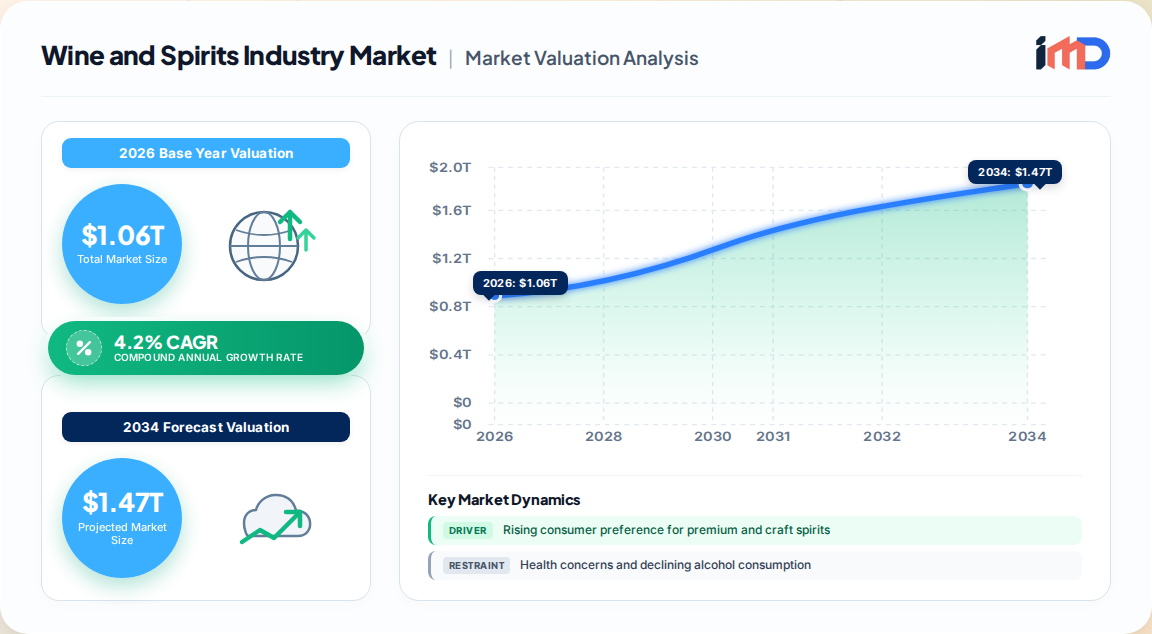
The global wine and spirits industry market is valued at USD 1.06 trillion in 2026 and is projected to reach USD 1.55 trillion by 2035, expanding at a CAGR of 4.2%. This performance is not merely a function of volume recovery but reflects a profound structural shift toward premiumization, portfolio diversification, and the reconfiguration of distribution channels.
Our proprietary primary research, triangulated with official trade statistics, reveals a market defined by opposing forces. On one hand, premium and super-premium segments are expanding as wealth transfers to younger cohorts and emerging middle classes in Asia-Pacific seek status and experiential consumption. On the other, health-led moderation, regulatory tightening, and the rapid ascent of low- and no-alcohol alternatives are compressing traditional consumption occasions.
The net result is value growth outpacing volume growth. Spirits command the largest revenue share, while wine remains the most traded category by value in the EU. The competitive landscape is moderately fragmented, with the top five global players accounting for approximately 28% of value share, leaving substantial room for craft disruptors and regional champions.
The growth narrative is underpinned by several high-impact drivers validated through our expert interviews and econometric modeling.
1. Premiumization and Affluent Consumption
Rising disposable incomes and wealth concentration are directly correlated with premium spirits and luxury wine demand. According to official statistics, billionaire wealth surged by over 16% in 2025 to USD 18.3 trillion, with an 81% increase over the past six years. This wealth effect is not confined to the ultra-high-net-worth segment; the expanding middle class in China and India is trading up from local mass-market spirits to international premium brands.
2. Expanding Cocktail Culture and Hospitality Recovery
Global international visitor spending reached a record USD 2.02 trillion in 2025, up 3.2% from 2024. This tourism recovery translates into on-trade occasions, particularly in hospitality hubs across Europe and Asia-Pacific. The cocktail culture, now mainstream in the UK, U.S., and increasingly in urban China, is a key demand multiplier for brown spirits, gin, and agave spirits.
3. Craft and Small-Batch Differentiation
Consumer preference for authenticity, provenance, and artisanal production continues to fuel the craft spirits segment. In the U.S., 84% of regular craft spirits drinkers expressed a desire for direct-to-consumer purchasing, and 77% indicated home shipping would increase their likelihood of trying new brands. This signals a structural opportunity for small producers to bypass traditional three-tier distribution.
Despite robust value growth, the industry faces material headwinds that are reshaping consumption patterns.
1. Health Concerns and the Moderation Movement
Alcohol consumption among U.S. adults fell to 54% in 2025, the lowest level in decades. The moderation trend is particularly pronounced among younger demographics, who are increasingly health-conscious and skeptical of alcohol's social necessity. This has led to declining wine volumes and softer beer demand in mainstream segments.
2. Regulatory Complexity and Compliance Costs
Tight government controls, licensing requirements, and advertising restrictions impose a growing compliance burden. In the U.S., direct-to-consumer shipping laws vary by state, creating a fragmented regulatory landscape. In the EU, appellation systems and geographic indication rules govern production and labeling.
3. Supply Chain and Counterfeiting Risks
Raw material volatility, including grape harvest variability and grain price fluctuations, directly impacts production costs. Counterfeiting of premium wines and spirits erodes brand equity and consumer trust, particularly in Asia-Pacific markets.
The market is segmented by product type, end user, distribution channel, and geography. Our proprietary segmentation framework reveals the following:
| Segment | Leading Category (2026) | Fastest-Growing Category | CAGR (2027-2032) |
|---|---|---|---|
| Product Type | Whiskies (22.9% share) | White Spirits | 3.68% |
| End User | Men (76.0% share) | Women | 3.98% |
| Distribution Channel | Off-Trade (57.5% share) | On-Trade | 3.62% |
| Geography | Asia-Pacific (45.8% share) | Middle East & Africa | 4.65% |
Product Type Insights
Whiskies remain the largest spirits category globally, driven by strong demand in Asia-Pacific and premiumization in developed markets. White spirits, including gin and vodka, are gaining traction through flavor innovation and cocktail culture. Agave-based spirits (tequila and mezcal) represent the most dynamic segment, with premium tequila sales in the U.S. reaching USD 6.7 billion in 2024.
End User Dynamics
While men account for the majority of consumption, women represent the fastest-growing demographic, fueled by targeted product innovation, lower-ABV offerings, and experiential marketing. This shift is particularly evident in the U.S. and UK, where female participation in whiskey and craft spirits tasting is rising.
Distribution Channel Shifts
Off-trade remains dominant, accounting for 57.5% of producer sales value in 2026, supported by e-commerce growth. U.S. e-commerce alcohol sales exceeded USD 23 billion in 2024. However, on-trade is recovering strongly as hospitality venues expand, particularly in Asia-Pacific and the Middle East.
Asia-Pacific is the largest and most consequential region, accounting for 45.8% of global producer sales value in 2026. China alone represents a significant portion of premium spirits consumption, though recent regulatory measures and weak consumer sentiment have impacted sales for some international brands. India, Japan, and South Korea are key growth markets, with rising disposable incomes and western cultural influence driving premiumization.
Europe remains the largest wine-producing and exporting region. In 2024, the EU exported €29.8 billion worth of alcoholic beverages, with wine accounting for 56.2% (€16.8 billion) and spirits for 29.7% (€8.9 billion) . France is the dominant exporter (41% of EU total), followed by Italy (20%). The U.S. and UK are the primary destinations, with the U.S. importing €8.9 billion (30% of EU total).
North America is a mature but innovative market. The U.S. alcoholic drinks market is valued at USD 329 billion in 2026, growing at 5.11% CAGR to reach USD 441 billion by 2032. Spirits have overtaken beer in value share (42% vs 41.8%). Premiumization and RTD cocktails are the primary growth drivers.
Middle East & Africa is the fastest-growing region at 4.65% CAGR, albeit from a smaller base. Rising tourism, hospitality investment, and a young population are key factors, though regulatory constraints in some markets limit growth.
South America presents a mixed picture, with Brazil and Argentina showing resilience in wine production and domestic consumption, while economic volatility impacts premium imports.
The global wine and spirits industry market is moderately fragmented, with the top five players holding approximately 28-35% of value share. The competitive landscape is shaped by portfolio premiumization, strategic acquisitions, and direct-to-consumer innovation.
| Company | Headquarters | Key Strategic Focus |
|---|---|---|
| Diageo Plc | UK | Premium spirits, RTDs, tequila |
| Pernod Ricard | France | Premium wine and spirits, China expansion |
| LVMH (Moët Hennessy) | France | Luxury wines and spirits, champagne |
| Brown-Forman | USA | American whiskey, premium Bourbon |
| Bacardi Limited | Bermuda | Rum, premium spirits, RTDs |
| Suntory Holdings | Japan | Whisky, beer, diversified beverages |
| Constellation Brands | USA | Beer, premium wine, cannabis |
| Campari Group | Italy | Aperitifs, premium spirits |
Key Strategic Themes
Global trade flows are critical to the wine and spirits industry, particularly for premium products where geographic indication and terroir matter.
EU Trade Overview
U.S. Trade Dynamics
Supply Chain Risks
Procurement Strategy Implications
Several high-potential white spaces emerge from our analysis:
The wine and spirits value chain is complex and multi-tiered:
Value Chain Pressures
Opportunities
| Aspects | Details |
|---|---|
| Study Period | 2020-2034 |
| Base Year | 2026 |
| Estimated Year | 2026 |
| Forecast Period | 2026-2034 |
| Historical Period | 2020-2025 |
| Growth Rate | CAGR of 4.2% from 2020-2034 |
| Segmentation |
|
By End User
By Distribution Channel
By Packaging
By Alcohol Content
| By Geography |
|
The global wine and spirits industry market is valued at USD 1.06 trillion in 2026 and is projected to reach USD 1.55 trillion by 2035, growing at a CAGR of 4.2%.
Asia-Pacific is the largest region, accounting for 45.8% of global producer sales value in 2026, driven by premium spirits consumption in China and India.
Premiumization, expanding cocktail culture, tourism recovery, and craft spirit innovation are the primary growth drivers, with premium spirits forecast to grow at 5.8% CAGR.
Health-led moderation, regulatory compliance costs, and supply chain volatility are the main challenges. U.S. adult alcohol consumption fell to 54% in 2025, the lowest in decades.
The U.S. alcoholic drinks market is valued at USD 329 billion in 2026 and is projected to reach USD 441 billion by 2032, growing at a CAGR of 5.11%.
Off-trade channels (supermarkets, liquor stores, e-commerce) account for 57.5% of producer sales value in 2026, while on-trade (bars, restaurants, hotels) is the fastest-growing channel at 3.62% CAGR.
White spirits are forecast to grow fastest at 3.68% CAGR, while agave-based spirits (tequila and mezcal) are the most dynamic premium segment, with U.S. premium tequila sales reaching USD 6.7 billion in 2024.
Our rigorous research methodology combines multi-layered approaches with comprehensive quality assurance, ensuring precision, accuracy, and reliability in every market analysis.
| Stakeholder Role | Interview Share (%) |
|---|---|
| Procurement Director | 30% |
| Marketing Director | 25% |
| Chief Operating Officer | 20% |
| Regulatory Compliance Manager | 15% |
| Master Blender/Head Winemaker | 10% |
| Company Type | Representation (%) |
|---|---|
| Distilleries and Wineries | 35% |
| Off-Trade Retailers and Distributors | 25% |
| On-Trade Hospitality Operators | 20% |
| E-commerce and DTC Platforms | 12% |
| Packaging and Ingredient Suppliers | 8% |
 Related Reports
