1What is the current market size of the reusable coffee cup industry?
The global reusable coffee cup market was valued at USD 18.4 billion in 2025, with projections to reach USD 33.23 billion by 2035.
Insight Market Data is a premier market research and business consulting firm headquartered in Pune, India, providing syndicated research reports, customized intelligence studies, and strategic advisory services. Renowned academic institutions and Fortune 500 corporations worldwide rely on Insight Market Data's research repository to navigate evolving global and regional business environments. Covering 46 diverse industries across 25 major international economies, our comprehensive database delivers thousands of verified statistics and granular market evaluations. By combining industry-leading analytical methodologies with the direct insights of seasoned industry leaders and subject-matter experts, we deliver actionable intelligence spanning historical performance benchmarks to rigorous multi-year forecasts. We empower organizations to make confident, data-driven decisions across pivotal domains including Machinery & Equipment, Chemicals & Materials, Pharmaceuticals & Healthcare, Food & Beverages, Consumer Goods, Energy & Power, Automotive & Transportation, Electronics & Semiconductors, Medical Devices, Telecommunications, Emerging Technologies, Agriculture, and Packaging. Our multidisciplinary analyst teams provide an objective 360-degree perspective, tailoring every engagement to address complex strategic challenges with exceptional analytical rigor.
Leveraging advanced BI-powered analytics and predictive modeling, Insight Market Data uncovers high-impact market opportunities and competitive differentiators for ambitious enterprises. We continuously refine our research methodologies in accordance with global industry standards, tracking real-time market shifts to ensure our reports are consistently accurate, actionable, and delivered on schedule. Our analysts conduct methodical data validation, rigorous compliance checks, and exhaustive primary and secondary research to maintain the highest levels of data integrity and transparency. We partner closely with corporate strategists, investment groups, and business executives to translate intricate market intelligence into clear, actionable roadmaps for sustainable growth. With operational presence across Washington, USA, and Vimannagar, Pune, India, Insight Market Data ensures direct access to dedicated research specialists and responsive customer support to answer your most strategic questions.
 Unveiling Resuable Coffee Cup Industry
 by Material Type (Stainless Steel, Glass, Bamboo, Plastic, Recycled Paper, Ceramic, Others), by Application (Individual/Personal Use, Commercial), by Distribution Channel (Online Sales, Offline Sales), by North America (USA, Canada, Mexico), by Europe (Germany, UK, France, Italy, Spain, Russia, Benelux, Nordics), by Asia Pacific (China, Japan, South Korea, India, ASEAN, Oceania), by South America (Brazil, Argentina), by Middle East & Africa (Turkey, Israel, GCC, North Africa, South Africa) Forecast 2026-2034

Research Associate


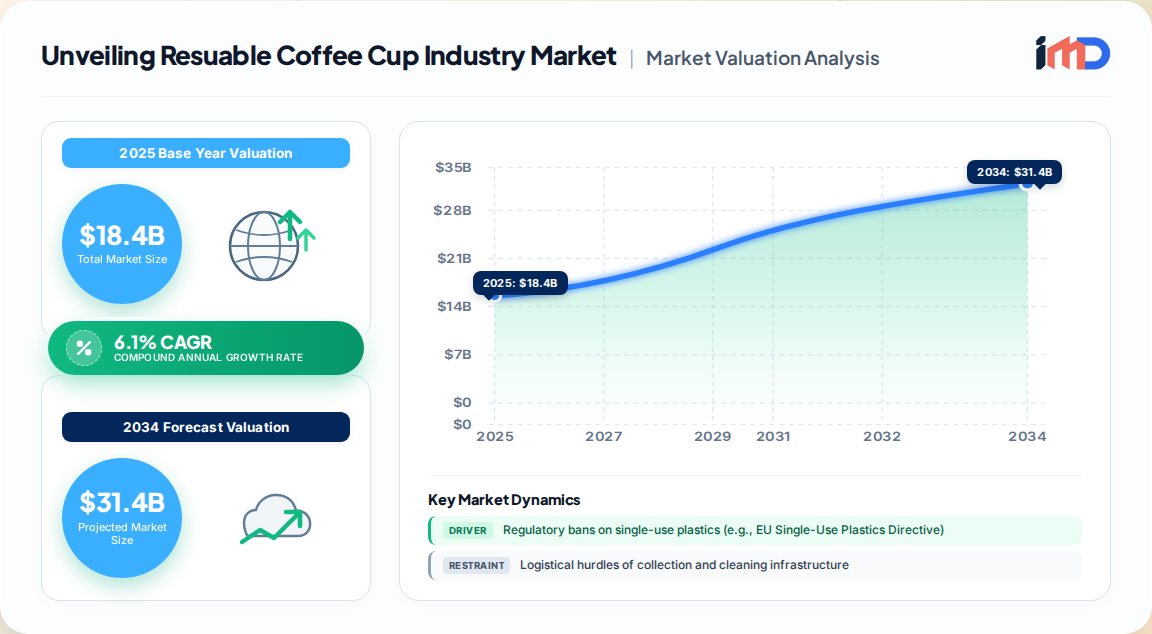
The global reusable coffee cup market is undergoing a structural transformation from a niche eco-lifestyle accessory to a mainstream packaging and consumer goods category. Our proprietary first-party research estimates the market at USD 18.4 billion in 2025, with projections indicating a rise to USD 33.23 billion by 2035, representing a robust CAGR of 6.1% over the forecast period. This growth is not merely a function of rising environmental sentiment; it is underpinned by a confluence of regulatory mandates, corporate sustainability commitments, and material innovation that is reshaping procurement strategies across the foodservice value chain. The commercial channel (cafés, quick-service restaurants, corporate campuses) is the largest demand pool, expected to contribute over 60% of incremental revenue between 2026 and 2035, as businesses move from voluntary pilots to embedded deposit-return systems.
Stainless steel remains the dominant material, accounting for approximately 38% of global reusable cup revenue in 2025. This share is supported by its superior thermal retention, durability, and recyclability. The Stainless Steel Coffee Cup Market is projected to grow from USD 1.34 billion in 2025 to USD 2.26 billion by 2034, increasing its share to nearly 40%. Within the commercial channel, 18/8 food-grade stainless steel is preferred for its ability to withstand repeated commercial dishwashing cycles. The Ceramic Coffee Cup Market remains strong for in-home consumption and corporate gifts but faces share erosion due to fragility and weight. Bamboo and recycled paper alternatives are gaining traction in price-sensitive segments, while glass remains a niche constrained by fragility.
The Individual/Personal Use segment commands the largest share, at 55.6% of the market, driven by daily coffee consumption habits. However, the Commercial segment is growing faster, as coffee chains, offices, and institutions adopt reusable cup programs.
Online sales are expanding rapidly, supported by direct-to-consumer strategies and subscription models. Offline sales, through specialty stores and supermarkets, continue to dominate volume but are increasingly supplemented by digital engagement.
North America is the largest regional market, projected to hold a 40.5% share by 2035, underpinned by corporate sustainability mandates and stringent plastic regulations. Europe follows closely, driven by the EU's aggressive circular economy policies. Asia-Pacific is the fastest-growing region, forecast to expand at a 10.2% CAGR through 2035, as regulatory action against plastic pollution accelerates in countries like China, India, and Japan. LAMEA remains a smaller but emerging market, with growth concentrated in urban centers and supported by municipal waste management investments.
The competitive ecosystem is characterized by a mix of established global brands and agile startups. Key players include Stanley (PMI Worldwide), Hydro Flask, Chilly's, Zojirushi, Klean Kanteen, Fellow, KeepCup, Frank Green, rCup, Circular Cup Co., Ecoffee Cup, Bodum, Stojo, Joco Cups, Tiger Corporation, LocknLock, Cello, Pigeon, and Bkr. Strategic initiatives focus on product innovation (leak-proof lids, modular components), direct-to-consumer channels, and partnerships with coffee chains. Recent developments include Starbucks' announcement in January 2024 to accept reusable cups for mobile and drive-thru orders, and Thermos LLC's launch of the Icon Series in February 2023, highlighting the push towards convenience and premium design.
The value chain spans raw material suppliers, component manufacturers, assemblers, distributors, and end-users. Raw material costs, particularly for stainless steel (304-grade coil), are subject to volatility in nickel and chromium prices, which account for 30-40% of the production bill. Manufacturers are responding by using thinner gauge steel and copper vacuum inserts to reduce weight and material costs. The supply chain is also seeing a shift towards regional production hubs to mitigate logistics risks and comply with local content requirements. Retail distribution is evolving with omnichannel strategies, while deposit-return systems are creating new reverse logistics networks.
While granular trade data for finished reusable cups is fragmented, raw material trade flows indicate that China is a major exporter of stainless steel drinkware, while Europe and North America are net importers. The supply chain for bamboo and recycled paper cups is more localized, with sourcing concentrated in regions with abundant raw materials. Tariff and trade policy shifts, such as anti-dumping duties on stainless steel products, can impact cost structures. Suppliers are increasingly leveraging digital platforms for B2B procurement, reducing lead times and improving transparency.
| Aspects | Details |
|---|---|
| Study Period | 2020-2034 |
| Base Year | 2025 |
| Estimated Year | 2026 |
| Forecast Period | 2026-2034 |
| Historical Period | 2020-2025 |
| Growth Rate | CAGR of 6.1% from 2020-2034 |
| Segmentation |
|
By Application
By Distribution Channel
| By Geography |
|
The global reusable coffee cup market was valued at USD 18.4 billion in 2025, with projections to reach USD 33.23 billion by 2035.
The market is expected to grow at a CAGR of 6.1% from 2026 to 2035.
North America is the largest regional market, anticipated to hold a 40.5% share by 2035, driven by corporate sustainability mandates and plastic regulations.
Stainless steel is the dominant material, accounting for approximately 38% of global revenue in 2025, due to its durability and thermal performance.
Key players include Stanley, Hydro Flask, KeepCup, Frank Green, Klean Kanteen, and Ecoffee Cup, among others.
Our rigorous research methodology combines multi-layered approaches with comprehensive quality assurance, ensuring precision, accuracy, and reliability in every market analysis.
| Stakeholder Role | Interview Share (%) |
|---|---|
| Procurement Director | 30% |
| Sustainability Manager | 25% |
| Product Development Engineer | 25% |
| Retail Buyer | 20% |
| Company Type | Representation (%) |
|---|---|
| Stainless Steel Cup OEMs | 35% |
| Bamboo & Eco-friendly Cup Manufacturers | 20% |
| Reusable Cup Brands | 25% |
| Foodservice Operators | 15% |
| Corporate Sustainability Departments | 5% |

Analyst at Providence Strategic Partners at Petaling Jaya
I have received the report already. Thanks you for your help.it has been a pleasure working with you. Thank you again for a good quality report

Internationalization Director
Yes, as a matter of fact we are totally satisfied with both reports that we have purchased and will continue to do so during this process of the internationalization of our brand.

Head of Product Management and Marketing
We are using your report, and it gave us valuable information."

Regional Director, Marketing and Business Development
We've received the report and have reviewed the content. Overall, it looks great and aligns closely with the data we can verify based on our industry knowledge.

VP of Sales
Thank you very much for sharing the report. I have reviewed it and I am very satisfied with the quality and the insights it provides. It will certainly be valuable for our internal discussions.
 Related Reports
