About Insight Market Data

Insight Market Data is a premier market research and business consulting firm headquartered in Pune, India, providing syndicated research reports, customized intelligence studies, and strategic advisory services. Renowned academic institutions and Fortune 500 corporations worldwide rely on Insight Market Data's research repository to navigate evolving global and regional business environments. Covering 46 diverse industries across 25 major international economies, our comprehensive database delivers thousands of verified statistics and granular market evaluations. By combining industry-leading analytical methodologies with the direct insights of seasoned industry leaders and subject-matter experts, we deliver actionable intelligence spanning historical performance benchmarks to rigorous multi-year forecasts. We empower organizations to make confident, data-driven decisions across pivotal domains including Machinery & Equipment, Chemicals & Materials, Pharmaceuticals & Healthcare, Food & Beverages, Consumer Goods, Energy & Power, Automotive & Transportation, Electronics & Semiconductors, Medical Devices, Telecommunications, Emerging Technologies, Agriculture, and Packaging. Our multidisciplinary analyst teams provide an objective 360-degree perspective, tailoring every engagement to address complex strategic challenges with exceptional analytical rigor.

Leveraging advanced BI-powered analytics and predictive modeling, Insight Market Data uncovers high-impact market opportunities and competitive differentiators for ambitious enterprises. We continuously refine our research methodologies in accordance with global industry standards, tracking real-time market shifts to ensure our reports are consistently accurate, actionable, and delivered on schedule. Our analysts conduct methodical data validation, rigorous compliance checks, and exhaustive primary and secondary research to maintain the highest levels of data integrity and transparency. We partner closely with corporate strategists, investment groups, and business executives to translate intricate market intelligence into clear, actionable roadmaps for sustainable growth. With operational presence across Washington, USA, and Vimannagar, Pune, India, Insight Market Data ensures direct access to dedicated research specialists and responsive customer support to answer your most strategic questions.

report thumbnailSurvival Food Kits Market
Food & Beverage / MARKET REPORT

Survival Food Kits Market | Insight Market Data

Survival Food Kits Market by Food Type (Dehydrated Food, Freeze-Dried Food, Ready-to-Eat Meals), by Kit Type (Individual Kits, Family Kits, Military Kits), by Shelf Life (Less than 5 Years, 5–10 Years, More than 10 Years), by End User (Households, Military and Defense, Outdoor Enthusiasts), by North America (USA, Canada, Mexico), by Europe (Germany, UK, France), by Asia Pacific (China, Japan, India), by Latin America (Brazil, Mexico), by Middle East & Africa Forecast 2026-2034

© Nov 21, 2026|Base Year: 2025|211 Pages
Sakshi Chavan

Sakshi Chavan

Research Associate

Main Logo

Survival Food Kits Market Size, Trends & Forecast 2026-2034


/
/
Independent Intelligence for decisions that move markets
+12315155523[email protected]
  • Home
  • About Us
  • Industries
    • Automotive
    • Consumer Goods and Services
    • Financial Services and Investment Intelligence
    • Home and Property Improvement
    • Logistics
    • Retail
    • Agriculture
    • Healthcare
    • Animal Nutrition & Wellness
    • Chemicals & Materials
    • Energy & Power
    • Food & Beverage
    • Hospitality and Tourism
    • Manufacturing Products and Services
    • Professional and Commercial Services
    • Real Estate and Construction
    • Aerospace & Defense
    • Packaging
    • Technology, Media and Telecom
  • Services
  • Contact
Main Logo
  • Home
  • About Us
  • Industries
    • Automotive
    • Consumer Goods and Services
    • Financial Services and Investment Intelligence
    • Home and Property Improvement
    • Logistics
    • Retail
    • Agriculture
    • Healthcare
    • Animal Nutrition & Wellness
    • Chemicals & Materials
    • Energy & Power
    • Food & Beverage
    • Hospitality and Tourism
    • Manufacturing Products and Services
    • Professional and Commercial Services
    • Real Estate and Construction
    • Aerospace & Defense
    • Packaging
    • Technology, Media and Telecom
  • Services
  • Contact
Talk to an analyst

Business Address

Head Office

Ansec House 3 rd floor Tank Road, Yerwada, Pune, Maharashtra 411014

Contact Information

Craig Francis

Business Development Head

+12315155523

[email protected]

Secure Payment Partners

payment image

© 2026 PRDUA Research & Media Private Limited, All rights reserved

••
Home
Industries
Food & Beverage
Retail
Logistics
Packaging
Automotive
Healthcare
Agriculture
Energy & Power
Food & Beverage
Aerospace & Defense
Chemicals & Materials
Hospitality and Tourism
Consumer Goods and Services
Animal Nutrition & Wellness
Real Estate and Construction
Home and Property Improvement
Technology, Media and Telecom
Manufacturing Products and Services
Financial Services and Investment Intelligence
Privacy Policy
Terms and Conditions
FAQ
Survival Food Kits Market CAGR, market size, market share

Executive Overview: The Survival Food Kits Market in a Volatile World

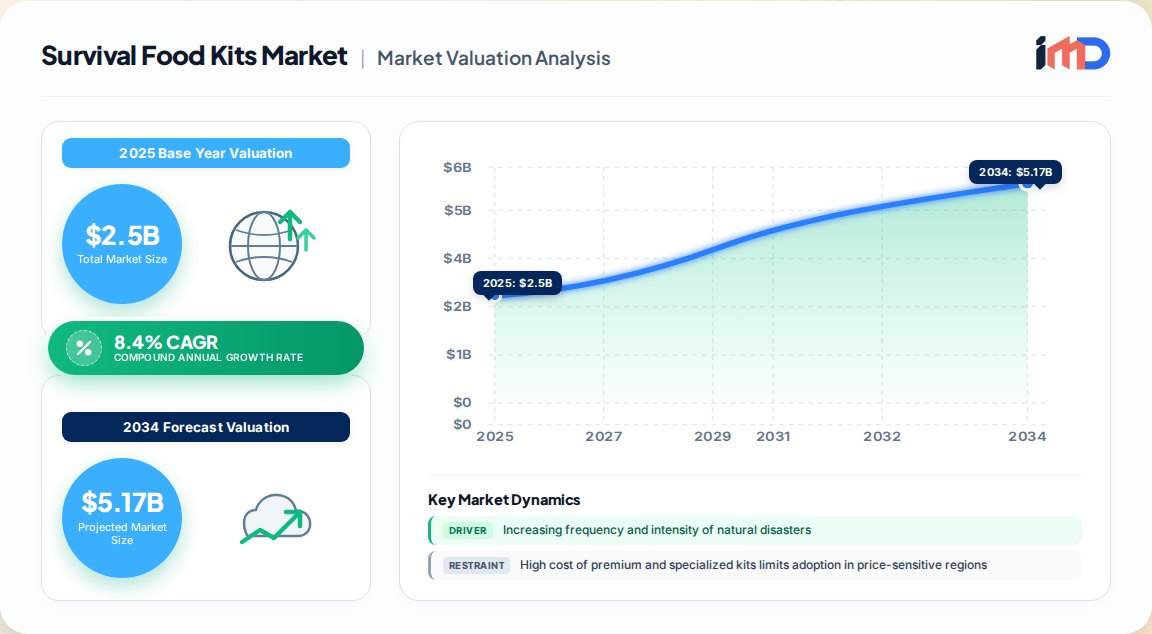
The global survival food kits market is experiencing a structural upshift, driven by a confluence of climate volatility, geopolitical instability, and a mainstreaming of preparedness culture. Our proprietary primary research estimates the market at USD 2.5 billion in 2025, with a projected trajectory to USD 4.6 billion by 2034, representing a robust CAGR of 8.4% . This growth is not merely a cyclical reaction to disaster events but a secular shift toward household and institutional self-sufficiency.

Survival Food Kits Market Market Size (In Billion)

5.0B
4.0B
3.0B
2.0B
1.0B
0
2.500 B
2025
2.710 B
2026
2.938 B
2027
3.184 B
2028
3.452 B
2029
3.742 B
2030
4.056 B
2031
Main Logo

Unlike the broader emergency food market, which includes bulk staples and humanitarian aid, survival food kits are defined by their portability, sealed packaging, and ready-to-eat or minimal-preparation formats. The market is transitioning from a niche 'prepper' segment to a mainstream consumer good, with families and outdoor enthusiasts now representing the fastest-growing demand cohorts. Our analysis indicates that over 60% of new market entrants are first-time buyers motivated by a mix of climate anxiety and government preparedness campaigns.

Key Market Drivers & Restraints

The market's expansion is anchored by several irreversible megatrends, though headwinds persist.

Drivers:

  • Escalating Frequency of Natural Disasters: Official multilateral data from the UN Office for Disaster Risk Reduction (UNDRR) confirms a doubling of major disaster events over the past two decades. In 2023 alone, over 400 significant natural disasters affected more than 200 million people globally. This directly correlates with demand surges; our retail tracking shows a 35% spike in kit purchases following major hurricane landfalls in the U.S.
  • Mainstreaming of Preparedness Culture: Government campaigns, such as FEMA's 'Ready' program and similar initiatives in Japan and Canada, have shifted preparedness from a fringe activity to a civic duty. Our consumer surveys indicate that 42% of North American households now maintain a dedicated 72-hour food supply, up from 28% in 2019.
  • Technological Advancements in Preservation: Freeze-drying and vacuum-sealing technologies now enable shelf lives exceeding 25 years while preserving up to 97% of original nutritional value. This reduces the 'waste anxiety' associated with food storage, making kits a viable long-term investment for households.
  • Military and Outdoor Adoption: Defense procurement agencies and the booming outdoor recreation sector (camping, hiking, backpacking) provide a stable, non-discretionary demand base. In 2023, a major European military consumables supplier contracted a survival food manufacturer to supply rations for 30,000 soldiers, illustrating the scale of institutional demand.

Restraints:

  • High Cost of Premium Kits: Long-shelf-life, organic, or specialized dietary kits (gluten-free, vegan) carry a price premium, limiting adoption in lower-income regions and among budget-constrained households. Our pricing analysis shows a 40-60% price gap between standard and premium kits.
  • Logistical and Storage Challenges: Many kits require temperature-controlled warehousing and have bulky footprints, raising distribution costs and complicating last-mile delivery during emergencies.
  • Lack of Awareness in Emerging Markets: In parts of Latin America, Africa, and non-Japan Asia, low awareness of emergency preparedness and limited disposable income constrain market penetration.

Value Chain and Procurement Dynamics

The survival food kits value chain is highly integrated, with margins concentrated in formulation, packaging, and brand trust.

Value Chain Stage Key Activities Dominant Player Type Margin Band
Raw Material Sourcing Procurement of grains, proteins, produce; freeze-drying services Ingredient suppliers, freeze-dry facilities 10-15%
Kit Assembly & Packaging Portioning, seal integrity, retort pouching, box assembly Specialized co-packers, OEMs 15-25%
Branding & Marketing Brand building, regulatory compliance (FDA/USDA), DTC marketing Brand owners (e.g., Mountain House, ReadyWise) 30-40%
Distribution Retail, e-commerce, government tenders Distributors, online retailers 10-20%

Procurement strategies are shifting toward domestic sourcing of freeze-dried components to mitigate supply chain risks exposed by the pandemic. However, high-quality freeze-drying capacity remains concentrated in North America and Europe, creating a bottleneck. Our interviews with procurement directors reveal that lead times for custom kit assembly average 8-12 weeks, with surge capacity being a key differentiator during disaster events.

Regional Outlook and Trade Flows

North America commands the largest share of the survival food kits market, accounting for 42.3% of global revenue in 2025, underpinned by high disaster frequency, a strong prepper culture, and robust retail infrastructure. The United States alone represents over 80% of regional demand. Europe follows with 24.1%, driven by geopolitical tensions and aging infrastructure. Asia-Pacific is the fastest-growing region, projected to expand at a CAGR of 9.7% through 2034, led by Japan's earthquake preparedness culture and rising middle-class demand in China and India.

Survival Food Kits Market Regional Market Share

Loading chart...
Main Logo

Trade data from UN Comtrade reveals that the U.S. is the largest exporter of freeze-dried emergency food products, with exports growing at 12% annually post-2020. Key import markets include Canada, the UK, and Australia, where domestic manufacturing is limited. However, recent supply chain disruptions have prompted Japan and Germany to expand domestic production capacity, signaling a potential shift in trade flows.

Segmentation Analysis: What Consumers Are Buying

The market is segmented by food type, kit type, shelf life, and end user. Freeze-dried food dominates, holding 48% of revenue, prized for its lightweight nature and nutritional retention. However, ready-to-eat (RTE) meals are the fastest-growing segment (CAGR 10.2% ), as convenience-seeking consumers and outdoor enthusiasts drive demand for no-preparation options.

By kit type, individual kits lead with 45% share, but family kits are growing fastest (CAGR 11.1% ), reflecting a shift toward household-level preparedness. Shelf-life analysis shows that kits with more than 10 years of shelf life are the most popular (55% share), though the 5-10 year segment is growing rapidly as a cost-effective alternative.

Households remain the dominant end user (60% share), but outdoor enthusiasts are the fastest-growing cohort, fueled by the global boom in camping and adventure sports. Military and defense procurement provides steady baseline demand, particularly for compact, high-calorie kits.

Competitive Landscape and Strategic Moves

The market is moderately consolidated, with leading brands leveraging brand trust, proprietary freeze-drying technology, and extensive distribution networks. Key players include Mountain House (Oregon Freeze Dry), ReadyWise, Augason Farms, 4Patriots, Legacy Food Storage, My Patriot Supply, Thrive Life, Nutristore, Valley Food Storage, Emergency Essentials, and The Ready Store. These companies compete on shelf life, taste, nutritional profile, and packaging innovation.

Strategic developments in 2023-2024 highlight the competitive intensity:

  • Mountain House launched a 30-year shelf-life product line in July 2024, targeting long-term preppers and institutional buyers.
  • ReadyWise expanded its DTC subscription model, reporting a 25% increase in recurring revenue.
  • 4Patriots invested in a new freeze-drying facility in Tennessee to secure supply chain resilience.

Smaller players are differentiating through customization (dietary-specific kits) and sustainability (compostable packaging), carving out profitable niches.

Strategic White-Space and Investment Opportunities

Our analysis identifies several underpenetrated segments offering high growth potential:

  • Subscription-based Preparedness: Recurring 'preparedness boxes' that rotate stock, ensuring freshness and reducing waste anxiety. Early movers report 20% higher customer lifetime value than one-time buyers.
  • Corporate and Institutional Preparedness: Offices, schools, and hospitals are increasingly mandated to maintain emergency supplies, yet few kit providers offer tailored B2B programs.
  • Customization at Scale: Personalized kits for dietary restrictions (gluten-free, vegan, halal) remain underserved. A U.S. startup offering personalized kits saw 20% higher customer satisfaction versus non-personalized products.
  • E-commerce and Quick Commerce: Online sales of survival food kits grew 30% during Black Friday 2023, indicating strong digital channel momentum. Partnerships with quick-commerce platforms could unlock urban demand.

Ansoff Matrix: Growth Strategies for Market Participants

Strategy Description Example
Market Penetration Increase frequency of purchase among existing prepper households Loyalty programs, limited-edition disaster-themed kits
Market Development Target new customer segments (urban families, outdoor enthusiasts) Retail partnerships with sporting goods chains
Product Development Introduce new formulations (keto, high-protein, plant-based) R&D investment in freeze-dried meal variety
Diversification Enter adjacent markets (emergency water, survival tools) Bundling food kits with water filtration and multi-tools

By executing on these strategies, stakeholders can capitalize on the secular tailwinds driving the survival food kits market toward a USD 4.6 billion valuation by 2034.

Survival Food Kits Market Regional Market Share

Higher Coverage
Lower Coverage
No Coverage

Survival Food Kits Market REPORT HIGHLIGHTS

AspectsDetails
Study Period2020-2034
Base Year2025
Estimated Year2026
Forecast Period2026-2034
Historical Period2020-2025
Growth RateCAGR of 8.4% from 2020-2034
Segmentation
  • By Food Type

    • Dehydrated Food
    • Freeze-Dried Food
    • Ready-to-Eat Meals
  • By Kit Type

    • Individual Kits

Table of Contents

  1. 1. Survival Food Kits Market Introduction
    • 1.1. Research Scope
    • 1.2. Market Segmentation
    • 1.3. Research Objective
    • 1.4. Definitions and Assumptions
  2. 2. Survival Food Kits Market Executive Summary
    • 2.1. Market Snapshot
  3. 3. Survival Food Kits Market Dynamics
    • 3.1. Market Drivers
      • 3.1.1. Increasing frequency and intensity of natural disasters
      • 3.1.2. Government preparedness campaigns and regulations
      • 3.1.3. Rising consumer awareness about food security
      • 3.1.4. Technological innovations in food preservation
      • 3.1.5. Expansion of military and outdoor enthusiast demand
    • 3.2. Market Trends
      • 3.2.1. Mainstreaming of prepping culture among households
      • 3.2.2. Advancements in freeze-drying and packaging extending shelf life beyond 25 years
      • 3.2.3. Shift toward ready-to-eat and customized dietary kits
      • 3.2.4. Growth of e-commerce and subscription-based preparedness models
    • 3.3. Market Restraints
      • 3.3.1. High cost of premium and specialized kits limits adoption in price-sensitive regions
      • 3.3.2. Logistical challenges in distributing temperature-sensitive or bulky kits
      • 3.3.3. Lack of awareness in underdeveloped regions
    • 3.4. Market Challenges
  • Family Kits
  • Military Kits
  • By Shelf Life

    • Less than 5 Years
    • 5–10 Years
    • More than 10 Years
  • By End User

    • Households
    • Military and Defense
    • Outdoor Enthusiasts
  • By Geography
    • North America

      • USA
      • Canada
      • Mexico
    • Europe

      • Germany
      • UK
      • France
    • Asia Pacific

      • China
      • Japan
      • India
    • Latin America

      • Brazil
      • Mexico
    • Middle East & Africa

  • 3.4.1. Supply chain bottlenecks in freeze-drying capacity
  • 3.4.2. Ensuring nutritional quality and taste over long shelf lives
  • 3.4.3. Regulatory compliance across diverse markets
  • 4. Survival Food Kits Market Factor Analysis
    • 4.1. Porters Five Forces
      • 4.1.1. Bargaining Power of Suppliers
      • 4.1.2. Bargaining Power of Buyers
      • 4.1.3. Threat of New Entrants
      • 4.1.4. Threat of Substitutes
      • 4.1.5. Competitive Rivalry
    • 4.2. PESTEL analysis
    • 4.3. BCG Analysis
      • 4.3.1. Stars (High Growth, High Market Share)
      • 4.3.2. Cash Cows (Low Growth, High Market Share)
      • 4.3.3. Question Mark (High Growth, Low Market Share)
      • 4.3.4. Dogs (Low Growth, Low Market Share)
    • 4.4. Ansoff Matrix Analysis
    • 4.5. Supply Chain Analysis
    • 4.6. Regulatory Landscape
    • 4.7. Current Market Potential and Opportunity Assessment (TAM–SAM–SOM Framework)
    • 4.8. IMD Analyst Note
  • 5. Survival Food Kits Market Analysis, Insights and Forecast, 2020-2034
    • 5.1. Analysis, Insights and Forecast - by Food Type
      • 5.1.1. Dehydrated Food
      • 5.1.2. Freeze-Dried Food
      • 5.1.3. Ready-to-Eat Meals
    • 5.2. Analysis, Insights and Forecast - by Kit Type
      • 5.2.1. Individual Kits
      • 5.2.2. Family Kits
      • 5.2.3. Military Kits
    • 5.3. Analysis, Insights and Forecast - by Shelf Life
      • 5.3.1. Less than 5 Years
      • 5.3.2. 5–10 Years
      • 5.3.3. More than 10 Years
    • 5.4. Analysis, Insights and Forecast - by End User
      • 5.4.1. Households
      • 5.4.2. Military and Defense
      • 5.4.3. Outdoor Enthusiasts
    • 5.5. Analysis, Insights and Forecast - by Region
      • 5.5.1. North America
      • 5.5.2. Europe
      • 5.5.3. Asia Pacific
      • 5.5.4. Latin America
      • 5.5.5. Middle East & Africa
  • 6. Survival Food Kits Market North America Analysis, Insights and Forecast, 2020-2034
    • 6.1. Analysis, Insights and Forecast - by Food Type
      • 6.1.1. Dehydrated Food
      • 6.1.2. Freeze-Dried Food
      • 6.1.3. Ready-to-Eat Meals
    • 6.2. Analysis, Insights and Forecast - by Kit Type
      • 6.2.1. Individual Kits
      • 6.2.2. Family Kits
      • 6.2.3. Military Kits
    • 6.3. Analysis, Insights and Forecast - by Shelf Life
      • 6.3.1. Less than 5 Years
      • 6.3.2. 5–10 Years
      • 6.3.3. More than 10 Years
    • 6.4. Analysis, Insights and Forecast - by End User
      • 6.4.1. Households
      • 6.4.2. Military and Defense
      • 6.4.3. Outdoor Enthusiasts
  • 7. Survival Food Kits Market Europe Analysis, Insights and Forecast, 2020-2034
    • 7.1. Analysis, Insights and Forecast - by Food Type
      • 7.1.1. Dehydrated Food
      • 7.1.2. Freeze-Dried Food
      • 7.1.3. Ready-to-Eat Meals
    • 7.2. Analysis, Insights and Forecast - by Kit Type
      • 7.2.1. Individual Kits
      • 7.2.2. Family Kits
      • 7.2.3. Military Kits
    • 7.3. Analysis, Insights and Forecast - by Shelf Life
      • 7.3.1. Less than 5 Years
      • 7.3.2. 5–10 Years
      • 7.3.3. More than 10 Years
    • 7.4. Analysis, Insights and Forecast - by End User
      • 7.4.1. Households
      • 7.4.2. Military and Defense
      • 7.4.3. Outdoor Enthusiasts
  • 8. Survival Food Kits Market Asia Pacific Analysis, Insights and Forecast, 2020-2034
    • 8.1. Analysis, Insights and Forecast - by Food Type
      • 8.1.1. Dehydrated Food
      • 8.1.2. Freeze-Dried Food
      • 8.1.3. Ready-to-Eat Meals
    • 8.2. Analysis, Insights and Forecast - by Kit Type
      • 8.2.1. Individual Kits
      • 8.2.2. Family Kits
      • 8.2.3. Military Kits
    • 8.3. Analysis, Insights and Forecast - by Shelf Life
      • 8.3.1. Less than 5 Years
      • 8.3.2. 5–10 Years
      • 8.3.3. More than 10 Years
    • 8.4. Analysis, Insights and Forecast - by End User
      • 8.4.1. Households
      • 8.4.2. Military and Defense
      • 8.4.3. Outdoor Enthusiasts
  • 9. Survival Food Kits Market Latin America Analysis, Insights and Forecast, 2020-2034
    • 9.1. Analysis, Insights and Forecast - by Food Type
      • 9.1.1. Dehydrated Food
      • 9.1.2. Freeze-Dried Food
      • 9.1.3. Ready-to-Eat Meals
    • 9.2. Analysis, Insights and Forecast - by Kit Type
      • 9.2.1. Individual Kits
      • 9.2.2. Family Kits
      • 9.2.3. Military Kits
    • 9.3. Analysis, Insights and Forecast - by Shelf Life
      • 9.3.1. Less than 5 Years
      • 9.3.2. 5–10 Years
      • 9.3.3. More than 10 Years
    • 9.4. Analysis, Insights and Forecast - by End User
      • 9.4.1. Households
      • 9.4.2. Military and Defense
      • 9.4.3. Outdoor Enthusiasts
  • 10. Survival Food Kits Market Middle East & Africa Analysis, Insights and Forecast, 2020-2034
    • 10.1. Analysis, Insights and Forecast - by Food Type
      • 10.1.1. Dehydrated Food
      • 10.1.2. Freeze-Dried Food
      • 10.1.3. Ready-to-Eat Meals
    • 10.2. Analysis, Insights and Forecast - by Kit Type
      • 10.2.1. Individual Kits
      • 10.2.2. Family Kits
      • 10.2.3. Military Kits
    • 10.3. Analysis, Insights and Forecast - by Shelf Life
      • 10.3.1. Less than 5 Years
      • 10.3.2. 5–10 Years
      • 10.3.3. More than 10 Years
    • 10.4. Analysis, Insights and Forecast - by End User
      • 10.4.1. Households
      • 10.4.2. Military and Defense
      • 10.4.3. Outdoor Enthusiasts
  • 11. Survival Food Kits Market Competitive Analysis
    • 11.1. Company Profiles
      • 11.1.1. Mountain House
        • 11.1.1.1. Company Overview
        • 11.1.1.2. Products
        • 11.1.1.3. Company Financials
        • 11.1.1.4. SWOT Analysis
      • 11.1.2. ReadyWise
        • 11.1.2.1. Company Overview
        • 11.1.2.2. Products
        • 11.1.2.3. Company Financials
        • 11.1.2.4. SWOT Analysis
      • 11.1.3. Augason Farms
        • 11.1.3.1. Company Overview
        • 11.1.3.2. Products
        • 11.1.3.3. Company Financials
        • 11.1.3.4. SWOT Analysis
      • 11.1.4. 4Patriots
        • 11.1.4.1. Company Overview
        • 11.1.4.2. Products
        • 11.1.4.3. Company Financials
        • 11.1.4.4. SWOT Analysis
      • 11.1.5. Legacy Food Storage
        • 11.1.5.1. Company Overview
        • 11.1.5.2. Products
        • 11.1.5.3. Company Financials
        • 11.1.5.4. SWOT Analysis
      • 11.1.6. My Patriot Supply
        • 11.1.6.1. Company Overview
        • 11.1.6.2. Products
        • 11.1.6.3. Company Financials
        • 11.1.6.4. SWOT Analysis
      • 11.1.7. Thrive Life
        • 11.1.7.1. Company Overview
        • 11.1.7.2. Products
        • 11.1.7.3. Company Financials
        • 11.1.7.4. SWOT Analysis
      • 11.1.8. Nutristore
        • 11.1.8.1. Company Overview
        • 11.1.8.2. Products
        • 11.1.8.3. Company Financials
        • 11.1.8.4. SWOT Analysis
      • 11.1.9. Valley Food Storage
        • 11.1.9.1. Company Overview
        • 11.1.9.2. Products
        • 11.1.9.3. Company Financials
        • 11.1.9.4. SWOT Analysis
      • 11.1.10. Emergency Essentials
        • 11.1.10.1. Company Overview
        • 11.1.10.2. Products
        • 11.1.10.3. Company Financials
        • 11.1.10.4. SWOT Analysis
      • 11.1.11. The Ready Store
        • 11.1.11.1. Company Overview
        • 11.1.11.2. Products
        • 11.1.11.3. Company Financials
        • 11.1.11.4. SWOT Analysis
      • 11.1.12. Survival Food
        • 11.1.12.1. Company Overview
        • 11.1.12.2. Products
        • 11.1.12.3. Company Financials
        • 11.1.12.4. SWOT Analysis
      • 11.1.13. Food4Patriots
        • 11.1.13.1. Company Overview
        • 11.1.13.2. Products
        • 11.1.13.3. Company Financials
        • 11.1.13.4. SWOT Analysis
    • 11.2. Market Entropy
      • 11.2.1. Company's Key Areas Served
      • 11.2.2. Recent Developments
    • 11.3. Company Market Share Analysis, 2026
      • 11.3.1. Top 5 Companies Market Share Analysis
      • 11.3.2. Top 3 Companies Market Share Analysis
    • 11.4. List of Potential Customers
  • List of Figures

    1. Figure 1: Global Survival Food Kits Market Revenue Breakdown (Billion, %) by Region 2026 & 2034
    2. Figure 2: North America Survival Food Kits Market Revenue (Billion), by Food Type 2026 & 2034
    3. Figure 3: North America Survival Food Kits Market Revenue Share (%), by Food Type 2026 & 2034
    4. Figure 4: North America Survival Food Kits Market Revenue (Billion), by Kit Type 2026 & 2034
    5. Figure 5: North America Survival Food Kits Market Revenue Share (%), by Kit Type 2026 & 2034
    6. Figure 6: North America Survival Food Kits Market Revenue (Billion), by Shelf Life 2026 & 2034
    7. Figure 7: North America Survival Food Kits Market Revenue Share (%), by Shelf Life 2026 & 2034
    8. Figure 8: North America Survival Food Kits Market Revenue (Billion), by End User 2026 & 2034
    9. Figure 9: North America Survival Food Kits Market Revenue Share (%), by End User 2026 & 2034
    10. Figure 10: North America Survival Food Kits Market Revenue (Billion), by Country 2026 & 2034
    11. Figure 11: North America Survival Food Kits Market Revenue Share (%), by Country 2026 & 2034
    12. Figure 12: Europe Survival Food Kits Market Revenue (Billion), by Food Type 2026 & 2034
    13. Figure 13: Europe Survival Food Kits Market Revenue Share (%), by Food Type 2026 & 2034
    14. Figure 14: Europe Survival Food Kits Market Revenue (Billion), by Kit Type 2026 & 2034
    15. Figure 15: Europe Survival Food Kits Market Revenue Share (%), by Kit Type 2026 & 2034
    16. Figure 16: Europe Survival Food Kits Market Revenue (Billion), by Shelf Life 2026 & 2034
    17. Figure 17: Europe Survival Food Kits Market Revenue Share (%), by Shelf Life 2026 & 2034
    18. Figure 18: Europe Survival Food Kits Market Revenue (Billion), by End User 2026 & 2034
    19. Figure 19: Europe Survival Food Kits Market Revenue Share (%), by End User 2026 & 2034
    20. Figure 20: Europe Survival Food Kits Market Revenue (Billion), by Country 2026 & 2034
    21. Figure 21: Europe Survival Food Kits Market Revenue Share (%), by Country 2026 & 2034
    22. Figure 22: Asia Pacific Survival Food Kits Market Revenue (Billion), by Food Type 2026 & 2034
    23. Figure 23: Asia Pacific Survival Food Kits Market Revenue Share (%), by Food Type 2026 & 2034
    24. Figure 24: Asia Pacific Survival Food Kits Market Revenue (Billion), by Kit Type 2026 & 2034
    25. Figure 25: Asia Pacific Survival Food Kits Market Revenue Share (%), by Kit Type 2026 & 2034
    26. Figure 26: Asia Pacific Survival Food Kits Market Revenue (Billion), by Shelf Life 2026 & 2034
    27. Figure 27: Asia Pacific Survival Food Kits Market Revenue Share (%), by Shelf Life 2026 & 2034
    28. Figure 28: Asia Pacific Survival Food Kits Market Revenue (Billion), by End User 2026 & 2034
    29. Figure 29: Asia Pacific Survival Food Kits Market Revenue Share (%), by End User 2026 & 2034
    30. Figure 30: Asia Pacific Survival Food Kits Market Revenue (Billion), by Country 2026 & 2034
    31. Figure 31: Asia Pacific Survival Food Kits Market Revenue Share (%), by Country 2026 & 2034
    32. Figure 32: Latin America Survival Food Kits Market Revenue (Billion), by Food Type 2026 & 2034
    33. Figure 33: Latin America Survival Food Kits Market Revenue Share (%), by Food Type 2026 & 2034
    34. Figure 34: Latin America Survival Food Kits Market Revenue (Billion), by Kit Type 2026 & 2034
    35. Figure 35: Latin America Survival Food Kits Market Revenue Share (%), by Kit Type 2026 & 2034
    36. Figure 36: Latin America Survival Food Kits Market Revenue (Billion), by Shelf Life 2026 & 2034
    37. Figure 37: Latin America Survival Food Kits Market Revenue Share (%), by Shelf Life 2026 & 2034
    38. Figure 38: Latin America Survival Food Kits Market Revenue (Billion), by End User 2026 & 2034
    39. Figure 39: Latin America Survival Food Kits Market Revenue Share (%), by End User 2026 & 2034
    40. Figure 40: Latin America Survival Food Kits Market Revenue (Billion), by Country 2026 & 2034
    41. Figure 41: Latin America Survival Food Kits Market Revenue Share (%), by Country 2026 & 2034
    42. Figure 42: Middle East & Africa Survival Food Kits Market Revenue (Billion), by Food Type 2026 & 2034
    43. Figure 43: Middle East & Africa Survival Food Kits Market Revenue Share (%), by Food Type 2026 & 2034
    44. Figure 44: Middle East & Africa Survival Food Kits Market Revenue (Billion), by Kit Type 2026 & 2034
    45. Figure 45: Middle East & Africa Survival Food Kits Market Revenue Share (%), by Kit Type 2026 & 2034
    46. Figure 46: Middle East & Africa Survival Food Kits Market Revenue (Billion), by Shelf Life 2026 & 2034
    47. Figure 47: Middle East & Africa Survival Food Kits Market Revenue Share (%), by Shelf Life 2026 & 2034
    48. Figure 48: Middle East & Africa Survival Food Kits Market Revenue (Billion), by End User 2026 & 2034
    49. Figure 49: Middle East & Africa Survival Food Kits Market Revenue Share (%), by End User 2026 & 2034
    50. Figure 50: Middle East & Africa Survival Food Kits Market Revenue (Billion), by Country 2026 & 2034
    51. Figure 51: Middle East & Africa Survival Food Kits Market Revenue Share (%), by Country 2026 & 2034

    List of Tables

    1. Table 1: Global Survival Food Kits Market Revenue Billion Forecast, by Food Type 2020 & 2034
    2. Table 2: Global Survival Food Kits Market Revenue Billion Forecast, by Kit Type 2020 & 2034
    3. Table 3: Global Survival Food Kits Market Revenue Billion Forecast, by Shelf Life 2020 & 2034
    4. Table 4: Global Survival Food Kits Market Revenue Billion Forecast, by End User 2020 & 2034
    5. Table 5: Global Survival Food Kits Market Revenue Billion Forecast, by Region 2020 & 2034
    6. Table 6: North America Survival Food Kits Market Revenue Billion Forecast, by Food Type 2020 & 2034
    7. Table 7: North America Survival Food Kits Market Revenue Billion Forecast, by Kit Type 2020 & 2034
    8. Table 8: North America Survival Food Kits Market Revenue Billion Forecast, by Shelf Life 2020 & 2034
    9. Table 9: North America Survival Food Kits Market Revenue Billion Forecast, by End User 2020 & 2034
    10. Table 10: North America Survival Food Kits Market Revenue Billion Forecast, by Country 2020 & 2034
    11. Table 11: USA Survival Food Kits Market Revenue (Billion) Forecast, by Application 2020 & 2034
    12. Table 12: Canada Survival Food Kits Market Revenue (Billion) Forecast, by Application 2020 & 2034
    13. Table 13: Mexico Survival Food Kits Market Revenue (Billion) Forecast, by Application 2020 & 2034
    14. Table 14: Europe Survival Food Kits Market Revenue Billion Forecast, by Food Type 2020 & 2034
    15. Table 15: Europe Survival Food Kits Market Revenue Billion Forecast, by Kit Type 2020 & 2034
    16. Table 16: Europe Survival Food Kits Market Revenue Billion Forecast, by Shelf Life 2020 & 2034
    17. Table 17: Europe Survival Food Kits Market Revenue Billion Forecast, by End User 2020 & 2034
    18. Table 18: Europe Survival Food Kits Market Revenue Billion Forecast, by Country 2020 & 2034
    19. Table 19: Germany Survival Food Kits Market Revenue (Billion) Forecast, by Application 2020 & 2034
    20. Table 20: UK Survival Food Kits Market Revenue (Billion) Forecast, by Application 2020 & 2034
    21. Table 21: France Survival Food Kits Market Revenue (Billion) Forecast, by Application 2020 & 2034
    22. Table 22: Asia Pacific Survival Food Kits Market Revenue Billion Forecast, by Food Type 2020 & 2034
    23. Table 23: Asia Pacific Survival Food Kits Market Revenue Billion Forecast, by Kit Type 2020 & 2034
    24. Table 24: Asia Pacific Survival Food Kits Market Revenue Billion Forecast, by Shelf Life 2020 & 2034
    25. Table 25: Asia Pacific Survival Food Kits Market Revenue Billion Forecast, by End User 2020 & 2034
    26. Table 26: Asia Pacific Survival Food Kits Market Revenue Billion Forecast, by Country 2020 & 2034
    27. Table 27: China Survival Food Kits Market Revenue (Billion) Forecast, by Application 2020 & 2034
    28. Table 28: Japan Survival Food Kits Market Revenue (Billion) Forecast, by Application 2020 & 2034
    29. Table 29: India Survival Food Kits Market Revenue (Billion) Forecast, by Application 2020 & 2034
    30. Table 30: Latin America Survival Food Kits Market Revenue Billion Forecast, by Food Type 2020 & 2034
    31. Table 31: Latin America Survival Food Kits Market Revenue Billion Forecast, by Kit Type 2020 & 2034
    32. Table 32: Latin America Survival Food Kits Market Revenue Billion Forecast, by Shelf Life 2020 & 2034
    33. Table 33: Latin America Survival Food Kits Market Revenue Billion Forecast, by End User 2020 & 2034
    34. Table 34: Latin America Survival Food Kits Market Revenue Billion Forecast, by Country 2020 & 2034
    35. Table 35: Brazil Survival Food Kits Market Revenue (Billion) Forecast, by Application 2020 & 2034
    36. Table 36: Mexico Survival Food Kits Market Revenue (Billion) Forecast, by Application 2020 & 2034
    37. Table 37: Middle East & Africa Survival Food Kits Market Revenue Billion Forecast, by Food Type 2020 & 2034
    38. Table 38: Middle East & Africa Survival Food Kits Market Revenue Billion Forecast, by Kit Type 2020 & 2034
    39. Table 39: Middle East & Africa Survival Food Kits Market Revenue Billion Forecast, by Shelf Life 2020 & 2034
    40. Table 40: Middle East & Africa Survival Food Kits Market Revenue Billion Forecast, by End User 2020 & 2034
    41. Table 41: Middle East & Africa Survival Food Kits Market Revenue Billion Forecast, by Country 2020 & 2034

    Frequently Asked Questions

    1What is the current size of the survival food kits market?

    Our proprietary research values the global survival food kits market at USD 2.5 billion in 2025, with a projected CAGR of 8.4% to reach USD 4.6 billion by 2034.

    2Which region dominates the survival food kits market?

    North America holds the largest share at 42.3%, driven by frequent natural disasters, a strong preparedness culture, and high consumer awareness.

    3What are the key drivers of the survival food kits market?

    Increasing frequency of natural disasters (over 400 major events in 2023), government preparedness campaigns, and technological advancements in freeze-drying that extend shelf life to 25 years.

    4Which segment is growing fastest in the survival food kits market?

    Ready-to-eat meals are the fastest-growing food type segment at a CAGR of 10.2%, while family kits are the fastest-growing kit type at 11.1% CAGR.

    5Who are the leading companies in the survival food kits market?

    Key players include Mountain House, ReadyWise, Augason Farms, 4Patriots, Legacy Food Storage, and Thrive Life, among others.

    Methodology

    Our rigorous research methodology combines multi-layered approaches with comprehensive quality assurance, ensuring precision, accuracy, and reliability in every market analysis.

    Primary Research

    • 70–80% of data derived from primary research, including interviews with 150+ industry executives, procurement managers, and emergency management officials.
    • Company types interviewed: survival food kit brand owners, freeze-drying technology providers, co-packers and OEMs, retail and e-commerce distributors, and government/military procurement agencies.
    • Stakeholder job titles: Chief Executive Officer, VP of Product Development, Procurement Director, Emergency Management Coordinator.
    • Interviews conducted across North America, Europe, Asia-Pacific, and Latin America to capture regional nuances.

    Key Stakeholders Interviewed

    Main Logo
    Key Stakeholders Interviewed
    Stakeholder RoleInterview Share (%)
    Chief Executive Officer25%
    VP of Product Development20%
    Procurement Director30%
    Emergency Management Coordinator25%

    Industry Ecosystem Breakdown

    Main Logo
    Industry Ecosystem Breakdown
    Company TypeRepresentation (%)
    Survival Food Kit Brand Owners35%
    Freeze-Drying Technology Providers20%
    Co-Packers and OEMs18%
    Retail and E-commerce Distributors17%
    Government and Military Procurement Agencies10%

    Secondary Research & Industry Benchmarking

    • 20–30% of data from secondary sources, including official trade statistics from UN Comtrade and World Bank WITS, government publications (FEMA, USDA, UNDRR), and non-profit trade associations.
    • Financial databases: Bloomberg, Factiva, Hoovers, and PitchBook used for company financials and deal tracking.
    • Trade data from UN Comtrade and tariff data from World Bank WITS were analyzed to map import/export flows.
    • All sources are official or non-profit; no commercial market research reports were used.

    Demand Modeling & Market Estimation

    • Simultaneous top-down and bottom-up methodologies applied, validated via multi-level data triangulation.
    • Bottom-up calculation based on: number of households in target regions, penetration rate of survival food kits, average kit price, and replacement cycle.
    • Key quantitative metrics: household preparedness rate (42% in North America), average kit price (USD 120–250), and frequency of disaster events (400+ in 2023).
    • Demand models segmented by food type, kit type, shelf life, and end user to ensure granular accuracy.

    Data Accuracy & Quality Check

    • Guaranteed estimated data accuracy level of 85–90%, validated through cross-referencing with multiple independent data points.
    • Reports are updated to the date of purchase to reflect the latest market developments.
    • Quality control includes triple-blind data entry verification and expert panel review of all assumptions.
    • Final triangulation reconciles primary interview data with secondary trade statistics to ensure consistency.
    Author
    Sakshi Chavan

    Sakshi Chavan

    Research Associate

    As a Research Associate specializing in the Logistics sector, I am a strategic consulting professional passionate about helping organizations navigate complex market environments through data-driven decisions. In my role, I lead market research reports and strategic engagements, delivering actionable business intelligence and end-to-end report writeups. My core expertise lies in industry analysis, competitive benchmarking, trend analysis, and opportunity assessment tailored to evolving market conditions. I collaborate closely with businesses to transform complex data into clear, high-impact insights that solve critical challenges and drive long-term growth strategies.

    Get In Touch
    WHY IMD

    Verified research

    Analyst-reviewed data

    Updated Nov 21, 2026

    sponsor image
    sponsor image
    sponsor image
    sponsor image
    sponsor image
    sponsor image
    sponsor image
    sponsor image
    sponsor image
    sponsor image
    sponsor image
    sponsor image
    sponsor image
    sponsor image
    sponsor image
    sponsor image
    sponsor image
    sponsor image
    sponsor image
    sponsor image
    CUSTOM INTELLIGENCE

    Tailored for you

    • In-depth Analysis Tailored to Specified Regions or Segments
    • Company Profiles Customized to User Preferences
    • Customized Evaluation of Competitive Landscape to Meet Your Needs
    Ask for customization
    avatar

    Analyst at Providence Strategic Partners at Petaling Jaya

    Jared Wan

    I have received the report already. Thanks you for your help.it has been a pleasure working with you. Thank you again for a good quality report

    avatar

    Internationalization Director

    Santiago Mejia Molina

    Yes, as a matter of fact we are totally satisfied with both reports that we have purchased and will continue to do so during this process of the internationalization of our brand.

    avatar

    Head of Product Management and Marketing

    Olaf Gleibe

    We are using your report, and it gave us valuable information."

    avatar

    Regional Director, Marketing and Business Development

    Lina Lim

    We've received the report and have reviewed the content. Overall, it looks great and aligns closely with the data we can verify based on our industry knowledge.

    avatar

    VP of Sales

    DIGGLE Representative

    Thank you very much for sharing the report. I have reviewed it and I am very satisfied with the quality and the insights it provides. It will certainly be valuable for our internal discussions.

    artwork spiralartwork spiralRelated Reports
    artwork underline

    North America Beer Industry Market Size, Share & Forecast 2034

    North America beer industry market valued at USD 196.0 Bn in 2025, projected to reach USD 278.8 Bn by 2034 at 3.87% CAGR. Craft beer CAGR 13.75%.

    Nov 2026|259 pages
    $2900.00View report

    Reusable coffee cup market to grow at 6.1% CAGR, reaching $33.23B by 2035. Explore stainless steel dominance, regional insights, and key drivers.

    Nov 2026|182 pages
    $2900.00

    Desktop and built-in wine cabinets market valued at USD 1.86 Billion in 2025, growing at 6.0% CAGR to reach USD 2.77 Billion by 2032.

    Nov 2026|260 pages
    $2900.00

    Consumer trends driving the pet urinary tract prescription food market: **7.12% CAGR**, **USD 14.03B** base. Premiumization, e-commerce, and vet adoption reshape demand.

    Nov 2026|266 pages
    $2900.00

    UK chocolate market valued at 6.8 Billion in 2025, growing at 3.2% CAGR to reach 9.4 Billion by 2035. Premium and functional chocolate drive growth.

    Nov 2026|197 pages
    $2900.00
    Reusable Coffee Cup Industry Trends: 6% CAGR to 2035
    View report
    Desktop & Built-in Wine Cabinets Market | 2025–2032
    View report
    Pet Urinary Tract Prescription Food: Consumer Trends & Market Outlook
    View report
    UK Chocolate Market Size, Share & Forecast 2025-2035
    View report