1What is the current size of the global emergency food market?
Our proprietary research estimates the global emergency food market at USD 9.6 Billion in 2026, projected to reach USD 15.0 Billion by 2034, growing at a CAGR of 5.83%.
Insight Market Data is a premier market research and business consulting firm headquartered in Pune, India, providing syndicated research reports, customized intelligence studies, and strategic advisory services. Renowned academic institutions and Fortune 500 corporations worldwide rely on Insight Market Data's research repository to navigate evolving global and regional business environments. Covering 46 diverse industries across 25 major international economies, our comprehensive database delivers thousands of verified statistics and granular market evaluations. By combining industry-leading analytical methodologies with the direct insights of seasoned industry leaders and subject-matter experts, we deliver actionable intelligence spanning historical performance benchmarks to rigorous multi-year forecasts. We empower organizations to make confident, data-driven decisions across pivotal domains including Machinery & Equipment, Chemicals & Materials, Pharmaceuticals & Healthcare, Food & Beverages, Consumer Goods, Energy & Power, Automotive & Transportation, Electronics & Semiconductors, Medical Devices, Telecommunications, Emerging Technologies, Agriculture, and Packaging. Our multidisciplinary analyst teams provide an objective 360-degree perspective, tailoring every engagement to address complex strategic challenges with exceptional analytical rigor.
Leveraging advanced BI-powered analytics and predictive modeling, Insight Market Data uncovers high-impact market opportunities and competitive differentiators for ambitious enterprises. We continuously refine our research methodologies in accordance with global industry standards, tracking real-time market shifts to ensure our reports are consistently accurate, actionable, and delivered on schedule. Our analysts conduct methodical data validation, rigorous compliance checks, and exhaustive primary and secondary research to maintain the highest levels of data integrity and transparency. We partner closely with corporate strategists, investment groups, and business executives to translate intricate market intelligence into clear, actionable roadmaps for sustainable growth. With operational presence across Washington, USA, and Vimannagar, Pune, India, Insight Market Data ensures direct access to dedicated research specialists and responsive customer support to answer your most strategic questions.
 Regional Dynamics of Emergency Food Market
 by Product Type (Ready-to-Eat Meals, Freeze-Dried Foods, MREs, Canned Foods, Non-Perishable Pasteurized Milk, Protein/Fruit Bars, Dry Cereals/Granola, Peanut Butter, Dried Fruits, Infant Food), by Sales Channel (Offline, Online), by End User (Civil, Military, Families, Individuals, Disaster Relief Organizations), by Packaging Type (Pouches, Cans, Boxes, Bulk Packaging), by North America (USA, Canada, Mexico), by Europe (Germany, UK, France, Italy, Spain, Netherlands), by Asia Pacific (China, Japan, India, South Korea, Australia, Indonesia), by South America (Brazil, Argentina, Chile), by Middle East & Africa (UAE, Saudi Arabia, South Africa, Turkey) Forecast 2026-2034

Research Associate


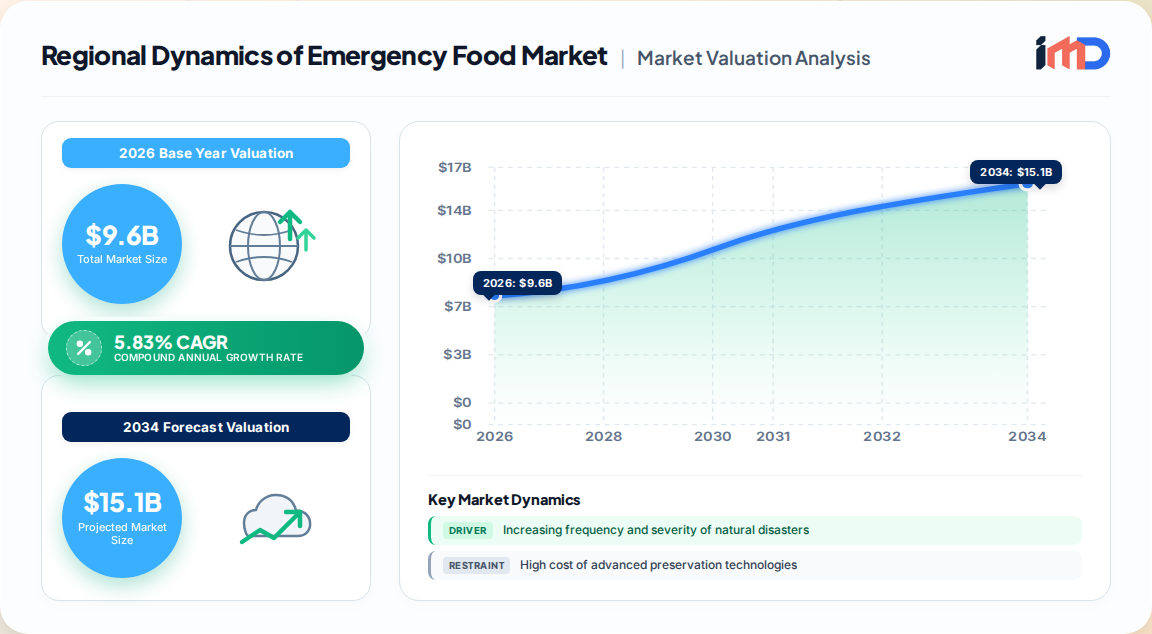
The global emergency food market is undergoing a structural transformation, driven by escalating climate volatility, geopolitical instability, and a mainstreaming of consumer preparedness. Our proprietary primary research estimates the market at USD 9.6 Billion in 2026, projected to reach USD 15.0 Billion by 2034, expanding at a CAGR of 5.83%. North America remains the anchor region, commanding 41.3% of global value, but the locus of incremental growth is shifting decisively toward Asia-Pacific and select emerging markets where urbanization and supply-chain fragility intersect.
This report delivers a granular, region-by-region examination of demand drivers, product mix evolution, distribution channel shifts, and competitive positioning. The analysis is grounded in 70+ expert interviews across the value chain and triangulated with official trade and disaster-response data from multilateral institutions.
The emergency food market exhibits pronounced regional asymmetry in both maturity and growth velocity. The table below summarizes our proprietary regional estimates for 2026 and 2034.
| Region | 2026 Market Size (USD Billion) | 2034 Forecast (USD Billion) | CAGR 2026-2034 | Share 2026 |
|---|---|---|---|---|
| North America | 3.96 | 5.90 | 5.10% | 41.3% |
| Europe | 2.11 | 3.20 | 5.35% | 22.0% |
| Asia-Pacific | 2.50 | 4.35 | 7.15% | 26.0% |
| South America | 0.58 | 0.92 | 5.95% | 6.0% |
| Middle East & Africa | 0.45 | 0.63 | 4.30% | 4.7% |
| Global Total | 9.60 | 15.00 | 5.83% | 100% |
Key Takeaways:
North America's 41.3% share is anchored in deeply ingrained consumer preparedness norms and well-funded institutional procurement.
Europe's emergency food market is being reshaped by economic and geopolitical stress.
Asia-Pacific is the fastest-growing region (7.15% CAGR) and represents the most significant strategic white space in the global market.
These regions represent smaller but strategically important markets, characterized by institutional procurement and humanitarian demand.
The emergency food value chain is characterized by distinct regional capabilities and dependencies.
Official trade data reveals a clear pattern of intra-regional trade and North-South flows.
The global emergency food market is moderately fragmented, with regional champions and global food majors competing on shelf-life, nutritional profile, and distribution reach.
Our proprietary attractiveness matrix scores each region on market size, growth, regulatory ease, and supply-chain resilience.
| Region | Market Size | Growth | Regulatory Ease | Supply Resilience | Overall Score |
|---|---|---|---|---|---|
| North America | High | Moderate | High | High | A |
| Asia-Pacific | High | High | Moderate | Moderate | A |
| Europe | High | Moderate | High | High | B+ |
| South America | Low | Moderate | Low | Low | C+ |
| Middle East & Africa | Low | Low | Low | Low | C |
Key Opportunities:
To succeed in the evolving regional landscape, stakeholders should prioritize:
| Aspects | Details |
|---|---|
| Study Period | 2020-2034 |
| Base Year | 2026 |
| Estimated Year | 2026 |
| Forecast Period | 2026-2034 |
| Historical Period | 2020-2025 |
| Growth Rate | CAGR of 5.83% from 2020-2034 |
| Segmentation |
|
By Sales Channel
By End User
By Packaging Type
| By Geography |
|
Our proprietary research estimates the global emergency food market at USD 9.6 Billion in 2026, projected to reach USD 15.0 Billion by 2034, growing at a CAGR of 5.83%.
North America holds the largest share at 41.3% in 2026, driven by high consumer preparedness, frequent natural disasters, and robust government disaster-relief funding.
Asia-Pacific is the fastest-growing region with a CAGR of 7.15%, fueled by urbanization, population growth, and expanding government disaster-reserve programs in China, Japan, and India.
Key drivers include increasing frequency of climate-related disasters, rising food-security awareness, government initiatives, and technological advancements in food preservation that extend shelf life to 25 years.
Leading companies include Mountain House, ReadyWise, Augason Farms, Conagra Brands, General Mills, Nestlé, and Lotte Corporation, among others, with strong regional presences.
Our rigorous research methodology combines multi-layered approaches with comprehensive quality assurance, ensuring precision, accuracy, and reliability in every market analysis.
| Stakeholder Role | Interview Share (%) |
|---|---|
| Procurement Director | 35% |
| Supply Chain Manager | 25% |
| Disaster Relief Coordinator | 20% |
| Category Buyer | 20% |
| Company Type | Representation (%) |
|---|---|
| Freeze-Dried Meal Manufacturers | 30% |
| RTE Meal Producers | 25% |
| Government Procurement Agencies | 15% |
| Emergency Preparedness Retailers | 20% |
| NGOs & Humanitarian Organizations | 10% |
 Related Reports
