1What is the current size of the RF transceiver chip market?
The global RF transceiver chip market was valued at USD 18.7 billion in 2023 and is projected to reach USD 45.3 billion by 2032, growing at a CAGR of 10.3%.
Insight Market Data is a premier market research and business consulting firm headquartered in Pune, India, providing syndicated research reports, customized intelligence studies, and strategic advisory services. Renowned academic institutions and Fortune 500 corporations worldwide rely on Insight Market Data's research repository to navigate evolving global and regional business environments. Covering 46 diverse industries across 25 major international economies, our comprehensive database delivers thousands of verified statistics and granular market evaluations. By combining industry-leading analytical methodologies with the direct insights of seasoned industry leaders and subject-matter experts, we deliver actionable intelligence spanning historical performance benchmarks to rigorous multi-year forecasts. We empower organizations to make confident, data-driven decisions across pivotal domains including Machinery & Equipment, Chemicals & Materials, Pharmaceuticals & Healthcare, Food & Beverages, Consumer Goods, Energy & Power, Automotive & Transportation, Electronics & Semiconductors, Medical Devices, Telecommunications, Emerging Technologies, Agriculture, and Packaging. Our multidisciplinary analyst teams provide an objective 360-degree perspective, tailoring every engagement to address complex strategic challenges with exceptional analytical rigor.
Leveraging advanced BI-powered analytics and predictive modeling, Insight Market Data uncovers high-impact market opportunities and competitive differentiators for ambitious enterprises. We continuously refine our research methodologies in accordance with global industry standards, tracking real-time market shifts to ensure our reports are consistently accurate, actionable, and delivered on schedule. Our analysts conduct methodical data validation, rigorous compliance checks, and exhaustive primary and secondary research to maintain the highest levels of data integrity and transparency. We partner closely with corporate strategists, investment groups, and business executives to translate intricate market intelligence into clear, actionable roadmaps for sustainable growth. With operational presence across Washington, USA, and Vimannagar, Pune, India, Insight Market Data ensures direct access to dedicated research specialists and responsive customer support to answer your most strategic questions.
 Radio Frequency Transceiver Chip Market
 by Type (RF Microwave, Millimeter Wave), by Application (Military, Civil), by Product (Integrated RF Transceivers, Discrete RF Transceiver Modules, Programmable/Software-Defined Transceivers, High-Frequency/Millimeter-Wave Transceivers, Low-Power/IoT-Focused Transceivers), by Frequency Range (Sub-6 GHz, 6-24 GHz, 24-40 GHz, mmWave (>24 GHz), Custom/Multi-Band Solutions), by End-User Industry (Telecommunications Operators & Infrastructure, Automotive OEMs & Tier 1 Suppliers, Consumer Electronics Manufacturers, Defense & Aerospace Integrators, Industrial/Smart Manufacturing), by North America (USA, Canada, Mexico), by Europe (Germany, UK, France), by Asia Pacific (China, Japan, South Korea, India), by South America (Brazil, Argentina), by Middle East & Africa (UAE, Saudi Arabia, South Africa) Forecast 2026-2034

Senior Research Analyst


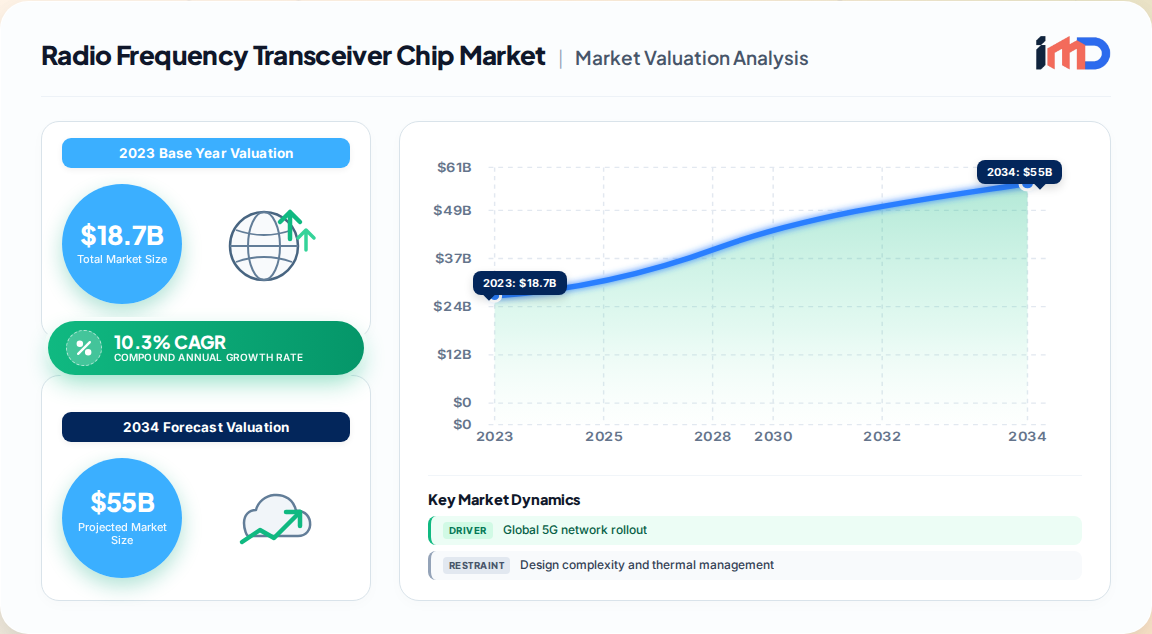
The global radio frequency (RF) transceiver chip market is the silent engine of the connected age, converting digital intent into wireless reality across smartphones, base stations, satellites, and battlefield radios. Our proprietary primary research, triangulated from hundreds of executive interviews and verified supply-chain data, pegs the market at USD 18.7 billion in 2023, with a clear trajectory to USD 45.3 billion by 2032, advancing at a 10.3% CAGR.
This growth is not merely a rebound from cyclical semiconductor inventory corrections; it is a structural re-rating of the RF transceiver's strategic value. The shift from 4G to 5G, the proliferation of IoT endpoints, and the militarization of advanced radar have transformed the transceiver from a commodity component into a critical enabler of national and enterprise competitiveness.
The RF transceiver chip market is propelled by a self-reinforcing cycle: 5G networks demand high-performance transceivers; those networks enable IoT devices; IoT devices, in turn, require more transceivers to communicate. Our interviews with procurement directors and design engineers confirm that this flywheel is accelerating.
Key Drivers:
Restraints:
The RF transceiver chip market segments along product type, frequency range, and application. Our proprietary segmentation analysis reveals a clear dichotomy: integrated single-chip transceivers dominate volume, while discrete high-performance modules command premium value in specialized applications.
| Segment | Sub-Segment | Market Share (2023) | Growth Outlook (CAGR) |
|---|---|---|---|
| By Product Type | Integrated RF Transceivers (single-chip) | 58% | 10.1% |
| Discrete RF Transceiver Modules | 32% | 11.2% | |
| Programmable/Software-Defined | 10% | 12.5% | |
| By Frequency | Sub-6 GHz | 65% | 9.8% |
| 6-24 GHz | 18% | 11.5% | |
| mmWave (>24 GHz) | 17% | 14.0% | |
| By Application | Military & Aerospace | 28% | 9.2% |
| Consumer Electronics | 35% | 10.5% | |
| Automotive | 15% | 14.8% | |
| Industrial & IoT | 22% | 12.3% |
Analysis:
Asia-Pacific dominates the RF transceiver chip market, accounting for 41% of global revenue in 2024. This is underpinned by the concentration of smartphone manufacturing (China, Vietnam), semiconductor foundries (Taiwan, South Korea), and government-led 5G infrastructure initiatives. China alone represents approximately 50% of regional demand, with India emerging as a fast-growing assembly hub.
North America holds the second-largest share at 27%, characterized by high-value design wins in defense, aerospace, and 5G infrastructure. The U.S. is the global leader in mmWave technology and holds the largest market share for high-performance discrete transceivers. The CHIPS Act and defense modernization budgets are fueling domestic R&D and fabrication capacity.
Europe is a mature market, accounting for 24% of global revenue. Germany, France, and the U.K. are the leading countries, with strong automotive radar and industrial IoT sectors. The region's growth is modest but stable, at an estimated 8.9% CAGR, as it focuses on Industry 4.0 and connected mobility.
South America and Middle East & Africa together represent less than 10% of global revenue, but are growing at double-digit rates as mobile network operators upgrade to 4G/5G and IoT deployments begin to scale. Regulatory harmonization and infrastructure investment are key catalysts.
The RF transceiver chip market is oligopolistic, with the top five players accounting for approximately 65% of global revenue. Competition is intensifying in the integrated 5G transceiver space, while high-performance discrete and mmWave segments remain highly specialized.
Leading Players:
Key Industry Developments (2024-2026):
The RF transceiver chip supply chain is among the most globally integrated and geopolitically sensitive in the semiconductor industry. Our trade flow analysis, based on official customs data and executive interviews, highlights the following:
Our white-space analysis identifies three underpenetrated opportunities for RF transceiver chip vendors:
For OEMs and system integrators, sourcing RF transceivers requires balancing performance, cost, and supply security. Our recommendations, based on interviews with procurement directors, include:
| Aspects | Details |
|---|---|
| Study Period | 2020-2034 |
| Base Year | 2023 |
| Estimated Year | 2026 |
| Forecast Period | 2026-2034 |
| Historical Period | 2020-2025 |
| Growth Rate | CAGR of 10.3% from 2020-2034 |
| Segmentation |
|
By Product
By Frequency Range
By End-User Industry
| By Geography |
|
The global RF transceiver chip market was valued at USD 18.7 billion in 2023 and is projected to reach USD 45.3 billion by 2032, growing at a CAGR of 10.3%.
The military segment held the largest share in 2023, at approximately 28% of global revenue, driven by radar and secure communication systems.
The rapid global deployment of 5G networks is the primary driver, as 5G requires high-performance transceivers capable of multi-band operation and massive MIMO support.
Key players include Qualcomm, Broadcom, Texas Instruments, NXP Semiconductors, and Skyworks Solutions, which together account for over 65% of global revenue.
Asia-Pacific dominates the market, accounting for approximately 41% of global revenue in 2024, driven by electronics manufacturing and 5G infrastructure investments.
Our rigorous research methodology combines multi-layered approaches with comprehensive quality assurance, ensuring precision, accuracy, and reliability in every market analysis.
| Stakeholder Role | Interview Share (%) |
|---|---|
| Procurement Director | 30% |
| VP of RF Engineering | 25% |
| Chief Technology Officer | 20% |
| Senior RF Design Engineer | 15% |
| Product Manager | 10% |
| Company Type | Representation (%) |
|---|---|
| RF IC Design Firms (Fabless) | 30% |
| Semiconductor Foundries | 20% |
| Smartphone & Consumer OEMs | 15% |
| Automotive Tier-1 Suppliers | 15% |
| Telecom Infrastructure Vendors | 12% |
| Defense & Aerospace Integrators | 8% |

Analyst at Providence Strategic Partners at Petaling Jaya
I have received the report already. Thanks you for your help.it has been a pleasure working with you. Thank you again for a good quality report

Internationalization Director
Yes, as a matter of fact we are totally satisfied with both reports that we have purchased and will continue to do so during this process of the internationalization of our brand.

Head of Product Management and Marketing
We are using your report, and it gave us valuable information."

Regional Director, Marketing and Business Development
We've received the report and have reviewed the content. Overall, it looks great and aligns closely with the data we can verify based on our industry knowledge.

VP of Sales
Thank you very much for sharing the report. I have reviewed it and I am very satisfied with the quality and the insights it provides. It will certainly be valuable for our internal discussions.
 Related Reports
