1What is the poultry diagnostics market size in 2026?
Our primary research estimates the market at USD 1.02 billion in 2026, growing from USD 930 million in 2025 and projected to reach USD 1.62 billion by 2031 at a 9.74% CAGR.
Insight Market Data is a premier market research and business consulting firm headquartered in Pune, India, providing syndicated research reports, customized intelligence studies, and strategic advisory services. Renowned academic institutions and Fortune 500 corporations worldwide rely on Insight Market Data's research repository to navigate evolving global and regional business environments. Covering 46 diverse industries across 25 major international economies, our comprehensive database delivers thousands of verified statistics and granular market evaluations. By combining industry-leading analytical methodologies with the direct insights of seasoned industry leaders and subject-matter experts, we deliver actionable intelligence spanning historical performance benchmarks to rigorous multi-year forecasts. We empower organizations to make confident, data-driven decisions across pivotal domains including Machinery & Equipment, Chemicals & Materials, Pharmaceuticals & Healthcare, Food & Beverages, Consumer Goods, Energy & Power, Automotive & Transportation, Electronics & Semiconductors, Medical Devices, Telecommunications, Emerging Technologies, Agriculture, and Packaging. Our multidisciplinary analyst teams provide an objective 360-degree perspective, tailoring every engagement to address complex strategic challenges with exceptional analytical rigor.
Leveraging advanced BI-powered analytics and predictive modeling, Insight Market Data uncovers high-impact market opportunities and competitive differentiators for ambitious enterprises. We continuously refine our research methodologies in accordance with global industry standards, tracking real-time market shifts to ensure our reports are consistently accurate, actionable, and delivered on schedule. Our analysts conduct methodical data validation, rigorous compliance checks, and exhaustive primary and secondary research to maintain the highest levels of data integrity and transparency. We partner closely with corporate strategists, investment groups, and business executives to translate intricate market intelligence into clear, actionable roadmaps for sustainable growth. With operational presence across Washington, USA, and Vimannagar, Pune, India, Insight Market Data ensures direct access to dedicated research specialists and responsive customer support to answer your most strategic questions.
 Poultry Diagnostics Market
 by Test Type (ELISA, PCR, Molecular Diagnostic Tests, Hemagglutination-Inhibition (HI), Immunofluorescent Assay, Others), by Disease Type (Infectious Diseases(Avian Influenza, Newcastle Disease, Infectious Bursal Disease, Infectious Bronchitis), Parasitic Diseases(Avian Coccidiosis), Avian Salmonellosis, Avian Mycoplasmosis, Others), by Service Type (Bacteriology, Virology, Serology, Molecular Diagnostics, Others), by End User (Veterinary Reference Laboratories, Veterinary Hospitals & Clinics, On-Farm Point-of-Care Units, Others), by Product (Instruments, Consumables, Kits), by North America (USA, Canada, Mexico), by Europe (Germany, UK, France, Italy, Spain), by Asia Pacific (China, India, Japan, Indonesia, Philippines), by South America (Brazil, Argentina), by Middle East & Africa (South Africa, Saudi Arabia) Forecast 2026-2034

Research Associate


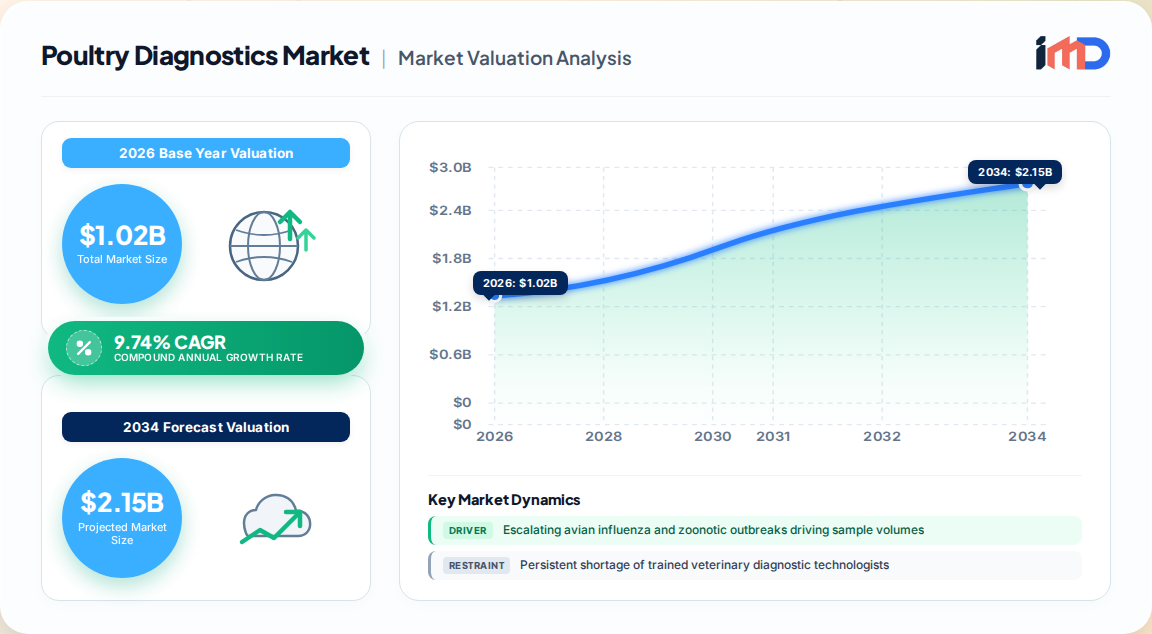
The global poultry diagnostics market represents one of the fastest-accelerating sub-sectors of veterinary health, transitioning from a discretionary farm input to a core operational pillar of commercial flock management. Our proprietary primary research places the market at USD 1.02 billion in 2026, advancing from an estimated USD 930 million in 2025 and on track to reach USD 1.62 billion by 2031, reflecting a 9.74% CAGR across the forecast window.
This expansion is not a simple volume story. It reflects a structural re-rating of diagnostics within the poultry value chain, where testing protocols are now embedded in export certification, biosecurity assurance, and genetic asset protection. The market is characterized by medium concentration, with a handful of multinational reference laboratories and diagnostic platform manufacturers holding outsized influence over pricing and protocol standardization.
Key market metrics at a glance:
| Metric | Value |
|---|---|
| Market Size (2025) | USD 930 Million |
| Market Size (2026) | USD 1.02 Billion |
| Market Size (2031) | USD 1.62 Billion |
| CAGR (2026–2031) | 9.74% |
| Largest Region | North America (41.73% share in 2025) |
| Fastest-Growing Region | Asia-Pacific (11.42% CAGR) |
| Leading Test Type | ELISA (45.52% revenue share, 2025) |
| Fastest Test Type | PCR (10.12% CAGR) |
The single most forceful near-term driver in our impact model is the escalation of avian influenza and zoonotic outbreaks, which we estimate contributes roughly +2.8 percentage points to the CAGR over a short-term horizon of two years or less. Highly pathogenic avian influenza circulates persistently in wild migratory birds, generating recurrent culls and sharp surges in sample submissions at reference laboratories.
Public-health authorities now treat veterinarians and diagnostic facilities as the first barrier against zoonotic spill-over. Documented viral fragments in veterinarians following routine farm visits have reinforced the case for high-sensitivity molecular assays as a routine farm-level control rather than an outbreak-only response.
Heightened government and NGO surveillance programs add a further ~+2.1 percentage points to CAGR over a medium-term horizon, concentrated in APAC and North America. National poultry improvement and monitoring frameworks link program compliance to interstate movement privileges and can suspend flock accreditation for non-conformance, converting diagnostics from a discretionary cost into an operational necessity.
Emerging-market protein demand contributes a longer-horizon ~+1.9 percentage point lift, with South and Southeast Asian broiler output projected to grow 4–5% annually through 2030, multiplying test volume with every incremental bird added to commercial inventories.
Diagnostic technology adoption is bifurcating. ELISA remains the workhorse platform, holding 45.52% revenue share in 2025, prized for throughput, cost-efficiency, and suitability for routine flock-level serosurveillance. Yet the growth premium sits squarely in molecular methods: PCR is forecast to post a 10.12% CAGR through 2031.
Labor constraints are the quiet accelerant behind automation. With shortages of trained technologists persistent across mature markets, high-throughput immunoassay and PCR platforms that automate pipetting and interpretation are becoming the new operational baseline, in turn broadening access for smaller farms.
By service type, bacteriology held 32.34% of market size in 2025, while virology is set to expand at 10.71% CAGR — a direct consequence of avian influenza and Newcastle disease pressures.
Infectious diseases accounted for 37.78% of market share in 2025, and parasitic diseases are on track for a 10.55% CAGR to 2031, reflecting growing recognition of coccidiosis and related productivity losses in intensive systems.
End-user structure is shifting faster than disease mix. Veterinary reference laboratories captured 42.68% share in 2025, but on-farm point-of-care units record the highest growth outlook at 11.02% CAGR. Farms that cannot wait for off-site results are adopting pen-side devices, giving the market additional momentum in low-infrastructure regions.
The value chain spans four principal layers:
North America dominated with 41.73% revenue share in 2025, anchored by advanced farming practice, high testing penetration, and compliance-linked surveillance frameworks. Asia-Pacific is the fastest-rising region at 11.42% CAGR, propelled by expanding broiler output, government matching grants for laboratory construction, and export-certification requirements in markets such as India, Indonesia, and the Philippines.
Diagnostic kits and reagents are highly traded inputs, and supplier dynamics are shaped by import dependence in emerging markets. Export access for poultry meat is increasingly conditional on documented, accredited testing — effectively exporting demand for diagnostic consumables alongside the protein trade itself. International funding for laboratory upgrades in Southeast Asia further expands the testing footprint.
| Region | Share (2025) | Growth Profile |
|---|---|---|
| North America | 41.73% | Mature, protocol-driven |
| Europe | ~24% | Accredited export testing |
| Asia-Pacific | ~26% | Fastest (11.42% CAGR) |
| South America | ~5% | Brazil-led integration |
| Middle East & Africa | ~3% | Early-stage, donor-supported |
Three white-space pockets warrant attention. First, farm-side molecular testing for mid-sized producers in infrastructure-constrained regions remains underserved. Second, AI-driven predictive analytics applied to hatchery health data — contributing roughly +0.8 percentage points to CAGR — is moving diagnostics from reactive to preventive, and few vendors offer integrated data layers. Third, automation-ready reference laboratory services answer the technologist shortage directly.
For procurement teams, sourcing strategy should prioritize validated, regulatory-recognized assay menus, multi-year reagent supply continuity, and vendor capacity to scale during outbreak surges. Buyers increasingly bundle instruments with consumable commitments to lock in pricing.
The competitive field combines multinational diagnostic platform manufacturers, specialist veterinary reference laboratories, and regional kit producers. Medium concentration means scale advantages in automation and accreditation matter, but local regulatory relationships often determine win rates in emerging markets.
Notable recent developments shaping competitive positioning include:
Strategic imperatives for 2026–2031 center on outbreak-surge capacity, menu breadth across bacterial and viral targets, and the ability to deliver actionable results at the point of care.
| Aspects | Details |
|---|---|
| Study Period | 2020-2034 |
| Base Year | 2026 |
| Estimated Year | 2026 |
| Forecast Period | 2026-2034 |
| Historical Period | 2020-2025 |
| Growth Rate | CAGR of 9.74% from 2020-2034 |
| Segmentation |
|
By Disease Type
By Service Type
By End User
By Product
| By Geography |
|
Our primary research estimates the market at USD 1.02 billion in 2026, growing from USD 930 million in 2025 and projected to reach USD 1.62 billion by 2031 at a 9.74% CAGR.
Asia-Pacific is the fastest-rising region at an 11.42% CAGR, driven by expanding broiler output, government laboratory funding, and export-certification testing requirements, while North America holds the largest share at 41.73%.
ELISA held the largest revenue share at 45.52% in 2025, but PCR is projected to post the fastest growth at a 10.12% CAGR through 2031 due to avian influenza sub-typing needs.
Key participants include Idexx Laboratories, Zoetis, Thermo Fisher Scientific, Biochek, Megacor Diagnostik, QIAGEN, Eurofins Scientific, Boehringer Ingelheim, IDVET, Bioneer, and BioInGenTech.
On-farm point-of-care units are the fastest-growing end-user segment at 11.02% CAGR, as producers in low-infrastructure regions require rapid results without waiting for off-site laboratory turnaround.
Our rigorous research methodology combines multi-layered approaches with comprehensive quality assurance, ensuring precision, accuracy, and reliability in every market analysis.
| Stakeholder Role | Interview Share (%) |
|---|---|
| Chief Veterinary Officer | 28% |
| Laboratory Operations Director | 30% |
| Flock Health Manager | 24% |
| Diagnostics Procurement Lead | 18% |
| Company Type | Representation (%) |
|---|---|
| Assay & Reagent Kit Developers | 32% |
| Diagnostic Instrument OEMs | 22% |
| Veterinary Reference Laboratory Networks | 28% |
| On-Farm Point-of-Care Device Suppliers | 18% |
 Related Reports


Analyst at Providence Strategic Partners at Petaling Jaya
I have received the report already. Thanks you for your help.it has been a pleasure working with you. Thank you again for a good quality report

Internationalization Director
Yes, as a matter of fact we are totally satisfied with both reports that we have purchased and will continue to do so during this process of the internationalization of our brand.

Head of Product Management and Marketing
We are using your report, and it gave us valuable information."

Regional Director, Marketing and Business Development
We've received the report and have reviewed the content. Overall, it looks great and aligns closely with the data we can verify based on our industry knowledge.

VP of Sales
Thank you very much for sharing the report. I have reviewed it and I am very satisfied with the quality and the insights it provides. It will certainly be valuable for our internal discussions.