Insight Market Data is a premier market research and business consulting firm headquartered in Pune, India, providing syndicated research reports, customized intelligence studies, and strategic advisory services. Renowned academic institutions and Fortune 500 corporations worldwide rely on Insight Market Data's research repository to navigate evolving global and regional business environments. Covering 46 diverse industries across 25 major international economies, our comprehensive database delivers thousands of verified statistics and granular market evaluations. By combining industry-leading analytical methodologies with the direct insights of seasoned industry leaders and subject-matter experts, we deliver actionable intelligence spanning historical performance benchmarks to rigorous multi-year forecasts. We empower organizations to make confident, data-driven decisions across pivotal domains including Machinery & Equipment, Chemicals & Materials, Pharmaceuticals & Healthcare, Food & Beverages, Consumer Goods, Energy & Power, Automotive & Transportation, Electronics & Semiconductors, Medical Devices, Telecommunications, Emerging Technologies, Agriculture, and Packaging. Our multidisciplinary analyst teams provide an objective 360-degree perspective, tailoring every engagement to address complex strategic challenges with exceptional analytical rigor.
Leveraging advanced BI-powered analytics and predictive modeling, Insight Market Data uncovers high-impact market opportunities and competitive differentiators for ambitious enterprises. We continuously refine our research methodologies in accordance with global industry standards, tracking real-time market shifts to ensure our reports are consistently accurate, actionable, and delivered on schedule. Our analysts conduct methodical data validation, rigorous compliance checks, and exhaustive primary and secondary research to maintain the highest levels of data integrity and transparency. We partner closely with corporate strategists, investment groups, and business executives to translate intricate market intelligence into clear, actionable roadmaps for sustainable growth. With operational presence across Washington, USA, and Vimannagar, Pune, India, Insight Market Data ensures direct access to dedicated research specialists and responsive customer support to answer your most strategic questions.
Pipeline Wastewater Grinder Market | Global Industry Forecast 2032 | Insight Market Data
Pipeline Wastewater Grinder Market
Energy & Power / MARKET REPORT
Pipeline Wastewater Grinder Market | Insight Market Data
Pipeline Wastewater Grinder Market by Type (Pipeline Wastewater Grinder, Channel Wastewater Grinder), by Application (Municipal, Industrial and Commercial), by Material (Stainless Steel, Alloy Steel, Others), by End-User (Municipal Utilities, Industrial Facilities, Commercial Buildings), by North America (USA, Canada, Mexico), by Europe (Germany, France, UK, Italy), by Asia Pacific (China, Japan, South Korea, Southeast Asia, India), by Latin America (Brazil, etc.), by Middle East & Africa (Turkey, GCC Countries, Africa, etc.) Forecast 2026-2034
Executive Overview: A Niche Yet Critical Infrastructure Market
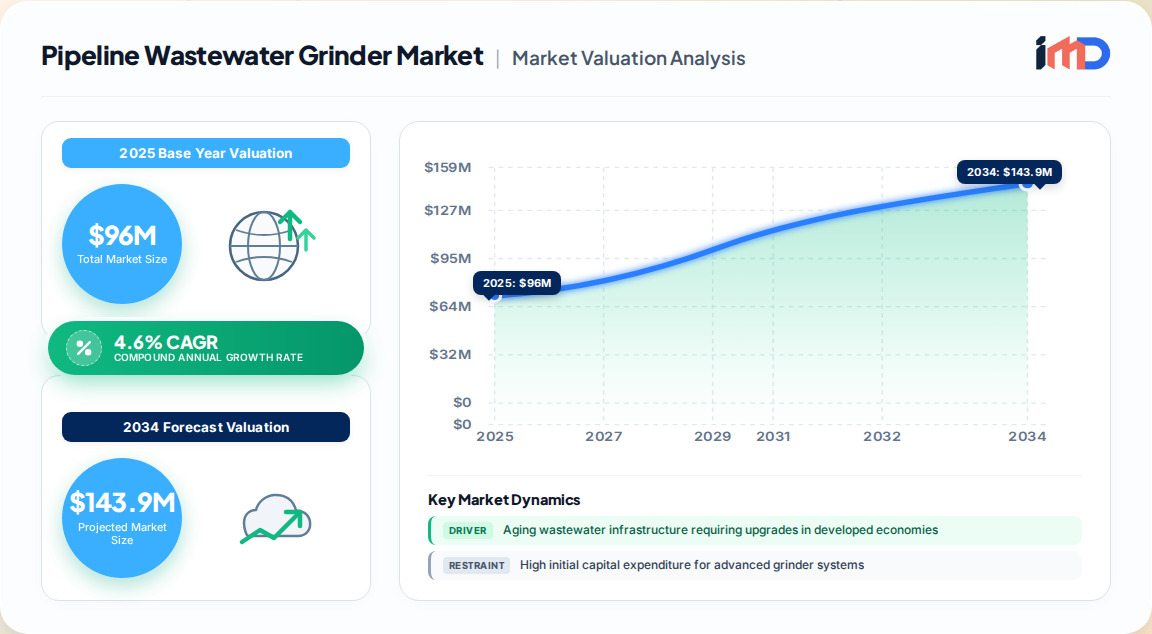
The global Pipeline Wastewater Grinder market stands as a vital yet often overlooked segment of the water and wastewater treatment equipment industry. Our proprietary primary research estimates the market at US$ 96 million in 2025, with a steady projected expansion to US$ 131 million by 2032, reflecting a CAGR of 4.6%. This growth is underpinned by relentless urbanization, tightening environmental discharge regulations, and the escalating operational costs associated with pipeline blockages caused by modern waste streams such as flushable wipes and non-biodegradable debris.
Pipeline Wastewater Grinder Market Market Size (In Million)
150.0M
100.0M
50.0M
0
96.00 M
2025
100.0 M
2026
105.0 M
2027
110.0 M
2028
115.0 M
2029
120.0 M
2030
126.0 M
2031
Pipeline wastewater grinders are specialized mechanical devices installed directly within closed pipelines or open channels. Their core function is to macerate and reduce the size of solid debris—ranging from plastics and textiles to sanitary products—into fine particles that can be transported smoothly by the flow. This prevents accumulation, protects downstream pumps and valves, and ensures the uninterrupted hydraulic capacity of critical drainage infrastructure.
Market Drivers, Restraints, and Key Trends
The demand for pipeline wastewater grinders is propelled by several interconnected factors.
Drivers:
Municipal Infrastructure Upgrades: Aging sewer systems in developed economies, particularly in North America and Europe, require retrofitting with grinder technology to handle increasing volumes and changing waste composition.
Industrial Compliance: Stringent discharge regulations imposed by environmental agencies (e.g., EPA in the US, EU Water Framework Directive) compel industrial facilities to pre-treat effluent, driving adoption of inline grinders.
Operational Cost Reduction: By preventing clogs and downstream equipment damage, grinders significantly reduce maintenance costs and energy consumption, a key consideration for utility operators.
Urbanization in Emerging Economies: Rapid urban growth in Asia-Pacific demands new wastewater infrastructure, creating a greenfield market for grinder installations.
Restraints:
High Initial Capital Expenditure: The cost of advanced grinder systems, especially those constructed from premium materials like stainless steel, can be prohibitive for smaller municipalities or industrial players.
Maintenance Complexity: Although grinders reduce downstream maintenance, the units themselves require periodic servicing and cutter replacement, necessitating skilled labor and planned downtime.
Competition from Alternative Technologies: In some applications, traditional screening or comminution equipment may be preferred, limiting market penetration.
Key Trends:
Material Innovation: Rising use of duplex stainless steel and advanced coatings to extend service life in corrosive environments is a prominent trend.
Smart Monitoring & IoT Integration: Manufacturers are increasingly incorporating sensors and remote monitoring capabilities to predict maintenance needs and optimize performance, aligning with the broader smart water management movement.
Modular and Compact Designs: Space constraints in urban settings are driving demand for compact, high-torque grinders that can be easily retrofitted into existing pipelines without extensive civil works.
Value Chain Analysis
The pipeline wastewater grinder value chain is characterized by a mix of specialized engineering firms and large diversified water technology conglomerates.
Upstream: Key raw materials include stainless steel, alloy steels, industrial diamonds (for cutter teeth), electric motors, and electronic control components. Suppliers of these materials are primarily global metals and components manufacturers. Fluctuations in steel prices directly impact production costs.
Midstream (Manufacturing): This stage involves precision machining, assembly, and rigorous testing. Manufacturers are concentrated in regions with strong industrial bases, such as North America, Europe, and East Asia. Companies like Franklin Miller, Sulzer, Vogelsang, and JWC Environmental are prominent players, leveraging decades of engineering expertise to produce reliable, high-torque grinders.
Downstream: End-users span municipal wastewater treatment plants, industrial facilities (food processing, chemical, pharmaceutical), and commercial establishments. Distribution typically occurs through direct sales forces for large projects and a network of authorized distributors for smaller-scale applications.
Regional Outlook: Asia-Pacific Leads Growth
Asia-Pacific dominates the global pipeline wastewater grinder market, accounting for an estimated 41% revenue share in 2025. This leadership is driven by massive infrastructure investments in China, India, and Southeast Asia, coupled with rapid urbanization and industrialization. Government initiatives to improve sanitation and wastewater treatment are creating substantial demand.
North America and Europe follow, representing 27% and 24% of the market, respectively. These regions are characterized by mature infrastructure requiring upgrades and strict environmental regulations. The presence of key manufacturers and a strong focus on technological innovation further support market stability.
South America and the Middle East & Africa hold smaller shares (4% each), but present opportunities for growth as investments in water infrastructure accelerate. However, economic volatility and political instability may temper growth prospects in these regions.
Competitive Landscape and Strategic Developments
The market is moderately consolidated, with the top three vendors accounting for a significant portion of global revenue. Competition is fierce, with players differentiating through product reliability, after-sales service, and technological innovation.
Key players include:
Sulzer (Switzerland): Known for submersible grinders and advanced waste management technology.
Vogelsang (Germany): Specializes in high-performance rotary lobe pumps and grinders.
Franklin Miller (USA): Offers a comprehensive range of TASKMASTER® and DIMMINUTOR® grinders for channel and inline applications.
JWC Environmental (USA): Renowned for inline and channel grinders, particularly for tough wastewater applications.
Xylem (USA): Provides sophisticated grinder solutions with a focus on energy efficiency.
Netzsch (Germany): Offers a range of grinding and pump solutions.
Sumitomo Heavy Industries Environment (Japan): Strong in the Asian market.
NOV (Mono) (USA/UK): Provides progressive cavity pumps and grinders.
ZENIT (Italy): Specializes in wastewater treatment equipment.
Aline (USA): Offers inline grinders for industrial and municipal applications.
Recent developments (2023-2024) include product launches such as Franklin Miller's TASKMASTER TITAN (high-flow channel grinder) and Sulzer's enhanced submersible grinder range with IoT capabilities. There have also been strategic acquisitions, such as Xylem's acquisition of Evoqua (2023), which broadened its water treatment portfolio. These moves indicate a trend toward consolidation and integration of smart technologies.
Import/Export & Supplier Dynamics
Global trade in pipeline wastewater grinders is driven by the export strength of manufacturing hubs in Europe, North America, and East Asia. Germany, the United States, and Japan are major exporters of high-end grinder equipment, leveraging their advanced engineering capabilities. China has emerged as a significant exporter of cost-effective grinders, particularly for price-sensitive markets in Southeast Asia and Africa.
Key supplier dynamics include:
Raw Material Sourcing: Stainless steel is sourced globally, with major producers in China, Europe, and the US. Price volatility in steel markets impacts manufacturing costs.
Component Supply: Electric motors and custom cutters are often sourced from specialized suppliers, creating dependencies that can affect lead times.
Trade Policies: Tariffs and trade agreements (e.g., US-China trade tensions, EU regulations) influence export competitiveness and supply chain decisions.
Despite these dynamics, the market remains resilient due to the essential nature of wastewater infrastructure and long equipment lifecycles.
Strategic White-Space Analysis
Several untapped opportunities exist for market participants:
Retrofit Market: Upgrading existing pipeline systems with advanced grinders presents a low-cost alternative to full replacement, especially in aging infrastructure.
Digital Services: Offering predictive maintenance and remote monitoring as a service can create recurring revenue streams and strengthen customer relationships.
Emerging Economies: Tailoring cost-effective, durable grinders for markets in Africa and Southeast Asia can unlock significant growth.
Industrial Niche Applications: Expanding into specialized industrial segments (e.g., food waste, pharmaceutical effluent) with customized grinder solutions.
By addressing these white spaces, manufacturers can gain a competitive edge and drive market expansion beyond the baseline forecast.
Table 46: GCC Countries Pipeline Wastewater Grinder Market Revenue (Million) Forecast, by Application 2020 & 2034
Table 47: Africa Pipeline Wastewater Grinder Market Revenue (Million) Forecast, by Application 2020 & 2034
Table 48: etc. Pipeline Wastewater Grinder Market Revenue (Million) Forecast, by Application 2020 & 2034
Frequently Asked Questions
1What is the current size of the global pipeline wastewater grinder market?
The global pipeline wastewater grinder market was valued at US$ 96 million in 2025, according to our proprietary primary research. It is projected to reach US$ 131 million by 2032, growing at a CAGR of 4.6%.
2Which region is expected to dominate the pipeline wastewater grinder market?
Asia-Pacific is the largest and fastest-growing region, accounting for approximately 41% of global revenue in 2025. This is driven by rapid urbanization and infrastructure investments in countries like China and India.
3Who are the key players in the pipeline wastewater grinder market?
Leading manufacturers include Sulzer, Vogelsang, Franklin Miller, JWC Environmental, Xylem, Netzsch, and Sumitomo Heavy Industries Environment. These companies compete on technology, reliability, and global service networks.
4What are the main drivers for the adoption of pipeline wastewater grinders?
Key drivers include aging infrastructure in developed regions, stringent environmental regulations, the need to reduce maintenance costs caused by blockages, and rapid urbanization in emerging economies.
5How does the material of construction impact the market?
The use of stainless steel and advanced alloys is increasing due to the need for corrosion resistance and durability, which extends equipment life and reduces maintenance. This trend is particularly strong in industrial applications.
Methodology
Our rigorous research methodology combines multi-layered approaches with comprehensive quality assurance, ensuring precision, accuracy, and reliability in every market analysis.
Primary Research
70–80% of the research effort is dedicated to primary research, targeting a guaranteed data accuracy level of 85–90%.
In-depth interviews are conducted with procurement directors at municipal water utilities, plant managers at industrial wastewater facilities, engineering consultants specializing in water infrastructure, and distributors of wastewater equipment.
We also engage with product managers at grinder OEMs to understand technical specifications and pricing strategies.
Primary research includes structured questionnaires, telephonic interviews, and on-site visits to wastewater treatment plants to observe grinder installations.
Key Stakeholders Interviewed
Key Stakeholders Interviewed
Stakeholder Role
Interview Share (%)
Procurement Director
35%
Plant Manager
30%
Project Engineer
20%
Operations Head
15%
Industry Ecosystem Breakdown
Industry Ecosystem Breakdown
Company Type
Representation (%)
Grinder OEMs
40%
Municipal Water Utilities
25%
Industrial Wastewater Facilities
20%
Distributors & Channel Partners
10%
Engineering & Consulting Firms
5%
Secondary Research & Industry Benchmarking
20–30% of the research is based on secondary sources, including financial databases such as Bloomberg, Factiva, Hoovers, and PitchBook.
We benchmark market data against official statistics from UN Comtrade for trade flows, World Bank for infrastructure spending, and OECD for environmental regulations.
Industry association data from WEF (Water Environment Federation) and EWA (European Water Association) are used to validate technology adoption trends.
All secondary data is cross-referenced with primary inputs to ensure consistency.
Demand Modeling & Market Estimation
We employ both top-down and bottom-up methodologies simultaneously, validated via multi-level data triangulation.
The bottom-up approach involves estimating the number of pipeline wastewater grinder units sold annually by summing procurement data from municipal and industrial end-users, multiplied by average unit prices.
Key quantitative metrics include: annual capital expenditure on wastewater infrastructure, number of new pipeline grinder installations per year, average replacement cycle (typically 10-15 years), and unit shipment volumes by grinder type (pipeline vs. channel).
The top-down approach uses regional wastewater equipment market sizes, from which the grinder segment is derived based on percentage shares obtained from primary interviews.
Data Accuracy & Quality Check
Every report is updated to the date of purchase to ensure the latest data is included.
A multi-stage quality check process is applied: data triangulation from at least three independent sources, validation by our in-house industry experts, and sanity checks against historical growth patterns.
We guarantee an estimated data accuracy level of 85–90%, with a confidence interval of ±5%.
All market sizes and forecasts are presented in US dollars, with currency conversions based on average annual exchange rates from the IMF.
Global PPA market to reach USD 604.2 Bn by 2034 from USD 36.6 Bn in 2024, at 32.4% CAGR. Virtual PPAs dominate with 59.9% share. Read full analysis.
Nov 2026|256 pages
$2900.00
The automatic drilling and riveting machine market is valued at USD 1.50 billion in 2025 and is forecast to reach USD 3.34 billion by 2033, at a 10.5% CAGR.
Nov 2026|196 pages
$2900.00
Floating substation solutions market to grow at 7.4% CAGR, driven by dynamic cable systems, modular topsides, and deepwater wind integration.
Nov 2026|223 pages
$2900.00
India battery market valued at USD 14.01B in 2026, projected to reach USD 25.51B by 2032 at 10.46% CAGR, driven by EV adoption and domestic manufacturing.