1What is the current size of the India battery market?
The India battery market is valued at USD 14.01 billion in 2026 and is projected to reach USD 25.51 billion by 2032.
Insight Market Data is a premier market research and business consulting firm headquartered in Pune, India, providing syndicated research reports, customized intelligence studies, and strategic advisory services. Renowned academic institutions and Fortune 500 corporations worldwide rely on Insight Market Data's research repository to navigate evolving global and regional business environments. Covering 46 diverse industries across 25 major international economies, our comprehensive database delivers thousands of verified statistics and granular market evaluations. By combining industry-leading analytical methodologies with the direct insights of seasoned industry leaders and subject-matter experts, we deliver actionable intelligence spanning historical performance benchmarks to rigorous multi-year forecasts. We empower organizations to make confident, data-driven decisions across pivotal domains including Machinery & Equipment, Chemicals & Materials, Pharmaceuticals & Healthcare, Food & Beverages, Consumer Goods, Energy & Power, Automotive & Transportation, Electronics & Semiconductors, Medical Devices, Telecommunications, Emerging Technologies, Agriculture, and Packaging. Our multidisciplinary analyst teams provide an objective 360-degree perspective, tailoring every engagement to address complex strategic challenges with exceptional analytical rigor.
Leveraging advanced BI-powered analytics and predictive modeling, Insight Market Data uncovers high-impact market opportunities and competitive differentiators for ambitious enterprises. We continuously refine our research methodologies in accordance with global industry standards, tracking real-time market shifts to ensure our reports are consistently accurate, actionable, and delivered on schedule. Our analysts conduct methodical data validation, rigorous compliance checks, and exhaustive primary and secondary research to maintain the highest levels of data integrity and transparency. We partner closely with corporate strategists, investment groups, and business executives to translate intricate market intelligence into clear, actionable roadmaps for sustainable growth. With operational presence across Washington, USA, and Vimannagar, Pune, India, Insight Market Data ensures direct access to dedicated research specialists and responsive customer support to answer your most strategic questions.
 india battery
 by Battery Type (Secondary Batteries, Primary Batteries), by Technology (Lead-Acid, Li-Ion, Nickel-Metal Hydride, Emerging Chemistries, Solid-State, Nickel-Cadmium, Sodium-Sulfur, Flow Battery), by Application (Automotive, Industrial, Portable, SLI, Power Tools, Other Applications), by North (Delhi, Haryana, Punjab, Uttar Pradesh), by West (Maharashtra, Gujarat, Rajasthan), by South (Karnataka, Tamil Nadu, Telangana, Andhra Pradesh, Kerala), by East (West Bengal, Odisha, Bihar, Jharkhand), by Central (Madhya Pradesh, Chhattisgarh) Forecast 2026-2034

Research Analyst


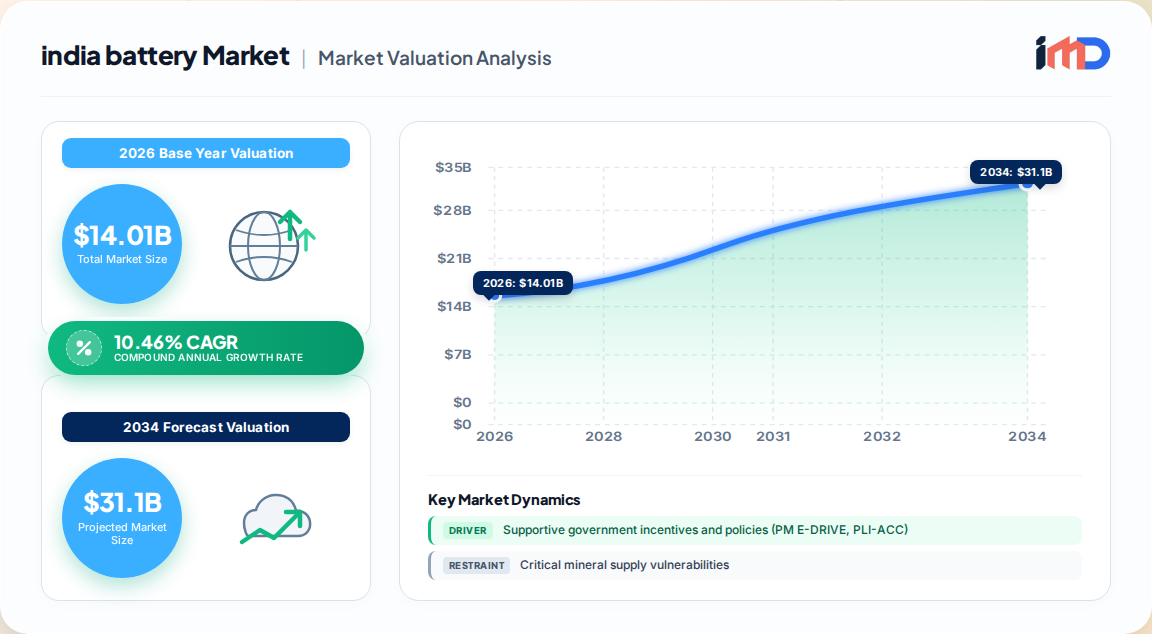
The India battery market is valued at USD 14.01 billion in 2026 and is projected to reach USD 25.51 billion by 2032, growing at a CAGR of 10.46% during the forecast period. This growth is underpinned by a confluence of policy support, declining lithium-ion prices, and rapid electrification across mobility and stationary storage applications. Our proprietary primary research indicates that secondary batteries accounted for 68.08% of the market in 2026 and are the fastest-growing segment at a 15.6% CAGR, reflecting the accelerating shift away from primary batteries.
The market remains medium-concentrated, with domestic incumbents and new entrants jostling for position across the value chain. Key players include HBL Engineering Ltd., Exide Industries Ltd., Amara Raja Energy & Mobility Ltd., Tata AutoComp GY Batteries Pvt. Ltd., and Luminous Power Technologies Pvt. Ltd., alongside emerging cell manufacturers supported by the PLI-ACC scheme.
By battery type, secondary batteries dominate with a 68.08% share in 2026, expected to grow at a CAGR of 15.6%. Primary batteries continue to serve niche applications but are losing share.
By technology, lead-acid batteries represented 50.6% of the market in 2026, largely due to their established presence in automotive SLI and backup power. However, lithium-ion is rapidly gaining, and solid-state is the fastest-growing technology at a 33.2% CAGR, albeit from a small base.
By application, automotive (HEV, PHEV, and EV) accounted for 41.24% of the market in 2026 and is the fastest-growing application at a 15% CAGR. Other significant applications include industrial (UPS, telecom, grid storage), portable (consumer electronics), and power tools.
Demand is concentrated in states with high EV adoption and manufacturing hubs. Maharashtra, Karnataka, Tamil Nadu, and Delhi lead in electric two-wheeler penetration, supported by state incentives and charging infrastructure. The PLI-ACC scheme has attracted investments in Karnataka, Tamil Nadu, Gujarat, with battery gigafactories clustering in these states. Hyderabad, Uttarakhand, Maharashtra, Karnataka, and Tamil Nadu are emerging as hubs for alternative chemistries such as sodium-ion.
The India battery market is characterized by a mix of established battery manufacturers and new entrants. Domestic leaders such as Exide Industries and Amara Raja Energy & Mobility are investing in lithium-ion cell manufacturing to reduce import reliance. Tata AutoComp GY Batteries leverages group synergies with Tata Motors' EV push. HBL Engineering focuses on niche industrial and defense applications. Luminous Power Technologies is a key player in the inverter and telecom backup segments.
Recent developments include:
The battery value chain in India spans raw material import, cell manufacturing, module and pack assembly, distribution, and after-sales service. Critical minerals (lithium, cobalt, nickel) are largely imported, creating supply vulnerabilities. Domestic cell manufacturing is ramping up with PLI-ACC support, but pack assembly remains fragmented. Recycling infrastructure is underdeveloped, though startups like Lohum (which issues over 70% of EPR certificates nationally) and BatX Energies are scaling capacity.
The OECD reports that global exports of EV battery packs and modules are highly concentrated, with China accounting for almost half of EV battery exports in 2023. This concentration poses a risk for India, which relies heavily on imported cells. In FY2025-26, India imported an estimated USD 5.2 billion worth of lithium-ion batteries, primarily from China, South Korea, and Japan. However, domestic manufacturing is expected to reduce import dependence over the forecast period. The EU-India TTC collaboration on recycling aims to diversify supply chains and promote circularity.
Winners in the India battery market will be those that combine local cell qualification, pack integration, and regional service networks. Key strategies include:
With government policies, declining costs, and rising demand, the India battery market presents a compelling growth opportunity over the next decade.
| Aspects | Details |
|---|---|
| Study Period | 2020-2034 |
| Base Year | 2026 |
| Estimated Year | 2026 |
| Forecast Period | 2026-2034 |
| Historical Period | 2020-2025 |
| Growth Rate | CAGR of 10.46% from 2020-2034 |
| Segmentation |
|
By Application
| By Geography |
|
The India battery market is valued at USD 14.01 billion in 2026 and is projected to reach USD 25.51 billion by 2032.
The market is expected to grow at a CAGR of 10.46% from 2027 to 2032.
Secondary batteries accounted for 68.08% of the market in 2026 and are the fastest-growing segment at a 15.6% CAGR.
Key players include HBL Engineering Ltd., Exide Industries Ltd., Amara Raja Energy & Mobility Ltd., Tata AutoComp GY Batteries Pvt. Ltd., and Luminous Power Technologies Pvt. Ltd.
Drivers include government incentives like PM E-DRIVE and PLI-ACC, declining lithium-ion prices, rapid EV adoption, and expanding telecom/data-center backup needs.
Our rigorous research methodology combines multi-layered approaches with comprehensive quality assurance, ensuring precision, accuracy, and reliability in every market analysis.
| Stakeholder Role | Interview Share (%) |
|---|---|
| Procurement Director | 25% |
| Chief Technology Officer | 25% |
| Plant Manager | 20% |
| Supply Chain Head | 15% |
| Policy Advisor | 15% |
| Company Type | Representation (%) |
|---|---|
| Lithium-ion cell manufacturers | 30% |
| Lead-acid battery producers | 20% |
| Battery pack assemblers | 20% |
| EV OEMs | 15% |
| Battery recycling companies | 10% |
| BMS and energy storage integrators | 5% |
 Related Reports


Analyst at Providence Strategic Partners at Petaling Jaya
I have received the report already. Thanks you for your help.it has been a pleasure working with you. Thank you again for a good quality report

Internationalization Director
Yes, as a matter of fact we are totally satisfied with both reports that we have purchased and will continue to do so during this process of the internationalization of our brand.

Head of Product Management and Marketing
We are using your report, and it gave us valuable information."

Regional Director, Marketing and Business Development
We've received the report and have reviewed the content. Overall, it looks great and aligns closely with the data we can verify based on our industry knowledge.

VP of Sales
Thank you very much for sharing the report. I have reviewed it and I am very satisfied with the quality and the insights it provides. It will certainly be valuable for our internal discussions.