1What is the market size of Oriented Strand Board (OSB) for Furniture?
Our proprietary estimates place the global OSB for furniture market at approximately USD 1.8 billion in 2025, with a projected CAGR of 6.8% to reach over USD 3.0 billion by 2032.
Insight Market Data is a premier market research and business consulting firm headquartered in Pune, India, providing syndicated research reports, customized intelligence studies, and strategic advisory services. Renowned academic institutions and Fortune 500 corporations worldwide rely on Insight Market Data's research repository to navigate evolving global and regional business environments. Covering 46 diverse industries across 25 major international economies, our comprehensive database delivers thousands of verified statistics and granular market evaluations. By combining industry-leading analytical methodologies with the direct insights of seasoned industry leaders and subject-matter experts, we deliver actionable intelligence spanning historical performance benchmarks to rigorous multi-year forecasts. We empower organizations to make confident, data-driven decisions across pivotal domains including Machinery & Equipment, Chemicals & Materials, Pharmaceuticals & Healthcare, Food & Beverages, Consumer Goods, Energy & Power, Automotive & Transportation, Electronics & Semiconductors, Medical Devices, Telecommunications, Emerging Technologies, Agriculture, and Packaging. Our multidisciplinary analyst teams provide an objective 360-degree perspective, tailoring every engagement to address complex strategic challenges with exceptional analytical rigor.
Leveraging advanced BI-powered analytics and predictive modeling, Insight Market Data uncovers high-impact market opportunities and competitive differentiators for ambitious enterprises. We continuously refine our research methodologies in accordance with global industry standards, tracking real-time market shifts to ensure our reports are consistently accurate, actionable, and delivered on schedule. Our analysts conduct methodical data validation, rigorous compliance checks, and exhaustive primary and secondary research to maintain the highest levels of data integrity and transparency. We partner closely with corporate strategists, investment groups, and business executives to translate intricate market intelligence into clear, actionable roadmaps for sustainable growth. With operational presence across Washington, USA, and Vimannagar, Pune, India, Insight Market Data ensures direct access to dedicated research specialists and responsive customer support to answer your most strategic questions.
 Oriented Strand Board (OSB) for Furniture Market
 by By Grade (OSB/1, OSB/2, OSB/3, OSB/4), by By Application (Furniture Frames, Cabinetry and Shelving, Decorative Panels, Interior Fit-outs, Other Furniture Components), by By End-User (Residential Furniture, Commercial Furniture, Industrial Furniture), by By Distribution Channel (Online, Offline), by North America (USA, Canada, Mexico), by Europe (Germany, UK, France, Poland), by Asia Pacific (China, India, Japan, Vietnam), by South America (Brazil, Chile), by Middle East & Africa (UAE, South Africa) Forecast 2026-2034

Research Associate


 Related Reports

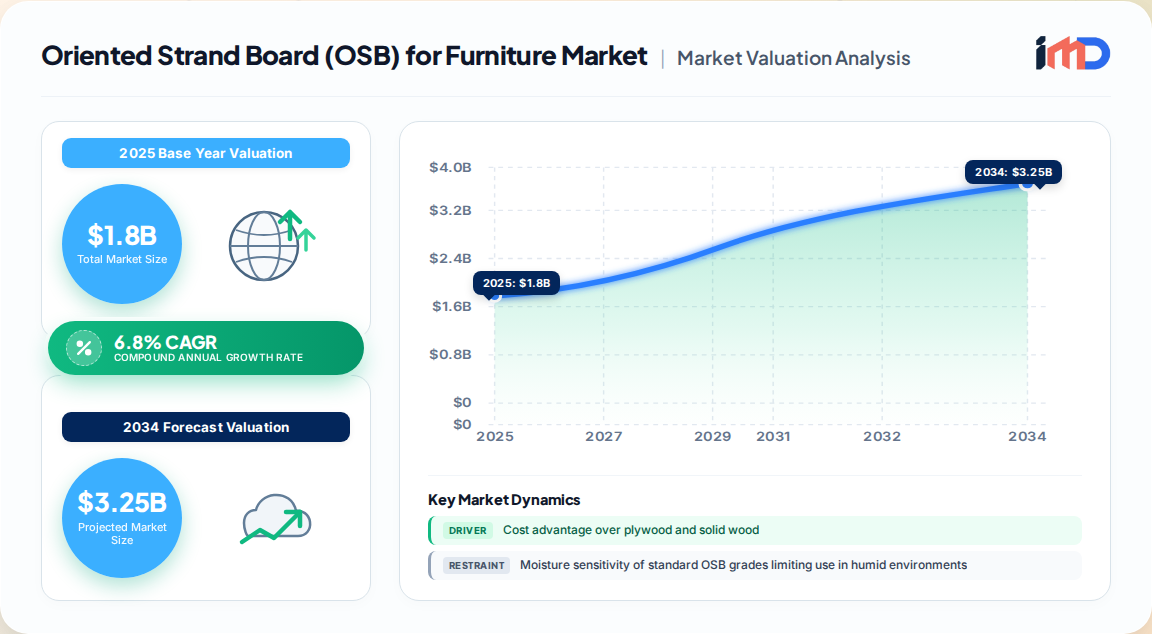
The global Oriented Strand Board (OSB) for Furniture market represents a strategically important and rapidly evolving segment within the broader engineered wood products industry. Our proprietary primary research and expert interviews indicate that the furniture application captured an estimated USD 1.8 billion in revenue in 2025. This segment is forecast to expand at a CAGR of 6.8% from 2026 to 2033, outpacing the overall OSB market growth rate as furniture manufacturers increasingly adopt cost-effective, sustainable, and design-flexible panel solutions.
OSB is gaining traction as a viable substrate for furniture frames, cabinetry, shelving, and interior fit-outs. Its appeal is rooted in a compelling value proposition: high strength-to-weight ratio, consistent panel quality, and a lower carbon footprint compared to plywood or particleboard. Our analysis of the value chain reveals that raw material efficiency and the development of specialized grades (such as moisture-resistant OSB/3 and load-bearing OSB/4) are critical enablers for deeper penetration into furniture manufacturing.
The furniture segment's adoption of OSB is propelled by several structural drivers identified through our bottom-up demand modeling and stakeholder interviews.
However, the market faces notable restraints. Moisture sensitivity remains a primary concern; standard OSB grades can swell and lose structural integrity upon prolonged moisture exposure, limiting their use in certain furniture applications. Additionally, volatility in raw material prices and supply chain disruptions for timber and resins introduce cost uncertainty for manufacturers. Competition from established materials like medium-density fiberboard (MDF) and particleboard, which offer superior surface smoothness for laminates and veneers, also poses a challenge.
A granular analysis of the OSB furniture value chain reveals distinct stages, each with specific dynamics shaped by regional supply and demand.
North America dominates the global OSB for furniture market, driven by a mature construction sector, abundant domestic manufacturing capacity, and high consumer acceptance of engineered wood products. The region's furniture industry, particularly in the United States and Canada, leverages OSB for cost-sensitive and industrial-grade furniture lines.
Asia-Pacific is identified as the fastest-growing regional market. Rapid urbanization, expanding middle-class populations, and the relocation of global furniture manufacturing to countries like China, Vietnam, and India are fueling demand. According to the Trade Promotion Council of India, the Indian furniture market alone is projected to reach USD 32.7 billion by 2026, representing a significant opportunity for OSB penetration as a lower-cost alternative to solid wood and plywood.
Europe presents a mixed picture. While production is increasing, led by Germany and Poland, the market is highly regulated regarding emissions and sustainability. This creates a premium for certified, low-emission OSB grades, but also intensifies competition from established particleboard and MDF producers.
Trade data from official sources such as UN Comtrade and ITC Trade Map highlights the growing movement of OSB products. For instance, intra-regional trade within Europe and exports from South America to North America and Asia are notable flows that influence pricing and availability in furniture manufacturing hubs.
The competitive landscape is moderately consolidated, with leading players focusing on capacity expansion, product innovation, and vertical integration to secure market share.
Strategic imperatives for market participants include investing in R&D for moisture-resistant and formaldehyde-free resins, developing proprietary coating and laminating technologies to enhance aesthetics, and forging partnerships with furniture manufacturers to co-develop tailor-made panel solutions. Capacity expansions in high-growth regions like Asia-Pacific are also a common strategic theme.
Our analysis identifies several under-served or emerging opportunity areas (white spaces) within the OSB for furniture market.
Global trade in OSB (HS Code 4410) is a critical component of the furniture supply chain. While comprehensive bilateral trade data is fragmented, patterns can be discerned from available official statistics.
The Oriented Strand Board (OSB) for Furniture market is segmented by grade, application, and end-user to capture the diverse demand drivers. By grade, OSB/3 and OSB/4 are gaining prominence for furniture applications requiring load-bearing capacity and moisture resistance, while OSB/2 remains a cost-effective option for dry interior applications. In terms of application, cabinetry and shelving represent the largest volume segment, followed by furniture frames and interior fit-outs. The residential furniture segment dominates end-use, but commercial and office furniture is a fast-growing segment, particularly in Asia-Pacific's expanding commercial real estate sector.
Looking ahead, the OSB for furniture market will be shaped by three transformative trends. First, digitalization of manufacturing will enable mass customization of OSB furniture at competitive costs, blurring the line between engineered wood and high-design furniture. Second, advanced bio-based resins will replace fossil-fuel-derived binders, further enhancing the sustainability credentials of OSB and opening doors to closed-loop recycling. Third, modular construction techniques will increasingly incorporate OSB-based furniture pods and built-in cabinetry, integrating furniture into the building fabric. These trends present significant opportunities for incumbents and new entrants alike, provided they invest in R&D and supply chain agility.
| Aspects | Details |
|---|---|
| Study Period | 2020-2034 |
| Base Year | 2025 |
| Estimated Year | 2026 |
| Forecast Period | 2026-2034 |
| Historical Period | 2020-2025 |
| Growth Rate | CAGR of 6.8% from 2020-2034 |
| Segmentation |
|
By End-User
By Distribution Channel
| By Geography |
|
Our proprietary estimates place the global OSB for furniture market at approximately USD 1.8 billion in 2025, with a projected CAGR of 6.8% to reach over USD 3.0 billion by 2032.
North America holds the largest revenue share, estimated at around 62% in 2025, driven by a mature furniture manufacturing sector and high adoption of engineered wood.
Key drivers include cost advantages over plywood, sustainability mandates favoring low-emission materials, and technological advancements improving moisture resistance and surface finish.
Challenges include OSB's inherent moisture sensitivity, volatile raw material prices, and competition from alternative panels like MDF and particleboard.
Leading players include Louisiana-Pacific Corporation, Norbord Inc., Weyerhaeuser Company, Georgia-Pacific LLC, and Kronospan, among others, who are investing in product innovation and capacity expansion.
Our rigorous research methodology combines multi-layered approaches with comprehensive quality assurance, ensuring precision, accuracy, and reliability in every market analysis.
| Stakeholder Role | Interview Share (%) |
|---|---|
| Procurement Director | 35% |
| Production Manager | 25% |
| R&D Head | 20% |
| Sales & Marketing VP | 20% |
| Company Type | Representation (%) |
|---|---|
| OSB Panel Manufacturers | 40% |
| Furniture OEMs | 25% |
| Raw Material Suppliers | 20% |
| Distributors & Retailers | 10% |
| Technology Providers | 5% |