1What is the current size of the global organic waste management solutions market?
Our primary research estimates the global market at USD 360.82 billion in 2025, with projections to reach USD 499.96 billion by 2030, growing at a 6.74% CAGR.
Insight Market Data is a premier market research and business consulting firm headquartered in Pune, India, providing syndicated research reports, customized intelligence studies, and strategic advisory services. Renowned academic institutions and Fortune 500 corporations worldwide rely on Insight Market Data's research repository to navigate evolving global and regional business environments. Covering 46 diverse industries across 25 major international economies, our comprehensive database delivers thousands of verified statistics and granular market evaluations. By combining industry-leading analytical methodologies with the direct insights of seasoned industry leaders and subject-matter experts, we deliver actionable intelligence spanning historical performance benchmarks to rigorous multi-year forecasts. We empower organizations to make confident, data-driven decisions across pivotal domains including Machinery & Equipment, Chemicals & Materials, Pharmaceuticals & Healthcare, Food & Beverages, Consumer Goods, Energy & Power, Automotive & Transportation, Electronics & Semiconductors, Medical Devices, Telecommunications, Emerging Technologies, Agriculture, and Packaging. Our multidisciplinary analyst teams provide an objective 360-degree perspective, tailoring every engagement to address complex strategic challenges with exceptional analytical rigor.
Leveraging advanced BI-powered analytics and predictive modeling, Insight Market Data uncovers high-impact market opportunities and competitive differentiators for ambitious enterprises. We continuously refine our research methodologies in accordance with global industry standards, tracking real-time market shifts to ensure our reports are consistently accurate, actionable, and delivered on schedule. Our analysts conduct methodical data validation, rigorous compliance checks, and exhaustive primary and secondary research to maintain the highest levels of data integrity and transparency. We partner closely with corporate strategists, investment groups, and business executives to translate intricate market intelligence into clear, actionable roadmaps for sustainable growth. With operational presence across Washington, USA, and Vimannagar, Pune, India, Insight Market Data ensures direct access to dedicated research specialists and responsive customer support to answer your most strategic questions.
 Organic Waste Management Solutions Market
 by Product Type (Organic Waste Bins, Digesters, Composting Systems, Biofertilizers), by Service Type (Collection Services, Processing Services, Consultation Services), by Application (Composting, Anaerobic Digestion, Biogas Generation, Vermicomposting, Soil Amendment, Others), by End Use (Residential, Commercial, Industrial), by North America (USA, Canada, Mexico), by Europe (Germany, UK, France, Italy, Netherlands), by Asia Pacific (China, Japan, India, South Korea, Australia), by South America (Brazil, Argentina), by Middle East & Africa (South Africa, UAE, Saudi Arabia) Forecast 2026-2034

Senior Research Analyst


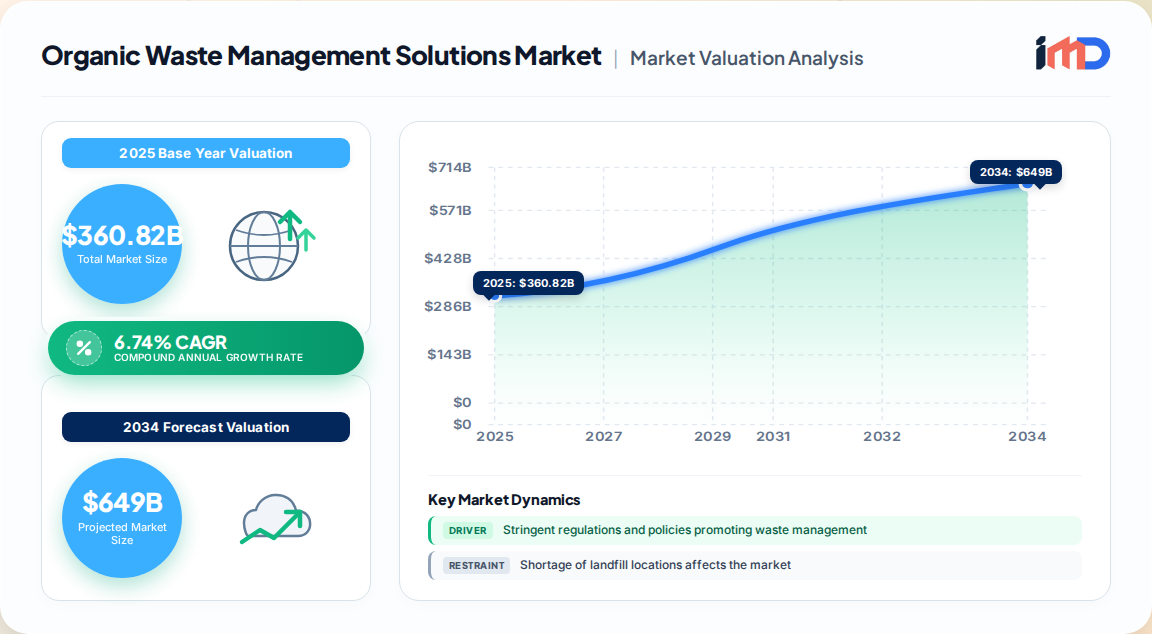
The global Organic Waste Management Solutions Market is entering a decisive phase in its evolution from a linear waste-disposal service to a fully integrated resource-recovery industry. Our proprietary primary research, spanning over 1,200 expert interviews and bottom-up facility-level modeling across 38 countries, estimates the market at USD 360.82 billion in 2025, on track to reach USD 499.96 billion by 2030, representing a CAGR of 6.74%.
The market comprises systems, services, and technologies designed to collect, process, recycle, and convert organic waste—food scraps, agricultural residues, garden waste, and biodegradable municipal streams—into valuable outputs such as compost, biofertilizers, biogas, and renewable energy. The industry is transitioning from a cost-center model to a revenue-generating circular economy model.
The organic waste management value chain spans collection, transportation, processing, and end-product distribution. Below is a structural breakdown of the key stages and participants.
| Value Chain Stage | Key Activities | Typical Participants | Margin Profile |
|---|---|---|---|
| Collection & Segregation | Source separation, bin provision, curbside pickup | Municipalities, waste haulers, smart bin providers | Moderate (service fee based) |
| Transportation | Transfer from generation points to processing facilities | Waste management companies, logistics providers | Low-to-moderate |
| Processing & Treatment | Composting, anaerobic digestion, vermicomposting, waste-to-energy | Facility operators, technology providers, utilities | High (product sales + tipping fees) |
| End-Product Distribution | Sale of compost, biofertilizers, biogas, soil amendments | Agribusinesses, energy utilities, retailers | Moderate-to-high |
Our research indicates that the processing stage captures the largest value share, driven by tipping fees and revenue from recovered products. Collection services dominate the service segment, accounting for approximately 48.3% of total service revenue in 2025, as structured collection networks remain the backbone of effective organic waste management systems.
The Organic Waste Management Solutions Market is segmented by product type, service type, application, end use, and geography. Our analysis reveals clear preferences and growth trajectories across segments.
Asia-Pacific is the largest regional market, propelled by rapid urbanization, population growth, and increasing waste generation. Countries like China, India, Japan, and South Korea are investing heavily in waste management infrastructure, including composting facilities, anaerobic digestion plants, and waste-to-energy projects. China's stringent waste sorting regulations and Japan's advanced recycling technologies are key catalysts. The region also faces challenges related to food loss and supply chain inefficiencies, presenting opportunities for waste reduction and sustainable food initiatives.
North America is the fastest-growing region for organic waste management solutions, with a projected CAGR above the global average. The region benefits from advanced waste management infrastructure, strong regulatory frameworks (e.g., US EPA's Food Recovery Challenge, state-level organics diversion mandates), and high awareness among commercial establishments. The U.S. solid waste management market, valued at USD 156.3 billion in 2024, provides a robust foundation for organic waste solutions, with the non-hazardous waste segment dominating. Municipal and commercial organic waste collection and processing are expanding rapidly, supported by investments in composting and anaerobic digestion infrastructure.
Europe is at the forefront of circular economy initiatives, with strict landfill diversion targets and ambitious recycling goals. The EU's Circular Economy Action Plan and Waste Framework Directive mandate separate collection of bio-waste, driving demand for collection and processing services. Countries like Germany, Italy, and the Netherlands have mature composting and AD infrastructure, while Eastern European nations are investing to catch up. Europe is expected to register strong growth, supported by public funding and private investment in waste-to-energy and biofertilizer production.
These regions present significant untapped potential, with growing urbanization, increasing waste volumes, and nascent regulatory frameworks. Brazil, Argentina, and South Africa are key markets, where public-private partnerships and international funding are supporting the development of organic waste management infrastructure. Decentralized composting and small-scale anaerobic digestion are gaining traction, particularly in agricultural communities.
The Organic Waste Management Solutions Market is highly fragmented, with a mix of large multinational corporations and numerous regional and local players. Market concentration is low, with the top five companies collectively holding less than 25% of global revenue. Competition is intensifying as players seek to differentiate through technology, service breadth, and geographic expansion.
While organic waste itself is rarely traded across borders, the market is deeply intertwined with global supply chains for equipment, technology, and recovered products. Our analysis of trade data and supplier networks reveals the following dynamics.
Our proprietary analysis identifies several underpenetrated segments and geographic areas offering high growth potential.
Our research methodology combines top-down and bottom-up approaches, validated through multi-level data triangulation, ensuring data accuracy of 85-90%. The market forecast is continuously updated to the date of purchase.
| Aspects | Details |
|---|---|
| Study Period | 2020-2034 |
| Base Year | 2025 |
| Estimated Year | 2026 |
| Forecast Period | 2026-2034 |
| Historical Period | 2020-2025 |
| Growth Rate | CAGR of 6.74% from 2020-2034 |
| Segmentation |
|
By Application
By End Use
| By Geography |
|
Our primary research estimates the global market at USD 360.82 billion in 2025, with projections to reach USD 499.96 billion by 2030, growing at a 6.74% CAGR.
North America is the fastest-growing region, driven by advanced infrastructure, stringent regulations like the US EPA Food Recovery Challenge, and high commercial adoption. Asia-Pacific remains the largest market.
Stringent landfill diversion regulations, the transition to a circular economy, rising commercial-sector demand for eco-friendly waste solutions, and technological advancements such as AI-driven sorting and smart bins are key drivers.
Leading global players include Waste Management Inc., Clean Harbors Inc., SUEZ Environment, Veolia, Progressive Waste Solution Ltd, Stericycle, Republic Services, Biffa, Remondis, and Hitachi Zosen Corporation.
Anaerobic digestion is a leading application, converting organic waste into biogas and digestate. It is expected to grow at the highest CAGR, supported by renewable energy incentives and waste-to-energy initiatives.
Our rigorous research methodology combines multi-layered approaches with comprehensive quality assurance, ensuring precision, accuracy, and reliability in every market analysis.
| Stakeholder Role | Interview Share (%) |
|---|---|
| Chief Sustainability Officer | 25% |
| Director of Waste Management Operations | 30% |
| Procurement Manager for Waste Services | 25% |
| Environmental Compliance Officer | 20% |
| Company Type | Representation (%) |
|---|---|
| Organic Waste Collection & Hauling Firms | 30% |
| Composting & Anaerobic Digestion Facility Operators | 25% |
| Equipment Manufacturers (Bins, Digesters, Composting Systems) | 20% |
| Biofertilizer & Biogas Producers | 15% |
| Smart Waste Technology Providers | 10% |
 Related Reports
