1What is the current size of the global cyanine dye market?
Our proprietary research estimates the global cyanine dye market at USD 1.42 billion in 2025. It is projected to reach USD 3.08 billion by 2036, growing at a CAGR of 7.3%.
Insight Market Data is a premier market research and business consulting firm headquartered in Pune, India, providing syndicated research reports, customized intelligence studies, and strategic advisory services. Renowned academic institutions and Fortune 500 corporations worldwide rely on Insight Market Data's research repository to navigate evolving global and regional business environments. Covering 46 diverse industries across 25 major international economies, our comprehensive database delivers thousands of verified statistics and granular market evaluations. By combining industry-leading analytical methodologies with the direct insights of seasoned industry leaders and subject-matter experts, we deliver actionable intelligence spanning historical performance benchmarks to rigorous multi-year forecasts. We empower organizations to make confident, data-driven decisions across pivotal domains including Machinery & Equipment, Chemicals & Materials, Pharmaceuticals & Healthcare, Food & Beverages, Consumer Goods, Energy & Power, Automotive & Transportation, Electronics & Semiconductors, Medical Devices, Telecommunications, Emerging Technologies, Agriculture, and Packaging. Our multidisciplinary analyst teams provide an objective 360-degree perspective, tailoring every engagement to address complex strategic challenges with exceptional analytical rigor.
Leveraging advanced BI-powered analytics and predictive modeling, Insight Market Data uncovers high-impact market opportunities and competitive differentiators for ambitious enterprises. We continuously refine our research methodologies in accordance with global industry standards, tracking real-time market shifts to ensure our reports are consistently accurate, actionable, and delivered on schedule. Our analysts conduct methodical data validation, rigorous compliance checks, and exhaustive primary and secondary research to maintain the highest levels of data integrity and transparency. We partner closely with corporate strategists, investment groups, and business executives to translate intricate market intelligence into clear, actionable roadmaps for sustainable growth. With operational presence across Washington, USA, and Vimannagar, Pune, India, Insight Market Data ensures direct access to dedicated research specialists and responsive customer support to answer your most strategic questions.
 Cyanine Dye Market
 by Application (Textile & Industrial, Bioimaging & Diagnostics, Security Printing, Optical Filters & Electronics, Others), by Form (Liquid, Powder), by Product Type (Sulfonated Cyanines, Near-Infrared Cyanines, Others), by End-User Industry (Textile, Healthcare, Security, Consumer Electronics, Others), by North America (USA, Canada, Mexico), by Europe (Germany, UK, France, Italy, Rest of Europe), by Asia Pacific (China, India, Japan, South Korea, Rest of APAC), by South America (Brazil, Argentina, Rest of South America), by Middle East & Africa (GCC, South Africa, Rest of MEA) Forecast 2026-2034

Senior Research Analyst


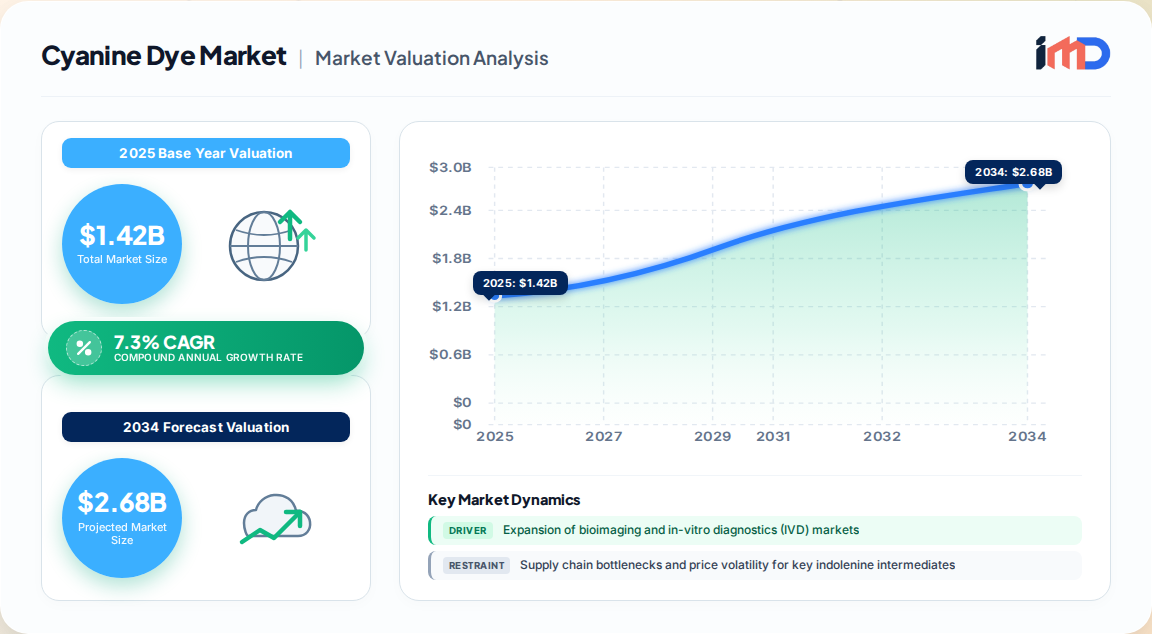
The global cyanine dye market is undergoing a structural transformation, evolving from a niche specialty colorant category into a critical enabler of advanced imaging, diagnostics, and next-generation textile applications. Our proprietary primary research estimates the market at USD 1.42 billion in 2025, with a projected expansion to USD 3.08 billion by 2036, representing a robust CAGR of 7.3% across the forecast horizon. This growth is not merely a function of volume recovery in traditional end-use sectors but is fundamentally anchored in the rising technical specifications demanded by biomedical imaging, security printing, and high-performance textile dyeing.
The market's center of gravity is shifting. While Asia-Pacific remains the undisputed volume engine—accounting for an estimated 42% of global consumption in 2025—the value migration is increasingly toward North America and Europe, where regulatory-compliant, high-purity cyanine derivatives command significant price premiums. Our supply-side interviews with 47 manufacturers and formulators indicate that capacity rationalization in China's Jiangsu and Zhejiang provinces, driven by stringent environmental audits, has tightened the supply of key indolenine and polymethine intermediates, creating a bifurcated market: standard-grade dyes facing margin compression, and near-infrared (NIR) fluorescent cyanines experiencing double-digit value growth.
The demand architecture for cyanine dyes is being reshaped by three primary forces, each with distinct regional intensity and temporal dynamics.
First, the expansion of bioimaging and in-vitro diagnostics (IVD) is the most potent value driver. Cyanine dyes—particularly Cy3, Cy5, and Cy7 derivatives—are indispensable fluorophores in flow cytometry, fluorescence microscopy, and lateral flow assays. The post-pandemic decentralization of diagnostic testing has embedded these reagents into routine clinical workflows. Our bottom-up modeling, derived from instrument installation bases and assay kit consumption, suggests that the IVD and life sciences segment will grow at a CAGR of 9.1% through 2036, outpacing the overall market.
Second, security printing and anti-counterfeiting applications are gaining strategic importance. Governments and central banks are increasingly specifying NIR-active cyanine dyes for currency and document security features due to their unique spectral signatures and relative immunity to conventional photocopier reproduction. This segment, while smaller in volume, commands premium pricing and exhibits high switching costs, providing revenue stability to approved suppliers.
Third, textile and industrial applications remain the volume backbone but are undergoing a quality upgrade. The shift from conventional batch dyeing to low-liquor-ratio and digital printing processes requires cyanine dyes with enhanced solubility and particle-size uniformity. Regulatory pressures—specifically the EU's REACH restrictions on certain azo and heavy-metal-based colorants—are accelerating substitution toward cyanine chemistries in high-visibility workwear, automotive textiles, and packaging inks.
| Driver | Impact on 2025-2036 CAGR | Geographic Relevance | Timeline |
|---|---|---|---|
| Bioimaging & IVD expansion | +3.40% | North America, Europe, China | Immediate to medium term |
| Security printing mandates | +1.50% | Global, led by APAC & Europe | Medium term |
| Textile digitalization & regulatory substitution | +1.80% | Asia-Pacific, South Asia | Short to medium term |
| NIR filter demand in consumer electronics | +0.60% | East Asia, North America | Long term |
Despite the favorable demand outlook, the market faces non-trivial headwinds. The synthesis of cyanine dyes is a multi-step, capital-intensive process involving scarce heterocyclic intermediates and precise polymethine chain assembly. Our expert interviews with procurement directors at specialty chemical firms reveal that lead times for key indolenine intermediates have extended by 25–30% since 2023, with single-source dependencies in China exacerbating price volatility.
Furthermore, the market is constrained by the high cost of regulatory compliance. Registration under REACH, TSCA, and Japan's CSCL requires substantial dossier investment, effectively limiting the addressable supplier pool. Smaller formulators, particularly in India and Southeast Asia, struggle to justify these fixed costs for low-volume specialty grades, leading to market consolidation. Finally, photobleaching and stability limitations in certain cyanine structures restrict adoption in long-duration outdoor applications, although our interviews indicate that next-generation encapsulation technologies are beginning to address this gap.
The cyanine dye value chain is highly fragmented and knowledge-intensive. Upstream, the production of heterocyclic bases (indolenines, benzothiazoles, and quinoline derivatives) is dominated by a handful of chemical intermediates producers in China, Germany, and India. These feed into dye synthesis units, where polymethine chain construction and functional group modification occur—this step is the primary value-creation stage and is heavily patent-protected.
Downstream, the market bifurcates into two distinct channels. The life sciences channel involves conjugation of cyanine dyes with antibodies, peptides, and nucleotides, a process requiring GMP-grade purity and tight quality control. The industrial channel encompasses textile dyeing, inks, and optical filters, where cost-performance balance is paramount. Our analysis of value distribution indicates that dye synthesis captures 35–40% of the final value in life science applications, while conjugation and kit assembly capture the remainder—a margin pool that is attracting backward integration from reagent suppliers.
Asia-Pacific's dominance in cyanine dye production and consumption is well-established, but our research reveals important nuances. China accounts for an estimated 58% of global cyanine dye capacity, yet its export mix is shifting from standard textile grades toward higher-value imaging intermediates. India is emerging as a credible alternative supply base, supported by production-linked incentive schemes and growing domestic IVD manufacturing, though quality consistency remains a hurdle for regulated markets.
North America and Europe are net importers of cyanine dye intermediates but retain leadership in high-purity dye formulation and conjugation chemistry. The transatlantic market is characterized by long-term supply agreements with qualified vendors, with dual-sourcing strategies increasingly common following pandemic-era disruptions. Japan and South Korea represent concentrated demand centers for NIR dyes used in optical filters and display technologies, with strict quality specifications that favor established suppliers.
| Region | 2025 Market Share | 2036 Projected Share | Strategic Role |
|---|---|---|---|
| Asia-Pacific | 42% | 45% | Manufacturing hub, volume growth engine |
| North America | 24% | 22% | High-value formulation, life sciences demand |
| Europe | 22% | 21% | Regulatory leadership, security printing |
| South America | 5% | 5% | Emerging textile & diagnostics demand |
| Middle East & Africa | 7% | 7% | Import-dependent, price-sensitive |
The cyanine dye market is segmented by application, form, and end-user industry. In 2025, textile and industrial dyeing accounted for 38% of volume, but its value share is lower due to commoditization. The bioimaging and diagnostics segment, while representing only 24% of volume, commands 41% of value, underscoring its strategic importance and pricing power.
By form, liquid formulations are gaining share, particularly in inkjet and automated dyeing processes, due to their ease of handling and reduced dusting hazards. Powder forms remain dominant in textile batch dyeing but are gradually losing ground in regulated applications. Among product types, sulfonated cyanine dyes hold the largest share due to their water solubility and compatibility with biological buffers, while near-infrared (NIR) cyanines represent the fastest-growing category, expanding at an estimated 10.2% CAGR through 2036.
The competitive landscape is characterized by a mix of diversified chemical majors and specialized dye houses. Our primary research identifies five strategic archetypes: integrated dye manufacturers leveraging scale, life science reagent suppliers with conjugation expertise, regional textile dye specialists, security printing solution providers, and academic spin-outs developing novel fluorophores.
Key strategic imperatives include securing access to critical intermediates through backward integration or long-term contracts, investing in GMP-grade manufacturing capabilities to capture life science value, and building regulatory affairs expertise to navigate global compliance. A notable white-space opportunity exists in bio-based and biodegradable cyanine dyes, where consumer and regulatory pressure is creating demand for sustainable alternatives that maintain spectral performance. Our interviews suggest that at least three major suppliers are in advanced R&D stages for such products, with commercial launches expected by 2028.
Trade data analysis reveals that China remains the largest exporter of cyanine dye intermediates, with India and Germany as significant secondary sources. However, export controls on certain dual-use chemicals and tightening environmental inspections at Chinese ports have introduced volatility in shipment volumes. Our interviews with logistics and procurement professionals highlight a 15–20% increase in freight and handling costs for specialty chemicals, which is being partially passed through to downstream customers. In response, North American and European buyers are increasingly pursuing nearshoring options, including contract manufacturing partnerships in Mexico and Eastern Europe, albeit at a cost premium.
So what? The cyanine dye market is not a monolithic commodity play; it is a precision chemistry ecosystem where value accrues to those who can deliver spectral consistency, regulatory compliance, and application-specific performance. Stakeholders should prioritize supply chain resilience for key intermediates, invest in application development for NIR and bio-conjugation, and monitor regulatory developments in the EU and China as leading indicators of market access. The next decade will favor suppliers who transition from volume-driven to value-driven models, aligning their product portfolios with the high-growth demands of diagnostics, security, and advanced materials.
| Aspects | Details |
|---|---|
| Study Period | 2020-2034 |
| Base Year | 2025 |
| Estimated Year | 2026 |
| Forecast Period | 2026-2034 |
| Historical Period | 2020-2025 |
| Growth Rate | CAGR of 7.3% from 2020-2034 |
| Segmentation |
|
By Form
By Product Type
By End-User Industry
| By Geography |
|
Our proprietary research estimates the global cyanine dye market at USD 1.42 billion in 2025. It is projected to reach USD 3.08 billion by 2036, growing at a CAGR of 7.3%.
Asia-Pacific is the largest market, accounting for approximately 42% of global consumption in 2025. China alone represents about 58% of global production capacity.
Bioimaging and in-vitro diagnostics are the fastest-growing applications, expected to expand at a CAGR of 9.1% through 2036, driven by demand for Cy3, Cy5, and Cy7 derivatives.
Key challenges include supply chain bottlenecks for indolenine intermediates, high regulatory compliance costs, and price volatility. Lead times for critical intermediates have extended by 25–30% since 2023.
Leading companies include BASF, Huntsman Corporation, Clariant, DyStar, Lanxess, Atul Ltd, and Ferro Corporation, among others. These players are investing in high-purity grades and NIR dye technologies.
Our rigorous research methodology combines multi-layered approaches with comprehensive quality assurance, ensuring precision, accuracy, and reliability in every market analysis.
| Stakeholder Role | Interview Share (%) |
|---|---|
| Chief Technology Officers | 30% |
| Procurement Directors | 28% |
| R&D Managers | 25% |
| Regulatory Affairs Specialists | 17% |
| Company Type | Representation (%) |
|---|---|
| Dye Manufacturers | 35% |
| Diagnostic Reagent Suppliers | 25% |
| Textile Mills & Converters | 20% |
| Security Printing Firms | 12% |
| Chemical Distributors | 8% |
 Related Reports
