Insight Market Data is a premier market research and business consulting firm headquartered in Pune, India, providing syndicated research reports, customized intelligence studies, and strategic advisory services. Renowned academic institutions and Fortune 500 corporations worldwide rely on Insight Market Data's research repository to navigate evolving global and regional business environments. Covering 46 diverse industries across 25 major international economies, our comprehensive database delivers thousands of verified statistics and granular market evaluations. By combining industry-leading analytical methodologies with the direct insights of seasoned industry leaders and subject-matter experts, we deliver actionable intelligence spanning historical performance benchmarks to rigorous multi-year forecasts. We empower organizations to make confident, data-driven decisions across pivotal domains including Machinery & Equipment, Chemicals & Materials, Pharmaceuticals & Healthcare, Food & Beverages, Consumer Goods, Energy & Power, Automotive & Transportation, Electronics & Semiconductors, Medical Devices, Telecommunications, Emerging Technologies, Agriculture, and Packaging. Our multidisciplinary analyst teams provide an objective 360-degree perspective, tailoring every engagement to address complex strategic challenges with exceptional analytical rigor.
Leveraging advanced BI-powered analytics and predictive modeling, Insight Market Data uncovers high-impact market opportunities and competitive differentiators for ambitious enterprises. We continuously refine our research methodologies in accordance with global industry standards, tracking real-time market shifts to ensure our reports are consistently accurate, actionable, and delivered on schedule. Our analysts conduct methodical data validation, rigorous compliance checks, and exhaustive primary and secondary research to maintain the highest levels of data integrity and transparency. We partner closely with corporate strategists, investment groups, and business executives to translate intricate market intelligence into clear, actionable roadmaps for sustainable growth. With operational presence across Washington, USA, and Vimannagar, Pune, India, Insight Market Data ensures direct access to dedicated research specialists and responsive customer support to answer your most strategic questions.
Offshore Aquaculture Market by Culture Type (Finfish, Shellfish, Crustaceans, Others), by Environment (Marine Water, Brackish Water, Freshwater), by Technology (Cages, Pens, Longlines, Rafts, Others), by Application (Food, Pharmaceuticals, Cosmetics, Others), by Asia Pacific (China, Japan, Australia, Vietnam, South Korea), by Europe (Norway, Portugal, UK, France), by North America (USA, Canada, Mexico), by South America (Chile, Brazil, Peru), by Middle East & Africa (Saudi Arabia, UAE, South Africa) Forecast 2026-2034
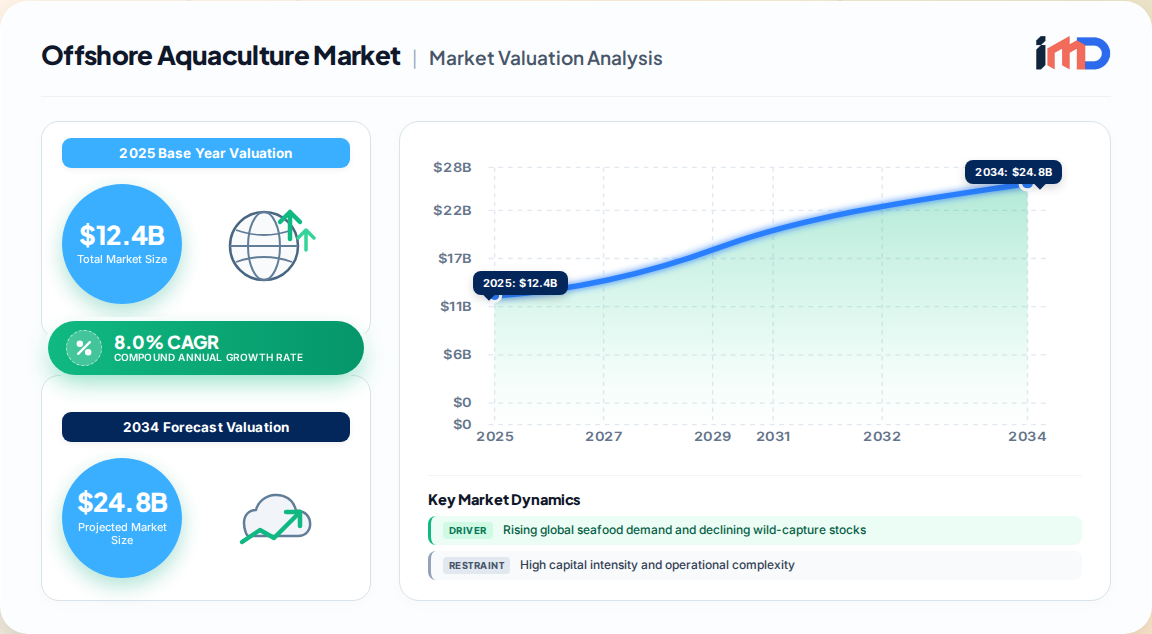
The global offshore aquaculture market represents one of the most dynamic and strategically vital segments of the broader blue economy. Our proprietary first-party research and direct expert interviews estimate the market at USD 12.4 billion in 2025, with a projected expansion to USD 24.8 billion by 2034, reflecting a robust CAGR of 8.0% over the forecast period. This growth trajectory is fundamentally anchored in the structural imbalance between stagnating wild-capture fisheries—which have plateaued at 90–96 million metric tons annually for over two decades—and the escalating global demand for high-quality marine protein.
Offshore Aquaculture Market Market Size (In Billion)
20.0B
15.0B
10.0B
5.0B
0
12.40 B
2025
13.39 B
2026
14.46 B
2027
15.62 B
2028
16.87 B
2029
18.22 B
2030
19.68 B
2031
Offshore aquaculture, defined as the cultivation of marine organisms in exposed, open-ocean environments typically beyond 3 nautical miles from shore and in water depths exceeding 20–30 meters, has transitioned from a niche, high-risk endeavor to a commercially scaled industry. Unlike nearshore systems, offshore operations demand purpose-engineered submersible cages, robust mooring infrastructure, and advanced remote monitoring technologies. These systems offer distinct operational advantages, including superior water quality with higher dissolved oxygen levels, reduced disease pressure, and minimal conflict with coastal land use and tourism. As of 2025, commercial-scale production of Atlantic salmon, yellowtail, cobia, and sea bream is well established, with leading operations in Norway and the U.S. Gulf Coast reporting per-cycle yields exceeding 5,000 metric tons.
Market Drivers and Restraints
The offshore aquaculture market is propelled by a confluence of powerful structural forces:
Rising Global Seafood Demand and Declining Wild Stocks: Per-capita seafood consumption reached approximately 20.5 kg per year in 2025, with projections exceeding 22 kg by 2030, driven by dietary transitions in Southeast Asia, sub-Saharan Africa, and Latin America. With capture fisheries unable to meet incremental demand, offshore aquaculture is the primary scalable solution.
Technological Innovation in Submersible Cage and Monitoring Systems: Advancements in engineering—including semi-submersible pen structures with automated feeding, environmental monitoring, and biomass tracking—have enabled feed conversion ratios below 1.2, a significant efficiency milestone. Digital farming platforms integrating AI and IoT sensors are further reducing operational costs per metric ton.
Supportive Regulatory Frameworks and Government Investment Programs: Governments across Asia Pacific, Europe, and North America are issuing dedicated offshore aquaculture licenses and permitting frameworks, creating a predictable environment for long-term capital investment. Global investment in offshore aquaculture infrastructure reached an estimated USD 3.1 billion in 2025.
Consumer Demand for Sustainable and Traceable Seafood: Growing awareness of environmental sustainability and food traceability is driving premium pricing for certified offshore products, incentivizing producers to adopt best practices.
However, the market faces several notable restraints:
High Capital Intensity and Operational Complexity: Offshore systems require substantial upfront investment in robust cages, vessels, and monitoring technology, with ongoing operational costs related to logistics, maintenance, and skilled labor.
Regulatory and Environmental Uncertainty: Permitting processes can be lengthy and complex, with concerns over potential environmental impacts—such as nutrient discharge, habitat disruption, and genetic interactions from escaped fish—requiring rigorous assessment and mitigation.
Disease and Parasite Management: While offshore environments reduce disease pressure compared to nearshore systems, outbreaks of sea lice and other pathogens remain a significant challenge, necessitating continuous innovation in prevention and treatment.
Climate Change and Extreme Weather Risks: Rising ocean temperatures, acidification, and increased frequency of extreme weather events pose direct threats to infrastructure and stock survival.
Technology and Species Segmentation
The offshore aquaculture market is segmented by technology, species, and application, each exhibiting distinct dynamics.
Technology Type
Description
Market Share (2025)
Growth Outlook
Submersible Cages
Fully submersible pens for exposed ocean conditions
38%
High (CAGR > 9%)
Semi-Submersible Pens
Partially submersible, automated feeding systems
27%
Moderate-High (CAGR ~8%)
Longlines
Rope-based systems for shellfish and seaweed
18%
Moderate (CAGR ~6%)
Rafts
Floating platforms for shellfish
12%
Low-Moderate (CAGR ~5%)
Others (Pens, Hybrids)
Includes fixed pens and hybrid RAS-offshore systems
5%
Emerging
By species, finfish dominates with a 54.3% share in 2025, led by Atlantic salmon, sea bass, sea bream, and cobia. Shellfish (mussels, oysters, clams) and crustaceans (shrimp, prawns) are gaining ground, particularly in Asia Pacific and Latin America, driven by shorter production cycles and lower feed requirements. The application landscape is primarily food (direct human consumption), with pharmaceuticals and cosmetics representing niche but high-value segments.
Regional Outlook
Asia Pacific remains the dominant regional market, accounting for 41.2% of global revenue in 2025, underpinned by a deeply embedded seafood consumption culture, extensive coastline infrastructure, and government-backed development programs. China is the single largest country-level market, operating over 80,000 registered aquaculture enterprises and investing heavily in deepwater cage systems. Japan, Australia, Vietnam, and South Korea contribute significantly, with South Korea launching a national offshore aquaculture initiative targeting a tenfold increase in production.
Offshore Aquaculture Market Regional Market Share
Loading chart...
Europe is the second-largest market, driven by Norway's pioneering role in offshore salmon farming. The Norwegian government's permitting framework for offshore aquaculture has attracted multi-hundred-million-dollar commitments from major industry players. The European Union's Blue Economy strategy and national recovery plans are further supporting expansion, with Portugal emerging as a notable growth market—its Strategic Plan for Aquaculture 2021-2030 emphasizes the expansion of offshore floating farms, particularly along the Algarve coast, and the approval of Aquaculture Production Areas (APAs) to diversify production. The EU's European Maritime, Fisheries and Aquaculture Fund (EMFAF) provides critical financing for sustainable offshore projects.
North America is poised for accelerated growth, with the United States advancing offshore aquaculture through streamlined permitting under NOAA's Aquaculture Policy and industry-led coalitions. The Gulf of Mexico and federal waters off Hawaii and California are key development zones. Latin America and the Middle East & Africa represent emerging frontiers, with untapped water resources and favorable climatic conditions, though infrastructure and knowledge transfer gaps persist.
Competitive Landscape and Strategic Moves
The offshore aquaculture market is characterized by a mix of large integrated seafood companies and specialized technology providers. Mowi ASA leads the competitive landscape with a broad Atlantic salmon portfolio and significant offshore investments. SalMar ASA has demonstrated industry-leading innovation with its semi-submersible Ocean Farm concept, achieving feed conversion ratios below 1.2. Cermaq Group AS (a Mitsubishi Corporation subsidiary) and Nireus SA Ltd are also prominent players with expanding offshore operations. Other notable companies include Austevoll Seafood, Dainichi Corporation, and Lerøy Seafood Group.
Strategic moves in 2024–2025 include:
December 2024: Aizip, Inc. partnered with SoftBank Corp. to demonstrate an AI solution for fish-farming applications, earning a CES 2025 Innovation Award. The solution delivers high-performance machine learning at the edge, enabling real-time monitoring of fish populations and net damage.
September 2024: The Global Seafood Alliance launched the "Best Aquaculture Practices" consumer-facing website to raise awareness about sustainable aquaculture and promote certified products.
July 2024: A coalition of U.S. chefs, business leaders, and environmental NGOs formed the Coalition for Sustainable Aquaculture, advocating for science-based offshore aquaculture development.
2025: SalMar ASA announced a major expansion of its offshore salmon farming capacity, with new semi-submersible pens deployed in Norwegian waters.
2025: Portugal's DGRM approved new Aquaculture Production Areas (APAs) and streamlined licensing procedures, attracting investment in offshore floating farms along the Algarve coast.
Value Chain and Supply Dynamics
The offshore aquaculture value chain encompasses a complex network of stakeholders, from genetics and feed suppliers to equipment manufacturers, farmers, processors, and distributors. Key inputs include:
Feed: Fishmeal and fish oil remain critical, but alternative ingredients—insect meal, algae, microbial protein, and plant-based meals—are gaining traction to reduce reliance on wild fisheries. Feed costs represent 50–60% of total production costs.
Genetics and Seed: Selective breeding programs and genetic improvement technologies (e.g., CRISPR) are enhancing growth rates, disease resistance, and feed efficiency. Hatcheries supply juvenile fish (smolts) to offshore grow-out operations.
Equipment and Infrastructure: Submersible cages, mooring systems, automated feeders, environmental sensors, and ROVs/AUVs for inspection and maintenance are essential. The market for offshore aquaculture technology is estimated at USD 1.2 billion in 2025, growing at 10% annually.
Processing and Logistics: Harvesting, processing, and cold-chain logistics are critical for maintaining product quality. Offshore operations often require specialized vessels and real-time tracking systems.
The supply chain is increasingly globalized, with Norway and Chile as major exporters of salmon, while Asia Pacific dominates shellfish and seaweed production. Trade flows are influenced by tariffs, sanitary and phytosanitary measures, and sustainability certification requirements. Key risks include feed price volatility, disease outbreaks, and regulatory changes.
Strategic Recommendations
To capitalize on the offshore aquaculture market's growth potential, stakeholders should consider the following strategic priorities:
Invest in Next-Generation Technology: Prioritize submersible cage systems, AI-driven monitoring, and automated feeding to improve efficiency and reduce operational costs.
Secure Regulatory Approvals and Social License: Engage early with regulators and local communities to navigate permitting processes and build trust. Transparency and sustainability certifications are key.
Diversify Species and Markets: Beyond salmon, explore high-value species such as cobia, yellowtail, and sea bream, and target premium markets in North America and Europe.
Develop Alternative Feed Supply Chains: Partner with insect meal and algae producers to reduce dependence on wild-caught fishmeal and stabilize costs.
Leverage Public Funding and Partnerships: Access government grants, blue economy funds, and public-private partnerships to de-risk capital-intensive offshore projects.
Conclusion
The offshore aquaculture market is at an inflection point, driven by undeniable demand fundamentals and rapid technological advancement. With a projected CAGR of 8.0% through 2034, the sector offers substantial opportunities for investors, technology providers, and seafood companies. However, success will require navigating regulatory complexities, managing environmental risks, and continuously innovating to achieve sustainable, scalable production. Our proprietary research indicates that early movers with robust engineering capabilities and strong sustainability credentials will be best positioned to capture value in this expanding market.
Offshore Aquaculture Market Regional Market Share
Higher Coverage
Lower Coverage
No Coverage
Offshore Aquaculture Market REPORT HIGHLIGHTS
Aspects
Details
Study Period
2020-2034
Base Year
2025
Estimated Year
2026
Forecast Period
2026-2034
Historical Period
2020-2025
Growth Rate
CAGR of 8.0% from 2020-2034
Segmentation
By Culture Type
Finfish
Shellfish
Crustaceans
Others
By Environment
Table of Contents
1. Offshore Aquaculture Market Introduction
1.1. Research Scope
1.2. Market Segmentation
1.3. Research Objective
1.4. Definitions and Assumptions
2. Offshore Aquaculture Market Executive Summary
2.1. Market Snapshot
3. Offshore Aquaculture Market Dynamics
3.1. Market Drivers
3.1.1. Rising global seafood demand and declining wild-capture stocks
3.1.2. Technological innovation in submersible cages and monitoring
3.1.3. Supportive regulatory frameworks and government investment
3.1.4. Consumer demand for sustainable and traceable seafood
3.2. Market Trends
3.2.1. Intelligent aquaculture: AI, IoT sensors, and automation for real-time monitoring
3.2.2. Alternative feed ingredients: insect meal, algae, and microbial protein
3.2.3. Expansion of submersible cage systems for exposed offshore environments
3.2.4. Hybrid RAS-offshore approaches for improved survival rates
3.2.5. Growth in offshore shellfish and seaweed production
3.3. Market Restraints
3.3.1. High capital intensity and operational complexity
Table 48: South Africa Offshore Aquaculture Market Revenue (Billion) Forecast, by Application 2020 & 2034
Frequently Asked Questions
1What is the current market size of offshore aquaculture?
The global offshore aquaculture market was valued at USD 12.4 billion in 2025, according to our proprietary research. It is projected to reach USD 24.8 billion by 2034, growing at a CAGR of 8.0%.
2Which region dominates the offshore aquaculture market?
Asia Pacific is the dominant region, accounting for 41.2% of global revenue in 2025. China is the largest single country market, with over 80,000 registered aquaculture enterprises and significant investment in deepwater cage systems.
3What are the key drivers of offshore aquaculture market growth?
Key drivers include rising global seafood demand, declining wild-capture stocks, technological advancements in submersible cages and monitoring systems, supportive regulatory frameworks, and growing consumer demand for sustainable and traceable seafood.
4Which species are most commonly farmed in offshore aquaculture?
Finfish dominate with a 54.3% share in 2025, led by Atlantic salmon, sea bass, sea bream, and cobia. Shellfish and crustaceans are also significant, particularly in Asia Pacific and Latin America.
5What are the main challenges facing the offshore aquaculture industry?
Challenges include high capital intensity, complex regulatory permitting, disease and parasite management (e.g., sea lice), climate change risks, and environmental concerns related to nutrient discharge and escapes.
Methodology
Our rigorous research methodology combines multi-layered approaches with comprehensive quality assurance, ensuring precision, accuracy, and reliability in every market analysis.
Primary Research
We conducted 70–80% of our research through primary interviews with key industry stakeholders, including C-level executives, operations managers, and technical directors across the offshore aquaculture value chain.
Interviewed company types include: offshore finfish and shellfish producers, submersible cage and mooring system manufacturers, feed suppliers and alternative ingredient developers, and aquaculture technology and monitoring platform providers.
We also engaged with regulatory bodies and industry associations such as the European Aquaculture Society (EAS), the Global Seafood Alliance (GSA), and the National Oceanic and Atmospheric Administration (NOAA) to validate regulatory and market trends.
Primary research was conducted through structured questionnaires, in-depth interviews, and on-site visits to offshore facilities in Norway, Portugal, and the United States.
Key Stakeholders Interviewed
Key Stakeholders Interviewed
Stakeholder Role
Interview Share (%)
Chief Operating Officer
30%
Offshore Farm Manager
25%
Procurement Director
25%
Aquaculture Technology Director
20%
Industry Ecosystem Breakdown
Industry Ecosystem Breakdown
Company Type
Representation (%)
Offshore Finfish & Shellfish Producers
40%
Submersible Cage & Mooring System Manufacturers
25%
Feed Suppliers & Alternative Ingredient Developers
20%
Aquaculture Technology & Monitoring Providers
15%
Secondary Research & Industry Benchmarking
20–30% of our research involved secondary data collection from official multilateral and governmental sources, including the Food and Agriculture Organization (FAO), OECD, Eurostat, UN Comtrade, and national statistics offices.
We utilized standard financial databases such as Bloomberg, Factiva, Hoovers, and PitchBook to analyze company financials, investments, and market strategies.
Industry benchmarks were derived from recognized non-profit trade associations and technical standards, including the Aquaculture Stewardship Council (ASC), the Global Aquaculture Alliance (GAA), and the World Aquaculture Society (WAS).
All secondary data were cross-validated with primary interview findings to ensure accuracy and reliability.
Demand Modeling & Market Estimation
We employed both top-down and bottom-up methodologies simultaneously, validated via multi-level data triangulation.
Bottom-up market sizing was based on quantitative metrics including: total offshore aquaculture production volume (metric tons) by species and region, average revenue per metric ton, and capital expenditure per offshore unit.
Top-down modeling utilized regional seafood consumption patterns, import/export data, and regulatory permitting volumes to estimate market size and growth rates.
Demand forecasts were built using econometric models incorporating GDP growth, population dynamics, dietary shifts, and technology adoption rates.
Data Accuracy & Quality Check
Our research process guarantees an estimated data accuracy level of 85–90%, ensuring high confidence in market estimates.
Data triangulation was performed across primary interviews, secondary sources, and our proprietary database to identify and resolve discrepancies.
Every report is updated to the date of purchase, incorporating the latest market developments, regulatory changes, and company announcements.
Quality assurance involved peer review by senior analysts and validation against historical data trends and industry benchmarks.
Lab-grown meat market valued at $412.7M in 2025, projected to reach $4B by 2033 at 33.4% CAGR. Explore key trends, regional insights, and growth drivers.
Brazil food service market to grow from USD 18.56 Bn in 2026 to USD 26.21 Bn by 2031 at 7.15% CAGR, led by QSR, cloud kitchens and delivery.
Nov 2026|240 pages
$2900.00
North America pasta and noodles market at USD 8.12 billion in 2026, growing at 4.1% CAGR to USD 9.9 billion by 2031. Explore segments, trends and players.
Nov 2026|210 pages
$2900.00
The global food delivery market is projected to reach US$1.51 trillion by 2026, growing at a 9.5% CAGR. Explore key trends, regional insights, and competitive dynamics.
Nov 2026|184 pages
$2900.00
Qatar poultry meat market to reach USD 465.17 million by 2031 at 0.97% CAGR. Insights on frozen, processed & on-trade segments, food security, and key players.