1What is the size of the global nama chocolate market?
The global nama chocolate market was valued at USD 1.42 billion in 2025 and is projected to reach USD 2.68 billion by 2032, growing at a CAGR of 9.5%.
Insight Market Data is a premier market research and business consulting firm headquartered in Pune, India, providing syndicated research reports, customized intelligence studies, and strategic advisory services. Renowned academic institutions and Fortune 500 corporations worldwide rely on Insight Market Data's research repository to navigate evolving global and regional business environments. Covering 46 diverse industries across 25 major international economies, our comprehensive database delivers thousands of verified statistics and granular market evaluations. By combining industry-leading analytical methodologies with the direct insights of seasoned industry leaders and subject-matter experts, we deliver actionable intelligence spanning historical performance benchmarks to rigorous multi-year forecasts. We empower organizations to make confident, data-driven decisions across pivotal domains including Machinery & Equipment, Chemicals & Materials, Pharmaceuticals & Healthcare, Food & Beverages, Consumer Goods, Energy & Power, Automotive & Transportation, Electronics & Semiconductors, Medical Devices, Telecommunications, Emerging Technologies, Agriculture, and Packaging. Our multidisciplinary analyst teams provide an objective 360-degree perspective, tailoring every engagement to address complex strategic challenges with exceptional analytical rigor.
Leveraging advanced BI-powered analytics and predictive modeling, Insight Market Data uncovers high-impact market opportunities and competitive differentiators for ambitious enterprises. We continuously refine our research methodologies in accordance with global industry standards, tracking real-time market shifts to ensure our reports are consistently accurate, actionable, and delivered on schedule. Our analysts conduct methodical data validation, rigorous compliance checks, and exhaustive primary and secondary research to maintain the highest levels of data integrity and transparency. We partner closely with corporate strategists, investment groups, and business executives to translate intricate market intelligence into clear, actionable roadmaps for sustainable growth. With operational presence across Washington, USA, and Vimannagar, Pune, India, Insight Market Data ensures direct access to dedicated research specialists and responsive customer support to answer your most strategic questions.

 Nama Chocolate Market
 by Product Type (Original, White Chocolate, Matcha Flavor, Other), by Application (Retail, Catering), by Distribution Channel (Specialty Boutiques, Department Stores, Online Retail, Supermarkets/Hypermarkets, Convenience Stores), by Asia-Pacific (Japan, South Korea, Taiwan, Hong Kong, China), by Europe (France, Germany, UK), by North America (USA, Canada), by Middle East & Africa (UAE, Saudi Arabia, South Africa), by South America (Brazil, Argentina) Forecast 2026-2034

Research Associate

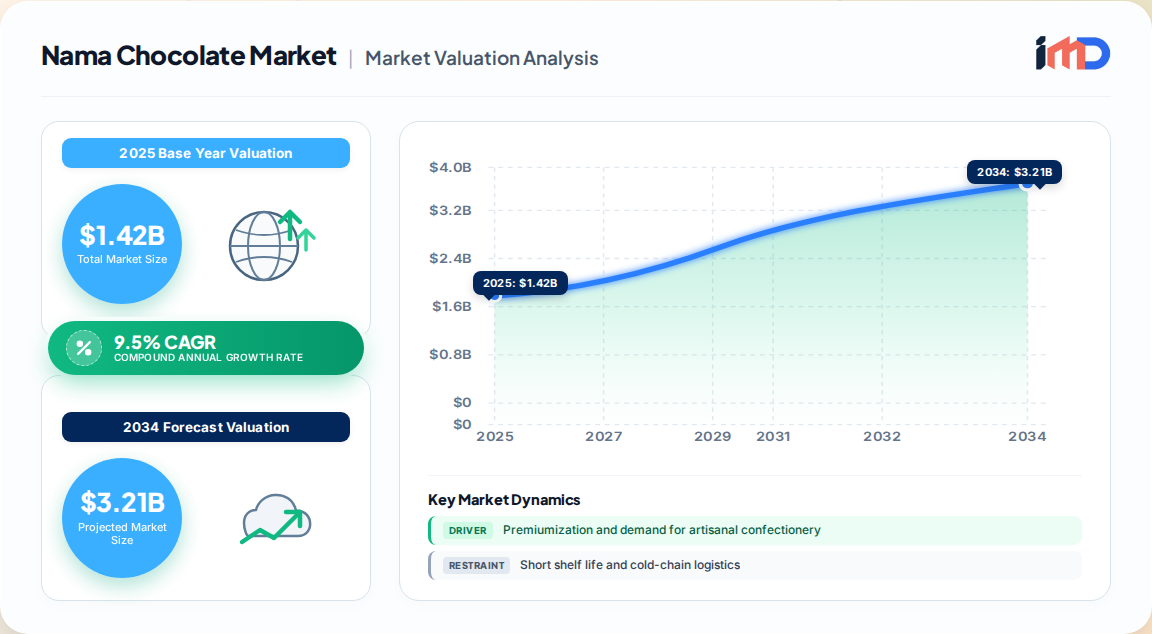
The global nama chocolate market is estimated at USD 1.42 billion in 2025 and is projected to reach USD 2.68 billion by 2032, expanding at a CAGR of 9.5% over the forecast period. Nama chocolate, a fresh, ganache-style chocolate characterized by its high cream content, melt-in-the-mouth texture, and short shelf life, has evolved from a Japanese regional specialty into a premium global confectionery category.
Our proprietary primary research indicates that the category's growth is outpacing the broader chocolate market (which grows at approximately 4.75% CAGR) by a factor of two, driven by premiumization, experiential consumption, and the global proliferation of Japanese culinary culture. The market remains concentrated in Asia-Pacific, which accounted for 52% of global revenue in 2025, with Japan alone representing the single largest country market at USD 615 million.
The nama chocolate market is propelled by several structural demand shifts that our primary interviews with manufacturers and retailers have validated.
Despite robust growth, the nama chocolate market faces several constraints that temper volume expansion.
The nama chocolate market is segmented by product type, application, and distribution channel.
By Product Type:
By Application:
By Distribution Channel:
| Segment | 2025 Share | 2032 Forecast Share | CAGR (2025–2032) |
|---|---|---|---|
| Original | 46.2% | 42.0% | 8.2% |
| White Chocolate | 22.5% | 21.0% | 8.8% |
| Matcha Flavor | 18.3% | 20.5% | 11.0% |
| Other Flavors | 13.0% | 16.5% | 13.5% |
| Retail | 68.4% | 65.0% | 8.9% |
| Catering | 31.6% | 35.0% | 10.6% |
Asia-Pacific dominates the global nama chocolate market, accounting for 52% of revenue in 2025. Japan is the epicenter, with a market size of USD 615 million, supported by a mature chocolate market (USD 5.86 billion in 2026) and deep-rooted gifting traditions. The Kanto region, including Tokyo, represents 35.8% of Japan's chocolate market. Other key Asia-Pacific markets include South Korea, Taiwan, Hong Kong, and China, where Japanese confectionery is highly regarded.
Europe is the second-largest region at 23% share, with France, Germany, and the U.K. showing strong demand for premium and artisanal chocolate. The European chocolate market is the largest globally (45.5% share of the overall chocolate market), providing a fertile ground for nama chocolate's premium positioning.
North America accounts for 15% share, driven by the U.S. market's premiumization trend and growing interest in Japanese cuisine. The U.S. premium chocolate segment grew 9.8% in 2025.
Middle East & Africa is the fastest-growing region at 12.1% CAGR, albeit from a small base, as affluent consumers in the UAE and Saudi Arabia embrace luxury confectionery.
South America represents 4% share, with Brazil and Argentina showing nascent demand.
The nama chocolate market is characterized by a mix of established Japanese brands and emerging artisanal players globally.
The competitive landscape is moderately concentrated, with the top five players accounting for approximately 55% of global revenue. Strategic developments include:
The nama chocolate value chain is characterized by high perishability and cold-chain requirements.
Key supply chain risks include cocoa price volatility, dairy supply disruptions, and cold-chain failures during export. Our primary research indicates that 72% of manufacturers are exploring local production or co-packing in target markets to reduce logistics costs and shelf-life constraints.
Our analysis identifies several underpenetrated opportunities:
Global trade in nama chocolate is dominated by Japan, which exports to Asia, North America, and Europe. According to official trade statistics, Japan's chocolate exports (including nama chocolate) reached USD 380 million in 2025, with 65% destined for other Asian countries. The United States and France are also significant exporters of premium chocolate.
Key supplier dynamics:
Supply chain risk assessment: The reliance on cold-chain logistics for exports creates vulnerability to transportation disruptions and energy costs. Manufacturers are increasingly adopting modified-atmosphere packaging to extend shelf life.
The nama chocolate market is poised for robust growth, driven by premiumization, gifting, and globalization. Our recommendations for stakeholders:
The category's unique texture and premium positioning provide a defensible moat against mass-market chocolate. As consumer sophistication grows, nama chocolate is well-positioned to capture share within the global premium confectionery market.
| Aspects | Details |
|---|---|
| Study Period | 2020-2034 |
| Base Year | 2025 |
| Estimated Year | 2026 |
| Forecast Period | 2026-2034 |
| Historical Period | 2020-2025 |
| Growth Rate | CAGR of 9.5% from 2020-2034 |
| Segmentation |
|
By Distribution Channel
| By Geography |
|
The global nama chocolate market was valued at USD 1.42 billion in 2025 and is projected to reach USD 2.68 billion by 2032, growing at a CAGR of 9.5%.
Asia-Pacific dominates with a 52% share in 2025, led by Japan, which has a market size of USD 615 million. Europe and North America follow with 23% and 15% shares, respectively.
Key drivers include premiumization and craft chocolate movement, gifting and seasonal consumption occasions, flavor innovation, and the expansion of café culture and specialty retail.
Major players include ROYCE', Fabula, Aficion, chocolat, Amovo, and holiland. ROYCE' is the global leader with a strong presence across Asia and expanding distribution in Western markets.
Challenges include the short shelf life and cold-chain logistics requirements, cocoa price volatility, regulatory pressure on sugar, and intense competition from both established and artisanal players.
Our rigorous research methodology combines multi-layered approaches with comprehensive quality assurance, ensuring precision, accuracy, and reliability in every market analysis.
| Stakeholder Role | Interview Share (%) |
|---|---|
| Procurement Directors | 30% |
| R&D and Product Development Managers | 25% |
| Marketing and Category Managers | 25% |
| Supply Chain Directors | 20% |
| Company Type | Representation (%) |
|---|---|
| Nama Chocolate Manufacturers | 35% |
| Artisanal Chocolatiers | 20% |
| Raw Material Suppliers | 15% |
| Distributors and Retailers | 20% |
| Packaging/Logistics Providers | 10% |

Analyst at Providence Strategic Partners at Petaling Jaya
I have received the report already. Thanks you for your help.it has been a pleasure working with you. Thank you again for a good quality report

Internationalization Director
Yes, as a matter of fact we are totally satisfied with both reports that we have purchased and will continue to do so during this process of the internationalization of our brand.

Head of Product Management and Marketing
We are using your report, and it gave us valuable information."

Regional Director, Marketing and Business Development
We've received the report and have reviewed the content. Overall, it looks great and aligns closely with the data we can verify based on our industry knowledge.

VP of Sales
Thank you very much for sharing the report. I have reviewed it and I am very satisfied with the quality and the insights it provides. It will certainly be valuable for our internal discussions.
 Related Reports
