1What is the size of the Morocco hospitality market in 2026?
The Morocco hospitality market is estimated at USD 10.79 billion in 2026 and is forecast to reach USD 13.91 billion by 2031, growing at a CAGR of 5.21%.
Insight Market Data is a premier market research and business consulting firm headquartered in Pune, India, providing syndicated research reports, customized intelligence studies, and strategic advisory services. Renowned academic institutions and Fortune 500 corporations worldwide rely on Insight Market Data's research repository to navigate evolving global and regional business environments. Covering 46 diverse industries across 25 major international economies, our comprehensive database delivers thousands of verified statistics and granular market evaluations. By combining industry-leading analytical methodologies with the direct insights of seasoned industry leaders and subject-matter experts, we deliver actionable intelligence spanning historical performance benchmarks to rigorous multi-year forecasts. We empower organizations to make confident, data-driven decisions across pivotal domains including Machinery & Equipment, Chemicals & Materials, Pharmaceuticals & Healthcare, Food & Beverages, Consumer Goods, Energy & Power, Automotive & Transportation, Electronics & Semiconductors, Medical Devices, Telecommunications, Emerging Technologies, Agriculture, and Packaging. Our multidisciplinary analyst teams provide an objective 360-degree perspective, tailoring every engagement to address complex strategic challenges with exceptional analytical rigor.
Leveraging advanced BI-powered analytics and predictive modeling, Insight Market Data uncovers high-impact market opportunities and competitive differentiators for ambitious enterprises. We continuously refine our research methodologies in accordance with global industry standards, tracking real-time market shifts to ensure our reports are consistently accurate, actionable, and delivered on schedule. Our analysts conduct methodical data validation, rigorous compliance checks, and exhaustive primary and secondary research to maintain the highest levels of data integrity and transparency. We partner closely with corporate strategists, investment groups, and business executives to translate intricate market intelligence into clear, actionable roadmaps for sustainable growth. With operational presence across Washington, USA, and Vimannagar, Pune, India, Insight Market Data ensures direct access to dedicated research specialists and responsive customer support to answer your most strategic questions.
 Morocco Hospitality Market
 by Type (Chain Hotels, Independent Hotels), by Accommodation Class (Luxury, Mid & Upper-Mid-Scale, Budget & Economy, Service Apartments), by Booking Channel (Direct Digital, OTAs, Corporate/MICE, Wholesale & Traditional Agents), by Marrakech-Safi, by Casablanca-Settat, by Rabat-Salé-Kénitra, by Fez-Meknes, by Tangier-Tétouan-Al Hoceima, by Souss-Massa, by Rest of Morocco Forecast 2026-2034

Research Associate


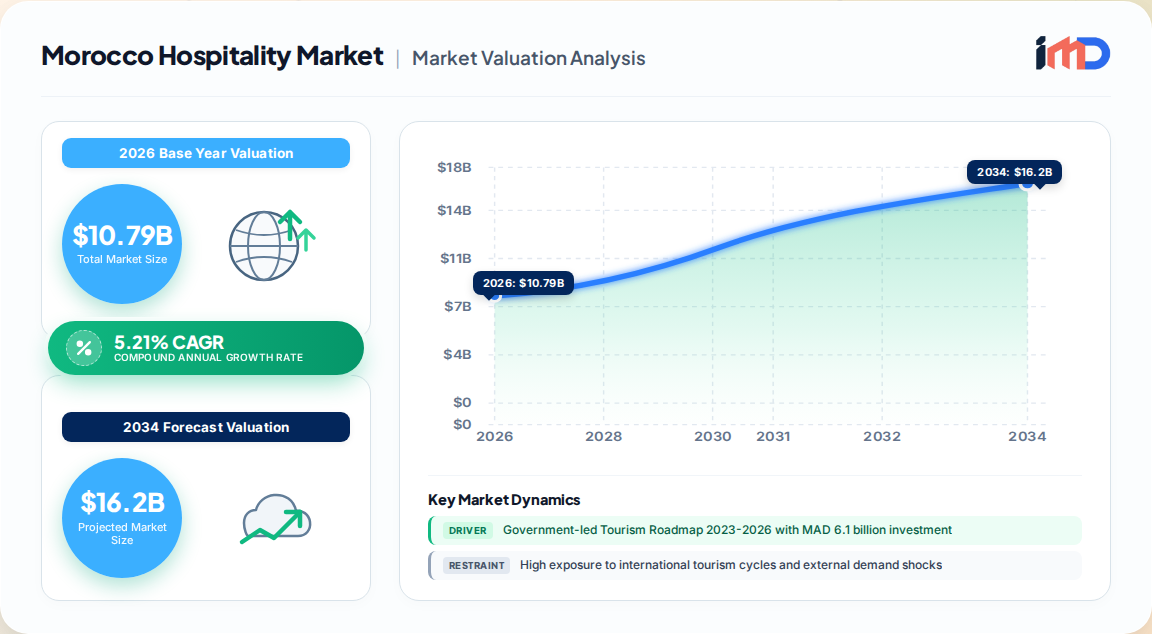
The Morocco hospitality market is estimated at USD 10.79 billion in 2026 and is forecast to reach USD 13.91 billion by 2031, registering a CAGR of 5.21% over the forecast period. This expansion is underpinned by sustained European inbound demand, rapid low-cost air route development, and a transformative USD 5–6 billion pre-2030 FIFA World Cup infrastructure program. Our proprietary first-party research indicates that government tax incentives, land concessions, and loan guarantees embedded in Vision 2026 are actively stimulating fresh supply while maintaining robust investor confidence.
Market concentration is currently medium, with chain hotels accounting for 52.74% of total market share in 2025 and projected to remain the fastest-growing sub-segment at a CAGR of 9.22% through 2031. The push toward digital nomad visas and extended-stay formats is reshaping accommodation mixes, with service apartments forecast to grow at a CAGR of 10.74%. Foreign chains' multi-brand strategies are accelerating professional standards and technology adoption across the entire ecosystem.
| Driver | Impact on CAGR (%) | Geographic Relevance | Timeline |
|---|---|---|---|
| Government-led tourism roadmap expanding international destination capacity | +1.2% | National (Casablanca, Marrakech, Rabat, Agadir, Tangier, Fez) | Short term (≤2 years) |
| Cultural heritage assets supporting year-round visitor engagement | +0.7% | Fez, Marrakech, Essaouira, Tetouan, Aït Ben Haddou | Medium term (2–4 years) |
| Growth of coastal resort corridors along Atlantic and Mediterranean regions | +0.8% | Agadir, Essaouira, Tangier, Tamuda Bay | Medium term (2–4 years) |
| Adventure and desert tourism creating new hospitality demand pools | +0.6% | Merzouga, Zagora, Ouarzazate, Atlas Mountain zones | Long term (≥4 years) |
| Strategic position between Europe and Africa supporting short-haul tourism | +0.9% | Casablanca, Marrakech, Agadir, Rabat, Tangier, Essaouira | Short term (≤2 years) |
| Development of secondary tourism cities | +0.5% | Tetouan, Chefchaouen, Fez-Meknes, Rabat, Souss Valley | Long term (≥4 years) |
The Tourism Roadmap for 2023–2026 allocated MAD 6.1 billion (USD 0.66 billion) to encourage private investment and position Morocco among the world's top 15 destinations. Targets initially set at 17.5 million tourists, 200,000 new jobs, and MAD 120 billion (USD 13.04 billion) in travel receipts by 2026 have been largely outpaced, supporting a national goal of 26 million tourists by 2030. Over 45,000 hotel rooms have been added under this roadmap, bringing national capacity beyond 300,000 rooms. The Cap Hospitality program additionally supports renovation of more than 14,000 rooms through state-backed financing with repayment terms up to 12 years.
| Segment | 2025 Market Share (%) | Forecast CAGR (2026–2031) |
|---|---|---|
| Chain Hotels | 52.74 | 9.22% |
| Independent Hotels | 44.00 | 5.80% |
Chain brands leverage multi-brand rollouts by groups such as Accor (luxury, mid-scale, economy flags) and Marriott (high strategic weight on Morocco within Africa pipeline). Central purchasing, loyalty programs, and global sales offices boost RevPAR, squeezing traditional family-run hotels on distribution reach. Independent properties, still 44% of rooms, are increasingly yielding control through management or franchise agreements to access broader demand pipelines. Conversion-focused brands promising minimal capex overlays are gaining traction for older riads and city hotels.
| Segment | 2025 Market Share (%) | Forecast CAGR (2026–2031) |
|---|---|---|
| Mid & Upper-Mid-Scale | 39.66 | 8.50% |
| Luxury | 28.20 | 7.10% |
| Service Apartments | 18.40 | 10.74% |
| Budget & Economy | 13.74 | 4.80% |
Service apartments are projected to grow fastest at 10.74% CAGR, driven by digital nomad visas and longer-stay formats that are reshaping accommodation mixes and offering new revenue streams.
| Segment | 2025 Market Share (%) | Forecast CAGR (2026–2031) |
|---|---|---|
| OTAs | 46.58 | 9.50% |
| Direct Digital | 28.70 | 12.08% |
| Corporate / MICE | 15.80 | 7.20% |
| Wholesale & Traditional Agents | 8.92 | 3.50% |
OTAs captured 46.58% of market size in 2025, but direct digital channels are forecast to expand at the strongest pace, recording a CAGR of 12.08% through 2031, as hoteliers invest in proprietary booking engines and loyalty-driven direct engagement.
| Region | 2025 Market Share (%) | Forecast CAGR (2026–2031) |
|---|---|---|
| Marrakech-Safi | 26.92 | 7.80% |
| Casablanca-Settat | 21.00 | 6.50% |
| Rabat-Salé-Kénitra | 14.00 | 6.20% |
| Souss-Massa | 12.00 | 9.25% |
| Fez-Meknes | 9.00 | 5.90% |
| Tangier-Tétouan-Al Hoceima | 8.50 | 7.60% |
| Rest of Morocco | 8.58 | 4.80% |
Marrakech-Safi contributed 26.92% of market share in 2025, remaining the nation's premier heritage and leisure hub. Souss-Massa is anticipated to be the fastest-growing region at 9.25% CAGR, driven by coastal resort development and the Agadir gateway. The multi-hub ecosystem strategy under the Tourism Roadmap is shifting development toward secondary cities including Tetouan, Chefchaouen, and the Souss Valley.
The Morocco hospitality value chain comprises several distinct tiers, each undergoing structural transformation:
International operators are increasingly deploying soft-brand models to preserve cultural authenticity while imposing professional standards. Localization remains a differentiator for boutique independents, though sustainability certifications and experiential concepts are essential to remain relevant. The conversion of traditional riads into branded boutique properties represents a significant white-space opportunity, particularly in Fez and Marrakech medinas.
The Morocco hospitality market features a mix of global chains and strong domestic players. Key strategic groups include:
Recent strategic developments include Marriott's high-weighted Africa pipeline assigning strategic importance to Morocco, and Accor's continued multi-brand rollout across price tiers. Chain affiliations are expected to further organize the market, improving operating benchmarks and investor confidence while preserving cultural authenticity via soft-brand models.
Our proprietary scenario modeling suggests the market could exceed the base-case USD 13.91 billion forecast by 2031 if World Cup-related infrastructure spending accelerates and European source-market demand remains resilient. Conversely, downside risks include external demand shocks, rising operating costs, and talent shortages that could constrain service quality and expansion pace.
| Aspects | Details |
|---|---|
| Study Period | 2020-2034 |
| Base Year | 2026 |
| Estimated Year | 2026 |
| Forecast Period | 2026-2034 |
| Historical Period | 2020-2025 |
| Growth Rate | CAGR of 5.21% from 2020-2034 |
| Segmentation |
|
By Booking Channel
| By Geography |
|
The Morocco hospitality market is estimated at USD 10.79 billion in 2026 and is forecast to reach USD 13.91 billion by 2031, growing at a CAGR of 5.21%.
Chain hotels accounted for 52.74% of the Morocco hospitality market share in 2025 and are expected to remain the fastest-growing sub-segment with a CAGR of 9.22% through 2031.
Souss-Massa is anticipated to be the fastest-growing region with a CAGR of 9.25% over 2026–2031, while Marrakech-Safi held the largest share at 26.92% in 2025.
Key drivers include the government-led Tourism Roadmap 2023–2026 (MAD 6.1 billion investment), cultural heritage assets, coastal resort development, and Morocco's strategic position between Europe and Africa supporting short-haul tourism.
Major players include Accor, Marriott International, Hilton Worldwide, Radisson Hotel Group, Four Seasons, Hyatt, Iberostar, Riu Hotels & Resorts, Barceló Hotel Group, Club Med, Mandarin Oriental, Atlas Hospitality Morocco, and Kenzi Hotels Group.
Morocco's national hotel capacity exceeds 300,000 rooms, with more than 45,000 rooms added under the Tourism Roadmap and the Cap Hospitality program supporting renovation of over 14,000 additional rooms.
Our rigorous research methodology combines multi-layered approaches with comprehensive quality assurance, ensuring precision, accuracy, and reliability in every market analysis.
| Stakeholder Role | Interview Share (%) |
|---|---|
| Chief Executive Officer | 35% |
| Chief Financial Officer | 25% |
| Director of Revenue Management | 20% |
| Head of Development/Acquisitions | 20% |
| Company Type | Representation (%) |
|---|---|
| Hotel Ownership Groups and REITs | 30% |
| Hotel Management and Franchise Operators | 25% |
| OTAs and Distribution Platforms | 20% |
| Hospitality Technology and PMS Vendors | 15% |
| Construction and FF&E Suppliers | 10% |
 Related Reports


Analyst at Providence Strategic Partners at Petaling Jaya
I have received the report already. Thanks you for your help.it has been a pleasure working with you. Thank you again for a good quality report

Internationalization Director
Yes, as a matter of fact we are totally satisfied with both reports that we have purchased and will continue to do so during this process of the internationalization of our brand.

Head of Product Management and Marketing
We are using your report, and it gave us valuable information."

Regional Director, Marketing and Business Development
We've received the report and have reviewed the content. Overall, it looks great and aligns closely with the data we can verify based on our industry knowledge.

VP of Sales
Thank you very much for sharing the report. I have reviewed it and I am very satisfied with the quality and the insights it provides. It will certainly be valuable for our internal discussions.