1What is the size of the Middle East and Africa online grocery delivery market?
The market is valued at **USD 20.13 Billion in 2026** and is projected to reach **USD 34.59 Billion by 2031**, growing at a **CAGR of 11.43%**.
Insight Market Data is a premier market research and business consulting firm headquartered in Pune, India, providing syndicated research reports, customized intelligence studies, and strategic advisory services. Renowned academic institutions and Fortune 500 corporations worldwide rely on Insight Market Data's research repository to navigate evolving global and regional business environments. Covering 46 diverse industries across 25 major international economies, our comprehensive database delivers thousands of verified statistics and granular market evaluations. By combining industry-leading analytical methodologies with the direct insights of seasoned industry leaders and subject-matter experts, we deliver actionable intelligence spanning historical performance benchmarks to rigorous multi-year forecasts. We empower organizations to make confident, data-driven decisions across pivotal domains including Machinery & Equipment, Chemicals & Materials, Pharmaceuticals & Healthcare, Food & Beverages, Consumer Goods, Energy & Power, Automotive & Transportation, Electronics & Semiconductors, Medical Devices, Telecommunications, Emerging Technologies, Agriculture, and Packaging. Our multidisciplinary analyst teams provide an objective 360-degree perspective, tailoring every engagement to address complex strategic challenges with exceptional analytical rigor.
Leveraging advanced BI-powered analytics and predictive modeling, Insight Market Data uncovers high-impact market opportunities and competitive differentiators for ambitious enterprises. We continuously refine our research methodologies in accordance with global industry standards, tracking real-time market shifts to ensure our reports are consistently accurate, actionable, and delivered on schedule. Our analysts conduct methodical data validation, rigorous compliance checks, and exhaustive primary and secondary research to maintain the highest levels of data integrity and transparency. We partner closely with corporate strategists, investment groups, and business executives to translate intricate market intelligence into clear, actionable roadmaps for sustainable growth. With operational presence across Washington, USA, and Vimannagar, Pune, India, Insight Market Data ensures direct access to dedicated research specialists and responsive customer support to answer your most strategic questions.
 Middle East and Africa Online Grocery Delivery Market
 by Product Type (Retail Delivery, Quick Commerce, Meal-Kit Delivery, Specialty and Ethnic Grocery, Pharmacy and Health Items), by Delivery Speed (Standard, Same-Day, Instant), by Platform Type (Mobile App, Web Portal, Voice and Smart-Device), by Customer Type (Household Consumers, Corporate and Institutional), by Middle East (United Arab Emirates, Saudi Arabia, Qatar, Kuwait, Bahrain, Oman, Turkey, Rest of Middle East), by Africa (South Africa, Egypt, Nigeria, Kenya, Morocco, Rest of Africa) Forecast 2026-2034

Research Associate


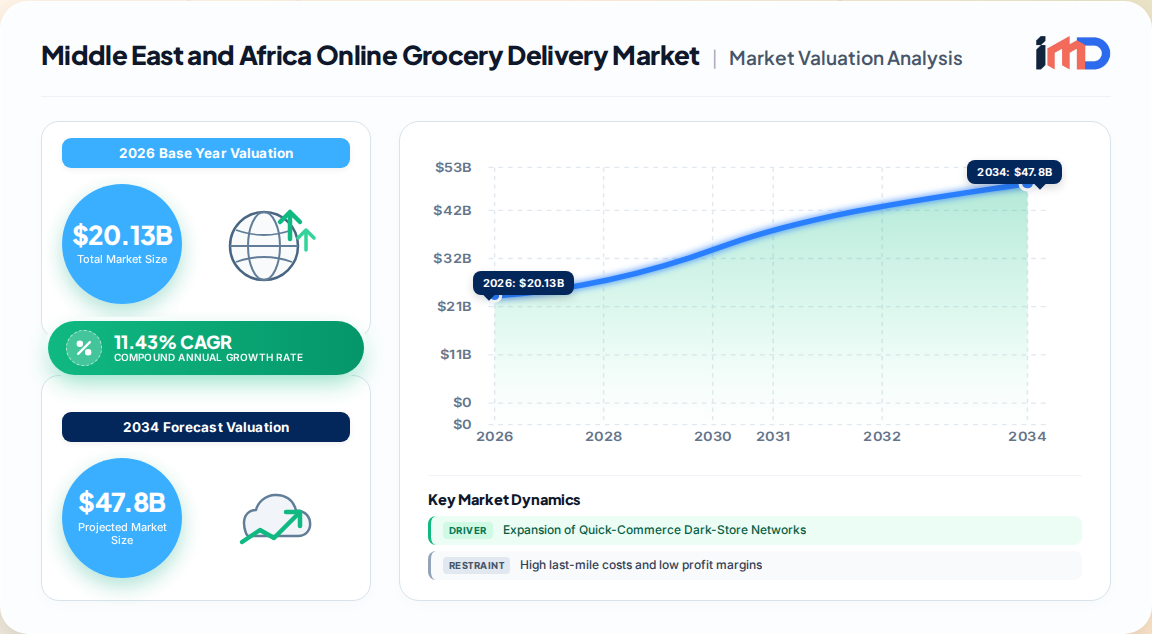
The Middle East and Africa online grocery delivery market is undergoing a structural transformation, moving from pandemic-era experimentation to a durable, high-frequency retail channel. Our proprietary primary research and expert interviews estimate the market at USD 20.13 Billion in 2026, projected to reach USD 34.59 Billion by 2031, expanding at a CAGR of 11.43% over the forecast period. The base year of 2025 closed at USD 18.98 Billion, confirming a robust year-over-year acceleration driven by dark-store densification and mobile-first consumer behavior.
This growth is not merely a function of digital adoption; it is a fundamental reconfiguration of urban grocery economics. The Gulf Cooperation Council (GCC) states, led by the UAE and Saudi Arabia, account for the majority of current revenue, but the strategic narrative is shifting toward profitability, vertical integration, and the expansion of quick-commerce fulfillment models that compress delivery windows to under 30 minutes.
The trajectory of the MEA online grocery delivery market is shaped by a distinct set of demand-side and supply-side forces. Our analysis quantifies the impact of each driver and restraint on the forecast CAGR, providing a clear view of the levers that will determine competitive advantage.
The market exhibits a clear bifurcation between planned, value-oriented shopping and instant, convenience-driven purchases. This is reflected in the performance of product types and delivery speeds.
| Segment | 2025 Share | Forecast CAGR (to 2031) | Strategic Insight |
|---|---|---|---|
| Retail Delivery | 70.73% | Baseline | The low-cost backbone for weekly stock-ups; remains essential for bulk orders. |
| Quick Commerce (<30 min) | ~30% (est.) | 14.01% | Fastest-growing segment; driven by dark stores and premium convenience. |
| Meal-Kit Delivery | Niche | Moderate | Appeals to health-conscious professionals; creates brand stickiness. |
| Specialty & Ethnic Grocery | Niche | Moderate | Serves expatriate communities; high margin, low volume. |
| Pharmacy & Health Items | Emerging | High | Blurs category lines; leverages existing delivery networks. |
Mobile apps processed 79.68% of transactions in 2025, but web portals are projected to post the highest CAGR of 11.86% to 2031. Voice and smart-device ordering remains nascent but is gaining traction among tech-savvy consumers.
Household consumers accounted for 89.19% of 2025 revenue. However, the corporate and institutional segment is growing at 11.48% CAGR, driven by office pantry stocking and bulk procurement.
The geographic distribution of the market reveals a high concentration of spending in the GCC, with Saudi Arabia and the UAE at the forefront. However, the long-term growth story is one of gradual diversification into North and Sub-Saharan Africa.
The competitive landscape is characterized by a mix of regional champions, global tech-backed platforms, and traditional retailers pursuing digital transformation. With an estimated 250 operators in the market, consolidation is expected as scale becomes the primary driver of profitability.
Recent strategic developments underscore the race for quick-commerce dominance:
Key players include Talabat Holding, noon, InstaShop, HungerStation, Kibsons, elGrocer, Breadfast, Shoprite Checkers, Deliveroo, Jahez, Mrsool, Majid Al Futtaim Retail, LuLu Group, Spinneys, and ADNOC Distribution.
The value chain is evolving from linear models to integrated ecosystems. Retailers are increasingly building proprietary technology stacks, while platforms are exploring vertical integration through private-label assortments and business-to-business (B2B) supply.
Our analysis identifies three areas of strategic whitespace for investors and operators:
The market is on a clear trajectory toward maturity, with growth increasingly driven by repeat orders and basket attachment rather than pure customer acquisition. Operators that prioritize margin realization, reliable fulfillment, and customer retention will be best positioned to capture value in the next five years.
| Aspects | Details |
|---|---|
| Study Period | 2020-2034 |
| Base Year | 2026 |
| Estimated Year | 2026 |
| Forecast Period | 2026-2034 |
| Historical Period | 2020-2025 |
| Growth Rate | CAGR of 11.43% from 2020-2034 |
| Segmentation |
|
By Delivery Speed
By Platform Type
By Customer Type
| By Geography |
|
The market is valued at **USD 20.13 Billion in 2026** and is projected to reach **USD 34.59 Billion by 2031**, growing at a **CAGR of 11.43%**.
The United Arab Emirates led with **27.26% revenue share** in 2025, while Saudi Arabia is forecast to grow at the fastest pace, with a **12.67% CAGR** to 2031.
Quick Commerce is expanding at a **14.01% CAGR**, driven by dark-store networks and sub-30-minute delivery models.
Household consumers accounted for **89.19%** of 2025 revenue, but the corporate and institutional segment is growing at **11.48% CAGR** and presents significant whitespace.
High last-mile costs (consuming **15-25%** of order value in Gulf cities) and limited cold-chain capacity in Africa are the primary restraints, with a combined negative impact of **-3.1%** on CAGR.
Our rigorous research methodology combines multi-layered approaches with comprehensive quality assurance, ensuring precision, accuracy, and reliability in every market analysis.
| Stakeholder Role | Interview Share (%) |
|---|---|
| Chief Operating Officer | 25% |
| Head of Digital Grocery | 30% |
| Supply Chain Director | 25% |
| Chief Technology Officer | 20% |
| Company Type | Representation (%) |
|---|---|
| Online grocery platforms & marketplaces | 30% |
| Brick-and-mortar grocery retailers | 25% |
| Dark store & quick commerce operators | 20% |
| Last-mile logistics providers | 15% |
| Technology & payment solution vendors | 10% |
 Related Reports
