1What is the size of the Middle East and Africa freight and logistics market in 2026?
The market is estimated at USD 321.36 billion in 2026, growing from USD 305.07 billion in 2025 and projected to reach USD 416.75 billion by 2031 at a 5.34% CAGR.
Insight Market Data is a premier market research and business consulting firm headquartered in Pune, India, providing syndicated research reports, customized intelligence studies, and strategic advisory services. Renowned academic institutions and Fortune 500 corporations worldwide rely on Insight Market Data's research repository to navigate evolving global and regional business environments. Covering 46 diverse industries across 25 major international economies, our comprehensive database delivers thousands of verified statistics and granular market evaluations. By combining industry-leading analytical methodologies with the direct insights of seasoned industry leaders and subject-matter experts, we deliver actionable intelligence spanning historical performance benchmarks to rigorous multi-year forecasts. We empower organizations to make confident, data-driven decisions across pivotal domains including Machinery & Equipment, Chemicals & Materials, Pharmaceuticals & Healthcare, Food & Beverages, Consumer Goods, Energy & Power, Automotive & Transportation, Electronics & Semiconductors, Medical Devices, Telecommunications, Emerging Technologies, Agriculture, and Packaging. Our multidisciplinary analyst teams provide an objective 360-degree perspective, tailoring every engagement to address complex strategic challenges with exceptional analytical rigor.
Leveraging advanced BI-powered analytics and predictive modeling, Insight Market Data uncovers high-impact market opportunities and competitive differentiators for ambitious enterprises. We continuously refine our research methodologies in accordance with global industry standards, tracking real-time market shifts to ensure our reports are consistently accurate, actionable, and delivered on schedule. Our analysts conduct methodical data validation, rigorous compliance checks, and exhaustive primary and secondary research to maintain the highest levels of data integrity and transparency. We partner closely with corporate strategists, investment groups, and business executives to translate intricate market intelligence into clear, actionable roadmaps for sustainable growth. With operational presence across Washington, USA, and Vimannagar, Pune, India, Insight Market Data ensures direct access to dedicated research specialists and responsive customer support to answer your most strategic questions.
 Middle East and Africa Freight & Logistics Market
 by Logistics Function (Courier, Express, and Parcel (CEP)(Domestic, International), Freight Forwarding(Air, Sea and Inland Waterways, Others), Freight Transport(Air, Rail, Road, Sea and Inland Waterways, Pipelines), Warehousing and Storage(Non-Temperature-Controlled, Temperature-Controlled), Other Services), by End-User Industry (Agriculture, Fishing, and Forestry, Construction, Manufacturing, Oil and Gas, Mining and Quarrying, Wholesale and Retail Trade, Others), by Middle East & Africa (Saudi Arabia, United Arab Emirates, Qatar, Oman, Kuwait, Nigeria, South Africa, Rest of Middle East & Africa) Forecast 2026-2034

Research Associate


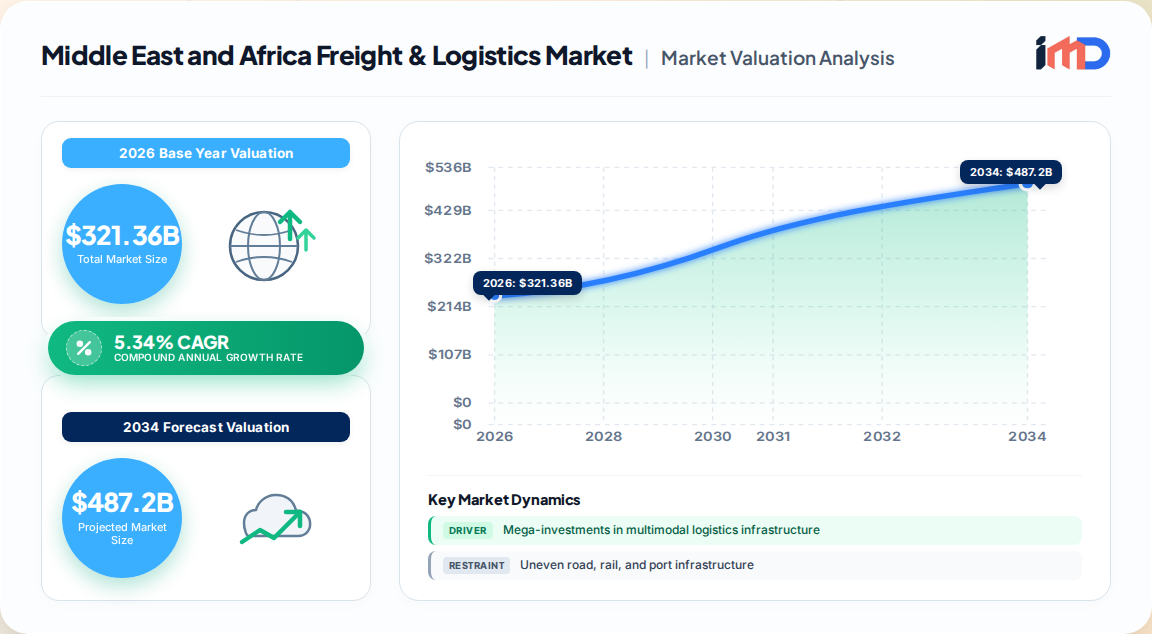
The Middle East and Africa (MEA) freight and logistics market is a strategically pivotal link connecting Asia, Europe, and Africa. Our proprietary first-party research estimates the market at USD 321.36 billion in 2026, up from USD 305.07 billion in 2025, and projects it to reach USD 416.75 billion by 2031, registering a 5.34% CAGR over the forecast period (2026–2031). This expansion is anchored in heavy sovereign infrastructure spending, permanent capacity upgrades triggered by Red Sea shipping disruptions, and a surge in e-commerce and cold-chain demand.
Operators that maximize network density, accelerate technology adoption, and embed sustainable practices are positioned to capture outsized returns. Sovereign wealth funds, free trade agreements, and digital freight platforms are reshaping competitive intensity while mitigating geopolitical volatility.
Key Market Metrics (2026–2031)
| Metric | Value |
|---|---|
| 2025 Base Market Size | USD 305.07 Billion |
| 2026 Market Size | USD 321.36 Billion |
| 2031 Forecast Market Size | USD 416.75 Billion |
| CAGR (2026–2031) | 5.34% |
| Market Concentration | Low |
| Fastest-Growing Function | Courier, Express & Parcel (5.57% CAGR) |
| Leading Freight Transport Mode (2025) | Road (40.88% share) |
Our primary research, validated through interviews with regional 3PLs, port authorities, and shippers, quantifies the following driver impacts on the forecast CAGR.
| Driver | CAGR Impact | Geographic Relevance | Timeline |
|---|---|---|---|
| Mega-investments in multimodal logistics infrastructure | +1.8% | UAE, Saudi Arabia, Qatar | Medium term (2–4 yrs) |
| E-commerce boom and cross-border retail | +1.2% | Global, UAE & Saudi Arabia leading | Short term (≤2 yrs) |
| Growth of FTAs and emerging trade corridors | +0.9% | AfCFTA members and GCC states | Long term (≥4 yrs) |
| Cold-chain demand for pharma and perishables | +0.7% | UAE, Saudi Arabia, South Africa, Nigeria | Medium term (2–4 yrs) |
| Warehouse automation to offset labour shortages | +0.6% | UAE, Saudi Arabia, Qatar, Kuwait | Short term (≤2 yrs) |
| Digital freight platforms and real-time visibility | +0.5% | Global, faster in Gulf states | Short term (≤2 yrs) |
Restraints Impact Analysis
| Restraint | CAGR Impact | Geographic Relevance | Timeline |
|---|---|---|---|
| Uneven road, rail, and port infrastructure | -1.1% | Sub-Saharan Africa | Long term (≥4 yrs) |
| Complex customs rules and border delays | -0.8% | Global, cross-border trade | Medium term (2–4 yrs) |
| Red Sea/Suez chokepoint disruptions | -0.6% | Global shipping routes | Recurring |
| Driver shortages and localisation policies | -0.4% | Gulf states | Medium term |
Saudi Arabia has earmarked USD 133.3 billion for ports, airports, and railways through 2030, including Port of NEOM’s first fully automated cranes slated for a 2026 launch. DP World’s USD 2.5 billion program, alongside record USD 20 billion 2024 revenue, signals deep private capital engagement. Automation and renewable energy integration are compressing dwell times and reshaping transshipment competitiveness.
In 2025, MEA merchandise exports reached approximately USD 1.36 trillion and imports USD 1.18 trillion, producing a positive trade balance of USD 180.8 billion (World Bank WITS). The region’s effectively applied tariff weighted average stands at 4.38%, with the MFN weighted average at 5.80%. GDP for the region is USD 4.84 trillion, and trade represents 41.66% of GDP on the export side and 36.59% on the import side.
Trade Flows & Supply Chain Risk
By Logistics Function
Freight transport dominated with 59.21% of 2025 market share, while courier, express, and parcel (CEP) is the fastest-growing function at a 5.57% CAGR to 2031. Within CEP, domestic deliveries controlled 67.10% of 2025 market size, while international services recorded a higher 5.63% CAGR.
| Segment | 2025 Share | CAGR (2026–2031) |
|---|---|---|
| Freight Transport | 59.21% | 5.20% |
| Freight Forwarding | 22.40% | 5.45% |
| CEP | 10.80% | 5.57% |
| Warehousing & Storage | 6.10% | 5.30% |
| Other Services | 1.49% | 5.60% |
By Freight Forwarding Mode
Sea and inland waterways accounted for 52.84% of 2025 market share and are projected to rise at a 5.62% CAGR. Air freight remains critical for high-value and time-sensitive cargo, particularly in the Gulf.
By Freight Transport Mode
| Mode | 2025 Share | CAGR (2026–2031) |
|---|---|---|
| Road | 40.88% | 5.10% |
| Sea & Inland Waterways | 38.50% | 5.49% |
| Air | 12.30% | 5.30% |
| Rail | 5.20% | 5.00% |
| Pipelines | 3.12% | 4.80% |
By Warehousing & Storage
Non-temperature-controlled facilities dominated with 86.95% of 2025 share, while temperature-controlled storage is advancing at a 5.54% CAGR to 2031.
By End-User Industry
Wholesale and retail trade captured 33.92% of 2025 revenue, whereas manufacturing is set to grow at a 5.58% CAGR through 2031 as localization and industrial parks proliferate. Oil, gas, and mining logistics remain sizable, supported by commodity flows and energy-security spending. Construction logistics taps infrastructure mega-projects, and agri-food shipments expand under food-security strategies.
Saudi Arabia captured 6.84% of 2025 regional revenue, with Vision 2030 driving port, rail, and logistics-zone investments. United Arab Emirates is set to grow at a 5.60% CAGR, leveraging Jebel Ali Port, Al Maktoum International Airport, and DP World’s global network. Nigeria’s USD 20 billion Ogidigben industrial park underscores demand for specialized heavy-lift and project cargo services.
| Country | 2025 Share | CAGR (2026–2031) |
|---|---|---|
| Saudi Arabia | 24.0% | 5.45% |
| UAE | 22.0% | 5.60% |
| South Africa | 14.0% | 5.10% |
| Nigeria | 11.0% | 5.35% |
| Qatar | 7.0% | 5.20% |
| Oman | 6.0% | 5.15% |
| Kuwait | 5.0% | 5.05% |
| Egypt | 5.0% | 5.25% |
| Rest of MEA | 6.0% | 5.30% |
The market is characterized by low concentration, with international integrators, regional 3PLs, and Gulf-based conglomerates competing on network density and digital orchestration. International integrators have pledged nine-figure capex for regional hubs, while Aramex, backed by ADQ, is consolidating regional share. Robotics and AI inventory tools are widening productivity differentials in Gulf warehouses.
Key Strategic Developments
Procurement & Sourcing Strategy Analysis
| Country | Infrastructure Spend | Logistics Performance | Investment Priority |
|---|---|---|---|
| Saudi Arabia | USD 133.3B through 2030 | High (Vision 2030) | Very High |
| UAE | DP World USD 2.5B program | Very High (Jebel Ali, Al Maktoum) | Very High |
| Qatar | Port and free-zone expansion | High | High |
| Nigeria | USD 20B Ogidigben industrial park | Medium (infrastructure gaps) | Medium-High |
| South Africa | Port and rail upgrades | Medium | Medium |
The region’s strategic location, sovereign wealth funding, and trade-corridor development create a compelling investment case. Operators that pair physical network expansion with digital visibility and sustainable practices will capture outsized returns through 2031.
| Aspects | Details |
|---|---|
| Study Period | 2020-2034 |
| Base Year | 2026 |
| Estimated Year | 2026 |
| Forecast Period | 2026-2034 |
| Historical Period | 2020-2025 |
| Growth Rate | CAGR of 5.34% from 2020-2034 |
| Segmentation |
|
By End-User Industry
| By Geography |
|
The market is estimated at USD 321.36 billion in 2026, growing from USD 305.07 billion in 2025 and projected to reach USD 416.75 billion by 2031 at a 5.34% CAGR.
Courier, express, and parcel (CEP) is the fastest-growing logistics function at a 5.57% CAGR to 2031, driven by e-commerce and cross-border retail expansion.
Saudi Arabia captured 6.84% of 2025 regional revenue, while the United Arab Emirates is set to grow at the fastest 5.60% CAGR through 2031.
Mega-investments in multimodal infrastructure (+1.8% CAGR impact), e-commerce boom (+1.2%), FTA growth (+0.9%), and cold-chain demand (+0.7%) are the primary drivers.
Key players include DHL, Aramex, Gulf Agency Company (GAC), RAK Logistics, Al-Futtaim Logistics, Almajdouie Group, Gulf Warehousing Company, RSA Global, and Saudi Transport & Investment Co. (Mubarrad).
Our rigorous research methodology combines multi-layered approaches with comprehensive quality assurance, ensuring precision, accuracy, and reliability in every market analysis.
| Stakeholder Role | Interview Share (%) |
|---|---|
| Chief Supply Chain Officer | 25% |
| Logistics Director | 30% |
| Head of Network Operations | 25% |
| Procurement Manager | 20% |
| Company Type | Representation (%) |
|---|---|
| Asset-based 3PLs | 30% |
| Freight Forwarders & Customs Brokers | 25% |
| CEP and Last-Mile Operators | 20% |
| Warehousing & Cold-Chain Operators | 15% |
| Port/Terminal Authorities | 10% |

Analyst at Providence Strategic Partners at Petaling Jaya
I have received the report already. Thanks you for your help.it has been a pleasure working with you. Thank you again for a good quality report

Internationalization Director
Yes, as a matter of fact we are totally satisfied with both reports that we have purchased and will continue to do so during this process of the internationalization of our brand.

Head of Product Management and Marketing
We are using your report, and it gave us valuable information."

Regional Director, Marketing and Business Development
We've received the report and have reviewed the content. Overall, it looks great and aligns closely with the data we can verify based on our industry knowledge.

VP of Sales
Thank you very much for sharing the report. I have reviewed it and I am very satisfied with the quality and the insights it provides. It will certainly be valuable for our internal discussions.
 Related Reports
