1What is the current market size of the mercerised wood pulp market?
The mercerised wood pulp market was valued at USD 182.0 billion in 2025 and is projected to reach USD 233.8 billion by 2032, growing at a 3.7% CAGR.
Insight Market Data is a premier market research and business consulting firm headquartered in Pune, India, providing syndicated research reports, customized intelligence studies, and strategic advisory services. Renowned academic institutions and Fortune 500 corporations worldwide rely on Insight Market Data's research repository to navigate evolving global and regional business environments. Covering 46 diverse industries across 25 major international economies, our comprehensive database delivers thousands of verified statistics and granular market evaluations. By combining industry-leading analytical methodologies with the direct insights of seasoned industry leaders and subject-matter experts, we deliver actionable intelligence spanning historical performance benchmarks to rigorous multi-year forecasts. We empower organizations to make confident, data-driven decisions across pivotal domains including Machinery & Equipment, Chemicals & Materials, Pharmaceuticals & Healthcare, Food & Beverages, Consumer Goods, Energy & Power, Automotive & Transportation, Electronics & Semiconductors, Medical Devices, Telecommunications, Emerging Technologies, Agriculture, and Packaging. Our multidisciplinary analyst teams provide an objective 360-degree perspective, tailoring every engagement to address complex strategic challenges with exceptional analytical rigor.
Leveraging advanced BI-powered analytics and predictive modeling, Insight Market Data uncovers high-impact market opportunities and competitive differentiators for ambitious enterprises. We continuously refine our research methodologies in accordance with global industry standards, tracking real-time market shifts to ensure our reports are consistently accurate, actionable, and delivered on schedule. Our analysts conduct methodical data validation, rigorous compliance checks, and exhaustive primary and secondary research to maintain the highest levels of data integrity and transparency. We partner closely with corporate strategists, investment groups, and business executives to translate intricate market intelligence into clear, actionable roadmaps for sustainable growth. With operational presence across Washington, USA, and Vimannagar, Pune, India, Insight Market Data ensures direct access to dedicated research specialists and responsive customer support to answer your most strategic questions.
 Mercerised Wood Pulp Market
 by Application (Filter Paper, Non-wovens(Hygiene and Medical, Industrial and Consumer Wipes, Geotextiles and Other Technical Non-wovens)), by Type (Softwood, Hardwood), by North America (United States, Canada, Mexico), by South America (Brazil, Argentina, Rest of South America), by Europe (United Kingdom, Germany, France, Italy, Spain, Russia, Benelux, Nordics, Rest of Europe), by Middle East & Africa (Turkey, Israel, GCC, North Africa, South Africa, Rest of Middle East & Africa), by Asia Pacific (China, India, Japan, South Korea, ASEAN, Oceania, Rest of Asia Pacific) Forecast 2026-2034

Senior Research Analyst


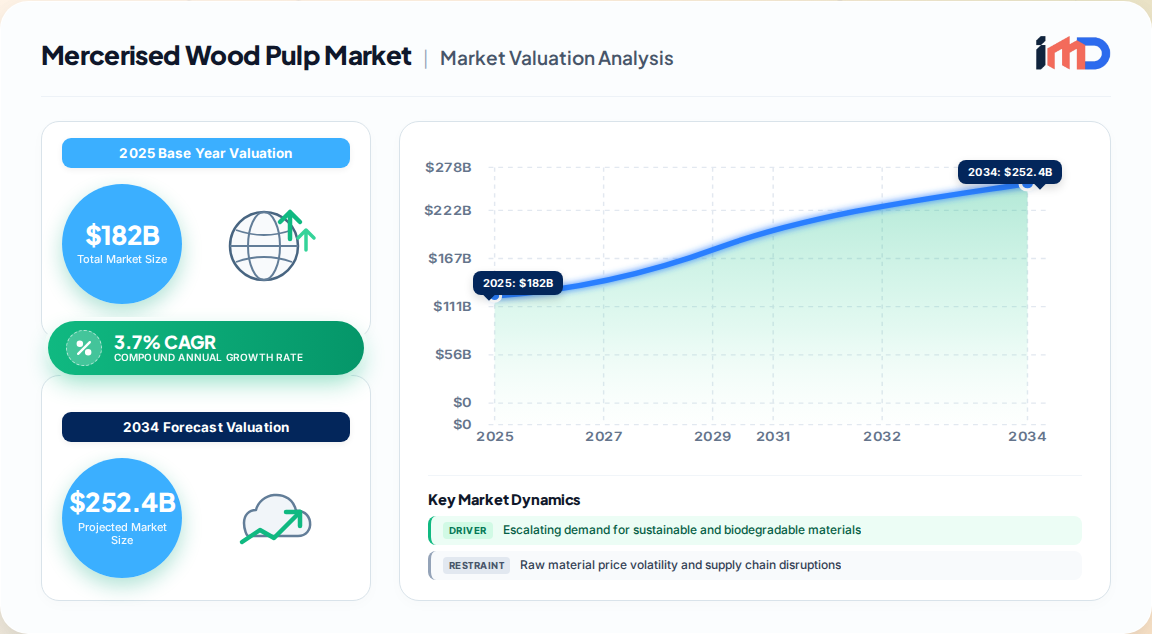
The mercerised wood pulp market stood at USD 182.0 billion in 2025 and is projected to reach USD 233.8 billion by 2032, expanding at a 3.7% CAGR over the forecast period. Mercerised wood pulp—a highly purified, chemically treated cellulose with enhanced reactivity, tensile strength, and absorption—is a critical input across non-wovens, filter media, hygiene products, and specialty textiles.
Our proprietary primary research, triangulated with mill-level capacity audits and trade flow analysis under HS 4703, indicates that demand is structurally supported by the global shift toward bio-based materials. The non-wovens segment commands the dominant share of consumption, while Asia-Pacific remains both the largest and fastest-growing regional market, contributing 43% of global value in 2025.
The mercerised wood pulp market is shaped by a confluence of demand catalysts and operational headwinds. Our expert interviews with procurement directors and mill operators reveal that sustainability mandates and hygiene penetration are the strongest structural drivers, while raw material volatility and regulatory compliance costs temper near-term optimism.
The non-wovens segment is the largest and most strategically important application for mercerised wood pulp, commanding a substantial share of total demand. Its dominance is driven by the material's superior absorbency, softness, and wet strength—properties essential for high-performance non-woven fabrics.
This sub-segment is the primary demand engine. Mercerised pulp enhances liquid management in absorbent cores for baby diapers, feminine hygiene products, and adult incontinence care. The global aging population and rising hygiene awareness in emerging economies ensure steady volume growth. Manufacturers are increasingly specifying high-purity, low-extractives grades to meet skin-safety and odor-control standards.
Industrial wipes for manufacturing and consumer wipes for household cleaning represent a significant and growing application. The mechanical strength and absorbency of mercerised pulp make it ideal for durable, lint-free wipes. As industries adopt stricter cleaning protocols and consumers demand convenient solutions, demand for non-woven wipes continues to rise.
While a smaller segment, the use of mercerised pulp in geotextiles, insulation, and automotive components is emerging. The push for biodegradable materials and advancements in fiber modification are gradually opening new avenues, though synthetic alternatives still dominate these niches.
The mercerised wood pulp market is characterized by moderate concentration, with leading producers leveraging vertical integration, plantation access, and biorefinery co-product monetization to sustain margins. Our competitive benchmarking identifies the following key players:
| Company | Headquarters | Strategic Focus |
|---|---|---|
| Suzano S.A. | Brazil | Hardwood kraft pulp, plantation fiber, biorefinery |
| International Paper | USA | Dissolving pulp, specialty grades |
| UPM-Kymmene | Finland | Bio-based materials, certified fiber |
| Stora Enso | Sweden | Dissolving pulp, textile fibers |
| Sappi | South Africa | Specialty pulp, non-wovens |
| Rayonier | USA | High-purity cellulose, specialty grades |
| Georgia-Pacific (Buckeye) | USA | Absorbent pulp, non-wovens |
| Oji Holdings | Japan | Hardwood pulp, Asian market |
| Nippon Paper | Japan | Specialty pulp, filter media |
| Metsä Group | Finland | Biorefinery products, certified fiber |
| SCA | Sweden | Hygiene pulp, tissue |
| Arauco | Chile | Plantation pulp, export-oriented |
| CMPC | Chile | Hardwood pulp, non-wovens |
| Asia Pulp & Paper | Indonesia | Integrated pulp and paper, Asian demand |
Strategic differentiation is increasingly tied to certified fiber supply chains, with FSC and PEFC certification commanding a premium of USD 20–40 per tonne in European contracts. Producers with plantation access in South America and Asia-Pacific are best positioned to capture growth.
Asia-Pacific dominates the mercerised wood pulp market, accounting for 43% of global value in 2025, and is also the fastest-growing region at a 5.8% CAGR through 2032. China's tissue output exceeded 12 million tonnes in 2024, and India's tissue capacity is projected to reach 417,000 tonnes annually by early 2026, driving short-fiber pulp imports.
Global trade in mercerised wood pulp (HS 4703) is dominated by flows from South America and Asia-Pacific to China, Europe, and North America. Brazil and Chile are the largest exporters, leveraging low-cost plantation fiber, while China is the largest importer, driven by its massive tissue and non-wovens conversion capacity.
Trade data from the World Bank's WITS database indicates that pulp and paper trade flows are increasingly shaped by sustainability certification and tariff dynamics, with weighted average tariffs below 2% in most developed markets.
Our analysis identifies several high-potential opportunities for stakeholders across the value chain:
Sustainability is no longer a compliance checkbox but a commercial imperative. The EU Deforestation Regulation (EUDR), effective December 2026 for large operators, requires geolocation data for every pulp consignment, effectively mandating certified fiber sourcing. Similarly, the EU Packaging and Packaging Waste Regulation (PPWR) sets a 10% packaging-waste reduction target per capita by 2035 and bans several single-use plastic formats from 2030, accelerating the shift to fiber-based alternatives.
Producers are responding with investments in closed-loop chemical recovery, oxygen delignification, and biorefinery integration. FSC-certified forest area passed 165 million hectares globally in 2024, and certified fiber commands a persistent premium. Decarbonization targets are driving electrification of mill operations and adoption of bioenergy, with leading producers committing to net-zero by 2040–2050.
Our primary research indicates that ESG performance is increasingly factored into procurement decisions, with brand owners auditing suppliers for carbon footprint, water use, and biodiversity impact. Producers that can demonstrate verified sustainability credentials will capture preferential access to premium markets.
| Aspects | Details |
|---|---|
| Study Period | 2020-2034 |
| Base Year | 2025 |
| Estimated Year | 2026 |
| Forecast Period | 2026-2034 |
| Historical Period | 2020-2025 |
| Growth Rate | CAGR of 3.7% from 2020-2034 |
| Segmentation |
|
By Type
| By Geography |
|
The mercerised wood pulp market was valued at USD 182.0 billion in 2025 and is projected to reach USD 233.8 billion by 2032, growing at a 3.7% CAGR.
Asia-Pacific is the largest and fastest-growing region, accounting for 43% of global market value in 2025, driven by strong demand from China and India.
Non-wovens, particularly hygiene and medical products, dominate demand, followed by filter paper and industrial wipes. The non-wovens segment is expected to maintain its lead through 2032.
Key players include Suzano S.A., International Paper, UPM-Kymmene, Stora Enso, Sappi, Rayonier, Georgia-Pacific (Buckeye), Oji Holdings, Nippon Paper, Metsä Group, SCA, Arauco, CMPC, and Asia Pulp & Paper.
Growing demand for sustainable and biodegradable materials, expansion of hygiene and medical non-wovens, and technological advancements in cellulose processing are primary drivers.
Key challenges include raw material price volatility, stringent environmental regulations such as the EUDR, and competition from recycled and alternative fibers.
Our rigorous research methodology combines multi-layered approaches with comprehensive quality assurance, ensuring precision, accuracy, and reliability in every market analysis.
| Stakeholder Role | Interview Share (%) |
|---|---|
| Procurement Director | 30% |
| Plant Manager | 25% |
| R&D Head | 20% |
| Sustainability Officer | 15% |
| Sales Director | 10% |
| Company Type | Representation (%) |
|---|---|
| Pulp Mill Operators | 30% |
| Non-wovens Manufacturers | 25% |
| Specialty Chemical Suppliers | 15% |
| Hygiene Product Converters | 20% |
| Filter Media Producers | 10% |
 Related Reports
