1What is the IoT Analytics market size in 2026?
The IoT Analytics market is estimated at USD 49.36 billion in 2026 and is forecast to reach USD 131.12 billion by 2031, growing at a CAGR of 21.58%.
Insight Market Data is a premier market research and business consulting firm headquartered in Pune, India, providing syndicated research reports, customized intelligence studies, and strategic advisory services. Renowned academic institutions and Fortune 500 corporations worldwide rely on Insight Market Data's research repository to navigate evolving global and regional business environments. Covering 46 diverse industries across 25 major international economies, our comprehensive database delivers thousands of verified statistics and granular market evaluations. By combining industry-leading analytical methodologies with the direct insights of seasoned industry leaders and subject-matter experts, we deliver actionable intelligence spanning historical performance benchmarks to rigorous multi-year forecasts. We empower organizations to make confident, data-driven decisions across pivotal domains including Machinery & Equipment, Chemicals & Materials, Pharmaceuticals & Healthcare, Food & Beverages, Consumer Goods, Energy & Power, Automotive & Transportation, Electronics & Semiconductors, Medical Devices, Telecommunications, Emerging Technologies, Agriculture, and Packaging. Our multidisciplinary analyst teams provide an objective 360-degree perspective, tailoring every engagement to address complex strategic challenges with exceptional analytical rigor.
Leveraging advanced BI-powered analytics and predictive modeling, Insight Market Data uncovers high-impact market opportunities and competitive differentiators for ambitious enterprises. We continuously refine our research methodologies in accordance with global industry standards, tracking real-time market shifts to ensure our reports are consistently accurate, actionable, and delivered on schedule. Our analysts conduct methodical data validation, rigorous compliance checks, and exhaustive primary and secondary research to maintain the highest levels of data integrity and transparency. We partner closely with corporate strategists, investment groups, and business executives to translate intricate market intelligence into clear, actionable roadmaps for sustainable growth. With operational presence across Washington, USA, and Vimannagar, Pune, India, Insight Market Data ensures direct access to dedicated research specialists and responsive customer support to answer your most strategic questions.
 IoT Analytics Market
 by Component (Solutions, Services), by Deployment (On-Premise, Cloud), by Organization Size (Large Enterprises, SMEs), by Application (Predictive Maintenance, Asset Performance Management, Energy Management, IT Infrastructure Management, Safety and Surveillance, Building Automation, Sales and Marketing, Others), by End-User Industry (Manufacturing, Energy and Utilities, Transportation and Logistics, Retail and E-Commerce, IT and Telecom, Healthcare, Government Defense, Banking and Financial Services, Others), by North America (USA, Canada, Mexico), by Europe (Germany, UK, France, Italy, Spain, Netherlands, Rest of Europe), by Asia Pacific (China, Japan, India, South Korea, Australia, Rest of APAC), by South America (Brazil, Argentina, Rest of South America), by Middle East & Africa Forecast 2026-2034

Senior Research Analyst


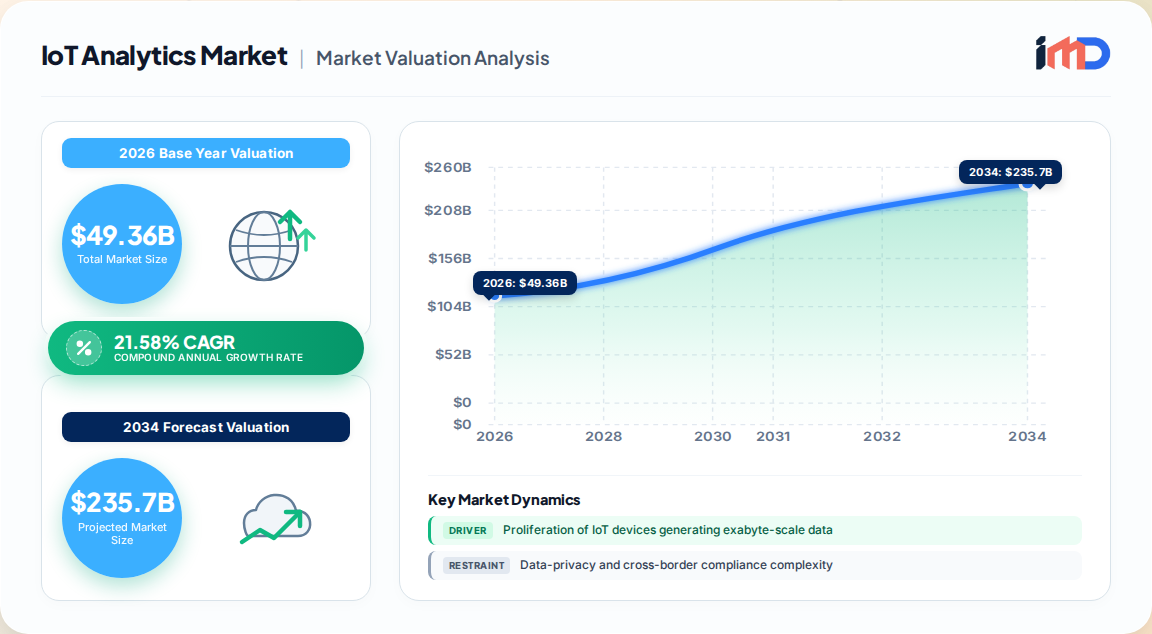
The global IoT Analytics market is experiencing unprecedented expansion, driven by the proliferation of connected devices and the urgent need to extract actionable intelligence from exabyte-scale data. Our proprietary primary research estimates the market at USD 49.36 billion in 2026, projected to reach USD 131.12 billion by 2031, registering a CAGR of 21.58%. This growth is fueled by the convergence of edge AI, cloud-native platforms, and enterprise digital transformation initiatives. Asia-Pacific commands the largest revenue share at 35.86% in 2025, followed by North America and Europe. The competitive landscape is intensifying as hyperscalers, specialist analytics vendors, and industrial automation players vie for ecosystem dominance through partnerships and acquisitions.
The IoT analytics value chain comprises hardware providers (sensors, gateways, edge devices), connectivity providers (wireless and wired networks), platform vendors (cloud and edge analytics software), service providers (integration, managed services), and end-users across industries. Key participants include:
Leading players are pursuing distinct strategies to capture market share:
Significant opportunities exist in:
Enterprises should consider:
| Aspects | Details |
|---|---|
| Study Period | 2020-2034 |
| Base Year | 2026 |
| Estimated Year | 2026 |
| Forecast Period | 2026-2034 |
| Historical Period | 2020-2025 |
| Growth Rate | CAGR of 21.58% from 2020-2034 |
| Segmentation |
|
 Related Reports


Analyst at Providence Strategic Partners at Petaling Jaya
I have received the report already. Thanks you for your help.it has been a pleasure working with you. Thank you again for a good quality report

Internationalization Director
Yes, as a matter of fact we are totally satisfied with both reports that we have purchased and will continue to do so during this process of the internationalization of our brand.

Head of Product Management and Marketing
We are using your report, and it gave us valuable information."

Regional Director, Marketing and Business Development
We've received the report and have reviewed the content. Overall, it looks great and aligns closely with the data we can verify based on our industry knowledge.

VP of Sales
Thank you very much for sharing the report. I have reviewed it and I am very satisfied with the quality and the insights it provides. It will certainly be valuable for our internal discussions.
By Organization Size
By Application
By End-User Industry
| By Geography |
|
The IoT Analytics market is estimated at USD 49.36 billion in 2026 and is forecast to reach USD 131.12 billion by 2031, growing at a CAGR of 21.58%.
Asia-Pacific commands the largest share at 35.86% in 2025, driven by rapid industrialization and smart-city initiatives, followed by North America at 30.0%.
Proliferation of IoT devices generating exabyte-scale data, cloud-native analytics adoption, predictive maintenance demand, edge-AI accelerators, and ESG monitoring mandates are the primary drivers.
Solutions held 67.95% of the market share in 2025, but services are growing faster at a 23.12% CAGR.
Key players include Microsoft, AWS, Google Cloud, IBM, Cisco, SAP, Siemens, PTC, and Oracle, among others.
Our rigorous research methodology combines multi-layered approaches with comprehensive quality assurance, ensuring precision, accuracy, and reliability in every market analysis.
| Stakeholder Role | Interview Share (%) |
|---|---|
| CTO/VP Engineering | 35% |
| IT Director/Manager | 30% |
| Data Analytics Manager | 20% |
| Procurement Head | 15% |
| Company Type | Representation (%) |
|---|---|
| IoT Device OEMs | 30% |
| Cloud Platform Providers | 25% |
| System Integrators | 20% |
| Analytics Software Vendors | 15% |
| End-User Industries | 10% |