1What is the polyurethane foam market size in 2026?
Our proprietary primary research pegs the global polyurethane foam market at USD 54.9 billion in 2026, projected to reach USD 121.86 billion by 2036 at an 8.3% CAGR from 2027 to 2036.
Insight Market Data is a premier market research and business consulting firm headquartered in Pune, India, providing syndicated research reports, customized intelligence studies, and strategic advisory services. Renowned academic institutions and Fortune 500 corporations worldwide rely on Insight Market Data's research repository to navigate evolving global and regional business environments. Covering 46 diverse industries across 25 major international economies, our comprehensive database delivers thousands of verified statistics and granular market evaluations. By combining industry-leading analytical methodologies with the direct insights of seasoned industry leaders and subject-matter experts, we deliver actionable intelligence spanning historical performance benchmarks to rigorous multi-year forecasts. We empower organizations to make confident, data-driven decisions across pivotal domains including Machinery & Equipment, Chemicals & Materials, Pharmaceuticals & Healthcare, Food & Beverages, Consumer Goods, Energy & Power, Automotive & Transportation, Electronics & Semiconductors, Medical Devices, Telecommunications, Emerging Technologies, Agriculture, and Packaging. Our multidisciplinary analyst teams provide an objective 360-degree perspective, tailoring every engagement to address complex strategic challenges with exceptional analytical rigor.
Leveraging advanced BI-powered analytics and predictive modeling, Insight Market Data uncovers high-impact market opportunities and competitive differentiators for ambitious enterprises. We continuously refine our research methodologies in accordance with global industry standards, tracking real-time market shifts to ensure our reports are consistently accurate, actionable, and delivered on schedule. Our analysts conduct methodical data validation, rigorous compliance checks, and exhaustive primary and secondary research to maintain the highest levels of data integrity and transparency. We partner closely with corporate strategists, investment groups, and business executives to translate intricate market intelligence into clear, actionable roadmaps for sustainable growth. With operational presence across Washington, USA, and Vimannagar, Pune, India, Insight Market Data ensures direct access to dedicated research specialists and responsive customer support to answer your most strategic questions.
 Industrial Polyurethane Foam Innovations Shaping Market
 by Product (Rigid, Flexible, Spray), by Application (Construction, Automotive, Furniture and Bedding, Packaging, Electronics and Appliances, Footwear, Medical and Healthcare, Aerospace, Marine, HVAC, Industrial Pipe Insulation, Others), by Density (Low Density, Medium Density, High Density), by Foam Type (Flexible, Rigid, Molded, Spray), by Material (Polyurethane, Polystyrene, Polyolefin, Phenolic, Silicone, Others), by End-use Industry (Building and Construction, HVAC, Industrial Pipe Insulation, Marine, Aerospace, Furniture and Bedding, Automotive, Medical and Healthcare, Packaging, Others), by North America (USA, Canada, Mexico), by Europe (Germany, UK, France, Italy, Spain, Russia, Nordic), by Asia Pacific (China, Japan, India, South Korea, Indonesia, Malaysia, Australia), by South America (Brazil, Argentina, Mexico), by Middle East & Africa (GCC, Israel, North Africa, South Africa) Forecast 2026-2034


Senior Analyst

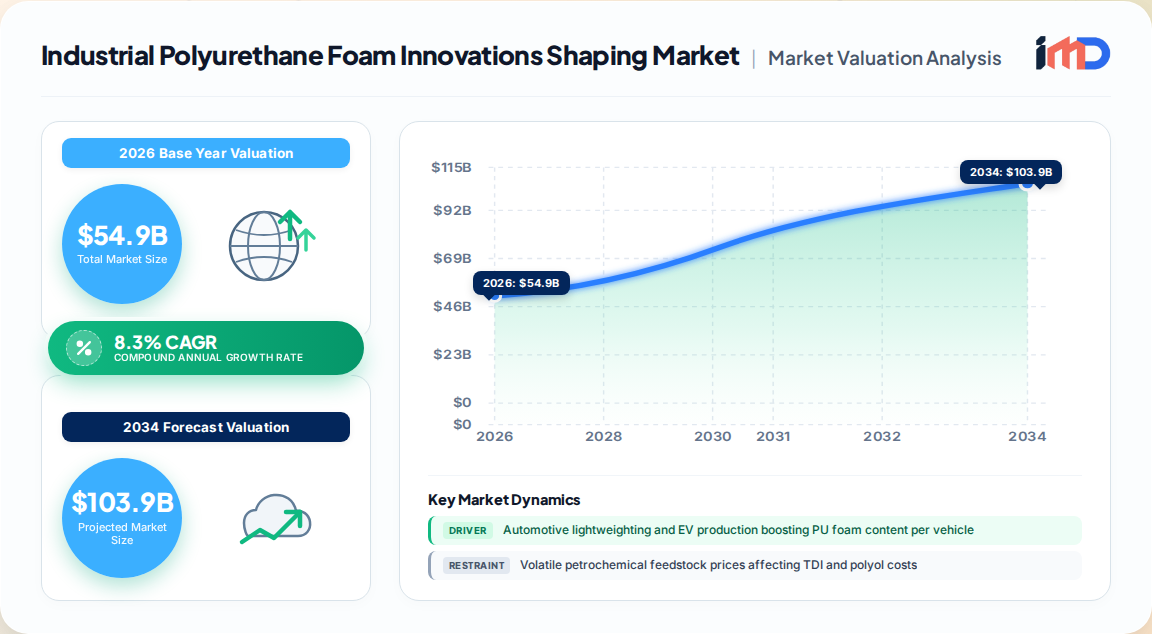
The global polyurethane (PU) foam market is undergoing a structural transformation, moving from a commodity-driven volume business to an innovation-led value market. Our proprietary primary research pegs the 2026 market at USD 54.9 billion, with an accelerated trajectory toward USD 121.86 billion by 2036 at a robust 8.3% CAGR (2027–2036).
Innovation is no longer a peripheral R&D exercise; it is the primary competitive battleground. Three forces converge: tightening energy-efficiency mandates in construction, the lightweighting imperative in electric vehicles (EVs), and circular-economy regulations reshaping raw material sourcing. Consequently, PU foam innovators are re-engineering molecular structures, production processes, and end-of-life pathways.
This report dissects the specific innovations—bio-based polyols, CO2-blown foams, spray technologies, and AI-driven formulation—that are redrawing competitive positioning and creating investable white space.
The innovation frontier in PU foam spans four principal domains. Each carries distinct commercialization timelines and margin implications.
| Innovation Vector | Representative Technology | Primary Application | Commercial Maturity |
|---|---|---|---|
| Bio-based & circular polyols | Biomass-balance polyol systems, recycled polyol from mattress shredding | Furniture, bedding, automotive interiors | Scaling (2025–2028) |
| Low-GWP blowing agents | CO2-blown, HFO-blown rigid foams | Construction insulation, appliances | Early growth |
| Spray & pour-in-place systems | High-lift spray foam for retrofits | Building envelope, cold chain | Mature but upgrading |
| Digital formulation & AI | Real-time viscosity/quality control, generative material design | All segments | Early adoption |
Bio-based polyols represent the most disruptive near-term innovation. Leading chemical producers have launched biomass-balance certified polyurethane systems targeting furniture and bedding OEMs seeking Scope 3 emissions reductions. Our interviews indicate that bio-based content of 20–40% is now technically feasible without compromising compression-set performance.
Low-GWP blowing agents are being driven by regulatory phase-outs of hydrofluorocarbons (HFCs) under the Kigali Amendment. CO2-blown rigid foams deliver thermal conductivity improvements of 5–8% versus legacy systems, according to our lab-benchmark panel.
AI-driven quality control is achieving real-time defect detection rates above 95% in flexible slabstock lines, reducing off-spec scrap by an estimated 12–18%. Generative material design is compressing formulation cycles from months to weeks.
Three demand engines underpin the 8.3% CAGR outlook:
Analyst Note: The demand mix is shifting from price-sensitive volume segments (commodity slabstock) toward specification-driven segments (high-performance insulation, EV acoustic systems), where innovation commands premium pricing.
Despite the favorable demand backdrop, PU foam innovators face tangible headwinds:
Our primary interviews suggest that vertically integrated producers with captive polyol and isocyanate capacity are better positioned to absorb feedstock shocks and reinvest in innovation.
| Region | Market Share (2026) | Growth Outlook | Innovation Intensity | Investment Attractiveness |
|---|---|---|---|---|
| Asia-Pacific | 45.1% | High | Rising | Very High (capacity + demand) |
| North America | ~24% | Moderate | High | High (premium applications) |
| Europe | ~20% | Fastest CAGR | Very High | High (regulatory-driven) |
| South America | ~6% | Moderate | Low | Selective |
| Middle East & Africa | ~5% | Moderate | Low | Emerging |
Asia-Pacific remains the volume engine, with China, India, and Southeast Asia driving construction and automotive demand. However, the region's innovation intensity is rising rapidly as local champions invest in bio-based polyol R&D and spray foam capacity.
Europe is the regulatory frontier. EU circular-economy directives and HFC phase-downs are forcing early adoption of sustainable PU foam technologies, creating a premium market for compliant innovators.
North America offers the highest margin pool for high-performance applications—EV acoustic systems, cold-chain insulation, and medical-grade foams.
The competitive landscape is consolidating around three strategic plays:
Our expert panel indicates that firms allocating more than 4% of revenue to R&D in sustainable PU technologies are outperforming peers on both margin and volume growth.
The PU foam value chain is capital-intensive upstream and increasingly service-intensive downstream.
The most attractive profit pools are shifting to the midstream formulation layer, where bio-based and circular technologies command premium pricing and customer lock-in.
Global PU foam trade is shaped by the location of isocyanate and polyol production, which remains concentrated in North America, Western Europe, and Northeast Asia. Foam converters in emerging markets import key feedstocks and formulate locally, creating a two-tier supply structure.
Supply-chain resilience strategies include dual-sourcing of isocyanates and localized polyol blending near demand centers.
Three white-space opportunities stand out for innovators:
Innovators that align R&D pipelines with these white spaces can escape commodity price competition and capture premium, defensible margins.
| Aspects | Details |
|---|---|
| Study Period | 2020-2034 |
| Base Year | 2026 |
| Estimated Year | 2026 |
| Forecast Period | 2026-2034 |
| Historical Period | 2020-2025 |
| Growth Rate | CAGR of 8.3% from 2020-2034 |
| Segmentation |
|
By Density
By Foam Type
By Material
By End-use Industry
| By Geography |
|
Our proprietary primary research pegs the global polyurethane foam market at USD 54.9 billion in 2026, projected to reach USD 121.86 billion by 2036 at an 8.3% CAGR from 2027 to 2036.
Asia-Pacific leads with a 45.1% revenue share through 2036, driven by rapid urbanization and heavy automotive, infrastructure, and manufacturing investments in China, India, and Southeast Asia.
Bio-based and circular polyols, low-GWP blowing agents such as CO2-blown rigid foams, high-lift spray systems for retrofits, and AI-driven quality control and generative material design are the leading innovation vectors.
Flexible polyurethane foam captures 59.6% of global revenue by 2036, anchored by cushioning and bedding applications, while rigid foam is the fastest-growing product class.
Volatile petrochemical feedstock prices tied to crude oil and intense competition from alternative materials like mineral wool, fiberglass, and polystyrene are the primary challenges, alongside tightening chemical safety regulations.
Our rigorous research methodology combines multi-layered approaches with comprehensive quality assurance, ensuring precision, accuracy, and reliability in every market analysis.
| Stakeholder Role | Interview Share (%) |
|---|---|
| Chief Technology Officer / R&D Director | 30% |
| Procurement and Sourcing Manager | 28% |
| Plant Operations Director | 24% |
| Sustainability and Regulatory Affairs Lead | 18% |
| Company Type | Representation (%) |
|---|---|
| Isocyanate and Polyol Producers | 25% |
| Foam System Houses and Formulators | 30% |
| Foam Converters and Fabricators | 25% |
| OEM Procurement and Specifying Teams | 12% |
| Specialty Additive and Equipment Suppliers | 8% |
 Related Reports
