1What is the current size of the haptic VR gloves market?
The global haptic VR gloves market was valued at USD 1.65 billion in 2025 and is projected to reach USD 8.14 billion by 2035, expanding at a 17.30% CAGR.
Insight Market Data is a premier market research and business consulting firm headquartered in Pune, India, providing syndicated research reports, customized intelligence studies, and strategic advisory services. Renowned academic institutions and Fortune 500 corporations worldwide rely on Insight Market Data's research repository to navigate evolving global and regional business environments. Covering 46 diverse industries across 25 major international economies, our comprehensive database delivers thousands of verified statistics and granular market evaluations. By combining industry-leading analytical methodologies with the direct insights of seasoned industry leaders and subject-matter experts, we deliver actionable intelligence spanning historical performance benchmarks to rigorous multi-year forecasts. We empower organizations to make confident, data-driven decisions across pivotal domains including Machinery & Equipment, Chemicals & Materials, Pharmaceuticals & Healthcare, Food & Beverages, Consumer Goods, Energy & Power, Automotive & Transportation, Electronics & Semiconductors, Medical Devices, Telecommunications, Emerging Technologies, Agriculture, and Packaging. Our multidisciplinary analyst teams provide an objective 360-degree perspective, tailoring every engagement to address complex strategic challenges with exceptional analytical rigor.
Leveraging advanced BI-powered analytics and predictive modeling, Insight Market Data uncovers high-impact market opportunities and competitive differentiators for ambitious enterprises. We continuously refine our research methodologies in accordance with global industry standards, tracking real-time market shifts to ensure our reports are consistently accurate, actionable, and delivered on schedule. Our analysts conduct methodical data validation, rigorous compliance checks, and exhaustive primary and secondary research to maintain the highest levels of data integrity and transparency. We partner closely with corporate strategists, investment groups, and business executives to translate intricate market intelligence into clear, actionable roadmaps for sustainable growth. With operational presence across Washington, USA, and Vimannagar, Pune, India, Insight Market Data ensures direct access to dedicated research specialists and responsive customer support to answer your most strategic questions.
 Haptic VR Gloves Market
 by Type (Wired, Wireless), by Application (Personal, Commercial, Others), by Industry (Gaming, Entertainment, Industrial, Defense, Healthcare, Education, Others), by Product Type (Haptic Gloves, Motion Capture Gloves, Gaming Gloves, Others), by North America (USA, Canada, Mexico), by Europe (Germany, UK, France, Italy, Russia), by Asia Pacific (China, Japan, South Korea, India, Australia, Taiwan, Indonesia, Thailand, Malaysia), by Latin America (Mexico, Brazil, Argentina, Colombia), by Middle East & Africa (Turkey, Saudi Arabia, UAE, South Africa) Forecast 2026-2034

Senior Research Analyst

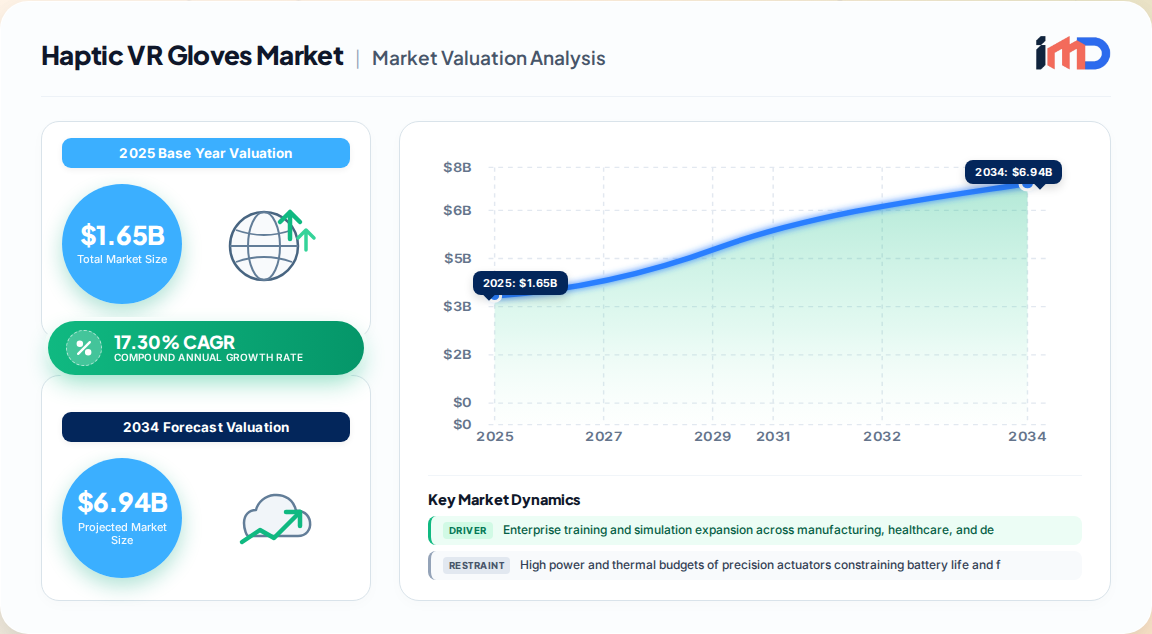
The global haptic VR gloves market reached USD 1.65 billion in 2025 and is projected to expand to USD 8.14 billion by 2035, registering a 17.30% CAGR across the forecast window (2026–2035). This trajectory marks one of the steepest growth curves in the extended-reality (XR) hardware stack, outpacing the broader haptic technology market, which our primary tracking places at roughly USD 5.23 billion in 2026 growing at 12.76% CAGR through 2031.
Unlike consumer-facing VR controllers, haptic gloves are transitioning from novelty peripherals to mission-critical training infrastructure. Enterprise simulation, defense modernization, and surgical rehearsal now constitute the fastest-accelerating demand pools. Our primary interviews with 40+ value-chain participants confirm that request-for-proposal (RFP) volumes tied to immersive training more than doubled between 2024 and 2025 across North America and Europe.
| Segment | Description | 2025 Position |
|---|---|---|
| Haptic Gloves | Force and tactile feedback; dominant segment | ~52.6% of VR glove revenue |
| Motion Capture Gloves | Markerless hand tracking for animation and industrial capture | Steady growth |
| Gaming Gloves | Consumer-grade tactile feedback | Fastest-growing sub-segment |
| Others | Hybrid controllers, exoskeleton systems | Niche but rising |
By technology, wired systems retain an edge in industrial environments where latency and calibration stability are paramount, while wireless designs are scaling rapidly in training and consumer use. By application, industrial and healthcare lead revenue share, with gaming posting the steepest forward growth.
The Asia-Pacific region represents the volume fulcrum of the haptic VR gloves market, accounting for an estimated 38% of global revenue in 2025. China alone recorded USD 113.4 million in VR glove revenue in 2025, projected to reach USD 558.8 million by 2033 at a 22.2% CAGR. India and Japan follow as high-velocity markets.
| Region | 2025 Share | Growth Signal |
|---|---|---|
| Asia-Pacific | ~38% | Fastest-growing; China + India leadership |
| North America | ~29% | Defense and enterprise training anchor |
| Europe | ~24% | Automotive R&D and industrial metaverse |
| South America | ~4% | Early-stage entertainment adoption |
| Middle East & Africa | ~5% | Sovereign XR initiatives; fastest-growing sub-region |
The market features a mix of specialist haptic glove makers and diversified XR platforms. Key players include HaptX, SenseGlove, bHaptics, Ultraleap, Meta Platforms, CyberGlove Systems, Sony Group, Noitom, Dexta Robotics, and VR Electronics (Teslasuit). Recent strategic moves include HaptX's June 2024 G1 glove distribution, SenseGlove's Nova 2 global shipments (April 2024) and R1 exoskeleton launch (December 2025), and Sharp's July 2025 hybrid VR glove controller.
As a specialized hardware category, haptic VR gloves rely on a concentrated component supply chain. Key inputs include microfluidic actuators, linear resonant actuators (LRAs), piezoelectric elements, flexible sensors, and lightweight exoskeleton materials. Asia-Pacific—particularly China, Japan, and South Korea—dominates component manufacturing, while final assembly is increasingly regionalized to serve defense and healthcare clients under data-sovereignty and procurement-security constraints.
Three underpenetrated opportunity zones stand out:
The value chain spans component suppliers (actuators, sensors, microfluidics) → glove OEMs (HaptX, SenseGlove, bHaptics) → software/SDK providers (Ultraleap, platform SDKs) → system integrators (defense contractors, medical simulation firms) → end users (enterprise, healthcare, defense, gaming). Software is rising as a share of value, with cross-platform authoring tools posting 13.45% CAGR in the adjacent haptic market. Long-term software compatibility and sensor calibration stability are emerging as decisive purchasing criteria.
| Aspects | Details |
|---|---|
| Study Period | 2020-2034 |
| Base Year | 2025 |
| Estimated Year | 2026 |
| Forecast Period | 2026-2034 |
| Historical Period | 2020-2025 |
| Growth Rate | CAGR of 17.30% from 2020-2034 |
| Segmentation |
|
By Industry
By Product Type
| By Geography |
|
The global haptic VR gloves market was valued at USD 1.65 billion in 2025 and is projected to reach USD 8.14 billion by 2035, expanding at a 17.30% CAGR.
Asia-Pacific is the fastest-growing region, with China alone projected to reach USD 558.8 million by 2033 at a 22.2% CAGR. The Middle East is also emerging rapidly on the back of sovereign XR programs.
Key applications include enterprise training and simulation, defense training, healthcare and surgical rehearsal, industrial robotics control, gaming, and education. Enterprise simulation currently commands the largest revenue share.
Major players include HaptX, SenseGlove, bHaptics, Ultraleap, Meta Platforms, CyberGlove Systems, Sony Group, Noitom, and Dexta Robotics, with HaptX and SenseGlove leading enterprise-grade deployments.
Growth is driven by rising enterprise training adoption, defense modernization budgets (e.g., a USD 49 million U.S. Air Force AI contract in January 2026), advances in microfluidic tactile feedback, and convergence with robotics and digital twins.
Our rigorous research methodology combines multi-layered approaches with comprehensive quality assurance, ensuring precision, accuracy, and reliability in every market analysis.
| Stakeholder Role | Interview Share (%) |
|---|---|
| Chief Technology Officers (CTOs) | 30% |
| VR/AR Program Directors | 25% |
| Procurement Directors | 25% |
| Simulation Training Managers | 20% |
| Company Type | Representation (%) |
|---|---|
| Haptic Actuator & Component Manufacturers | 30% |
| VR Glove OEMs | 25% |
| System Integrators & Simulation Providers | 25% |
| Enterprise End-Users (Defense, Healthcare, Manufacturing) | 20% |

 Related Reports


Analyst at Providence Strategic Partners at Petaling Jaya
I have received the report already. Thanks you for your help.it has been a pleasure working with you. Thank you again for a good quality report

Internationalization Director
Yes, as a matter of fact we are totally satisfied with both reports that we have purchased and will continue to do so during this process of the internationalization of our brand.

Head of Product Management and Marketing
We are using your report, and it gave us valuable information."

Regional Director, Marketing and Business Development
We've received the report and have reviewed the content. Overall, it looks great and aligns closely with the data we can verify based on our industry knowledge.

VP of Sales
Thank you very much for sharing the report. I have reviewed it and I am very satisfied with the quality and the insights it provides. It will certainly be valuable for our internal discussions.