1What is the hands off detection steering wheel market size?
Our proprietary research values the global HOD steering wheel market at USD 2.1 Billion in 2025, growing at a 13.4% CAGR to reach approximately USD 5.0 Billion by 2032.
Insight Market Data is a premier market research and business consulting firm headquartered in Pune, India, providing syndicated research reports, customized intelligence studies, and strategic advisory services. Renowned academic institutions and Fortune 500 corporations worldwide rely on Insight Market Data's research repository to navigate evolving global and regional business environments. Covering 46 diverse industries across 25 major international economies, our comprehensive database delivers thousands of verified statistics and granular market evaluations. By combining industry-leading analytical methodologies with the direct insights of seasoned industry leaders and subject-matter experts, we deliver actionable intelligence spanning historical performance benchmarks to rigorous multi-year forecasts. We empower organizations to make confident, data-driven decisions across pivotal domains including Machinery & Equipment, Chemicals & Materials, Pharmaceuticals & Healthcare, Food & Beverages, Consumer Goods, Energy & Power, Automotive & Transportation, Electronics & Semiconductors, Medical Devices, Telecommunications, Emerging Technologies, Agriculture, and Packaging. Our multidisciplinary analyst teams provide an objective 360-degree perspective, tailoring every engagement to address complex strategic challenges with exceptional analytical rigor.
Leveraging advanced BI-powered analytics and predictive modeling, Insight Market Data uncovers high-impact market opportunities and competitive differentiators for ambitious enterprises. We continuously refine our research methodologies in accordance with global industry standards, tracking real-time market shifts to ensure our reports are consistently accurate, actionable, and delivered on schedule. Our analysts conduct methodical data validation, rigorous compliance checks, and exhaustive primary and secondary research to maintain the highest levels of data integrity and transparency. We partner closely with corporate strategists, investment groups, and business executives to translate intricate market intelligence into clear, actionable roadmaps for sustainable growth. With operational presence across Washington, USA, and Vimannagar, Pune, India, Insight Market Data ensures direct access to dedicated research specialists and responsive customer support to answer your most strategic questions.
 Hands Off Detection (HOD) Steering Wheel Industry
 by Type (2-Zone Hands Off Detection, 3-Zone Hands Off Detection, 4-Zone Hands Off Detection, Others), by Application (Passenger Vehicle, Commercial Vehicle), by Asia Pacific (China, Japan, Korea, India, Southeast Asia, Australia), by North America (United States, Canada, Mexico), by Europe (Germany, France, UK, Italy, Spain, Rest of Europe), by Middle East & Africa (GCC Countries, Turkey, South Africa, Rest of MEA), by Latin America (Brazil, Rest of Latin America) Forecast 2026-2034

Research Analyst


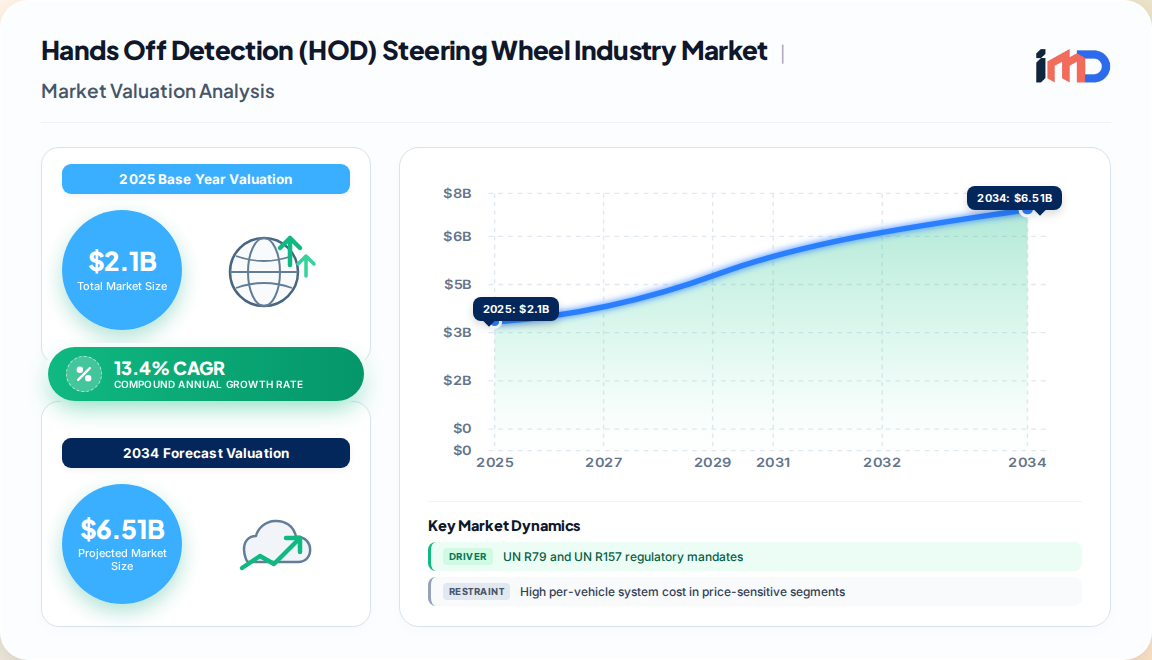
The global Hands Off Detection (HOD) steering wheel market is a precision sensing segment nested inside the broader automotive steering and driver monitoring ecosystem. Our proprietary first-party research values the market at USD 2.1 Billion in 2025, expanding at a 13.4% CAGR to exceed USD 5.0 Billion by 2032. Growth is structurally decoupled from flat global vehicle output because HOD content per vehicle is rising sharply — from a single capacitive mat in 2018 platforms to multi-zone, heater-compatible, software-integrated sensing architectures today.
HOD is no longer a comfort feature. It is the certified handshake between human and machine. Under UN Regulation No. 79 for Lane Keeping Assist Systems, and UN Regulation No. 157 for Automated Lane Keeping Systems, vehicles must reliably determine whether the driver retains physical control of the wheel. This regulatory anchor makes HOD a mandatory bill-of-material item for any OEM selling Level 1 through Level 3 functionality into signatory markets.
Segment value is migrating rapidly up the zone count. Two-zone systems — typically a left/right split — remain the volume workhorse for entry and mid-trim passenger cars but carry the lowest average selling price and are increasingly commoditized. Three-zone and four-zone configurations, which add rim coverage at the top and bottom arcs, deliver superior detection during one-handed driving, low-contact grip and winter glove use.
| Configuration | Typical Function | Price Positioning | 2025 Value Share | Growth Outlook |
|---|---|---|---|---|
| 2-Zone | Basic hands-on/off state for LKAS | Entry | ~41% | Moderate, volume-led |
| 3-Zone | Enhanced rim coverage, ASIL-ready | Mid | ~34% | Fastest |
| 4-Zone | Premium, hands-off highway pilot | Premium | ~19% | Strong in luxury |
| Others (full-rim, optical) | Camera/IR fusion, exotic rims | Niche | ~6% | Emerging |
A decisive technical differentiator is heater compatibility. Capacitive mats must remain accurate while the wheel is thermally cycling between -40°C and 85°C, and must not false-trigger from moisture, rain ingress or conductive gloves. Suppliers that have solved heater co-existence and humidity rejection command measurable price premiums and are winning multi-year platform awards.
Four demand engines are compounding simultaneously:
Asia-Pacific leads on volume and value, anchored by vehicle assembly density in China, Japan, Korea and India, and by aggressive domestic ADAS feature rollout. China's localized supplier ecosystem is compressing HOD price points and accelerating feature democratization into mid-market vehicles.
Europe retains the strongest regulatory pull and the highest value density per vehicle, with premium German OEMs standardizing 3-zone and 4-zone systems. North America grows on the back of hands-free highway assistance adoption and commercial fleet safety mandates. South America and Middle East & Africa remain early-stage, driven by imported premium content rather than local regulation.
Our competitive assessment identifies a concentrated Tier-1 core — Valeo, Autoliv, ZF, Joyson Safety Systems — alongside steering-wheel specialists and sensor specialists such as AEW and ams-OSRAM AG, with regional champions like Hongqi anchoring Chinese domestic programs. The strategic battleground has shifted from sensor supply to system integration partnership with steering wheel manufacturers, because the sensing layer must be co-designed with the rim, heater and airbag module.
Key strategic moves we observe:
| Value Chain Stage | Key Inputs | Sourcing Risk | Strategic Priority |
|---|---|---|---|
| Conductive film & sensor mat | PET films, conductive inks, silver paste | Medium | Dual-source qualified film suppliers |
| ECU & signal processing | MCUs, capacitive controllers | High (semiconductor) | Multi-year capacity reservations |
| Steering wheel integration | Foam, leather, heaters, airbag modules | Low–Medium | Co-development agreements with wheel makers |
| OEM validation & homologation | Test rigs, regulatory documentation | Medium | Early regulatory pre-compliance |
Procurement teams should prioritize heater-compatible qualified sensor film capacity and secure capacitive controller allocations through 2027, as automotive semiconductor lead times remain the single most likely cause of HOD program delay. We recommend negotiating price-indexed contracts tied to silver paste and MCU pricing rather than fixed multi-year pricing.
Three underserved opportunities stand out in our assessment:
HOD systems trade primarily as embedded content within steering wheel assemblies rather than as standalone commodities, so customs data tracks wheel modules. Asia-Pacific — particularly China, Mexico and Eastern Europe — is the dominant export origin for steering wheel assemblies with embedded sensing, while the EU and US are net importers of finished modules and exporters of high-value ECUs and sensor films. Tariff exposure on automotive electronic assemblies and semiconductor content remains the principal trade risk to landed cost.
By 2030 we expect multi-zone HOD to be standard on the majority of new passenger platforms sold in regulated markets, with sensor fusion against interior cameras becoming the default safety architecture. The commercial winner will not be the lowest-cost mat supplier but the partner that delivers heater-compatible, ASIL-rated, software-integrated sensing at scale.
| Aspects | Details |
|---|---|
| Study Period | 2020-2034 |
| Base Year | 2025 |
| Estimated Year | 2026 |
| Forecast Period | 2026-2034 |
| Historical Period | 2020-2025 |
| Growth Rate | CAGR of 13.4% from 2020-2034 |
| Segmentation |
|
| By Geography |
|
Our proprietary research values the global HOD steering wheel market at USD 2.1 Billion in 2025, growing at a 13.4% CAGR to reach approximately USD 5.0 Billion by 2032.
UN Regulation No. 79 for Lane Keeping Assist and UN Regulation No. 157 for Automated Lane Keeping Systems require vehicles to verify driver hand contact before and during assisted driving, making HOD a compliance item for OEMs in signatory markets.
Three-zone hands-off detection is the fastest-growing configuration, accounting for roughly 34% of 2025 value, as it improves detection during one-handed and low-contact driving while remaining heater-compatible.
The Tier-1 core includes Valeo, Autoliv, ZF, Joyson Safety Systems, AEW and ams-OSRAM AG, with Hongqi prominent in Chinese domestic programs and steering wheel specialists co-developing integrated rims.
Asia-Pacific leads with approximately 44% of global value, driven by vehicle assembly density in China, Japan, Korea and India and rapid ADAS feature rollout in mid-market vehicles.
Our rigorous research methodology combines multi-layered approaches with comprehensive quality assurance, ensuring precision, accuracy, and reliability in every market analysis.
| Stakeholder Role | Interview Share (%) |
|---|---|
| Chief ADAS Safety Engineer | 32% |
| Steering Systems Program Manager | 28% |
| Automotive Procurement Director | 24% |
| Homologation & Regulatory Compliance Lead | 16% |
| Company Type | Representation (%) |
|---|---|
| Capacitive sensor mat & film manufacturers | 30% |
| Steering wheel Tier-1 integrators | 26% |
| OEM ADAS & safety engineering teams | 22% |
| Automotive semiconductor & controller suppliers | 14% |
| Commercial fleet & telematics providers | 8% |
 Related Reports
