1What is the market size of the halal food testing kits market in 2025?
The global halal food testing kits market is valued at USD 1.25 Billion in 2025, according to our proprietary research.
Insight Market Data is a premier market research and business consulting firm headquartered in Pune, India, providing syndicated research reports, customized intelligence studies, and strategic advisory services. Renowned academic institutions and Fortune 500 corporations worldwide rely on Insight Market Data's research repository to navigate evolving global and regional business environments. Covering 46 diverse industries across 25 major international economies, our comprehensive database delivers thousands of verified statistics and granular market evaluations. By combining industry-leading analytical methodologies with the direct insights of seasoned industry leaders and subject-matter experts, we deliver actionable intelligence spanning historical performance benchmarks to rigorous multi-year forecasts. We empower organizations to make confident, data-driven decisions across pivotal domains including Machinery & Equipment, Chemicals & Materials, Pharmaceuticals & Healthcare, Food & Beverages, Consumer Goods, Energy & Power, Automotive & Transportation, Electronics & Semiconductors, Medical Devices, Telecommunications, Emerging Technologies, Agriculture, and Packaging. Our multidisciplinary analyst teams provide an objective 360-degree perspective, tailoring every engagement to address complex strategic challenges with exceptional analytical rigor.
Leveraging advanced BI-powered analytics and predictive modeling, Insight Market Data uncovers high-impact market opportunities and competitive differentiators for ambitious enterprises. We continuously refine our research methodologies in accordance with global industry standards, tracking real-time market shifts to ensure our reports are consistently accurate, actionable, and delivered on schedule. Our analysts conduct methodical data validation, rigorous compliance checks, and exhaustive primary and secondary research to maintain the highest levels of data integrity and transparency. We partner closely with corporate strategists, investment groups, and business executives to translate intricate market intelligence into clear, actionable roadmaps for sustainable growth. With operational presence across Washington, USA, and Vimannagar, Pune, India, Insight Market Data ensures direct access to dedicated research specialists and responsive customer support to answer your most strategic questions.
 HALAL Food Testing Kits Market
 by Product Type (Kits and Reagents, Consumables and Accessories), by Application (Meat and Poultry, Processed Foods, Beverages, Others), by Technology (PCR, ELISA, Lateral Flow Assays), by End User (Food Manufacturers, Certification Bodies, Government Agencies, Laboratories), by North America (USA, Canada, Mexico), by Europe (Germany, UK, France, Italy, Spain, Rest of Europe), by Asia Pacific (China, Japan, India, Indonesia, Malaysia, Australia, Rest of APAC), by South America (Brazil, Argentina, Colombia, Chile, Peru, Rest of South America), by Middle East & Africa (Saudi Arabia, UAE, Turkey, Egypt, Qatar, South Africa, Rest of MEA) Forecast 2026-2034

Research Associate


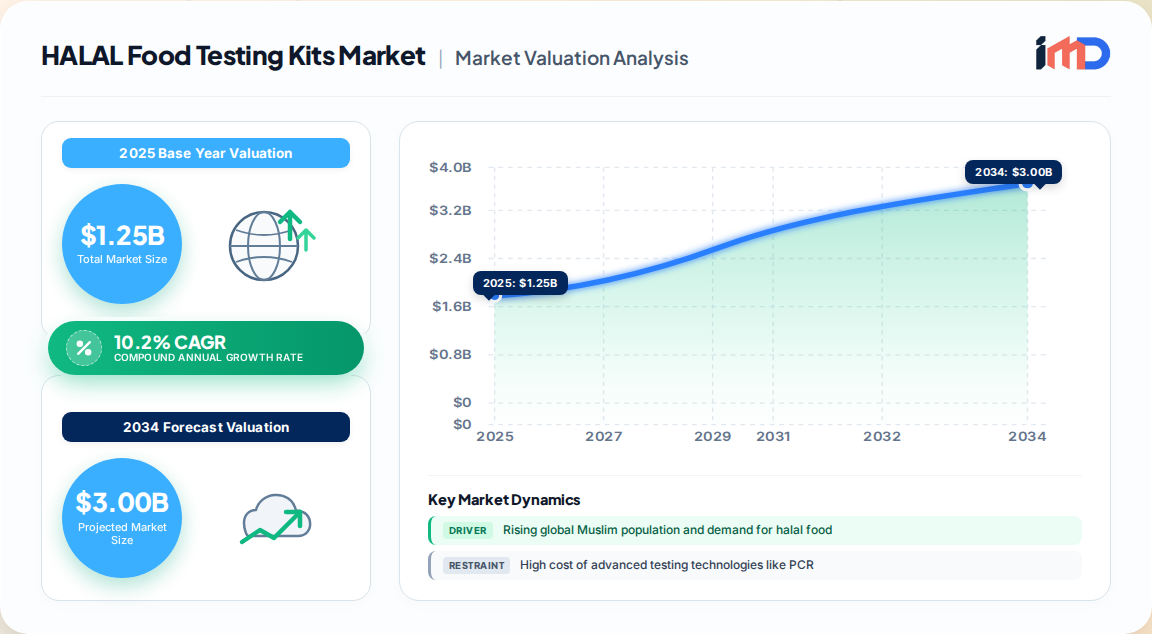
The global halal food testing kits market is experiencing robust growth, driven by the escalating demand for halal-certified products and the corresponding need for reliable, rapid, and accurate verification methods. Our proprietary research estimates the market at USD 1.25 Billion in 2025, projected to reach USD 2.8 Billion by 2034, expanding at a CAGR of 10.2%. This growth is underpinned by the fundamental expansion of the global halal food sector, which we value at USD 2.95 Trillion in 2025 and forecast to reach USD 6.32 Trillion by 2034. As the halal food industry becomes increasingly globalized and complex, the integrity of the supply chain is paramount, making testing kits an indispensable tool for manufacturers, regulators, and certifiers.
The market is characterized by a diverse array of testing technologies, including PCR (Polymerase Chain Reaction), ELISA (Enzyme-Linked Immunosorbent Assay), and lateral flow assays, each catering to specific detection needs such as porcine DNA, alcohol, and other non-halal substances. The Asia-Pacific region dominates the market, holding a 41% share in 2025, reflecting its large Muslim population and proactive government regulations, such as Indonesia's mandatory halal certification law. North America and Europe follow, with significant contributions from their growing Muslim demographics and a broader consumer shift toward ethical and transparent food production.
The halal food testing kits value chain comprises several distinct stages, each adding value and ensuring the final product's reliability.
A critical trend is the integration of digital solutions, such as blockchain for traceability and cloud-based data management, which enhances the value proposition of testing kits by providing a verifiable chain of custody.
Given the global nature of the food trade and halal certification, testing kits are traded internationally. Official trade data from UN Comtrade indicates that developed economies in North America and Europe are net exporters of advanced testing kits, while Asia-Pacific and the Middle East are major importers. This flow is driven by the concentration of kit manufacturers in regions with strong life sciences sectors.
Supply chain risks include dependency on a few key suppliers for critical raw materials and geopolitical trade tensions that can disrupt logistics.
The market is segmented by product type, application, technology, and end user.
| Segment | Sub-segment | Market Share (2025) | Growth Outlook |
|---|---|---|---|
| By Product Type | Kits and Reagents | 65% | High |
| Consumables and Accessories | 35% | Moderate | |
| By Application | Meat and Poultry | 40% | Very High |
| Processed Foods | 30% | High | |
| Beverages | 15% | Moderate | |
| Others | 15% | Moderate | |
| By Technology | PCR | 45% | Very High |
| ELISA | 30% | High | |
| Lateral Flow Assays | 25% | High | |
| By End User | Food Manufacturers | 50% | High |
| Certification Bodies | 25% | High | |
| Government Agencies | 15% | Moderate | |
| Laboratories | 10% | Moderate |
Meat and poultry is the largest application segment, driven by the high risk of adulteration and the dominance of meat in the halal food market. PCR technology leads due to its high sensitivity and specificity, while lateral flow assays are gaining traction for rapid on-site testing.
Asia-Pacific dominates the market with a 41% share, fueled by Indonesia's mandatory certification and Malaysia's advanced halal ecosystem. The region is expected to maintain its lead, growing at a CAGR of 10.5%.
North America holds 27% of the market, driven by a growing Muslim population and stringent food safety regulations. The U.S. and Canada are key markets, with a strong presence of certification bodies and testing laboratories.
Europe accounts for 24%, with the UK, Germany, and France leading. The region's growth is supported by harmonized halal standards and increasing demand for ethical products.
Middle East & Africa and South America each hold 4% but are expected to grow steadily, as halal awareness and regulatory frameworks develop.
The market is moderately concentrated, with key players focusing on innovation, strategic partnerships, and geographic expansion. Our primary research identifies the following leading companies:
Strategic initiatives include product launches, such as rapid test kits for porcine DNA, and collaborations with certification bodies to develop standardized protocols.
Significant opportunities exist in developing cost-effective, rapid testing kits for SMEs and in emerging markets. Additionally, integrating digital traceability with testing kits can create a premium offering. The development of multiplex kits that detect multiple non-halal substances in a single test represents a key innovation frontier.
Food manufacturers should adopt a risk-based approach to procuring testing kits, balancing cost with reliability. Establishing long-term partnerships with kit suppliers can ensure consistent quality and supply. For certification bodies, investing in training and infrastructure for on-site testing is critical. Governments can incentivize local production of testing kits to reduce import dependency and improve supply chain resilience.
The global trade of halal food testing kits is influenced by regulatory requirements and food safety incidents. According to World Bank WITS data, imports of diagnostic kits have grown steadily, particularly in Southeast Asia. Supply chain risks include reliance on single-source suppliers for critical reagents and potential disruptions from trade policies. Diversifying suppliers and maintaining strategic inventory can mitigate these risks.
| Aspects | Details |
|---|---|
| Study Period | 2020-2034 |
| Base Year | 2025 |
| Estimated Year | 2026 |
| Forecast Period | 2026-2034 |
| Historical Period | 2020-2025 |
| Growth Rate | CAGR of 10.2% from 2020-2034 |
| Segmentation |
|
 Related Reports

By Technology
By End User
| By Geography |
|
The global halal food testing kits market is valued at USD 1.25 Billion in 2025, according to our proprietary research.
Asia-Pacific holds the largest share, accounting for 41% of the global market in 2025, driven by countries like Indonesia and Malaysia.
Key drivers include the rising global Muslim population, stringent regulatory frameworks, increasing consumer awareness, and the globalization of food supply chains.
Challenges include the high cost of advanced testing technologies, lack of standardized protocols, limited awareness in emerging markets, and a shortage of skilled technicians.
Major companies include Nestlé S.A., Cargill, Incorporated, Unilever PLC, Danone S.A., and BRF S.A., among others.
Our rigorous research methodology combines multi-layered approaches with comprehensive quality assurance, ensuring precision, accuracy, and reliability in every market analysis.
| Stakeholder Role | Interview Share (%) |
|---|---|
| Procurement Director | 30% |
| Quality Assurance Manager | 25% |
| Regulatory Affairs Specialist | 20% |
| R&D Scientist | 15% |
| Operations Manager | 10% |
| Company Type | Representation (%) |
|---|---|
| Food Manufacturers | 45% |
| Certification Bodies | 25% |
| Government Agencies | 15% |
| Testing Laboratories | 10% |
| Kit Manufacturers | 5% |