1What is the projected size and growth rate of the gene sequencing market?
The global gene sequencing market is valued at $14.8 billion in 2024 and is projected to reach $34.8 billion by 2029, expanding at an 18.6% CAGR over the forecast period.
Insight Market Data is a premier market research and business consulting firm headquartered in Pune, India, providing syndicated research reports, customized intelligence studies, and strategic advisory services. Renowned academic institutions and Fortune 500 corporations worldwide rely on Insight Market Data's research repository to navigate evolving global and regional business environments. Covering 46 diverse industries across 25 major international economies, our comprehensive database delivers thousands of verified statistics and granular market evaluations. By combining industry-leading analytical methodologies with the direct insights of seasoned industry leaders and subject-matter experts, we deliver actionable intelligence spanning historical performance benchmarks to rigorous multi-year forecasts. We empower organizations to make confident, data-driven decisions across pivotal domains including Machinery & Equipment, Chemicals & Materials, Pharmaceuticals & Healthcare, Food & Beverages, Consumer Goods, Energy & Power, Automotive & Transportation, Electronics & Semiconductors, Medical Devices, Telecommunications, Emerging Technologies, Agriculture, and Packaging. Our multidisciplinary analyst teams provide an objective 360-degree perspective, tailoring every engagement to address complex strategic challenges with exceptional analytical rigor.
Leveraging advanced BI-powered analytics and predictive modeling, Insight Market Data uncovers high-impact market opportunities and competitive differentiators for ambitious enterprises. We continuously refine our research methodologies in accordance with global industry standards, tracking real-time market shifts to ensure our reports are consistently accurate, actionable, and delivered on schedule. Our analysts conduct methodical data validation, rigorous compliance checks, and exhaustive primary and secondary research to maintain the highest levels of data integrity and transparency. We partner closely with corporate strategists, investment groups, and business executives to translate intricate market intelligence into clear, actionable roadmaps for sustainable growth. With operational presence across Washington, USA, and Vimannagar, Pune, India, Insight Market Data ensures direct access to dedicated research specialists and responsive customer support to answer your most strategic questions.
 gene sequencing Market
 by Technology (NGS, Third-Generation Sequencing, Sanger Sequencing, Pyrosequencing), by Product (Sequencing Instruments, Consumables, Services & Bioinformatics), by Application (Clinical Diagnostics, Research & Academic, Biopharma, Microbiology, Agriculture), by End User (Academic & Research Institutes, Hospitals & Diagnostic Laboratories, Pharmaceutical & Biotechnology Companies, Contract Research Organizations), by Disease Category (Cancer, Reproductive Health, Mendelian Disorders, Others), by North America (USA, Canada, Mexico), by Europe (Germany, UK, France, Italy, Spain), by Asia-Pacific (China, Japan, India, Australia, South Korea), by Rest of the World Forecast 2026-2034

Senior Research Analyst


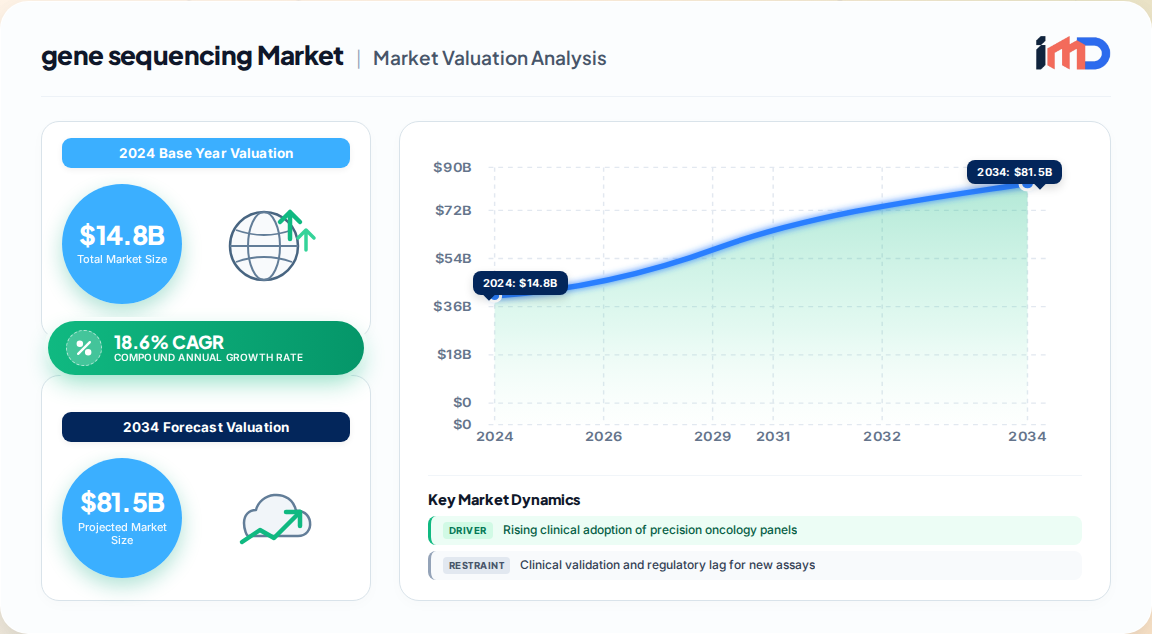
The global gene sequencing market is undergoing a structural transformation from a research-enablement technology into the operational backbone of clinical medicine, population health, and applied biosurveillance. Our proprietary primary research and expert interview program places the market at $14.8 billion in 2024, with a projected expansion to $34.8 billion by 2029, representing a robust CAGR of 18.6% across the forecast window.
This trajectory is not a simple continuation of historical instrument cycles. It reflects a decisive shift in demand composition: recurring consumable and service revenue now outpaces capital equipment placement growth, and clinical diagnostics has become the single largest application vector. The installed-base model—where every platform placed generates years of flow cell, reagent, and library-preparation pull-through—is the dominant economic engine of the market.
Key structural observations from our primary research:
Comprehensive genomic profiling in oncology remains the strongest volume engine in the gene sequencing market. Reimbursement frameworks for advanced cancer patients—particularly where sequencing panels carry regulatory approval as companion diagnostics—have institutionalized sequencing within routine treatment-selection pathways. More importantly, minimal residual disease and molecular residual disease monitoring convert sequencing from a one-time diagnostic event into a serial testing regimen, materially improving instrument utilization and recurring consumable pull-through.
Rapid reduction in per-sample sequencing cost is resetting buying behavior. Long-read whole-genome workflows have moved below the $300 per sample threshold at scale through chemistry and cell-reuse innovations, while short-read whole-genome consumable-plus-analysis pricing has fallen toward the $395 per sample level on existing high-throughput infrastructure. The strategic consequence is that workflow fit, bioinformatics integration, and clinical validation now matter more than headline instrument price in vendor selection.
National cohort programs have become the most efficient volume builders in the market. Large integrated genomics-and-health-record databases now exceed 535,000 whole genome sequences linked to nearly 482,000 electronic health records in flagship public programs, while national biobank efforts have completed whole-genome sequencing of roughly 490,000 participants at ~32.5x average depth, surfacing close to 1.5 billion genetic variants. These programs aggregate multi-year demand and de-risk vendor capacity planning.
Compact, lower-footprint platforms are expanding sequencing into decentralized and near-patient settings, with early commercial traction concentrated in Asia-Pacific health systems seeking to bypass centralized reference-lab bottlenecks.
| Segment | Revenue Share (Recent Base) | Growth Outlook |
|---|---|---|
| Next-generation sequencing (short-read) | ~69% | Steady, volume-led |
| Third-generation / long-read sequencing | Emerging | Fastest technology CAGR (~13%) |
| Sanger sequencing | Declining | Structural substitution |
| Pyrosequencing | Niche | Mature/declining |
| Consumables | ~53% | Recurring, high visibility |
| Sequencing instruments | ~31% | Fastest product CAGR (~13.5%) |
| Services & bioinformatics | Balance | Rising attach rate |
Our primary interviews confirm that the long-read segment is transitioning from a research niche into a clinically credible tool for structural variant discovery, repeat expansion disorders, and HLA typing. However, short-read platforms retain decisive advantages in throughput economics and cost-per-gigabase for high-volume population screening, ensuring technology coexistence rather than outright displacement through the forecast period.
Application segmentation reveals a market still dominated by clinical diagnostics but with differentiated growth vectors:
Within clinical applications, reproductive health—led by non-invasive prenatal testing, carrier screening, and IVF screening—remains the largest single clinical application cluster, while oncology is the fastest-growing, propelled by companion diagnostics and therapy-response monitoring. Mendelian and rare disease programs are expanding as whole-genome sequencing becomes first-tier in undiagnosed disease pathways.
End-user spend is concentrated among pharmaceutical and biotechnology companies (roughly 36% of spending), reflecting heavy internal R&D sequencing demand. Hospitals and diagnostic laboratories constitute the fastest-growing end-user class, consistent with the migration of sequencing into routine care delivery.
North America leads with approximately 41% of global revenue, supported by mature reimbursement infrastructure, deep biopharma R&D spending, and concentrated reference-lab capacity. Europe follows with a strong public-genomics orientation and harmonized diagnostic regulation. Asia-Pacific is the fastest-growing region, expanding at a rate above the global average, driven by national genomics initiatives, expanding hospital diagnostic networks, and domestic platform development.
| Region | Share | Growth Profile | Attractiveness |
|---|---|---|---|
| North America | ~41% | Moderate-high | Highest near-term revenue density |
| Europe | ~24% | Moderate | Strong public-program funding |
| Asia-Pacific | ~28% | Highest | Volume growth and localization opportunity |
| South America | ~4% | Emerging | Reference-lab build-out |
| Middle East & Africa | ~3% | Early | Sovereign genomics investment |
Competition is no longer decided on instrument specifications alone. Our primary research identifies four defensible battlegrounds:
White-space opportunities cluster around decentralized near-patient sequencing, long-read structural variant testing, multi-omic integration services, and sovereign population-genomics partnerships in emerging regions. Vendors that can bundle assay design, data interpretation, quality assurance, and reimbursement navigation are positioned to capture disproportionate share as the market matures.
| Existing Products | New Products | |
|---|---|---|
| Existing Markets | Consumable pull-through on installed clinical base; menu expansion within oncology | Companion diagnostic panel launches; MRD monitoring assays |
| New Markets | Decentralized near-patient placement of existing platforms | Long-read assays for structural variants in emerging clinical settings |
| Aspects | Details |
|---|---|
| Study Period | 2020-2034 |
| Base Year | 2024 |
| Estimated Year | 2026 |
| Forecast Period | 2026-2034 |
| Historical Period | 2020-2025 |
| Growth Rate | CAGR of 18.6% from 2020-2034 |
| Segmentation |
|
By Application
By End User
By Disease Category
| By Geography |
|
The global gene sequencing market is valued at $14.8 billion in 2024 and is projected to reach $34.8 billion by 2029, expanding at an 18.6% CAGR over the forecast period.
Growth is driven by rising clinical adoption of precision oncology panels, falling per-base sequencing costs, expansion of rare disease whole-genome programs, and population-scale genomics and biobank initiatives.
Next-generation sequencing holds approximately 69% of technology revenue, while third-generation long-read sequencing is the fastest-growing technology segment at a CAGR near 13%.
North America accounts for roughly 41% of global revenue, supported by mature reimbursement frameworks and concentrated biopharma R&D, while Asia-Pacific is the fastest-growing region.
Leading participants include Illumina, Thermo Fisher Scientific, PacBio, Oxford Nanopore Technologies, Agilent Technologies, QIAGEN, F. Hoffmann-La Roche, Guardant Health, Myriad Genetics, and BGI.
Our rigorous research methodology combines multi-layered approaches with comprehensive quality assurance, ensuring precision, accuracy, and reliability in every market analysis.
| Stakeholder Role | Interview Share (%) |
|---|---|
| Laboratory Director | 30% |
| Chief Scientific Officer | 25% |
| Head of Genomics Operations | 25% |
| VP of Clinical Diagnostics | 20% |
| Company Type | Representation (%) |
|---|---|
| Sequencing Platform OEMs & Instrument Manufacturers | 30% |
| Clinical Reference & Diagnostic Laboratories | 24% |
| Biopharma & Translational Research Organizations | 20% |
| Consumable & Reagent Suppliers | 15% |
| Bioinformatics & Interpretation Software Vendors | 11% |
 Related Reports
