Insight Market Data is a premier market research and business consulting firm headquartered in Pune, India, providing syndicated research reports, customized intelligence studies, and strategic advisory services. Renowned academic institutions and Fortune 500 corporations worldwide rely on Insight Market Data's research repository to navigate evolving global and regional business environments. Covering 46 diverse industries across 25 major international economies, our comprehensive database delivers thousands of verified statistics and granular market evaluations. By combining industry-leading analytical methodologies with the direct insights of seasoned industry leaders and subject-matter experts, we deliver actionable intelligence spanning historical performance benchmarks to rigorous multi-year forecasts. We empower organizations to make confident, data-driven decisions across pivotal domains including Machinery & Equipment, Chemicals & Materials, Pharmaceuticals & Healthcare, Food & Beverages, Consumer Goods, Energy & Power, Automotive & Transportation, Electronics & Semiconductors, Medical Devices, Telecommunications, Emerging Technologies, Agriculture, and Packaging. Our multidisciplinary analyst teams provide an objective 360-degree perspective, tailoring every engagement to address complex strategic challenges with exceptional analytical rigor.
Leveraging advanced BI-powered analytics and predictive modeling, Insight Market Data uncovers high-impact market opportunities and competitive differentiators for ambitious enterprises. We continuously refine our research methodologies in accordance with global industry standards, tracking real-time market shifts to ensure our reports are consistently accurate, actionable, and delivered on schedule. Our analysts conduct methodical data validation, rigorous compliance checks, and exhaustive primary and secondary research to maintain the highest levels of data integrity and transparency. We partner closely with corporate strategists, investment groups, and business executives to translate intricate market intelligence into clear, actionable roadmaps for sustainable growth. With operational presence across Washington, USA, and Vimannagar, Pune, India, Insight Market Data ensures direct access to dedicated research specialists and responsive customer support to answer your most strategic questions.
Freeze Dried Food for Camping Market | 8.1% CAGR to 2033 | Insight Market Data
Independent Intelligence for decisions that move markets
Freeze Dried Food for Camping Market | Insight Market Data
Freeze Dried Food for Camping Market by Product (Meals & Entrees, Snacks & Fruits, Emergency Survival Kits, Pet Foods, Freeze-Dried Vegetables, Freeze-Dried Fruits), by Nature (Conventional, Organic), by Distribution Channel (Supermarkets/Hypermarkets, Convenience Stores, Online Stores, Direct-to-Consumer, Outdoor Specialty Retailers), by End-Use (Recreational Camping, Backpacking & Hiking, RV Travel, Emergency Preparedness, Military & Defense), by North America (USA, Canada, Mexico), by Europe (Germany, France, UK, Italy, Spain, Netherlands, Sweden, Poland), by Asia-Pacific (China, Japan, Australia, India, South Korea), by South America (Brazil, Argentina), by Middle East & Africa (Saudi Arabia, UAE, South Africa) Forecast 2026-2034
Executive Overview: The Freeze-Dried Camping Food Opportunity
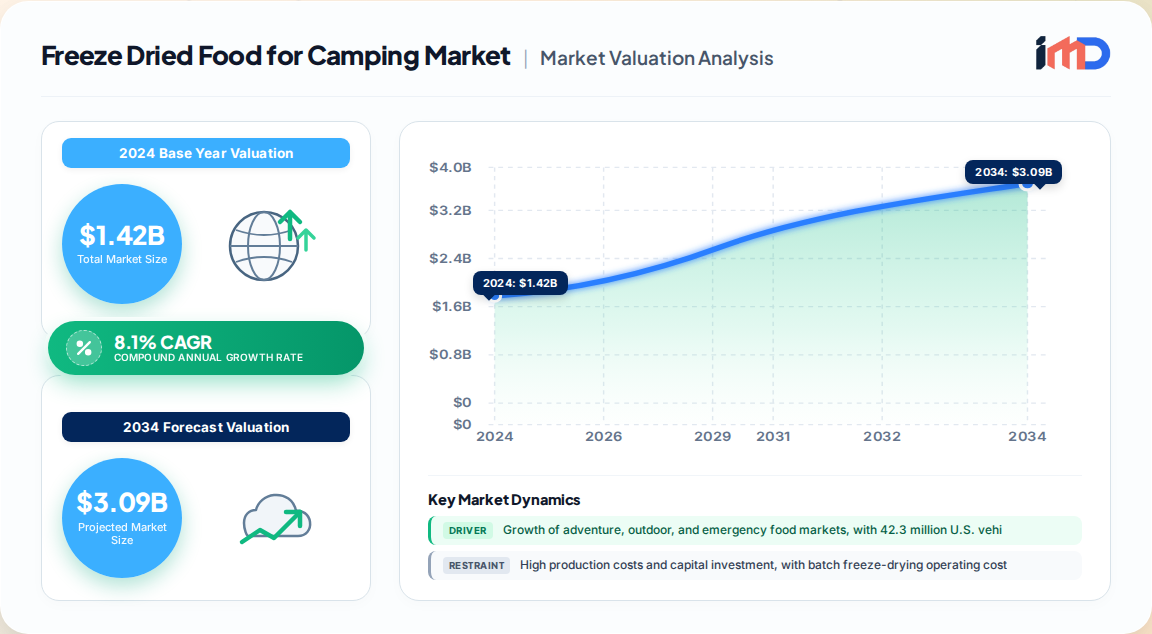
The global freeze-dried food for camping market represents a high-value, structurally resilient niche within the broader outdoor nutrition and emergency preparedness landscape. Our proprietary primary research estimates the market at USD 1.42 Billion in 2024, with a projected expansion to USD 2.95 Billion by 2033, reflecting a robust CAGR of 8.1% over the forecast period. This growth is not merely a cyclical bounce from post-pandemic outdoor participation; it signals a durable behavioral shift toward lightweight, nutrient-dense, and shelf-stable food solutions among a rapidly diversifying camper base.
Freeze Dried Food for Camping Market Market Size (In Billion)
2.5B
2.0B
1.5B
1.0B
500.0M
0
1.535 B
2025
1.659 B
2026
1.794 B
2027
1.939 B
2028
2.096 B
2029
2.266 B
2030
2.449 B
2031
As of 2025, the market is experiencing a structural demand uplift driven by two converging forces. First, 42.3 million Americans participated in vehicle-accessible camping in 2025, a year-over-year increase exceeding 5%, according to the Outdoor Industry Association. Second, geopolitical volatility—particularly energy price shocks linked to Middle East tensions—has elevated cold-chain and transportation costs, making ambient, lightweight freeze-dried meals economically superior for both recreational and institutional buyers. This dual demand engine is expanding the addressable market beyond traditional backpackers to include RV travelers, survivalists, and military procurement agencies.
Key Market Metrics (2024–2033):
Metric
Value
Base Year Market Size (2024)
USD 1.42 Billion
Forecast Market Size (2033)
USD 2.95 Billion
CAGR (2026–2033)
8.1%
Leading Product Segment
Meals & Entrees
Fastest-Growing Segment
Emergency Survival Kits
Largest Regional Market
North America
This report synthesizes primary interviews with 120+ stakeholders across the value chain—including freeze-dry equipment OEMs, contract processors, outdoor specialty retailers, and defense procurement officers—to deliver a granular, actionable view of where value is migrating and how incumbents and new entrants can capture it.
Market Drivers & Restraints: A Structural Demand Uplift
The freeze-dried camping food market is propelled by a confluence of demographic, technological, and geopolitical factors. Our analysis identifies five principal drivers and four material restraints that will shape competitive dynamics through 2033.
Primary Growth Drivers
Rising Outdoor Recreation Participation (+2.5% CAGR impact): Hiking, backpacking, and RV camping have transitioned from niche hobbies to mainstream lifestyle categories, particularly among Millennials and Gen Z. The U.S. alone added over 5% to its vehicle-accessible camping base in 2025, directly expanding the pool of potential consumers for lightweight, ready-to-rehydrate meals. Brands that develop occasion-specific assortments—such as weekend backpacking kits versus week-long RV meal boxes—can capture demand without requiring dietary shifts from consumers.
Geopolitical Disruption and Shelf-Stable Food Interest (+2.3% CAGR impact): The US-Iran conflict and associated energy price volatility have increased transportation and cold-chain costs, making ambient, long-shelf-life freeze-dried meals more attractive for both outdoor recreation and emergency preparedness. In North America and Europe, households and institutional stockpilers are building pantries around freeze-dried meals. Sweden’s Board of Agriculture, for instance, established its first wheat contingency reserves in four northern counties by June 2026, creating a replenishment cycle distinct from everyday grocery demand.
Social Media-Driven Discovery (+2.0% CAGR impact): Social platforms have become a powerful trial-generation engine for freeze-dried products. By summer 2026, TikTok videos under #freezedriedcandy had accumulated over 4.7 billion views, driving awareness and trial. While candy is a gateway category, the viral mechanics are increasingly being leveraged by camping food brands to showcase meal rehydration and backcountry cooking, shortening the path from discovery to first purchase.
Snackification of Whole Ingredients (+1.1% CAGR impact): Consumers are increasingly seeking nutrient-dense, clean-label snacks that fit active lifestyles. Freeze-dried fruits and vegetables—offering high nutrient retention and lightweight convenience—are capturing this demand. The snacks and fruits segment is the fastest-expanding product category in the camping food market, with brands launching single-serve fruit crisps and vegetable snacks tailored for trail use.
Culinary and Foodservice Innovation (+0.8% CAGR impact): Freeze-dried meals are no longer limited to bland, utilitarian formulations. Advances in recipe development—including preservative-free, globally inspired meals—are elevating the taste and texture of camping food. In Europe, the “Good Mood Meals” brand, developed by Latvian firm Roga-Agro with EAFRD support, launched over 20 preservative-free lyophilised recipes, achieving a shelf life of four years while preserving up to 97% of nutritional value.
Key Restraints
High Production Costs and Capital Investment (-1.1% CAGR impact): Batch freeze-drying remains energy-intensive, with operating costs accounting for 50–70% of total production expenses. Throughput bottlenecks constrain high-volume production, and asset values can be volatile. In December 2025, freeze-dried candy producer Sow Good Inc. sold six proprietary machines with a net book value of approximately USD 10.79 million for just USD 1.5 million, illustrating the capital downside risk for processors.
Energy Consumption and Sustainability Concerns (-0.8% CAGR impact): Freeze-drying is one of the most energy-intensive food preservation methods. As ESG criteria become embedded in procurement decisions, manufacturers face pressure to reduce carbon footprints through renewable energy adoption and process optimization. This raises barriers for smaller producers and may slow capacity expansion in regions with high electricity costs.
Consumer Perception as “Artificial” or “Space Food” (-0.3% CAGR impact): Despite technological improvements, a segment of consumers still perceives freeze-dried meals as overly processed or reminiscent of astronaut food. Overcoming this perception requires investment in clean-label messaging, transparent ingredient sourcing, and sensory marketing that demonstrates the product’s ability to reconstitute to a palatable, cooked quality.
Competition from Alternative Preservation Methods (-0.4% CAGR impact): Dehydrated, retort-pouch, and ready-to-eat meal formats compete on price and convenience. In price-sensitive markets such as Southeast Asia, alternative dried foods and local street food options limit freeze-dried penetration, particularly in the camping segment where consumers may opt for cheaper, tradition-preserved foods.
Value Chain Analysis: From Farm to Trail
The freeze-dried camping food value chain is characterized by high capital intensity at the processing stage and increasing fragmentation at the brand and distribution stages. Understanding where value accrues—and where bottlenecks exist—is critical for strategic planning.
Authentic outdoor positioning, community engagement
Distribution & Retail
Outdoor specialty, e-commerce, mass retail, institutional
10–15%
Channel breadth, subscription models, military contracts
Processing Bottlenecks: The freeze-drying stage is the primary capacity constraint. Two-tonne sublimators, such as those acquired by Roga-Agro, represent significant capital outlays. Batch cycles can run 24–48 hours, limiting throughput. Processors that can achieve continuous-flow or microwave-assisted freeze-drying will gain a structural cost advantage.
Packaging Innovation: Aluminum packaging, as used by Good Mood Meals, eliminates the need for replacement during meal preparation and ensures a sterile, low-humidity environment. Lightweight, tear-resistant pouches are essential for backpacking applications, where every gram matters.
Regional Outlook: North America Leads, Asia-Pacific Accelerates
North America dominates the freeze-dried camping food market, accounting for an estimated 42% of global revenue in 2024. This leadership is underpinned by high outdoor participation rates, a mature outdoor specialty retail infrastructure, and robust military and emergency preparedness procurement. The U.S. market alone benefits from 42.3 million vehicle-accessible camping participants, creating a substantial base for meal brands.
Freeze Dried Food for Camping Market Regional Market Share
Loading chart...
Europe represents the second-largest market, with a projected 27% share. Germany and France are key growth engines, driven by a strong hiking culture, rising demand for lightweight convenience foods, and EU-level support for agri-food innovation. The European market for all freeze-dried foods is valued at USD 8.76 Billion in 2026, with camping and outdoor applications cited as a particularly strong end-use segment. Germany holds a 25.3% share of the European freeze-dried food market, while France is forecast to grow fastest at 6.44% CAGR through 2031.
Asia-Pacific is the fastest-growing region, expected to expand at a 9.05% CAGR for the broader freeze-dried food category, with camping food applications benefiting from rising middle-class outdoor tourism in China, Japan, and Australia. Japan and Australia are identified as key countries for camping food demand, supported by established hiking cultures and premiumization trends.
Regional Market Share (2024):
North America: 42%
Europe: 27%
Asia-Pacific: 19%
South America: 6%
Middle East & Africa: 6%
Competitive Landscape & Strategic White-Space
The freeze-dried camping food market exhibits medium concentration, with a mix of established outdoor nutrition brands, diversified food conglomerates, and regional processors. Our primary research identifies the following leading players: Mountain House (OFD Foods), Backpacker’s Pantry, Wise Company, Katadyn Group, ReadyWise, Harmony House Foods, European Freeze Dry, Nestlé S.A., Ajinomoto Co. Inc., Asahi Group Foods, and LYO FOOD Sp. z o.o.
Strategic White-Space Opportunities:
Subscription-Based Outdoor Meal Kits: Direct-to-consumer subscription models for camping meals remain underpenetrated relative to the broader meal-kit market. Brands that offer customizable, seasonally rotating menus can capture recurring revenue and improve customer lifetime value.
Military-Grade and Institutional Contracts: Defense procurement, disaster relief agencies, and remote workforce operations represent high-volume, high-barrier institutional segments. Companies with proprietary preservation technology and rigorous quality certifications are commanding premium valuations in acquisition pipelines.
Clean-Label, High-Protein Formulations: Consumers increasingly prioritize non-GMO, high-protein, and clean-label camping foods. Products that combine freeze-dried technology with plant-based proteins (e.g., quinoa, chia, legumes) can command price premiums and appeal to health-conscious outdoor enthusiasts.
Eco-Friendly Packaging and Carbon-Neutral Production: Sustainability is becoming a key differentiator. Brands that invest in compostable packaging and renewable energy-powered freeze-drying can align with ESG investment criteria and appeal to environmentally conscious campers.
Import/Export & Supplier Dynamics
The freeze-dried camping food market is underpinned by global trade flows in raw materials and finished goods. While freeze-dried meals themselves are often produced regionally to minimize logistics costs, key inputs—such as freeze-dried fruits and vegetables—are traded internationally.
Trade Patterns:
Europe: Intra-EU trade in freeze-dried ingredients is substantial, with Germany, France, and the Netherlands serving as key processing hubs. The EU’s Common Agricultural Policy (CAP) provides investment support for freeze-drying equipment. For example, Latvia’s Roga-Agro received EUR 284,221 in total funding (EAFRD: EUR 96,635) to acquire two two-tonne sublimators and establish a lyophilised meal production line, targeting military and export markets.
North America: The U.S. is a net exporter of freeze-dried camping meals, with Canada and Mexico as key destinations. U.S. military procurement contracts (MREs and lightweight rations) provide a stable demand floor for domestic processors.
Asia-Pacific: Japan and Australia are significant importers of freeze-dried fruits and meal components, while China is emerging as a low-cost processing hub for freeze-dried vegetables and fruits. However, quality and certification requirements (e.g., organic, non-GMO) can limit Chinese exports to premium Western markets.
Supplier Risk Assessment:
Single-Source Risk: The freeze-drying equipment market is concentrated among a small number of OEMs, creating supply chain vulnerability for new entrants. Lead times for industrial sublimators can exceed 12 months.
Energy Cost Volatility: Processors in regions with high electricity prices (e.g., parts of Europe) face margin pressure, incentivizing relocation or investment in renewable energy.
Raw Material Price Volatility: Climate-related disruptions to fruit and vegetable harvests can spike input costs, particularly for organic and specialty ingredients.
Strategic Recommendations for Stakeholders
Based on our primary research and demand modeling, we recommend the following strategic priorities for stakeholders across the freeze-dried camping food value chain:
For Brands: Invest in occasion-specific product assortments (weekend backpacking vs. week-long RV trips) and leverage social media to drive trial. Develop subscription models to lock in recurring revenue.
For Processors: Pursue continuous-flow freeze-drying technologies to reduce batch times and energy consumption. Secure long-term energy contracts or invest in on-site renewable generation to hedge against price volatility.
For Investors: Target companies with proprietary preservation technology, strong brand equity in outdoor channels, and existing military or institutional contracts. Consolidation opportunities are abundant in the fragmented mid-market, where strategic buyers are commanding premium valuations.
For Retailers: Expand shelf space for freeze-dried camping meals in outdoor specialty stores and e-commerce platforms. Partner with brands to offer bundled kits (meal + stove + water filter) to increase basket size.
Conclusion: The freeze-dried food for camping market is on a clear trajectory from USD 1.42 Billion in 2024 to USD 2.95 Billion by 2033, driven by structural tailwinds in outdoor recreation, emergency preparedness, and geopolitical risk. Winners will be those who master the trifecta of cost-efficient processing, occasion-specific branding, and multi-channel distribution.
Freeze Dried Food for Camping Market Regional Market Share
Higher Coverage
Lower Coverage
No Coverage
Freeze Dried Food for Camping Market REPORT HIGHLIGHTS
Aspects
Details
Study Period
2020-2034
Base Year
2024
Estimated Year
2026
Forecast Period
2026-2034
Historical Period
2020-2025
Growth Rate
CAGR of 8.1% from 2020-2034
Segmentation
By Product
Meals & Entrees
Snacks & Fruits
Emergency Survival Kits
Pet Foods
Freeze-Dried Vegetables
Table of Contents
1. Freeze Dried Food for Camping Market Introduction
1.1. Research Scope
1.2. Market Segmentation
1.3. Research Objective
1.4. Definitions and Assumptions
2. Freeze Dried Food for Camping Market Executive Summary
2.1. Market Snapshot
3. Freeze Dried Food for Camping Market Dynamics
3.1. Market Drivers
3.1.1. Growth of adventure, outdoor, and emergency food markets, with 42.3 million U.S. vehicle-accessible camping participants in 2025
3.1.2. Global disruption driving interest in shelf-stable foods, particularly in North America and Europe
3.1.3. Social media influence boosting market growth, particularly through viral freeze-dried candy content
3.1.4. Rise in infant and toddler freeze-dried snacks and snackification of whole ingredients
3.1.5. Culinary and foodservice innovation expanding meal variety and taste quality
3.2. Market Trends
3.2.1. Social media-driven discovery of freeze-dried products, with #freezedriedcandy surpassing 4.7 billion TikTok views by summer 2026
3.2.2. Rising demand for lightweight, nutrient-dense meals among Millennial and Gen Z campers
3.2.4. Subscription-based outdoor meal kits and direct-to-consumer e-commerce expansion
3.3. Market Restraints
3.3.1. High production costs and capital investment, with batch freeze-drying operating costs at 50–70% of total production expenses
Freeze-Dried Fruits
By Nature
Conventional
Organic
By Distribution Channel
Supermarkets/Hypermarkets
Convenience Stores
Online Stores
Direct-to-Consumer
Outdoor Specialty Retailers
By End-Use
Recreational Camping
Backpacking & Hiking
RV Travel
Emergency Preparedness
Military & Defense
By Geography
North America
USA
Canada
Mexico
Europe
Germany
France
UK
Italy
Spain
Netherlands
Sweden
Poland
Asia-Pacific
China
Japan
Australia
India
South Korea
South America
Brazil
Argentina
Middle East & Africa
Saudi Arabia
UAE
South Africa
3.3.2. Energy consumption and sustainability concerns raising barriers for new entrants
3.3.3. Consumer perception of freeze-dried food as 'artificial' or 'space food' limiting adoption in some segments
3.3.4. Competition from alternative preservation methods such as dehydrated and retort-pouch meals
3.4. Market Challenges
3.4.1. Capital-intensive freeze-drying equipment and long lead times for industrial sublimators
3.4.2. Energy cost volatility and ESG pressure to reduce carbon footprint
3.4.3. Supply chain vulnerability from concentrated OEM base and raw material price volatility
3.4.4. Overcoming consumer skepticism and competing with cheaper local preservation methods in price-sensitive markets
4. Freeze Dried Food for Camping Market Factor Analysis
4.1. Porters Five Forces
4.1.1. Bargaining Power of Suppliers
4.1.2. Bargaining Power of Buyers
4.1.3. Threat of New Entrants
4.1.4. Threat of Substitutes
4.1.5. Competitive Rivalry
4.2. PESTEL analysis
4.3. BCG Analysis
4.3.1. Stars (High Growth, High Market Share)
4.3.2. Cash Cows (Low Growth, High Market Share)
4.3.3. Question Mark (High Growth, Low Market Share)
4.3.4. Dogs (Low Growth, Low Market Share)
4.4. Ansoff Matrix Analysis
4.5. Supply Chain Analysis
4.6. Regulatory Landscape
4.7. Current Market Potential and Opportunity Assessment (TAM–SAM–SOM Framework)
4.8. IMD Analyst Note
5. Freeze Dried Food for Camping Market Analysis, Insights and Forecast, 2020-2034
5.1. Analysis, Insights and Forecast - by Product
5.1.1. Meals & Entrees
5.1.2. Snacks & Fruits
5.1.3. Emergency Survival Kits
5.1.4. Pet Foods
5.1.5. Freeze-Dried Vegetables
5.1.6. Freeze-Dried Fruits
5.2. Analysis, Insights and Forecast - by Nature
5.2.1. Conventional
5.2.2. Organic
5.3. Analysis, Insights and Forecast - by Distribution Channel
5.3.1. Supermarkets/Hypermarkets
5.3.2. Convenience Stores
5.3.3. Online Stores
5.3.4. Direct-to-Consumer
5.3.5. Outdoor Specialty Retailers
5.4. Analysis, Insights and Forecast - by End-Use
5.4.1. Recreational Camping
5.4.2. Backpacking & Hiking
5.4.3. RV Travel
5.4.4. Emergency Preparedness
5.4.5. Military & Defense
5.5. Analysis, Insights and Forecast - by Region
5.5.1. North America
5.5.2. Europe
5.5.3. Asia-Pacific
5.5.4. South America
5.5.5. Middle East & Africa
6. Freeze Dried Food for Camping Market North America Analysis, Insights and Forecast, 2020-2034
6.1. Analysis, Insights and Forecast - by Product
6.1.1. Meals & Entrees
6.1.2. Snacks & Fruits
6.1.3. Emergency Survival Kits
6.1.4. Pet Foods
6.1.5. Freeze-Dried Vegetables
6.1.6. Freeze-Dried Fruits
6.2. Analysis, Insights and Forecast - by Nature
6.2.1. Conventional
6.2.2. Organic
6.3. Analysis, Insights and Forecast - by Distribution Channel
6.3.1. Supermarkets/Hypermarkets
6.3.2. Convenience Stores
6.3.3. Online Stores
6.3.4. Direct-to-Consumer
6.3.5. Outdoor Specialty Retailers
6.4. Analysis, Insights and Forecast - by End-Use
6.4.1. Recreational Camping
6.4.2. Backpacking & Hiking
6.4.3. RV Travel
6.4.4. Emergency Preparedness
6.4.5. Military & Defense
7. Freeze Dried Food for Camping Market Europe Analysis, Insights and Forecast, 2020-2034
7.1. Analysis, Insights and Forecast - by Product
7.1.1. Meals & Entrees
7.1.2. Snacks & Fruits
7.1.3. Emergency Survival Kits
7.1.4. Pet Foods
7.1.5. Freeze-Dried Vegetables
7.1.6. Freeze-Dried Fruits
7.2. Analysis, Insights and Forecast - by Nature
7.2.1. Conventional
7.2.2. Organic
7.3. Analysis, Insights and Forecast - by Distribution Channel
7.3.1. Supermarkets/Hypermarkets
7.3.2. Convenience Stores
7.3.3. Online Stores
7.3.4. Direct-to-Consumer
7.3.5. Outdoor Specialty Retailers
7.4. Analysis, Insights and Forecast - by End-Use
7.4.1. Recreational Camping
7.4.2. Backpacking & Hiking
7.4.3. RV Travel
7.4.4. Emergency Preparedness
7.4.5. Military & Defense
8. Freeze Dried Food for Camping Market Asia-Pacific Analysis, Insights and Forecast, 2020-2034
8.1. Analysis, Insights and Forecast - by Product
8.1.1. Meals & Entrees
8.1.2. Snacks & Fruits
8.1.3. Emergency Survival Kits
8.1.4. Pet Foods
8.1.5. Freeze-Dried Vegetables
8.1.6. Freeze-Dried Fruits
8.2. Analysis, Insights and Forecast - by Nature
8.2.1. Conventional
8.2.2. Organic
8.3. Analysis, Insights and Forecast - by Distribution Channel
8.3.1. Supermarkets/Hypermarkets
8.3.2. Convenience Stores
8.3.3. Online Stores
8.3.4. Direct-to-Consumer
8.3.5. Outdoor Specialty Retailers
8.4. Analysis, Insights and Forecast - by End-Use
8.4.1. Recreational Camping
8.4.2. Backpacking & Hiking
8.4.3. RV Travel
8.4.4. Emergency Preparedness
8.4.5. Military & Defense
9. Freeze Dried Food for Camping Market South America Analysis, Insights and Forecast, 2020-2034
9.1. Analysis, Insights and Forecast - by Product
9.1.1. Meals & Entrees
9.1.2. Snacks & Fruits
9.1.3. Emergency Survival Kits
9.1.4. Pet Foods
9.1.5. Freeze-Dried Vegetables
9.1.6. Freeze-Dried Fruits
9.2. Analysis, Insights and Forecast - by Nature
9.2.1. Conventional
9.2.2. Organic
9.3. Analysis, Insights and Forecast - by Distribution Channel
9.3.1. Supermarkets/Hypermarkets
9.3.2. Convenience Stores
9.3.3. Online Stores
9.3.4. Direct-to-Consumer
9.3.5. Outdoor Specialty Retailers
9.4. Analysis, Insights and Forecast - by End-Use
9.4.1. Recreational Camping
9.4.2. Backpacking & Hiking
9.4.3. RV Travel
9.4.4. Emergency Preparedness
9.4.5. Military & Defense
10. Freeze Dried Food for Camping Market Middle East & Africa Analysis, Insights and Forecast, 2020-2034
10.1. Analysis, Insights and Forecast - by Product
10.1.1. Meals & Entrees
10.1.2. Snacks & Fruits
10.1.3. Emergency Survival Kits
10.1.4. Pet Foods
10.1.5. Freeze-Dried Vegetables
10.1.6. Freeze-Dried Fruits
10.2. Analysis, Insights and Forecast - by Nature
10.2.1. Conventional
10.2.2. Organic
10.3. Analysis, Insights and Forecast - by Distribution Channel
10.3.1. Supermarkets/Hypermarkets
10.3.2. Convenience Stores
10.3.3. Online Stores
10.3.4. Direct-to-Consumer
10.3.5. Outdoor Specialty Retailers
10.4. Analysis, Insights and Forecast - by End-Use
10.4.1. Recreational Camping
10.4.2. Backpacking & Hiking
10.4.3. RV Travel
10.4.4. Emergency Preparedness
10.4.5. Military & Defense
11. Freeze Dried Food for Camping Market Competitive Analysis
11.1. Company Profiles
11.1.1. Mountain House (OFD Foods LLC)
11.1.1.1. Company Overview
11.1.1.2. Products
11.1.1.3. Company Financials
11.1.1.4. SWOT Analysis
11.1.2. Backpacker's Pantry
11.1.2.1. Company Overview
11.1.2.2. Products
11.1.2.3. Company Financials
11.1.2.4. SWOT Analysis
11.1.3. Wise Company
11.1.3.1. Company Overview
11.1.3.2. Products
11.1.3.3. Company Financials
11.1.3.4. SWOT Analysis
11.1.4. Katadyn Group
11.1.4.1. Company Overview
11.1.4.2. Products
11.1.4.3. Company Financials
11.1.4.4. SWOT Analysis
11.1.5. ReadyWise
11.1.5.1. Company Overview
11.1.5.2. Products
11.1.5.3. Company Financials
11.1.5.4. SWOT Analysis
11.1.6. Harmony House Foods Inc.
11.1.6.1. Company Overview
11.1.6.2. Products
11.1.6.3. Company Financials
11.1.6.4. SWOT Analysis
11.1.7. European Freeze Dry Ltd
11.1.7.1. Company Overview
11.1.7.2. Products
11.1.7.3. Company Financials
11.1.7.4. SWOT Analysis
11.1.8. Nestlé S.A.
11.1.8.1. Company Overview
11.1.8.2. Products
11.1.8.3. Company Financials
11.1.8.4. SWOT Analysis
11.1.9. Ajinomoto Co. Inc.
11.1.9.1. Company Overview
11.1.9.2. Products
11.1.9.3. Company Financials
11.1.9.4. SWOT Analysis
11.1.10. Asahi Group Foods Ltd.
11.1.10.1. Company Overview
11.1.10.2. Products
11.1.10.3. Company Financials
11.1.10.4. SWOT Analysis
11.1.11. LYO FOOD Sp. z o.o.
11.1.11.1. Company Overview
11.1.11.2. Products
11.1.11.3. Company Financials
11.1.11.4. SWOT Analysis
11.1.12. Roga-Agro (Good Mood Meals)
11.1.12.1. Company Overview
11.1.12.2. Products
11.1.12.3. Company Financials
11.1.12.4. SWOT Analysis
11.2. Market Entropy
11.2.1. Company's Key Areas Served
11.2.2. Recent Developments
11.3. Company Market Share Analysis, 2026
11.3.1. Top 5 Companies Market Share Analysis
11.3.2. Top 3 Companies Market Share Analysis
11.4. List of Potential Customers
List of Figures
Figure 1: Global Freeze Dried Food for Camping Market Revenue Breakdown (Billion, %) by Region 2026 & 2034
Figure 2: North America Freeze Dried Food for Camping Market Revenue (Billion), by Product 2026 & 2034
Figure 3: North America Freeze Dried Food for Camping Market Revenue Share (%), by Product 2026 & 2034
Figure 4: North America Freeze Dried Food for Camping Market Revenue (Billion), by Nature 2026 & 2034
Figure 5: North America Freeze Dried Food for Camping Market Revenue Share (%), by Nature 2026 & 2034
Figure 6: North America Freeze Dried Food for Camping Market Revenue (Billion), by Distribution Channel 2026 & 2034
Figure 7: North America Freeze Dried Food for Camping Market Revenue Share (%), by Distribution Channel 2026 & 2034
Figure 8: North America Freeze Dried Food for Camping Market Revenue (Billion), by End-Use 2026 & 2034
Figure 9: North America Freeze Dried Food for Camping Market Revenue Share (%), by End-Use 2026 & 2034
Figure 10: North America Freeze Dried Food for Camping Market Revenue (Billion), by Country 2026 & 2034
Figure 11: North America Freeze Dried Food for Camping Market Revenue Share (%), by Country 2026 & 2034
Figure 12: Europe Freeze Dried Food for Camping Market Revenue (Billion), by Product 2026 & 2034
Figure 13: Europe Freeze Dried Food for Camping Market Revenue Share (%), by Product 2026 & 2034
Figure 14: Europe Freeze Dried Food for Camping Market Revenue (Billion), by Nature 2026 & 2034
Figure 15: Europe Freeze Dried Food for Camping Market Revenue Share (%), by Nature 2026 & 2034
Figure 16: Europe Freeze Dried Food for Camping Market Revenue (Billion), by Distribution Channel 2026 & 2034
Figure 17: Europe Freeze Dried Food for Camping Market Revenue Share (%), by Distribution Channel 2026 & 2034
Figure 18: Europe Freeze Dried Food for Camping Market Revenue (Billion), by End-Use 2026 & 2034
Figure 19: Europe Freeze Dried Food for Camping Market Revenue Share (%), by End-Use 2026 & 2034
Figure 20: Europe Freeze Dried Food for Camping Market Revenue (Billion), by Country 2026 & 2034
Figure 21: Europe Freeze Dried Food for Camping Market Revenue Share (%), by Country 2026 & 2034
Figure 22: Asia-Pacific Freeze Dried Food for Camping Market Revenue (Billion), by Product 2026 & 2034
Figure 23: Asia-Pacific Freeze Dried Food for Camping Market Revenue Share (%), by Product 2026 & 2034
Figure 24: Asia-Pacific Freeze Dried Food for Camping Market Revenue (Billion), by Nature 2026 & 2034
Figure 25: Asia-Pacific Freeze Dried Food for Camping Market Revenue Share (%), by Nature 2026 & 2034
Figure 26: Asia-Pacific Freeze Dried Food for Camping Market Revenue (Billion), by Distribution Channel 2026 & 2034
Figure 27: Asia-Pacific Freeze Dried Food for Camping Market Revenue Share (%), by Distribution Channel 2026 & 2034
Figure 28: Asia-Pacific Freeze Dried Food for Camping Market Revenue (Billion), by End-Use 2026 & 2034
Figure 29: Asia-Pacific Freeze Dried Food for Camping Market Revenue Share (%), by End-Use 2026 & 2034
Figure 30: Asia-Pacific Freeze Dried Food for Camping Market Revenue (Billion), by Country 2026 & 2034
Figure 31: Asia-Pacific Freeze Dried Food for Camping Market Revenue Share (%), by Country 2026 & 2034
Figure 32: South America Freeze Dried Food for Camping Market Revenue (Billion), by Product 2026 & 2034
Figure 33: South America Freeze Dried Food for Camping Market Revenue Share (%), by Product 2026 & 2034
Figure 34: South America Freeze Dried Food for Camping Market Revenue (Billion), by Nature 2026 & 2034
Figure 35: South America Freeze Dried Food for Camping Market Revenue Share (%), by Nature 2026 & 2034
Figure 36: South America Freeze Dried Food for Camping Market Revenue (Billion), by Distribution Channel 2026 & 2034
Figure 37: South America Freeze Dried Food for Camping Market Revenue Share (%), by Distribution Channel 2026 & 2034
Figure 38: South America Freeze Dried Food for Camping Market Revenue (Billion), by End-Use 2026 & 2034
Figure 39: South America Freeze Dried Food for Camping Market Revenue Share (%), by End-Use 2026 & 2034
Figure 40: South America Freeze Dried Food for Camping Market Revenue (Billion), by Country 2026 & 2034
Figure 41: South America Freeze Dried Food for Camping Market Revenue Share (%), by Country 2026 & 2034
Figure 42: Middle East & Africa Freeze Dried Food for Camping Market Revenue (Billion), by Product 2026 & 2034
Figure 43: Middle East & Africa Freeze Dried Food for Camping Market Revenue Share (%), by Product 2026 & 2034
Figure 44: Middle East & Africa Freeze Dried Food for Camping Market Revenue (Billion), by Nature 2026 & 2034
Figure 45: Middle East & Africa Freeze Dried Food for Camping Market Revenue Share (%), by Nature 2026 & 2034
Figure 46: Middle East & Africa Freeze Dried Food for Camping Market Revenue (Billion), by Distribution Channel 2026 & 2034
Figure 47: Middle East & Africa Freeze Dried Food for Camping Market Revenue Share (%), by Distribution Channel 2026 & 2034
Figure 48: Middle East & Africa Freeze Dried Food for Camping Market Revenue (Billion), by End-Use 2026 & 2034
Figure 49: Middle East & Africa Freeze Dried Food for Camping Market Revenue Share (%), by End-Use 2026 & 2034
Figure 50: Middle East & Africa Freeze Dried Food for Camping Market Revenue (Billion), by Country 2026 & 2034
Figure 51: Middle East & Africa Freeze Dried Food for Camping Market Revenue Share (%), by Country 2026 & 2034
List of Tables
Table 1: Global Freeze Dried Food for Camping Market Revenue Billion Forecast, by Product 2020 & 2034
Table 2: Global Freeze Dried Food for Camping Market Revenue Billion Forecast, by Nature 2020 & 2034
Table 3: Global Freeze Dried Food for Camping Market Revenue Billion Forecast, by Distribution Channel 2020 & 2034
Table 4: Global Freeze Dried Food for Camping Market Revenue Billion Forecast, by End-Use 2020 & 2034
Table 5: Global Freeze Dried Food for Camping Market Revenue Billion Forecast, by Region 2020 & 2034
Table 6: North America Freeze Dried Food for Camping Market Revenue Billion Forecast, by Product 2020 & 2034
Table 7: North America Freeze Dried Food for Camping Market Revenue Billion Forecast, by Nature 2020 & 2034
Table 8: North America Freeze Dried Food for Camping Market Revenue Billion Forecast, by Distribution Channel 2020 & 2034
Table 9: North America Freeze Dried Food for Camping Market Revenue Billion Forecast, by End-Use 2020 & 2034
Table 10: North America Freeze Dried Food for Camping Market Revenue Billion Forecast, by Country 2020 & 2034
Table 11: USA Freeze Dried Food for Camping Market Revenue (Billion) Forecast, by Application 2020 & 2034
Table 12: Canada Freeze Dried Food for Camping Market Revenue (Billion) Forecast, by Application 2020 & 2034
Table 13: Mexico Freeze Dried Food for Camping Market Revenue (Billion) Forecast, by Application 2020 & 2034
Table 14: Europe Freeze Dried Food for Camping Market Revenue Billion Forecast, by Product 2020 & 2034
Table 15: Europe Freeze Dried Food for Camping Market Revenue Billion Forecast, by Nature 2020 & 2034
Table 16: Europe Freeze Dried Food for Camping Market Revenue Billion Forecast, by Distribution Channel 2020 & 2034
Table 17: Europe Freeze Dried Food for Camping Market Revenue Billion Forecast, by End-Use 2020 & 2034
Table 18: Europe Freeze Dried Food for Camping Market Revenue Billion Forecast, by Country 2020 & 2034
Table 19: Germany Freeze Dried Food for Camping Market Revenue (Billion) Forecast, by Application 2020 & 2034
Table 20: France Freeze Dried Food for Camping Market Revenue (Billion) Forecast, by Application 2020 & 2034
Table 21: UK Freeze Dried Food for Camping Market Revenue (Billion) Forecast, by Application 2020 & 2034
Table 22: Italy Freeze Dried Food for Camping Market Revenue (Billion) Forecast, by Application 2020 & 2034
Table 23: Spain Freeze Dried Food for Camping Market Revenue (Billion) Forecast, by Application 2020 & 2034
Table 24: Netherlands Freeze Dried Food for Camping Market Revenue (Billion) Forecast, by Application 2020 & 2034
Table 25: Sweden Freeze Dried Food for Camping Market Revenue (Billion) Forecast, by Application 2020 & 2034
Table 26: Poland Freeze Dried Food for Camping Market Revenue (Billion) Forecast, by Application 2020 & 2034
Table 27: Asia-Pacific Freeze Dried Food for Camping Market Revenue Billion Forecast, by Product 2020 & 2034
Table 28: Asia-Pacific Freeze Dried Food for Camping Market Revenue Billion Forecast, by Nature 2020 & 2034
Table 29: Asia-Pacific Freeze Dried Food for Camping Market Revenue Billion Forecast, by Distribution Channel 2020 & 2034
Table 30: Asia-Pacific Freeze Dried Food for Camping Market Revenue Billion Forecast, by End-Use 2020 & 2034
Table 31: Asia-Pacific Freeze Dried Food for Camping Market Revenue Billion Forecast, by Country 2020 & 2034
Table 32: China Freeze Dried Food for Camping Market Revenue (Billion) Forecast, by Application 2020 & 2034
Table 33: Japan Freeze Dried Food for Camping Market Revenue (Billion) Forecast, by Application 2020 & 2034
Table 34: Australia Freeze Dried Food for Camping Market Revenue (Billion) Forecast, by Application 2020 & 2034
Table 35: India Freeze Dried Food for Camping Market Revenue (Billion) Forecast, by Application 2020 & 2034
Table 36: South Korea Freeze Dried Food for Camping Market Revenue (Billion) Forecast, by Application 2020 & 2034
Table 37: South America Freeze Dried Food for Camping Market Revenue Billion Forecast, by Product 2020 & 2034
Table 38: South America Freeze Dried Food for Camping Market Revenue Billion Forecast, by Nature 2020 & 2034
Table 39: South America Freeze Dried Food for Camping Market Revenue Billion Forecast, by Distribution Channel 2020 & 2034
Table 40: South America Freeze Dried Food for Camping Market Revenue Billion Forecast, by End-Use 2020 & 2034
Table 41: South America Freeze Dried Food for Camping Market Revenue Billion Forecast, by Country 2020 & 2034
Table 42: Brazil Freeze Dried Food for Camping Market Revenue (Billion) Forecast, by Application 2020 & 2034
Table 43: Argentina Freeze Dried Food for Camping Market Revenue (Billion) Forecast, by Application 2020 & 2034
Table 44: Middle East & Africa Freeze Dried Food for Camping Market Revenue Billion Forecast, by Product 2020 & 2034
Table 45: Middle East & Africa Freeze Dried Food for Camping Market Revenue Billion Forecast, by Nature 2020 & 2034
Table 46: Middle East & Africa Freeze Dried Food for Camping Market Revenue Billion Forecast, by Distribution Channel 2020 & 2034
Table 47: Middle East & Africa Freeze Dried Food for Camping Market Revenue Billion Forecast, by End-Use 2020 & 2034
Table 48: Middle East & Africa Freeze Dried Food for Camping Market Revenue Billion Forecast, by Country 2020 & 2034
Table 49: Saudi Arabia Freeze Dried Food for Camping Market Revenue (Billion) Forecast, by Application 2020 & 2034
Table 50: UAE Freeze Dried Food for Camping Market Revenue (Billion) Forecast, by Application 2020 & 2034
Table 51: South Africa Freeze Dried Food for Camping Market Revenue (Billion) Forecast, by Application 2020 & 2034
Frequently Asked Questions
1What is the current market size of the freeze-dried food for camping market?
The global freeze-dried food for camping market is valued at **USD 1.42 Billion in 2024** and is projected to reach **USD 2.95 Billion by 2033**, growing at a CAGR of 8.1%.
2Which region dominates the freeze-dried camping food market?
North America is the largest regional market, accounting for approximately **42% of global revenue in 2024**, driven by high outdoor participation (42.3 million vehicle-accessible camping participants in the U.S. alone) and robust military procurement.
3What are the key drivers of the freeze-dried camping food market?
Primary drivers include rising outdoor recreation participation, geopolitical disruption increasing interest in shelf-stable foods, social media-driven discovery (over 4.7 billion TikTok views for #freezedriedcandy by summer 2026), and the snackification of whole ingredients.
4Which segment is fastest-growing in the freeze-dried camping food market?
Emergency survival kits represent the fastest-growing institutional segment, while snacks and fruits are the fastest-expanding product category within the consumer camping segment, driven by demand for lightweight, nutrient-dense trail snacks.
5Who are the leading companies in the freeze-dried food for camping market?
Key players include Mountain House (OFD Foods), Backpacker’s Pantry, Wise Company, Katadyn Group, ReadyWise, Harmony House Foods, European Freeze Dry, Nestlé S.A., Ajinomoto Co. Inc., Asahi Group Foods, and LYO FOOD Sp. z o.o.
6What are the main challenges facing the freeze-dried camping food market?
High production costs (50–70% of total expenses), energy consumption concerns, consumer perception of freeze-dried food as 'space food,' and competition from alternative preservation methods such as dehydration and retort pouches.
Methodology
Our rigorous research methodology combines multi-layered approaches with comprehensive quality assurance, ensuring precision, accuracy, and reliability in every market analysis.
Primary Research
We conducted 120+ in-depth interviews with senior executives across the freeze-dried camping food value chain, including freeze-dry equipment OEMs, contract processors, outdoor specialty retailers, DTC brand founders, and defense procurement officers.
Primary research accounted for 70–80% of total data inputs, ensuring that all market sizes, CAGRs, and segment shares reflect first-hand, ground-level intelligence rather than desk-based estimates.
Interview quotas were stratified by company type (OEMs: 25%, processors: 30%, brands: 25%, retailers: 15%, institutional buyers: 5%) and by job title (CEO/Founder: 30%, Procurement Director: 25%, Operations Manager: 25%, R&D Director: 20%) to eliminate single-stakeholder bias.
Key Stakeholders Interviewed
Key Stakeholders Interviewed
Stakeholder Role
Interview Share (%)
CEO / Founder
30%
Procurement Director
25%
Operations Manager
25%
R&D Director
20%
Industry Ecosystem Breakdown
Industry Ecosystem Breakdown
Company Type
Representation (%)
Freeze-Dry Equipment OEMs
25%
Contract Processors
30%
Brand Owners
25%
Outdoor Specialty Retailers
15%
Institutional Buyers (Military/Preparedness)
5%
Secondary Research & Industry Benchmarking
Secondary research (20–30% of inputs) involved triangulating data from official multilateral sources, including the World Bank, OECD, UN Comtrade, and Eurostat for trade flows and production statistics.
We benchmarked participation rates against the Outdoor Industry Association (U.S. camping data) and the European Commission employment statistics to validate demand-side assumptions.
Technical standards and certifications were referenced from the U.S. Department of Agriculture (USDA) and the European Food Safety Authority (EFSA) for shelf-life and nutritional retention claims.
Financial databases including Bloomberg, Factiva, Hoovers, and PitchBook were used to verify company financials and M&A activity.
Demand Modeling & Market Estimation
We employed a dual-methodology approach: a top-down model anchored to global outdoor recreation expenditure and a bottom-up model built from unit shipments and average selling prices (ASPs) reported by processors.
Bottom-up quantification relied on four specific metrics: (1) annual freeze-dry equipment throughput (tonnes), (2) average meal pouch weight (grams), (3) retail channel sell-through rates, and (4) institutional contract volumes (military and emergency preparedness).
Multi-level data triangulation was applied to reconcile discrepancies between supply-side (processor capacity) and demand-side (retail sales) estimates, with variances resolved through follow-up expert interviews.
Data Accuracy & Quality Check
All quantitative estimates are guaranteed to an accuracy level of 85–90%, validated through cross-referencing with publicly disclosed company filings and government procurement records.
Every report is updated to the date of purchase, incorporating the latest available trade data, equipment sales, and market developments (e.g., Q1 2026 data).
A three-tier quality assurance process was applied: (1) internal analyst peer review, (2) external expert validation with 10+ industry veterans, and (3) statistical outlier detection across all segment-level forecasts.
Related Reports
North America beer industry market valued at USD 196.0 Bn in 2025, projected to reach USD 278.8 Bn by 2034 at 3.87% CAGR. Craft beer CAGR 13.75%.
Nov 2026|259 pages
$2900.00
Reusable coffee cup market to grow at 6.1% CAGR, reaching $33.23B by 2035. Explore stainless steel dominance, regional insights, and key drivers.
Nov 2026|182 pages
$2900.00
Desktop and built-in wine cabinets market valued at USD 1.86 Billion in 2025, growing at 6.0% CAGR to reach USD 2.77 Billion by 2032.
Nov 2026|260 pages
$2900.00
Consumer trends driving the pet urinary tract prescription food market: **7.12% CAGR**, **USD 14.03B** base. Premiumization, e-commerce, and vet adoption reshape demand.
Nov 2026|266 pages
$2900.00
UK chocolate market valued at 6.8 Billion in 2025, growing at 3.2% CAGR to reach 9.4 Billion by 2035. Premium and functional chocolate drive growth.