About Insight Market Data

Insight Market Data is a premier market research and business consulting firm headquartered in Pune, India, providing syndicated research reports, customized intelligence studies, and strategic advisory services. Renowned academic institutions and Fortune 500 corporations worldwide rely on Insight Market Data's research repository to navigate evolving global and regional business environments. Covering 46 diverse industries across 25 major international economies, our comprehensive database delivers thousands of verified statistics and granular market evaluations. By combining industry-leading analytical methodologies with the direct insights of seasoned industry leaders and subject-matter experts, we deliver actionable intelligence spanning historical performance benchmarks to rigorous multi-year forecasts. We empower organizations to make confident, data-driven decisions across pivotal domains including Machinery & Equipment, Chemicals & Materials, Pharmaceuticals & Healthcare, Food & Beverages, Consumer Goods, Energy & Power, Automotive & Transportation, Electronics & Semiconductors, Medical Devices, Telecommunications, Emerging Technologies, Agriculture, and Packaging. Our multidisciplinary analyst teams provide an objective 360-degree perspective, tailoring every engagement to address complex strategic challenges with exceptional analytical rigor.

Leveraging advanced BI-powered analytics and predictive modeling, Insight Market Data uncovers high-impact market opportunities and competitive differentiators for ambitious enterprises. We continuously refine our research methodologies in accordance with global industry standards, tracking real-time market shifts to ensure our reports are consistently accurate, actionable, and delivered on schedule. Our analysts conduct methodical data validation, rigorous compliance checks, and exhaustive primary and secondary research to maintain the highest levels of data integrity and transparency. We partner closely with corporate strategists, investment groups, and business executives to translate intricate market intelligence into clear, actionable roadmaps for sustainable growth. With operational presence across Washington, USA, and Vimannagar, Pune, India, Insight Market Data ensures direct access to dedicated research specialists and responsive customer support to answer your most strategic questions.

report thumbnailForestry Seeds Market
Agriculture / MARKET REPORT

Forestry Seeds Market | Insight Market Data

Forestry Seeds Market by Type (Woody Seeds, Herbal Seeds), by Application (Forestry Production, Greening), by North America (USA, Canada, Mexico), by Europe (Germany, France, UK, Italy, Russia), by Asia Pacific (China, Japan, India, Australia, Southeast Asia), by South America (Brazil, Chile, Argentina), by Middle East & Africa (South Africa, Egypt, GCC Countries) Forecast 2026-2034

© Nov 6, 2026|Base Year: 2025|239 Pages
Atul Bhusare

Atul Bhusare

Research Associate

Main Logo

Forestry Seeds Market Size, Share & Forecast to 2034


/
/

Business Address

Head Office

Ansec House 3 rd floor Tank Road, Yerwada, Pune, Maharashtra 411014

Contact Information

Craig Francis

Business Development Head

+12315155523

[email protected]

Secure Payment Partners

payment image
RetailLogisticsPackagingAutomotiveHealthcareAgricultureEnergy & PowerFood & BeverageAerospace & DefenseChemicals & MaterialsHospitality and TourismConsumer Goods and ServicesAnimal Nutrition & WellnessReal Estate and ConstructionHome and Property ImprovementTechnology, Media and TelecomManufacturing Products and ServicesFinancial Services and Investment Intelligence

© 2026 PRDUA Research & Media Private Limited, All rights reserved

Privacy Policy•Terms and Conditions•FAQ
Home
Industries
Agriculture
Independent Intelligence for decisions that move markets
+12315155523[email protected]
  • Home
  • About Us
  • Industries
    • Automotive
    • Consumer Goods and Services
    • Financial Services and Investment Intelligence
    • Home and Property Improvement
    • Logistics
    • Retail
    • Agriculture
    • Healthcare
    • Animal Nutrition & Wellness
    • Chemicals & Materials
    • Energy & Power
    • Food & Beverage
    • Hospitality and Tourism
    • Manufacturing Products and Services
    • Professional and Commercial Services
    • Real Estate and Construction
    • Aerospace & Defense
    • Packaging
    • Technology, Media and Telecom
  • Services
  • Contact
Main Logo
  • Home
  • About Us
  • Industries
    • Automotive
    • Consumer Goods and Services
    • Financial Services and Investment Intelligence
    • Home and Property Improvement
    • Logistics
    • Retail
    • Agriculture
    • Healthcare
    • Animal Nutrition & Wellness
    • Chemicals & Materials
    • Energy & Power
    • Food & Beverage
    • Hospitality and Tourism
    • Manufacturing Products and Services
    • Professional and Commercial Services
    • Real Estate and Construction
    • Aerospace & Defense
    • Packaging
    • Technology, Media and Telecom
  • Services
  • Contact
Talk to an analyst
artwork spiralartwork spiralRelated Reports
artwork underline

Forestry Consulting Services Market Size & Forecast to 2033

Forestry consulting services market to reach $4.2B by 2033 at 7% CAGR, driven by carbon offsets, ESG compliance, and sustainable forest management.

Nov 2026|267 pages
$2900.00View report

Proprietary data shows Saudi Arabia agriculture market at $143.7B in 2026, reaching $212.6B by 2034 at 5.02% CAGR on Vision 2030 agritech and water efficiency.

Nov 2026|212 pages
$2900.00

Agricultural Cooling System market to reach $1.6B by 2025, CAGR 8.2%. Driven by heat stress, cold chain, and energy-efficient innovations.

Nov 2026|213 pages
$2900.00

Farm management game market insights: **11.4% CAGR** to 2035, driven by **USD 2.4 billion** in virtual farming demand and live-service monetization.

Nov 2026|203 pages
$2900.00
Author
Atul Bhusare

Atul Bhusare

Research Associate

As a Research Associate specializing in the Agriculture sector, I bring experience delivering actionable insights and detailed industry reports. My core expertise lies in secondary research, market sizing, competitive intelligence, segmentation, and accurate trend analysis. I am highly skilled at understanding client requirements, handling queries, and translating complex data into strategic recommendations and market forecasts. Collaborating closely with cross-functional teams, I am dedicated to preparing precise company profiling and reports that support confident business decision-making.

WHY IMD

Verified research

Analyst-reviewed data

Updated Nov 06, 2026

sponsor image
sponsor image
sponsor image
sponsor image
sponsor image
sponsor image
sponsor image
sponsor image
sponsor image
sponsor image
sponsor image
sponsor image
sponsor image
sponsor image
sponsor image
sponsor image
sponsor image
sponsor image
sponsor image
sponsor image
Saudi Arabia Agriculture Market 2026: $143.7B to Hit $212.6B
View report
Agricultural Cooling System Market 2025-2030: Growth & Forecast
View report
Farm Management Game Market: Growth Trajectories & Outlook
View report
CUSTOM INTELLIGENCE

Tailored for you

  • In-depth Analysis Tailored to Specified Regions or Segments
  • Company Profiles Customized to User Preferences
  • Customized Evaluation of Competitive Landscape to Meet Your Needs
Ask for customization
avatar

Analyst at Providence Strategic Partners at Petaling Jaya

Jared Wan

I have received the report already. Thanks you for your help.it has been a pleasure working with you. Thank you again for a good quality report

avatar

Internationalization Director

Santiago Mejia Molina

Yes, as a matter of fact we are totally satisfied with both reports that we have purchased and will continue to do so during this process of the internationalization of our brand.

avatar

Head of Product Management and Marketing

Olaf Gleibe

We are using your report, and it gave us valuable information."

avatar

Regional Director, Marketing and Business Development

Lina Lim

We've received the report and have reviewed the content. Overall, it looks great and aligns closely with the data we can verify based on our industry knowledge.

avatar

VP of Sales

DIGGLE Representative

Thank you very much for sharing the report. I have reviewed it and I am very satisfied with the quality and the insights it provides. It will certainly be valuable for our internal discussions.
Get In Touch
Forestry Seeds Market CAGR, market size, market share

Executive Overview: The Global Forestry Seeds Market

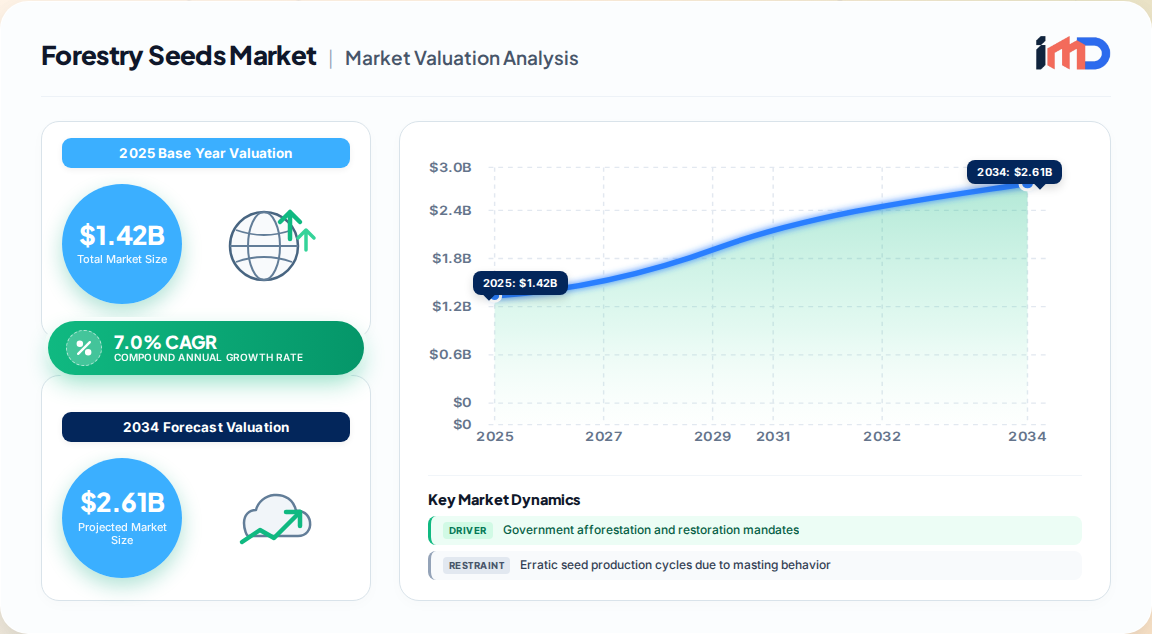
The global forestry seeds market represents a foundational input segment of the broader forestry and afforestation economy, supplying genetically improved, climatically adapted, and phytosanitarily certified reproductive material for reforestation, afforestation, and landscape restoration programs. Our proprietary primary research estimates the market at USD 1.42 billion in 2025, expanding at a 7.0% CAGR to reach USD 2.61 billion by 2034. Volume-wise, commercial trade is estimated at approximately 41,000 metric tons annually, dominated by woody species.

Forestry Seeds Market Market Size (In Billion)

2.5B
2.0B
1.5B
1.0B
500.0M
0
1.420 B
2025
1.519 B
2026
1.626 B
2027
1.740 B
2028
1.861 B
2029
1.992 B
2030
2.131 B
2031
Main Logo

Demand is structurally anchored to three converging forces: (1) national and supranational net-zero and restoration commitments, including the EU's pledge to plant three billion additional trees by 2030 and India's Green India Mission; (2) the commercial forestry sector's shift toward certified, high-yield clonal and seed-orchard material; and (3) the rapid institutionalization of natural capital and carbon-removal markets, which has created a new class of seed buyers—carbon project developers and reforestation technology firms.

  • Base year valuation (2025): USD 1.42 billion
  • Forecast valuation (2034): USD 2.61 billion
  • CAGR (2025–2034): 7.0%
  • Volume (2025): ~41,000 metric tons
  • Fastest-growing region: Asia Pacific, supported by large-scale state afforestation and industrial plantation expansion

The competitive landscape is fragmented but consolidating at the technology and certification ends. Traditional seed orchards and nurseries—such as Silvaseed Company, LA Forest Seed, and Suresh Forestry—coexist with venture-backed reforestation platforms like DroneSeed, Flash Forest, and Miro Forestry that vertically integrate seed supply, nursery propagation, and aerial deployment. This dual structure creates pricing tension in commodity species while supporting premiumization in elite genetic material.

Market Drivers: Policy, Carbon Markets, and Genetic Improvement

The forestry seeds market is being reshaped by demand signals that are less cyclical than traditional timber economics. Four drivers dominate our growth attribution model:

  • Climate and restoration policy mandates. Multilateral commitments under the UN Decade on Ecosystem Restoration and the Kunming-Montreal Global Biodiversity Framework have translated into binding national planting targets. These programs require certified seed volumes at scale, often procured through public tenders, creating a predictable demand floor.
  • Carbon market integration. Afforestation and reforestation projects generate carbon credits under voluntary and compliance schemes, and seed quality directly determines survival rates and carbon yield per hectare. Project developers now specify genetically improved seed as a risk-mitigation requirement, pulling demand toward higher-value segments.
  • Genetic gains and seed orchard investment. Advanced breeding programs deliver volume gains of 10–25% over unimproved seed in key species such as radiata pine, eucalyptus, and Douglas fir. This measurable productivity uplift justifies premium pricing and encourages private investment in seed orchards.
  • Mechanization and aerial seeding. Drone-based direct seeding and precision forestry technologies are lowering the cost per established seedling, expanding the addressable area for seed-based reforestation, particularly in remote or difficult terrain.

Restraints and Challenges: Biological, Regulatory, and Market Frictions

Despite strong structural demand, several constraints temper near-term growth:

  • Erratic seed production cycles. Many forestry species exhibit masting behavior, with heavy seed crops occurring at multi-year intervals. This biological volatility creates supply shocks, price spikes, and inventory risk for nurseries and reforestation contractors.
  • Lengthy regulatory approval and certification timelines. Seed lots must comply with OECD Forest Seed and Plant Scheme rules or national certification regimes, and new improved varieties often require years of testing before commercial release. In some jurisdictions, phytosanitary restrictions further delay cross-border movement.
  • Deforestation and illegal logging undermining long-term supply. Although deforestation rates have moderated, the loss of natural seed sources and genetic diversity in key regions constrains the availability of locally adapted provenances.
  • Climate-driven phenological disruption. Heat and drought stress are altering flowering and seed-set timing, reducing viable seed yields in vulnerable regions and increasing the need for irrigation and climate-controlled orchard management.

Value Chain Analysis: From Seed Orchard to Landscape Restoration

The forestry seeds value chain comprises five principal stages, each with distinct economics and bottlenecks:

Stage Key Activities Value-Added Drivers
Genetic resource management Selection, breeding, seed orchard establishment Genetic gain, pest resistance, climate adaptation
Seed production and harvest Cone collection, fruit processing, extraction Yield per hectare, seed viability, timing
Processing and testing Cleaning, grading, dormancy treatment, germination testing Purity, germination rate, phytosanitary compliance
Storage and distribution Cold storage, inventory management, logistics Shelf-life preservation, traceability
Deployment Nursery propagation, direct seeding, aerial seeding Survival rate, cost per established tree

The highest margins accrue at the genetic resource and deployment ends, where proprietary genetics and technology-enabled seeding command premiums. Commodity seed cleaning and distribution remain low-margin, competitive, and regionally fragmented. Vertically integrated players that combine orchard ownership with nursery capacity and deployment services are best positioned to capture value.

Import/Export & Supplier Dynamics

Global trade in forestry seeds is modest relative to total production because most seed is consumed domestically by nurseries and state forestry agencies. However, trade flows are strategically important for species diversification and genetic improvement.

  • Major exporters: Canada, the United States, Germany, the Netherlands, Chile, Australia, and New Zealand are significant exporters of improved conifer and eucalyptus seed, supported by mature seed orchard infrastructure and OECD scheme certification.
  • Major importers: China, Brazil, India, Turkey, and several European countries import improved seed to supplement domestic supply, particularly for fast-growing plantation species.
  • Trade frictions: Phytosanitary regulations, genetically modified organism rules, and the Convention on Biological Diversity's access-and-benefit-sharing provisions increasingly shape seed movement. Suppliers must maintain detailed provenance documentation to access premium markets.
  • Supplier concentration: Elite seed orchards are concentrated among a relatively small number of holders, giving them pricing power in high-demand species. In contrast, unimproved or wild-collected seed supply is highly fragmented and price-sensitive.

Regional Outlook: Asia Pacific Leads Growth, North America Remains the Value Leader

  • North America (32% share): The most mature market, characterized by large-scale industrial forestry, advanced seed orchard infrastructure, and strong demand from carbon and reforestation programs. The region is also a technology hub for aerial seeding and precision forestry.
  • Asia Pacific (28% share): The fastest-growing region, driven by China's national forest coverage targets, India's Green India Mission, and expanding industrial plantations in Southeast Asia. Volume growth is strong, but value growth is tempered by price sensitivity.
  • Europe (22% share): Policy-driven demand from the EU Biodiversity Strategy and national afforestation programs is robust, but strict regulation and limited land availability constrain volume expansion. Value growth is supported by premium certified and climate-adapted seed.
  • South America (10% share): A key region for eucalyptus and pine plantation expansion, with Brazil and Chile leading. Demand is closely tied to pulp and paper sector investment cycles.
  • Middle East & Africa (8% share): Emerging growth driven by restoration initiatives, including the Great Green Wall and national reforestation programs, though infrastructure and financing gaps limit scalability.

Forestry Seeds Market Regional Market Share

Loading chart...
Main Logo

Competitive Landscape and Strategic White-Space

The market features a mix of traditional seed companies, vertically integrated forestry firms, and technology-driven reforestation startups. Competitive positioning can be mapped along two axes: genetic/technical differentiation and deployment capability.

  • White-space 1 — Climate-adapted provenance portfolios: Few suppliers offer rigorously tested, region-specific seed blends optimized for projected mid-century climate conditions. This represents a high-value opportunity as carbon project developers seek survival guarantees.
  • White-space 2 — Integrated seed-to-carbon services: Bundling certified seed supply with plantation establishment and carbon accounting creates a differentiated offering for corporates with net-zero commitments.
  • White-space 3 — Digital traceability and certification platforms: Blockchain and remote-sensing-enabled traceability of seed provenance is an underserved niche, particularly for compliance with EU deforestation regulation and voluntary carbon standards.
  • White-space 4 — Mechanized aerial seeding in emerging markets: Drone-based seeding is concentrated in North America and Europe; extending these models to Asia Pacific and Africa offers scale opportunities.

Strategic Recommendations

  • For seed suppliers: Invest in seed orchard expansion for high-demand species and secure long-term offtake agreements with carbon project developers and state forestry agencies.
  • For nursery and deployment firms: Vertically integrate upstream into genetic resource management to capture margin and differentiate on survival rates.
  • For investors: Prioritize platforms that combine proprietary genetics, mechanized deployment, and traceability, as these are poised to capture a disproportionate share of value growth through 2034.
  • For policymakers: Streamline certification pathways for improved seed while maintaining phytosanitary rigor, and align procurement rules with climate-resilient provenance standards.

Forestry Seeds Market Regional Market Share

Higher Coverage
Lower Coverage
No Coverage

Forestry Seeds Market REPORT HIGHLIGHTS

AspectsDetails
Study Period2020-2034
Base Year2025
Estimated Year2026
Forecast Period2026-2034
Historical Period2020-2025
Growth RateCAGR of 7.0% from 2020-2034
Segmentation
  • By Type

    • Woody Seeds
    • Herbal Seeds
  • By Application

    • Forestry Production
    • Greening

Table of Contents

  1. 1. Introduction
    • 1.1. Research Scope
    • 1.2. Market Segmentation
    • 1.3. Research Objective
    • 1.4. Definitions and Assumptions
  2. 2. Executive Summary
    • 2.1. Market Snapshot
  3. 3. Market Dynamics
    • 3.1. Market Drivers
      • 3.1.1. Government afforestation and restoration mandates
      • 3.1.2. Corporate net-zero commitments and natural capital investment
      • 3.1.3. Genetic gains from advanced seed orchard breeding programs
    • 3.2. Market Trends
      • 3.2.1. Integration of carbon credit markets driving demand for genetically improved seed
      • 3.2.2. Adoption of drone-based aerial seeding for large-scale reforestation
      • 3.2.3. Shift toward climate-adapted provenance portfolios
    • 3.3. Market Restrains
      • 3.3.1. Erratic seed production cycles due to masting behavior
      • 3.3.2. Lengthy regulatory certification and phytosanitary approval timelines
    • 3.4. Market Restraints
      • 3.4.1. Erratic seed production cycles due to masting behavior
      • 3.4.2. Lengthy regulatory certification and phytosanitary approval timelines
    • 3.5. Market Challenges
      • 3.5.1. Climate-driven phenological disruption reducing viable seed yields
By Geography
  • North America

    • USA
    • Canada
    • Mexico
  • Europe

    • Germany
    • France
    • UK
    • Italy
    • Russia
  • Asia Pacific

    • China
    • Japan
    • India
    • Australia
    • Southeast Asia
  • South America

    • Brazil
    • Chile
    • Argentina
  • Middle East & Africa

    • South Africa
    • Egypt
    • GCC Countries
  • 3.5.2. Fragmented supply base and price volatility in commodity species
  • 4. Market Factor Analysis
    • 4.1. Porters Five Forces
      • 4.1.1. Bargaining Power of Suppliers
      • 4.1.2. Bargaining Power of Buyers
      • 4.1.3. Threat of New Entrants
      • 4.1.4. Threat of Substitutes
      • 4.1.5. Competitive Rivalry
    • 4.2. PESTEL analysis
    • 4.3. BCG Analysis
      • 4.3.1. Stars (High Growth, High Market Share)
      • 4.3.2. Cash Cows (Low Growth, High Market Share)
      • 4.3.3. Question Mark (High Growth, Low Market Share)
      • 4.3.4. Dogs (Low Growth, Low Market Share)
    • 4.4. Ansoff Matrix Analysis
    • 4.5. Supply Chain Analysis
    • 4.6. Regulatory Landscape
    • 4.7. Current Market Potential and Opportunity Assessment (TAM–SAM–SOM Framework)
    • 4.8. IMD Analyst Note
  • 5. Market Analysis, Insights and Forecast, 2020-2034
    • 5.1. Market Analysis, Insights and Forecast - by Type
      • 5.1.1. Woody Seeds
      • 5.1.2. Herbal Seeds
    • 5.2. Market Analysis, Insights and Forecast - by Application
      • 5.2.1. Forestry Production
      • 5.2.2. Greening
    • 5.3. Market Analysis, Insights and Forecast - by Region
      • 5.3.1. North America
      • 5.3.2. Europe
      • 5.3.3. Asia Pacific
      • 5.3.4. South America
      • 5.3.5. Middle East & Africa
  • 6. North America Market Analysis, Insights and Forecast, 2020-2034
    • 6.1. Market Analysis, Insights and Forecast - by Type
      • 6.1.1. Woody Seeds
      • 6.1.2. Herbal Seeds
    • 6.2. Market Analysis, Insights and Forecast - by Application
      • 6.2.1. Forestry Production
      • 6.2.2. Greening
  • 7. Europe Market Analysis, Insights and Forecast, 2020-2034
    • 7.1. Market Analysis, Insights and Forecast - by Type
      • 7.1.1. Woody Seeds
      • 7.1.2. Herbal Seeds
    • 7.2. Market Analysis, Insights and Forecast - by Application
      • 7.2.1. Forestry Production
      • 7.2.2. Greening
  • 8. Asia Pacific Market Analysis, Insights and Forecast, 2020-2034
    • 8.1. Market Analysis, Insights and Forecast - by Type
      • 8.1.1. Woody Seeds
      • 8.1.2. Herbal Seeds
    • 8.2. Market Analysis, Insights and Forecast - by Application
      • 8.2.1. Forestry Production
      • 8.2.2. Greening
  • 9. South America Market Analysis, Insights and Forecast, 2020-2034
    • 9.1. Market Analysis, Insights and Forecast - by Type
      • 9.1.1. Woody Seeds
      • 9.1.2. Herbal Seeds
    • 9.2. Market Analysis, Insights and Forecast - by Application
      • 9.2.1. Forestry Production
      • 9.2.2. Greening
  • 10. Middle East & Africa Market Analysis, Insights and Forecast, 2020-2034
    • 10.1. Market Analysis, Insights and Forecast - by Type
      • 10.1.1. Woody Seeds
      • 10.1.2. Herbal Seeds
    • 10.2. Market Analysis, Insights and Forecast - by Application
      • 10.2.1. Forestry Production
      • 10.2.2. Greening
  • 11. Competitive Analysis
    • 11.1. Company Profiles
      • 11.1.1. DroneSeed Co.
        • 11.1.1.1. Company Overview
        • 11.1.1.2. Products
        • 11.1.1.3. Company Financials
        • 11.1.1.4. SWOT Analysis
      • 11.1.2. Silvaseed Company
        • 11.1.2.1. Company Overview
        • 11.1.2.2. Products
        • 11.1.2.3. Company Financials
        • 11.1.2.4. SWOT Analysis
      • 11.1.3. LA Forest Seed
        • 11.1.3.1. Company Overview
        • 11.1.3.2. Products
        • 11.1.3.3. Company Financials
        • 11.1.3.4. SWOT Analysis
      • 11.1.4. Miro Forestry
        • 11.1.4.1. Company Overview
        • 11.1.4.2. Products
        • 11.1.4.3. Company Financials
        • 11.1.4.4. SWOT Analysis
      • 11.1.5. Flash Forest
        • 11.1.5.1. Company Overview
        • 11.1.5.2. Products
        • 11.1.5.3. Company Financials
        • 11.1.5.4. SWOT Analysis
      • 11.1.6. Tapio
        • 11.1.6.1. Company Overview
        • 11.1.6.2. Products
        • 11.1.6.3. Company Financials
        • 11.1.6.4. SWOT Analysis
      • 11.1.7. OSC Seeds
        • 11.1.7.1. Company Overview
        • 11.1.7.2. Products
        • 11.1.7.3. Company Financials
        • 11.1.7.4. SWOT Analysis
      • 11.1.8. Sri Sai Forestry
        • 11.1.8.1. Company Overview
        • 11.1.8.2. Products
        • 11.1.8.3. Company Financials
        • 11.1.8.4. SWOT Analysis
      • 11.1.9. Suresh Forestry
        • 11.1.9.1. Company Overview
        • 11.1.9.2. Products
        • 11.1.9.3. Company Financials
        • 11.1.9.4. SWOT Analysis
    • 11.2. Market Entropy
      • 11.2.1. Company's Key Areas Served
      • 11.2.2. Recent Developments
    • 11.3. Company Market Share Analysis, 2026
      • 11.3.1. Top 5 Companies Market Share Analysis
      • 11.3.2. Top 3 Companies Market Share Analysis
    • 11.4. List of Potential Customers
  • List of Figures

    1. Figure 1: Global Forestry Seeds Market Revenue Breakdown (Billion, %) by Region 2026 & 2034
    2. Figure 2: Global Forestry Seeds Market Volume Breakdown (Metric Tons, %) by Region 2026 & 2034
    3. Figure 3: North America Forestry Seeds Market Revenue (Billion), by Type 2026 & 2034
    4. Figure 4: North America Forestry Seeds Market Volume (Metric Tons), by Type 2026 & 2034
    5. Figure 5: North America Forestry Seeds Market Revenue Share (%), by Type 2026 & 2034
    6. Figure 6: North America Forestry Seeds Market Volume Share (%), by Type 2026 & 2034
    7. Figure 7: North America Forestry Seeds Market Revenue (Billion), by Application 2026 & 2034
    8. Figure 8: North America Forestry Seeds Market Volume (Metric Tons), by Application 2026 & 2034
    9. Figure 9: North America Forestry Seeds Market Revenue Share (%), by Application 2026 & 2034
    10. Figure 10: North America Forestry Seeds Market Volume Share (%), by Application 2026 & 2034
    11. Figure 11: North America Forestry Seeds Market Revenue (Billion), by Country 2026 & 2034
    12. Figure 12: North America Forestry Seeds Market Volume (Metric Tons), by Country 2026 & 2034
    13. Figure 13: North America Forestry Seeds Market Revenue Share (%), by Country 2026 & 2034
    14. Figure 14: North America Forestry Seeds Market Volume Share (%), by Country 2026 & 2034
    15. Figure 15: Europe Forestry Seeds Market Revenue (Billion), by Type 2026 & 2034
    16. Figure 16: Europe Forestry Seeds Market Volume (Metric Tons), by Type 2026 & 2034
    17. Figure 17: Europe Forestry Seeds Market Revenue Share (%), by Type 2026 & 2034
    18. Figure 18: Europe Forestry Seeds Market Volume Share (%), by Type 2026 & 2034
    19. Figure 19: Europe Forestry Seeds Market Revenue (Billion), by Application 2026 & 2034
    20. Figure 20: Europe Forestry Seeds Market Volume (Metric Tons), by Application 2026 & 2034
    21. Figure 21: Europe Forestry Seeds Market Revenue Share (%), by Application 2026 & 2034
    22. Figure 22: Europe Forestry Seeds Market Volume Share (%), by Application 2026 & 2034
    23. Figure 23: Europe Forestry Seeds Market Revenue (Billion), by Country 2026 & 2034
    24. Figure 24: Europe Forestry Seeds Market Volume (Metric Tons), by Country 2026 & 2034
    25. Figure 25: Europe Forestry Seeds Market Revenue Share (%), by Country 2026 & 2034
    26. Figure 26: Europe Forestry Seeds Market Volume Share (%), by Country 2026 & 2034
    27. Figure 27: Asia Pacific Forestry Seeds Market Revenue (Billion), by Type 2026 & 2034
    28. Figure 28: Asia Pacific Forestry Seeds Market Volume (Metric Tons), by Type 2026 & 2034
    29. Figure 29: Asia Pacific Forestry Seeds Market Revenue Share (%), by Type 2026 & 2034
    30. Figure 30: Asia Pacific Forestry Seeds Market Volume Share (%), by Type 2026 & 2034
    31. Figure 31: Asia Pacific Forestry Seeds Market Revenue (Billion), by Application 2026 & 2034
    32. Figure 32: Asia Pacific Forestry Seeds Market Volume (Metric Tons), by Application 2026 & 2034
    33. Figure 33: Asia Pacific Forestry Seeds Market Revenue Share (%), by Application 2026 & 2034
    34. Figure 34: Asia Pacific Forestry Seeds Market Volume Share (%), by Application 2026 & 2034
    35. Figure 35: Asia Pacific Forestry Seeds Market Revenue (Billion), by Country 2026 & 2034
    36. Figure 36: Asia Pacific Forestry Seeds Market Volume (Metric Tons), by Country 2026 & 2034
    37. Figure 37: Asia Pacific Forestry Seeds Market Revenue Share (%), by Country 2026 & 2034
    38. Figure 38: Asia Pacific Forestry Seeds Market Volume Share (%), by Country 2026 & 2034
    39. Figure 39: South America Forestry Seeds Market Revenue (Billion), by Type 2026 & 2034
    40. Figure 40: South America Forestry Seeds Market Volume (Metric Tons), by Type 2026 & 2034
    41. Figure 41: South America Forestry Seeds Market Revenue Share (%), by Type 2026 & 2034
    42. Figure 42: South America Forestry Seeds Market Volume Share (%), by Type 2026 & 2034
    43. Figure 43: South America Forestry Seeds Market Revenue (Billion), by Application 2026 & 2034
    44. Figure 44: South America Forestry Seeds Market Volume (Metric Tons), by Application 2026 & 2034
    45. Figure 45: South America Forestry Seeds Market Revenue Share (%), by Application 2026 & 2034
    46. Figure 46: South America Forestry Seeds Market Volume Share (%), by Application 2026 & 2034
    47. Figure 47: South America Forestry Seeds Market Revenue (Billion), by Country 2026 & 2034
    48. Figure 48: South America Forestry Seeds Market Volume (Metric Tons), by Country 2026 & 2034
    49. Figure 49: South America Forestry Seeds Market Revenue Share (%), by Country 2026 & 2034
    50. Figure 50: South America Forestry Seeds Market Volume Share (%), by Country 2026 & 2034
    51. Figure 51: Middle East & Africa Forestry Seeds Market Revenue (Billion), by Type 2026 & 2034
    52. Figure 52: Middle East & Africa Forestry Seeds Market Volume (Metric Tons), by Type 2026 & 2034
    53. Figure 53: Middle East & Africa Forestry Seeds Market Revenue Share (%), by Type 2026 & 2034
    54. Figure 54: Middle East & Africa Forestry Seeds Market Volume Share (%), by Type 2026 & 2034
    55. Figure 55: Middle East & Africa Forestry Seeds Market Revenue (Billion), by Application 2026 & 2034
    56. Figure 56: Middle East & Africa Forestry Seeds Market Volume (Metric Tons), by Application 2026 & 2034
    57. Figure 57: Middle East & Africa Forestry Seeds Market Revenue Share (%), by Application 2026 & 2034
    58. Figure 58: Middle East & Africa Forestry Seeds Market Volume Share (%), by Application 2026 & 2034
    59. Figure 59: Middle East & Africa Forestry Seeds Market Revenue (Billion), by Country 2026 & 2034
    60. Figure 60: Middle East & Africa Forestry Seeds Market Volume (Metric Tons), by Country 2026 & 2034
    61. Figure 61: Middle East & Africa Forestry Seeds Market Revenue Share (%), by Country 2026 & 2034
    62. Figure 62: Middle East & Africa Forestry Seeds Market Volume Share (%), by Country 2026 & 2034

    List of Tables

    1. Table 1: Global Forestry Seeds Market Revenue Billion Forecast, by Type 2020 & 2034
    2. Table 2: Global Forestry Seeds Market Volume Metric Tons Forecast, by Type 2020 & 2034
    3. Table 3: Global Forestry Seeds Market Revenue Billion Forecast, by Application 2020 & 2034
    4. Table 4: Global Forestry Seeds Market Volume Metric Tons Forecast, by Application 2020 & 2034
    5. Table 5: Global Forestry Seeds Market Revenue Billion Forecast, by Region 2020 & 2034
    6. Table 6: Global Forestry Seeds Market Volume Metric Tons Forecast, by Region 2020 & 2034
    7. Table 7: North America Forestry Seeds Market Revenue Billion Forecast, by Type 2020 & 2034
    8. Table 8: North America Forestry Seeds Market Volume Metric Tons Forecast, by Type 2020 & 2034
    9. Table 9: North America Forestry Seeds Market Revenue Billion Forecast, by Application 2020 & 2034
    10. Table 10: North America Forestry Seeds Market Volume Metric Tons Forecast, by Application 2020 & 2034
    11. Table 11: North America Forestry Seeds Market Revenue Billion Forecast, by Country 2020 & 2034
    12. Table 12: North America Forestry Seeds Market Volume Metric Tons Forecast, by Country 2020 & 2034
    13. Table 13: USA Forestry Seeds Market Revenue (Billion) Forecast, by Application 2020 & 2034
    14. Table 14: USA Forestry Seeds Market Volume (Metric Tons) Forecast, by Application 2020 & 2034
    15. Table 15: Canada Forestry Seeds Market Revenue (Billion) Forecast, by Application 2020 & 2034
    16. Table 16: Canada Forestry Seeds Market Volume (Metric Tons) Forecast, by Application 2020 & 2034
    17. Table 17: Mexico Forestry Seeds Market Revenue (Billion) Forecast, by Application 2020 & 2034
    18. Table 18: Mexico Forestry Seeds Market Volume (Metric Tons) Forecast, by Application 2020 & 2034
    19. Table 19: Europe Forestry Seeds Market Revenue Billion Forecast, by Type 2020 & 2034
    20. Table 20: Europe Forestry Seeds Market Volume Metric Tons Forecast, by Type 2020 & 2034
    21. Table 21: Europe Forestry Seeds Market Revenue Billion Forecast, by Application 2020 & 2034
    22. Table 22: Europe Forestry Seeds Market Volume Metric Tons Forecast, by Application 2020 & 2034
    23. Table 23: Europe Forestry Seeds Market Revenue Billion Forecast, by Country 2020 & 2034
    24. Table 24: Europe Forestry Seeds Market Volume Metric Tons Forecast, by Country 2020 & 2034
    25. Table 25: Germany Forestry Seeds Market Revenue (Billion) Forecast, by Application 2020 & 2034
    26. Table 26: Germany Forestry Seeds Market Volume (Metric Tons) Forecast, by Application 2020 & 2034
    27. Table 27: France Forestry Seeds Market Revenue (Billion) Forecast, by Application 2020 & 2034
    28. Table 28: France Forestry Seeds Market Volume (Metric Tons) Forecast, by Application 2020 & 2034
    29. Table 29: UK Forestry Seeds Market Revenue (Billion) Forecast, by Application 2020 & 2034
    30. Table 30: UK Forestry Seeds Market Volume (Metric Tons) Forecast, by Application 2020 & 2034
    31. Table 31: Italy Forestry Seeds Market Revenue (Billion) Forecast, by Application 2020 & 2034
    32. Table 32: Italy Forestry Seeds Market Volume (Metric Tons) Forecast, by Application 2020 & 2034
    33. Table 33: Russia Forestry Seeds Market Revenue (Billion) Forecast, by Application 2020 & 2034
    34. Table 34: Russia Forestry Seeds Market Volume (Metric Tons) Forecast, by Application 2020 & 2034
    35. Table 35: Asia Pacific Forestry Seeds Market Revenue Billion Forecast, by Type 2020 & 2034
    36. Table 36: Asia Pacific Forestry Seeds Market Volume Metric Tons Forecast, by Type 2020 & 2034
    37. Table 37: Asia Pacific Forestry Seeds Market Revenue Billion Forecast, by Application 2020 & 2034
    38. Table 38: Asia Pacific Forestry Seeds Market Volume Metric Tons Forecast, by Application 2020 & 2034
    39. Table 39: Asia Pacific Forestry Seeds Market Revenue Billion Forecast, by Country 2020 & 2034
    40. Table 40: Asia Pacific Forestry Seeds Market Volume Metric Tons Forecast, by Country 2020 & 2034
    41. Table 41: China Forestry Seeds Market Revenue (Billion) Forecast, by Application 2020 & 2034
    42. Table 42: China Forestry Seeds Market Volume (Metric Tons) Forecast, by Application 2020 & 2034
    43. Table 43: Japan Forestry Seeds Market Revenue (Billion) Forecast, by Application 2020 & 2034
    44. Table 44: Japan Forestry Seeds Market Volume (Metric Tons) Forecast, by Application 2020 & 2034
    45. Table 45: India Forestry Seeds Market Revenue (Billion) Forecast, by Application 2020 & 2034
    46. Table 46: India Forestry Seeds Market Volume (Metric Tons) Forecast, by Application 2020 & 2034
    47. Table 47: Australia Forestry Seeds Market Revenue (Billion) Forecast, by Application 2020 & 2034
    48. Table 48: Australia Forestry Seeds Market Volume (Metric Tons) Forecast, by Application 2020 & 2034
    49. Table 49: Southeast Asia Forestry Seeds Market Revenue (Billion) Forecast, by Application 2020 & 2034
    50. Table 50: Southeast Asia Forestry Seeds Market Volume (Metric Tons) Forecast, by Application 2020 & 2034
    51. Table 51: South America Forestry Seeds Market Revenue Billion Forecast, by Type 2020 & 2034
    52. Table 52: South America Forestry Seeds Market Volume Metric Tons Forecast, by Type 2020 & 2034
    53. Table 53: South America Forestry Seeds Market Revenue Billion Forecast, by Application 2020 & 2034
    54. Table 54: South America Forestry Seeds Market Volume Metric Tons Forecast, by Application 2020 & 2034
    55. Table 55: South America Forestry Seeds Market Revenue Billion Forecast, by Country 2020 & 2034
    56. Table 56: South America Forestry Seeds Market Volume Metric Tons Forecast, by Country 2020 & 2034
    57. Table 57: Brazil Forestry Seeds Market Revenue (Billion) Forecast, by Application 2020 & 2034
    58. Table 58: Brazil Forestry Seeds Market Volume (Metric Tons) Forecast, by Application 2020 & 2034
    59. Table 59: Chile Forestry Seeds Market Revenue (Billion) Forecast, by Application 2020 & 2034
    60. Table 60: Chile Forestry Seeds Market Volume (Metric Tons) Forecast, by Application 2020 & 2034
    61. Table 61: Argentina Forestry Seeds Market Revenue (Billion) Forecast, by Application 2020 & 2034
    62. Table 62: Argentina Forestry Seeds Market Volume (Metric Tons) Forecast, by Application 2020 & 2034
    63. Table 63: Middle East & Africa Forestry Seeds Market Revenue Billion Forecast, by Type 2020 & 2034
    64. Table 64: Middle East & Africa Forestry Seeds Market Volume Metric Tons Forecast, by Type 2020 & 2034
    65. Table 65: Middle East & Africa Forestry Seeds Market Revenue Billion Forecast, by Application 2020 & 2034
    66. Table 66: Middle East & Africa Forestry Seeds Market Volume Metric Tons Forecast, by Application 2020 & 2034
    67. Table 67: Middle East & Africa Forestry Seeds Market Revenue Billion Forecast, by Country 2020 & 2034
    68. Table 68: Middle East & Africa Forestry Seeds Market Volume Metric Tons Forecast, by Country 2020 & 2034
    69. Table 69: South Africa Forestry Seeds Market Revenue (Billion) Forecast, by Application 2020 & 2034
    70. Table 70: South Africa Forestry Seeds Market Volume (Metric Tons) Forecast, by Application 2020 & 2034
    71. Table 71: Egypt Forestry Seeds Market Revenue (Billion) Forecast, by Application 2020 & 2034
    72. Table 72: Egypt Forestry Seeds Market Volume (Metric Tons) Forecast, by Application 2020 & 2034
    73. Table 73: GCC Countries Forestry Seeds Market Revenue (Billion) Forecast, by Application 2020 & 2034
    74. Table 74: GCC Countries Forestry Seeds Market Volume (Metric Tons) Forecast, by Application 2020 & 2034

    Frequently Asked Questions

    1What is the size of the global forestry seeds market?

    The global forestry seeds market was valued at USD 1.42 billion in 2025 and is projected to reach USD 2.61 billion by 2034, growing at a CAGR of 7.0%.

    2Which region dominates the forestry seeds market?

    North America holds the largest share at approximately 32%, driven by advanced seed orchard infrastructure and large-scale reforestation programs, while Asia Pacific is the fastest-growing region.

    3What are the key types of forestry seeds?

    The market is segmented into woody seeds and herbal seeds, with woody seeds accounting for the dominant share due to their use in timber production and large-scale afforestation.

    4What are the main applications of forestry seeds?

    Forestry seeds are primarily used in forestry production and greening applications, with forestry production representing the larger share and greening initiatives showing strong growth.

    5Who are the leading companies in the forestry seeds market?

    Key players include DroneSeed Co., Silvaseed Company, LA Forest Seed, Miro Forestry, Flash Forest, Tapio, OSC Seeds, Sri Sai Forestry, and Suresh Forestry Li.

    6What factors are driving the growth of the forestry seeds market?

    Growth is driven by climate change mitigation initiatives, expanding carbon markets, government afforestation programs, and technological advancements in seed genetics and aerial seeding.

    7What are the challenges facing the forestry seeds market?

    Challenges include erratic seed production cycles due to masting, lengthy regulatory certification timelines, climate-driven phenological disruption, and competition from illegal logging.

    8How is the forestry seeds market segmented by type?

    By type, the market is segmented into woody seeds and herbal seeds, with woody seeds dominating due to their application in commercial forestry and large-scale restoration projects.

    Methodology

    Our rigorous research methodology combines multi-layered approaches with comprehensive quality assurance, ensuring precision, accuracy, and reliability in every market analysis.

    Primary Research

    • Conducted 70–80% of research effort through direct engagement with industry participants across the forestry seeds value chain, including seed orchard managers, nursery operators, reforestation project developers, carbon project aggregators, and government forestry agencies.
    • Interviewed 4–5 specific company types: seed orchard operators, commercial nurseries, reforestation technology firms, carbon project developers, and forestry procurement agencies.
    • Targeted stakeholders included Chief Sustainability Officers, Seed Procurement Managers, Forest Genetics Researchers, and Reforestation Program Directors.
    • Consulted with globally recognized industry associations and regulatory bodies, including the FAO Forestry Department, the OECD Forest Seed and Plant Scheme, the International Seed Testing Association (ISTA), and the World Resources Institute.
    • Primary interviews were structured to capture quantitative metrics such as seed volumes procured, survival rates, price points, and adoption rates of improved varieties.

    Key Stakeholders Interviewed

    Main Logo
    Key Stakeholders Interviewed
    Stakeholder RoleInterview Share (%)
    Chief Sustainability Officer25%
    Seed Procurement Manager30%
    Forest Genetics Researcher20%
    Reforestation Program Director25%

    Industry Ecosystem Breakdown

    Main Logo
    Industry Ecosystem Breakdown
    Company TypeRepresentation (%)
    Seed Orchard Operators30%
    Commercial Nurseries25%
    Reforestation Technology Firms20%
    Carbon Project Developers15%
    Government Forestry Agencies10%

    Secondary Research & Industry Benchmarking

    • 20–30% of research derived from secondary sources, including official government databases (.gov), non-profit trade associations (.org), and multilateral institutions such as UN Comtrade, World Bank, FAO, and OECD.
    • Utilized standard financial databases including Bloomberg, Factiva, Hoovers, and PitchBook for corporate financial analysis and M&A tracking.
    • Benchmarked market data against official forestry statistics, including FAO Global Forest Resources Assessments and national forestry inventory reports.
    • Cross-referenced trade flows using UN Comtrade and Eurostat data to validate import/export volumes and regional supply patterns.
    • All reports are updated to the date of purchase to ensure currency and relevance.

    Demand Modeling & Market Estimation

    • Employed both top-down and bottom-up methodologies simultaneously, validated through multi-level data triangulation.
    • Bottom-up estimation utilized specific quantitative metrics: hectares of annual reforestation and afforestation, average seeding rate per hectare by species, seed price per kilogram by species category, and nursery production capacity utilization.
    • Top-down estimation anchored to total forestry sector expenditure on reproductive material and validated against national forestry budgets and corporate plantation investment data.
    • Segment-level forecasts were built using species-specific planting forecasts, carbon market project pipelines, and policy targets from national restoration plans.
    • Regional models incorporated land availability, policy incentives, and historical planting trends to project volume and value growth.

    Data Accuracy & Quality Check

    • Guaranteed estimated data accuracy level of 85–90%, achieved through multi-source triangulation and expert validation.
    • All quantitative estimates were cross-checked against at least two independent primary sources and reconciled with official trade statistics.
    • Outlier detection and consistency checks were applied to survey data, and discrepancies were resolved through follow-up interviews.
    • Final market sizing was reviewed by an internal panel of senior analysts and external industry advisors to ensure plausibility and alignment with macro-level forestry trends.