1What is the current size of the fish leather market?
The global fish leather market was valued at approximately $256 million in 2025 and is projected to reach $289.28 million by 2026, growing at a CAGR of 13% to reach $680.56 million by 2033.
Insight Market Data is a premier market research and business consulting firm headquartered in Pune, India, providing syndicated research reports, customized intelligence studies, and strategic advisory services. Renowned academic institutions and Fortune 500 corporations worldwide rely on Insight Market Data's research repository to navigate evolving global and regional business environments. Covering 46 diverse industries across 25 major international economies, our comprehensive database delivers thousands of verified statistics and granular market evaluations. By combining industry-leading analytical methodologies with the direct insights of seasoned industry leaders and subject-matter experts, we deliver actionable intelligence spanning historical performance benchmarks to rigorous multi-year forecasts. We empower organizations to make confident, data-driven decisions across pivotal domains including Machinery & Equipment, Chemicals & Materials, Pharmaceuticals & Healthcare, Food & Beverages, Consumer Goods, Energy & Power, Automotive & Transportation, Electronics & Semiconductors, Medical Devices, Telecommunications, Emerging Technologies, Agriculture, and Packaging. Our multidisciplinary analyst teams provide an objective 360-degree perspective, tailoring every engagement to address complex strategic challenges with exceptional analytical rigor.
Leveraging advanced BI-powered analytics and predictive modeling, Insight Market Data uncovers high-impact market opportunities and competitive differentiators for ambitious enterprises. We continuously refine our research methodologies in accordance with global industry standards, tracking real-time market shifts to ensure our reports are consistently accurate, actionable, and delivered on schedule. Our analysts conduct methodical data validation, rigorous compliance checks, and exhaustive primary and secondary research to maintain the highest levels of data integrity and transparency. We partner closely with corporate strategists, investment groups, and business executives to translate intricate market intelligence into clear, actionable roadmaps for sustainable growth. With operational presence across Washington, USA, and Vimannagar, Pune, India, Insight Market Data ensures direct access to dedicated research specialists and responsive customer support to answer your most strategic questions.
 Fish Leather Market
 by Type (Salmon, Perch, Wolffish, Cod, Shark, Nile Perch, Haddock, Tilapia), by Application (Clothing, Shoes, Handbags, Wallets, Belts, Footwear, Automotive, Furniture, Accessories), by Distribution Channel (Online, Offline), by End-User (Men, Women), by North America (USA, Canada, Mexico), by Europe (Germany, UK, France, Italy, Spain, Russia, Switzerland, Sweden, Denmark, Luxembourg, Rest of Europe), by Asia Pacific (China, Japan, India, South Korea, Australia, Singapore, Taiwan, South East Asia, Rest of APAC), by South America (Brazil, Argentina, Colombia, Peru, Chile, Rest of South America), by Middle East (Saudi Arabia, UAE, Turkey, Egypt, Qatar, Rest of Middle East), by Africa (South Africa, East Africa, West Africa, North Africa) Forecast 2026-2034

Research Associate


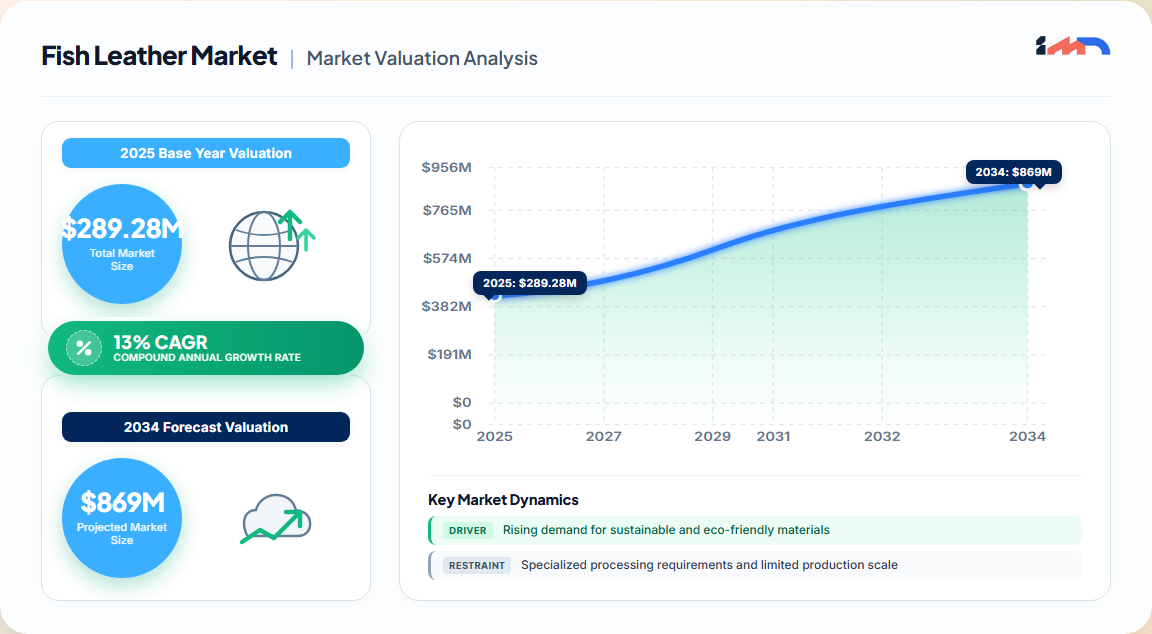
The global fish leather market represents a dynamic and rapidly evolving niche within the broader sustainable materials landscape. Our proprietary primary research indicates that the market, valued at $256 million in 2025, is on a clear growth trajectory, projected to reach $289.28 million by 2026 and expand to $680.56 million by 2033, registering a robust CAGR of 13% during the forecast period. This growth is underpinned by a fundamental shift in consumer and industrial demand toward circular-economy materials, transforming a low-value seafood byproduct into a premium, design-led textile.
Fish leather, derived from the skins of species such as salmon, cod, perch, and tilapia, offers a unique combination of distinctive aesthetics, durability, and a compelling sustainability narrative. Europe currently dominates the market, holding a 33% share in 2025, with established fashion houses and tanneries in Iceland, Italy, and Germany leading the charge. However, Asia Pacific is emerging as the fastest-growing region, driven by expanding manufacturing capabilities and a rising middle class in countries like China and India. The market is characterized by a high degree of innovation, with designers and material scientists continuously exploring new tanning techniques and applications, from high-end footwear to automotive interiors.
The fish leather value chain is a fascinating example of industrial symbiosis. It begins with the fishing and aquaculture industry, which supplies the raw fish skins. These skins, often considered waste, are collected and preserved by specialized tanneries and processors. These processors transform the raw skins into finished leather through a series of mechanical and chemical operations, including descaling, tanning, dyeing, and finishing.
In Europe, this stage is dominated by specialized tanneries in Iceland, Italy, and Germany that have perfected the craft. The finished leather is then sold to manufacturers and artisans who create final products such as handbags, shoes, wallets, and automotive interiors. Finally, these products reach consumers through offline retail channels (boutiques, department stores) and online platforms (e-commerce, brand websites). Our primary research highlights that the offline channel held a 61.4% share in 2025, but the online channel is growing faster at a CAGR of 8.57%.
The global trade in fish leather is relatively small compared to conventional leather but is growing rapidly. Europe is the largest net exporter of finished fish leather, with countries like Iceland and Italy leading the way. North America is a significant consumer market but also has its own production, particularly from salmon skins in Alaska and Canada. Asia Pacific is predominantly a processor and consumer market, importing raw skins and exporting finished goods.
Key supply chain risks include:
We have assessed each region based on market attractiveness, considering factors such as growth potential, regulatory environment, and supply chain maturity.
| Region | Market Share (2025) | CAGR (2026-2033) | Attractiveness | Key Insights |
|---|---|---|---|---|
| Europe | 33% | 12.3% | High | Dominated by established luxury brands and advanced tanning technologies. Strong regulatory support for circular economy. |
| North America | 22% | 12.8% | Medium-High | Growing demand for sustainable fashion and automotive interiors. Strong domestic supply from salmon fisheries. |
| Asia Pacific | 24% | 14.2% | High | Fastest-growing region due to expanding middle class, manufacturing base, and increasing focus on sustainable materials. |
| South America | 8% | 13.7% | Medium | Emerging market with potential, but limited infrastructure and consumer awareness. Brazil is the key market. |
| Middle East & Africa | 8% | 11.4% | Low-Medium | Nascent market, but with growing interest in sustainable luxury goods. Africa has significant potential due to its fisheries. |
The salmon segment dominates the market, driven by the abundant availability of salmon skins as a byproduct of the global salmon farming industry. Our analysis estimates that salmon leather accounted for 29.4% of the global market in 2025, valued at approximately $75 million. Its popularity stems from its distinctive, flexible, and durable nature. Other significant segments include Nile perch, tilapia, cod, and perch. The Nile perch segment is expected to grow notably in Africa, while tilapia is gaining traction in Asia and Latin America.
The handbags segment is the largest application, followed by shoes and footwear. The automotive segment, while currently smaller (around 6.8% share in 2025), is projected to be the fastest-growing application, with a CAGR of 8.36%, as car manufacturers seek unique, sustainable materials for interior trims and seats. Other applications include clothing, wallets, belts, and furniture.
The offline channel remains the dominant distribution method, accounting for 61.4% of sales in 2025. This is due to the importance of physical touch and feel for leather products. However, the online channel is growing at a faster rate (CAGR of 8.57%) as e-commerce platforms make it easier for consumers to access specialized products and for brands to reach a global audience.
The fish leather market is highly fragmented, with a mix of specialized tanneries, fashion brands, and material innovation startups. Key players include:
Recent developments include:
Companies are adopting strategies such as vertical integration, partnerships with fashion brands, and investment in R&D for new tanning technologies to gain a competitive edge. The focus is on scaling production, improving consistency, and educating consumers about the material's benefits.
| Aspects | Details |
|---|---|
| Study Period | 2020-2034 |
| Base Year | 2025 |
| Estimated Year | 2026 |
| Forecast Period | 2026-2034 |
| Historical Period | 2020-2025 |
| Growth Rate | CAGR of 13% from 2020-2034 |
| Segmentation |
|
By Application
By Distribution Channel
By End-User
| By Geography |
|
The global fish leather market was valued at approximately $256 million in 2025 and is projected to reach $289.28 million by 2026, growing at a CAGR of 13% to reach $680.56 million by 2033.
Europe leads the fish leather market with a 33% share in 2025, driven by strong fashion industries in countries like Iceland and Italy and a high demand for sustainable luxury materials.
The market is primarily driven by the growing demand for sustainable and eco-friendly materials, the push towards circular economy practices, and the unique aesthetic properties of fish leather that appeal to premium fashion brands.
Key challenges include specialized processing requirements, limited production scale, inconsistent raw material supply due to seasonal variations, and low consumer awareness compared to traditional leather.
Salmon is the leading segment, accounting for about 29.4% of the market in 2025, due to the abundant supply of salmon skins from the seafood industry and their durable, flexible properties. Other species include Nile perch, tilapia, and cod.
Our rigorous research methodology combines multi-layered approaches with comprehensive quality assurance, ensuring precision, accuracy, and reliability in every market analysis.
| Stakeholder Role | Interview Share (%) |
|---|---|
| Procurement Director | 30% |
| Sustainability Manager | 25% |
| Product Development Head | 20% |
| Tannery Operations Manager | 15% |
| Material Innovation Lead | 10% |
| Company Type | Representation (%) |
|---|---|
| Fish Leather Tanneries | 40% |
| Fashion Brands & OEMs | 25% |
| Material Innovation Startups | 15% |
| Seafood Processors | 10% |
| Automotive Interior Suppliers | 10% |
 Related Reports
