1What is the size of the Europe car rental market in 2026?
The Europe car rental market is valued at USD 28.3 Billion in 2026, up from USD 25.6 Billion in 2025, and is projected to reach USD 63.0 Billion by 2034 at a CAGR of 10.55%.
Insight Market Data is a premier market research and business consulting firm headquartered in Pune, India, providing syndicated research reports, customized intelligence studies, and strategic advisory services. Renowned academic institutions and Fortune 500 corporations worldwide rely on Insight Market Data's research repository to navigate evolving global and regional business environments. Covering 46 diverse industries across 25 major international economies, our comprehensive database delivers thousands of verified statistics and granular market evaluations. By combining industry-leading analytical methodologies with the direct insights of seasoned industry leaders and subject-matter experts, we deliver actionable intelligence spanning historical performance benchmarks to rigorous multi-year forecasts. We empower organizations to make confident, data-driven decisions across pivotal domains including Machinery & Equipment, Chemicals & Materials, Pharmaceuticals & Healthcare, Food & Beverages, Consumer Goods, Energy & Power, Automotive & Transportation, Electronics & Semiconductors, Medical Devices, Telecommunications, Emerging Technologies, Agriculture, and Packaging. Our multidisciplinary analyst teams provide an objective 360-degree perspective, tailoring every engagement to address complex strategic challenges with exceptional analytical rigor.
Leveraging advanced BI-powered analytics and predictive modeling, Insight Market Data uncovers high-impact market opportunities and competitive differentiators for ambitious enterprises. We continuously refine our research methodologies in accordance with global industry standards, tracking real-time market shifts to ensure our reports are consistently accurate, actionable, and delivered on schedule. Our analysts conduct methodical data validation, rigorous compliance checks, and exhaustive primary and secondary research to maintain the highest levels of data integrity and transparency. We partner closely with corporate strategists, investment groups, and business executives to translate intricate market intelligence into clear, actionable roadmaps for sustainable growth. With operational presence across Washington, USA, and Vimannagar, Pune, India, Insight Market Data ensures direct access to dedicated research specialists and responsive customer support to answer your most strategic questions.
 Europe Car Rental Market
 by Booking Type (Offline, Online), by Rental Length (Short Term, Long Term), by Vehicle Type (Passenger Cars, Light Commercial Vehicles, Premium and Luxury Cars, SUVs and MPVs, Vans and Commercial), by Application (Leisure/Tourism, Business), by Powertrain (ICE, Hybrid, BEV), by Service Model (Traditional Car Rental, Subscription, Peer-to-Peer), by End-User (Self-Drive Individual, Chauffeur-Driven, Corporate Fleet Outsourcing), by Rental Channel (On-Airport, Off-Airport), by Western Europe (Germany, UK, France, Netherlands, Belgium, Austria, Switzerland), by Southern Europe (Spain, Italy, Portugal, Greece), by Northern Europe (Denmark, Sweden, Norway, Finland), by Central & Eastern Europe (Poland, Czech Republic, Hungary, Romania) Forecast 2026-2034

Research Analyst


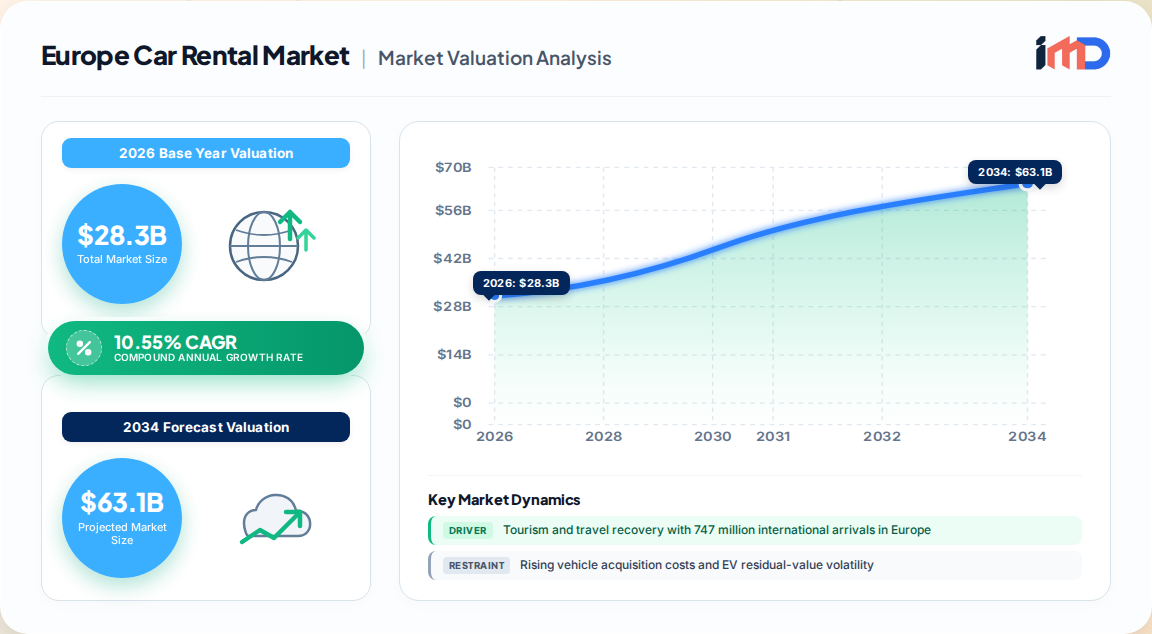
The Europe car rental market is executing a structural pivot from post-pandemic volume recovery toward margin-disciplined, digitally intermediated mobility. Our proprietary primary research values the market at USD 28.3 Billion in 2026, expanding from USD 25.6 Billion in 2025 and forecast to reach USD 63.0 Billion by 2034, a CAGR of 10.55% across 2026–2034.
Growth is no longer a simple function of paid rental days. Fleet utilization, revenue per rental day, ancillary attachment, and residual-value control now determine operator economics. Paid rental days are projected to approach 498 million by 2031, while average revenue per rental day rises toward USD 82.9, confirming that value-led expansion is replacing pure volume competition.
The European demand base is structurally broader than in prior cycles, with three drivers doing most of the work.
1. Inbound tourism and Mediterranean seasonality. International tourist arrivals to Europe reached 747 million in 2024 (UN Tourism), exceeding pre-pandemic levels. Spain alone welcomed 9.2 million international tourists in October 2025, up 3.2% year-on-year, swelling self-drive leisure demand in coastal corridors. EU residents completed approximately 1.2 billion overnight tourism trips in 2024, with 92% remaining within the EU.
2. Airport throughput and mobile-first booking. EU airports handled roughly 1.1 billion passengers in 2024; Paris Charles de Gaulle and Amsterdam Schiphol processed 70 million and 67 million passengers respectively. Mobile and app-based reservations now represent a significant share of digital rental transactions in Western Europe, compressing booking windows and enabling dynamic pricing.
3. Fleet electrification mandates. The EU Fit-for-55 package and European Climate Law mandate a 55% net GHG reduction by 2030 versus 1990. Operators are placing multi-year battery-electric and plug-in hybrid orders, installing high-power depot chargers, and locking in OEM allocation advantages that widen the cost gap versus fast followers.
| Driver | Estimated CAGR Impact | Geographic Relevance |
|---|---|---|
| EU Fit-for-55 electrification mandates | +1.6% | EU-wide; Germany, France, Netherlands, Nordics |
| Mediterranean tourism rebound | +1.4% | Spain, Italy, France, Greece |
| Digital-native traveller surge | +1.2% | UK, Germany, Netherlands |
| Subscription-based service models | +0.8% | Berlin, Munich, Paris, Amsterdam |
| EV charging infrastructure expansion | +0.6% | Nordics, Netherlands, Germany, France |
Headwinds temper but do not reverse the growth curve. Interaction effects mean the impact percentages below are not directly subtractable from the headline CAGR.
The European rental value chain interfaces OEMs, leasing companies, insurance providers, remarketing channels, and digital aggregators. Our primary interviews indicate that operators with integrated procurement, telematics, real-time pricing, and resale capability achieve materially stronger returns than seasonal fleet expanders or broker-dependent businesses.
Key economic benchmarks from our 2026 operator panel:
Short-term rentals dominate revenue at 63.8% (2025), underpinned by leisure tourism and intra-European business travel, while long-term rentals (36.2%) gain traction among corporate fleets and subscription users.
| Segment Dimension | Leading Category (2025) | Fastest-Growing Category |
|---|---|---|
| Booking type | Offline (57.5%) | Online (~12.6% CAGR) |
| Rental length | Short term (63.8%) | Long term / subscription |
| Application | Leisure (~60–65%) | Business (recovering) |
| Vehicle type | Passenger cars (~46.6%) | Light commercial vehicles (5.3% CAGR) |
| Powertrain | ICE (83.0%) | BEV (14.77% CAGR) |
| Service model | Traditional daily rental (71.87%) | Subscription (7.87% CAGR) |
| End user | Self-drive (84.0%) | Corporate fleet outsourcing (7.2% CAGR) |
| Rental channel | Off-airport (55.68%) | On-airport (5.2% CAGR) |
Germany leads with 24.5% revenue share (2025), reflecting its position as Europe's largest automotive market and dense airport/high-speed rail corridor network across Frankfurt, Munich, and Berlin. The United Kingdom (19.0%) and France (16.5%) follow, supported by Heathrow and Charles de Gaulle hub traffic. Spain is projected to be the fastest-growing major country market at a 9.02% CAGR through 2031, driven by Mediterranean leisure demand and low-cost carrier expansion.
The market is medium-concentrated, with balance-sheet strength increasingly decisive as residual-value volatility and compliance burdens push mid-tier firms toward partnerships or outright sale. Our competitive benchmarking identifies three white-space opportunities:
The Europe car rental market is a services market with an embedded vehicle-procurement supply chain. Fleet sourcing is dominated by intra-EU OEM allocation and cross-border remarketing rather than conventional trade flows.
| Aspects | Details |
|---|---|
| Study Period | 2020-2034 |
| Base Year | 2026 |
| Estimated Year | 2026 |
| Forecast Period | 2026-2034 |
| Historical Period | 2020-2025 |
| Growth Rate | CAGR of 10.55% from 2020-2034 |
| Segmentation |
|
By Vehicle Type
By Application
By Powertrain
By Service Model
By End-User
By Rental Channel
| By Geography |
|
The Europe car rental market is valued at USD 28.3 Billion in 2026, up from USD 25.6 Billion in 2025, and is projected to reach USD 63.0 Billion by 2034 at a CAGR of 10.55%.
Germany leads the European market with a 24.5% revenue share in 2025, followed by the United Kingdom at 19.0% and France at 16.5%.
Online booking is the fastest-growing booking channel at approximately 12.6% CAGR through 2034, while battery-electric vehicles are the fastest-growing powertrain category at 14.77% CAGR to 2031.
Battery-electric vehicles represented over 8% of European rental fleets in 2025, driven by EU CO₂ regulations and low-emission zones in Paris, London, and Amsterdam.
Leading operators include Volkswagen Group, Enterprise Holdings, Sixt, Hertz Global Holdings, Avis Budget Group, Europcar Mobility Group, Localiza, and Turo.
Our rigorous research methodology combines multi-layered approaches with comprehensive quality assurance, ensuring precision, accuracy, and reliability in every market analysis.
| Stakeholder Role | Interview Share (%) |
|---|---|
| Chief Executive Officer / Chief Financial Officer | 28% |
| VP of Fleet Operations | 26% |
| Head of Revenue Management | 24% |
| Corporate Travel Procurement Director | 22% |
| Company Type | Representation (%) |
|---|---|
| Rental Fleet Operators | 38% |
| OEM Fleet Sales & Leasing Divisions | 22% |
| Airport Concession & Ground Transport Authorities | 14% |
| Corporate Travel & Mobility Procurement Teams | 16% |
| Insurance, Remarketing & Charging Infrastructure Providers | 10% |
 Related Reports
