1What is the current size of the Electric Double-layer Capacitor (EDLC) market?
The global EDLC market is valued at USD 2.07 billion in 2026 and is projected to reach USD 7.28 billion by 2035, growing at a CAGR of 15.0%.
Insight Market Data is a premier market research and business consulting firm headquartered in Pune, India, providing syndicated research reports, customized intelligence studies, and strategic advisory services. Renowned academic institutions and Fortune 500 corporations worldwide rely on Insight Market Data's research repository to navigate evolving global and regional business environments. Covering 46 diverse industries across 25 major international economies, our comprehensive database delivers thousands of verified statistics and granular market evaluations. By combining industry-leading analytical methodologies with the direct insights of seasoned industry leaders and subject-matter experts, we deliver actionable intelligence spanning historical performance benchmarks to rigorous multi-year forecasts. We empower organizations to make confident, data-driven decisions across pivotal domains including Machinery & Equipment, Chemicals & Materials, Pharmaceuticals & Healthcare, Food & Beverages, Consumer Goods, Energy & Power, Automotive & Transportation, Electronics & Semiconductors, Medical Devices, Telecommunications, Emerging Technologies, Agriculture, and Packaging. Our multidisciplinary analyst teams provide an objective 360-degree perspective, tailoring every engagement to address complex strategic challenges with exceptional analytical rigor.
Leveraging advanced BI-powered analytics and predictive modeling, Insight Market Data uncovers high-impact market opportunities and competitive differentiators for ambitious enterprises. We continuously refine our research methodologies in accordance with global industry standards, tracking real-time market shifts to ensure our reports are consistently accurate, actionable, and delivered on schedule. Our analysts conduct methodical data validation, rigorous compliance checks, and exhaustive primary and secondary research to maintain the highest levels of data integrity and transparency. We partner closely with corporate strategists, investment groups, and business executives to translate intricate market intelligence into clear, actionable roadmaps for sustainable growth. With operational presence across Washington, USA, and Vimannagar, Pune, India, Insight Market Data ensures direct access to dedicated research specialists and responsive customer support to answer your most strategic questions.

 Electric Double-layer Capacitor (EDLC) Market
 by Product Form Factor (Cylindrical Cell, Coin and Chip Cell, Pouch Cell, Radial Cell, Button Cell), by Module Voltage (Less Than 10V, 10-25V, Above 25V to 100V, Above 100V), by Electrode Material (Activated Carbon, Graphene/Graphene Composite, Carbon Nanotubes, Others), by End-User Industry (Consumer Electronics, Energy and Utilities, Industrial, Automotive and Transportation, Telecommunications, Defense), by Asia-Pacific (China, Japan, South Korea, India), by North America (USA, Canada, Mexico), by Europe (Germany, UK, France), by South America (Brazil, Argentina), by Middle East & Africa (UAE, Saudi Arabia, South Africa) Forecast 2026-2034

Research Analyst

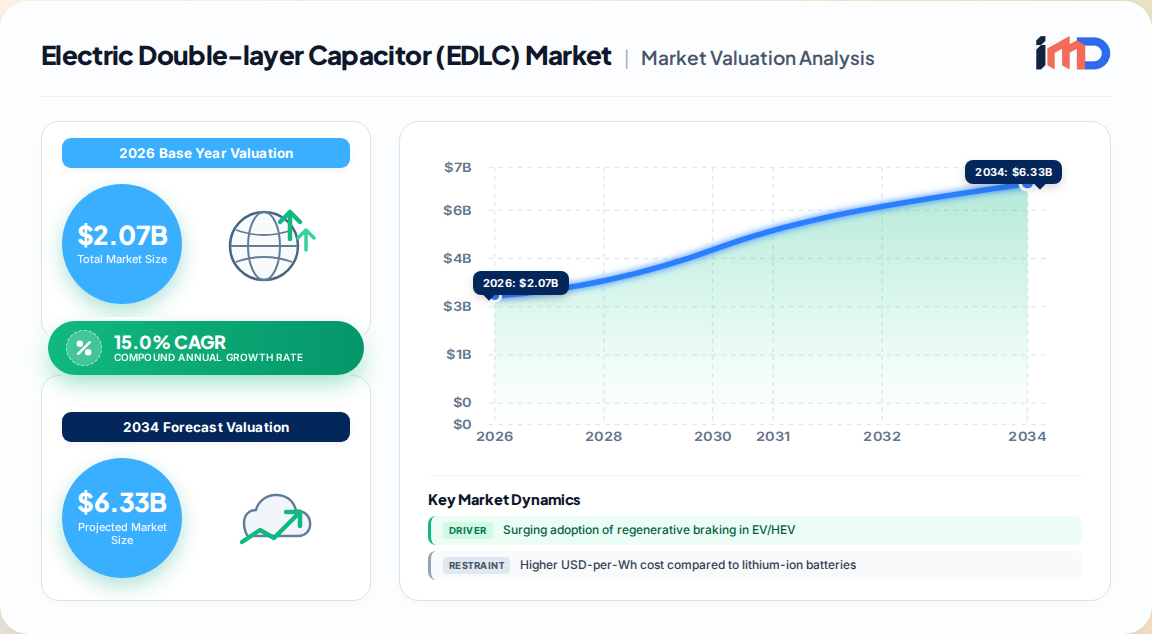
The Electric Double-layer Capacitor (EDLC) market is entering a phase of accelerated commercial expansion, driven by the convergence of transportation electrification, grid modernization, and the proliferation of power-hungry edge devices. Our proprietary primary research estimates the global EDLC market at USD 2.07 billion in 2026, projected to reach USD 7.28 billion by 2035, representing a robust 15.0% CAGR over the forecast period. This growth is underpinned by the unique ability of EDLCs to deliver sub-second power bursts and withstand millions of charge-discharge cycles, capabilities that conventional lithium-ion batteries cannot match economically.
The market is transitioning from a niche component category to a critical enabler of hybrid energy storage architectures. Asia-Pacific remains the largest and fastest-growing region, commanding a 42.1% revenue share in 2025, propelled by manufacturing scale-up in China, Japan, and South Korea, alongside aggressive EV adoption targets.
The EDLC market exhibits distinct growth patterns across product form factors, module voltages, electrode materials, and end-user industries.
| Segment | Dominant Category (2025 Share) | Fastest-Growing Category (CAGR) |
|---|---|---|
| Product Form Factor | Cylindrical Cells (35.42%) | Coin & Chip Cells (14.88%) |
| Module Voltage | 10-25V (40.12%) | Above 100V (14.63%) |
| Electrode Material | Activated Carbon (51.86%) | Graphene Composites (14.31%) |
| End-User Industry | Consumer Electronics (31.25%) | Automotive & Transportation (13.96%) |
Cylindrical cells remain the backbone of automotive and industrial applications due to their robust design and high energy density. However, coin and chip cells are gaining traction in wearables, where form-factor constraints demand compact burst-power buffers.
The 10-25V segment dominates due to broad compatibility with consumer electronics and light industrial systems, while above 100V modules are experiencing rapid uptake in grid stabilization and microgrid buffer storage.
Activated carbon maintains cost-effectiveness and high surface area, but graphene composites offer superior conductivity and energy density, attracting significant R&D investment. Recent advances in graphene-enhanced electrodes are expected to narrow the performance gap with pseudocapacitors.
Consumer electronics remain the largest end-user segment, but automotive and transportation is the fastest-growing, with the global fleet of vehicles equipped with start-stop technology exceeding 120 million units in 2024.
Asia-Pacific leads the EDLC market with a 42.1% share in 2025, growing at 13.64% CAGR. The region's dominance is driven by China's EV production scale, Japan's advanced materials expertise, and South Korea's electronics manufacturing base. North America follows with a 26% share, supported by grid modernization initiatives and EV tax incentives. Europe accounts for 21%, with stringent emission regulations accelerating automotive EDLC adoption. South America and the Middle East & Africa represent emerging opportunities, particularly in off-grid renewable energy storage.
The EDLC market is moderately concentrated, with the top five players holding approximately 30.8% of global revenue in 2025. Leading companies are pursuing vertical integration and strategic partnerships to secure raw material supply and expand application engineering capabilities.
Key players include Maxwell Technologies (Tesla Inc.), Skeleton Technologies OÜ, Eaton Corporation, KYOCERA Corporation, Panasonic Holding Corporation, NEC Corporation, Murata Manufacturing, KEMET Corporation, Vishay Intertechnology, and CAP-XX Limited, among others. Recent strategic moves include Clarios' acquisition of Maxwell Technologies, signaling automotive supply channels' interest in low-voltage energy-storage capabilities.
The EDLC value chain spans raw material suppliers (activated carbon, graphene, electrolytes), cell manufacturers, module integrators, and end-system OEMs. Activated carbon remains the dominant electrode material, but supply concentration in APAC creates price volatility. Suppliers are investing in supply-chain security and certification support to mitigate risks.
Manufacturing scale-up in Asia-Pacific is reducing unit costs, while advances in graphene-enhanced electrodes are improving energy density. However, the fragmented global safety standards landscape necessitates region-specific certification, adding complexity for module suppliers.
The most significant white-space opportunities lie in grid-scale frequency regulation and coin-cell miniaturization. Utilities are increasingly procuring fast-frequency-response assets, with ancillary-service auctions in the U.S. and Germany rewarding sub-second response. In consumer electronics, the integration of EDLCs into wearables and IoT devices enables burst-power loads without compromising form factor. Additionally, defense applications, particularly high-pulse directed-energy platforms, represent a long-term growth avenue.
| Aspects | Details |
|---|---|
| Study Period | 2020-2034 |
| Base Year | 2026 |
| Estimated Year | 2026 |
| Forecast Period | 2026-2034 |
| Historical Period | 2020-2025 |
| Growth Rate | CAGR of 15.0% from 2020-2034 |
| Segmentation |
|
By Module Voltage
By Electrode Material
By End-User Industry
| By Geography |
|
The global EDLC market is valued at USD 2.07 billion in 2026 and is projected to reach USD 7.28 billion by 2035, growing at a CAGR of 15.0%.
Asia-Pacific is the largest and fastest-growing region, holding 42.1% of the market share in 2025, driven by EV production and electronics manufacturing.
Key drivers include the adoption of regenerative braking in EVs, grid-scale frequency regulation for renewable integration, and miniaturization in consumer electronics.
Major companies include Maxwell Technologies (Tesla Inc.), Skeleton Technologies OÜ, Eaton Corporation, KYOCERA Corporation, and Panasonic Holding Corporation.
Challenges include higher USD-per-Wh cost compared to lithium-ion batteries, fragmented global safety standards, and volatile activated-carbon feedstock pricing.
Our rigorous research methodology combines multi-layered approaches with comprehensive quality assurance, ensuring precision, accuracy, and reliability in every market analysis.
| Stakeholder Role | Interview Share (%) |
|---|---|
| Procurement Director | 35% |
| Chief Technology Officer | 25% |
| Energy Storage Engineer | 25% |
| Product Manager | 15% |
| Company Type | Representation (%) |
|---|---|
| EDLC Cell Manufacturers | 35% |
| Module Integrators | 25% |
| Automotive OEMs | 20% |
| Grid Operators & Utilities | 12% |
| Consumer Electronics OEMs | 8% |
 Related Reports
