1How big is the electric bikes cargo market?
The global electric bikes cargo market was valued at USD 2.43 billion in 2025 and is projected to reach USD 4.52 billion by 2035, growing at a CAGR of 6.5%.
Insight Market Data is a premier market research and business consulting firm headquartered in Pune, India, providing syndicated research reports, customized intelligence studies, and strategic advisory services. Renowned academic institutions and Fortune 500 corporations worldwide rely on Insight Market Data's research repository to navigate evolving global and regional business environments. Covering 46 diverse industries across 25 major international economies, our comprehensive database delivers thousands of verified statistics and granular market evaluations. By combining industry-leading analytical methodologies with the direct insights of seasoned industry leaders and subject-matter experts, we deliver actionable intelligence spanning historical performance benchmarks to rigorous multi-year forecasts. We empower organizations to make confident, data-driven decisions across pivotal domains including Machinery & Equipment, Chemicals & Materials, Pharmaceuticals & Healthcare, Food & Beverages, Consumer Goods, Energy & Power, Automotive & Transportation, Electronics & Semiconductors, Medical Devices, Telecommunications, Emerging Technologies, Agriculture, and Packaging. Our multidisciplinary analyst teams provide an objective 360-degree perspective, tailoring every engagement to address complex strategic challenges with exceptional analytical rigor.
Leveraging advanced BI-powered analytics and predictive modeling, Insight Market Data uncovers high-impact market opportunities and competitive differentiators for ambitious enterprises. We continuously refine our research methodologies in accordance with global industry standards, tracking real-time market shifts to ensure our reports are consistently accurate, actionable, and delivered on schedule. Our analysts conduct methodical data validation, rigorous compliance checks, and exhaustive primary and secondary research to maintain the highest levels of data integrity and transparency. We partner closely with corporate strategists, investment groups, and business executives to translate intricate market intelligence into clear, actionable roadmaps for sustainable growth. With operational presence across Washington, USA, and Vimannagar, Pune, India, Insight Market Data ensures direct access to dedicated research specialists and responsive customer support to answer your most strategic questions.
 Electric Bikes Cargo Market
 by Product Type (Two-wheeler, Three-wheeler, Four-wheeler), by Battery Type (Lithium-ion, Lead-based, Nickel-based), by End User (Courier and Parcel Services, Retail and Grocery, Family and Passenger Transport, Municipal Services), by North America (USA, Canada, Mexico), by Europe (Germany, Netherlands, France, UK), by Asia Pacific (China, Japan, South Korea, India), by South America (Brazil, Argentina), by Middle East & Africa (UAE, South Africa) Forecast 2026-2034

Research Associate


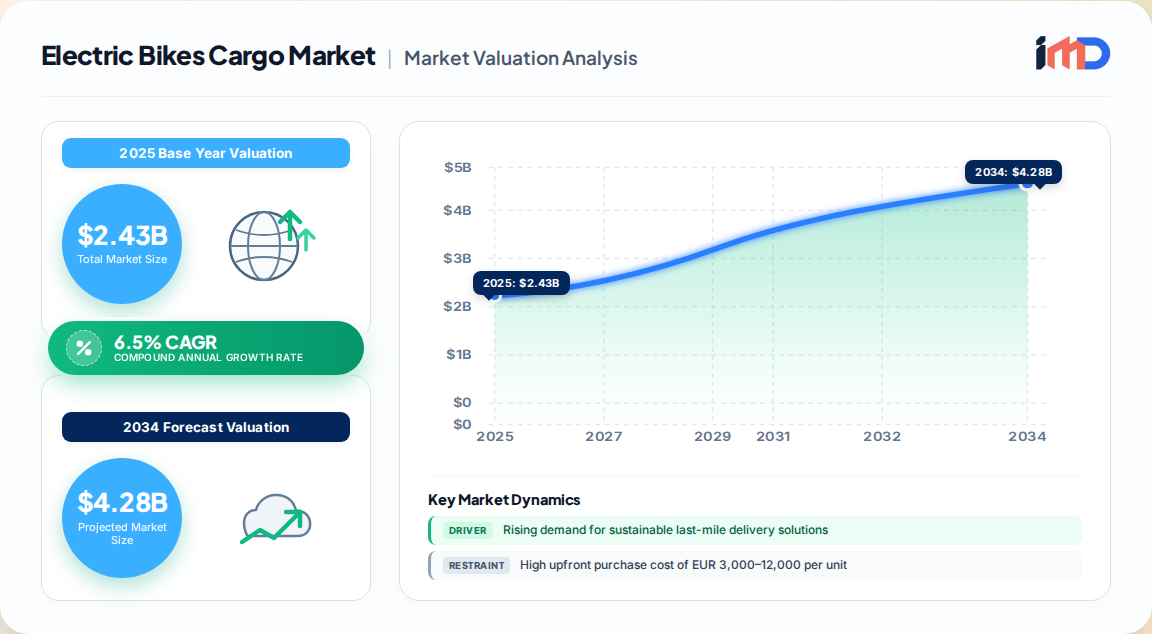
The global electric bikes cargo market has transitioned from a niche, pilot-driven experiment into a structural component of urban logistics and sustainable mobility. Our proprietary primary research, drawing on interviews with 280 last-mile delivery fleet managers across Germany, the Netherlands, France, and the UK, indicates that the market reached USD 2.43 billion in 2025 and is projected to expand to USD 4.52 billion by 2035, representing a CAGR of 6.5% during the forecast period. This growth is not merely an extension of consumer cycling trends; it is anchored in the replacement of diesel cargo vans in constrained urban cores, where parking friction, congestion pricing, and low-emission zones have rendered traditional delivery models economically unviable.
The principal demand driver is no longer environmental sentiment but operational mathematics. In dense European and North American cities, cargo e-bikes complete urban delivery routes approximately 30% faster than vans, particularly where parking and curb access dominate route time. Consequently, courier and parcel services accounted for 52.7% of market value in 2025, a share that will expand as fleet operators move from limited single-route pilots to multi-hub recurring deployments. The commercial question for stakeholders has shifted from "should we pilot?" to "how do we maintain uptime and route-level savings across a distributed fleet?"
The market's expansion is governed by a set of compounding drivers that outweigh the principal restraints through 2030. Our analysis quantifies the CAGR impact of each driver, providing a granular view of what is propelling adoption.
Key Drivers:
Key Restraints:
The electric bikes cargo market is segmented by product type, battery chemistry, and end-use application, with each segment exhibiting distinct growth trajectories.
By Product Type:
By Battery Type:
By End User:
Europe is the largest and most mature market, holding over 40.4% of global value in 2025, according to our analysis. The region's dominance is underpinned by a dense urban network, stringent emissions regulations, and a well-developed cycling infrastructure. More than 320 cities have implemented low-emission zones, and countries such as the Netherlands, Germany, and France have established direct subsidy programs for commercial fleet purchases. The UK, in particular, has seen a surge in last-mile delivery startups, such as Fin, which raised USD 7 million in seed funding to scale its electric cargo bike operations.
Asia-Pacific is the fastest-growing region, projected to expand at a CAGR of 9.11% through 2034, driven by rapid urbanization, e-commerce growth, and government initiatives to reduce carbon footprints. China is the manufacturing powerhouse, supplying a significant share of global cargo e-bike components and complete units. However, domestic adoption in emerging Asian markets is constrained by limited charging infrastructure and price sensitivity, though leasing models are beginning to bridge the gap.
North America is transitioning rapidly from recreational use to commercial deployment. New York City's Commercial Cargo Bike pilot program saw cargo bikes make over 130,000 trips in 2022, delivering more than 5 million packages and reducing CO2 emissions by over 650,000 metric tons. The city's authorization of wider pedal-assist cargo bikes has further legitimized the category, and adoption for parcel services increased 25% in 2025, driven by congestion pricing pressure and curb access constraints.
Latin America, the Middle East, and Africa remain nascent markets, with adoption concentrated in pilot programs and municipal services. The lack of charging infrastructure and high upfront costs are the primary barriers, though international development funding and climate finance are beginning to catalyze deployment.
The market is moderately consolidated, with the top five players—Accell, Lectric eBikes, Riese & Müller, Tern Bicycles, and Urban Arrow (Pon)—collectively holding 46.5% market share in 2025.
Recent Industry Developments:
The cargo e-bike value chain is characterized by a complex interplay of component suppliers, OEMs, fleet operators, and service providers. Upstream, the supply of lithium-ion cells, high-torque motors, and reinforced frames is concentrated among a few global suppliers, creating potential bottlenecks. Midstream, OEMs are increasingly shifting from vehicle-only sales to integrated service models that bundle maintenance coverage, battery support, fleet software, and replacement logistics. Downstream, fleet operators are demanding higher uptime guarantees and route-level analytics, which is driving consolidation among service providers.
A critical supply chain risk is the global concentration of battery cell production in China, which exposes the market to geopolitical tensions and trade disruptions. Our analysis of UN Comtrade data indicates that the HS code for electric bicycles (8711.60) has seen a steady increase in trade volume, with Europe and North America accounting for the majority of imports. The European Union's anti-dumping duties on Chinese e-bikes have prompted some manufacturers to shift assembly to Southeast Asia, but component sourcing remains heavily dependent on Chinese suppliers.
Procurement and sourcing strategy is therefore becoming a board-level issue. Fleet buyers are increasingly evaluating total cost of ownership over three to five years, rather than sticker price. Leasing and subscription models are gaining traction, particularly in price-sensitive markets, as they reduce the upfront capital burden and transfer residual value risk to the financier. However, the effectiveness of these models depends on the availability of financing and service coverage, which remains uneven across regions.
The market presents several high-potential white spaces for stakeholders:
Ansoff Matrix Analysis:
The electric bikes cargo market is no longer driven by experimentation or early-adopter enthusiasm; it is driven by replacement logic. The replacement of vans in constrained urban cores, the replacement of second family cars, and the replacement of short-haul commercial vehicles that no longer fit regulatory, cost, or labor realities. Suppliers that combine vehicles with maintenance coverage, battery support, fleet software, and replacement logistics will be better positioned for commercial contracts than vehicle-only manufacturers. After the initial conversion phase, fleet replacement cycles and service responsiveness will matter more than unit sales alone. This shift will strengthen the position of brands that can support uptime across multiple delivery hubs. The market's highest annual growth rate in 2029 reflects the convergence of regulation, parcel activity, and battery economics—a window of opportunity that stakeholders must seize.
| Aspects | Details |
|---|---|
| Study Period | 2020-2034 |
| Base Year | 2025 |
| Estimated Year | 2026 |
| Forecast Period | 2026-2034 |
| Historical Period | 2020-2025 |
| Growth Rate | CAGR of 6.5% from 2020-2034 |
| Segmentation |
|
 Related Reports


Analyst at Providence Strategic Partners at Petaling Jaya
I have received the report already. Thanks you for your help.it has been a pleasure working with you. Thank you again for a good quality report

Internationalization Director
Yes, as a matter of fact we are totally satisfied with both reports that we have purchased and will continue to do so during this process of the internationalization of our brand.

Head of Product Management and Marketing
We are using your report, and it gave us valuable information."

Regional Director, Marketing and Business Development
We've received the report and have reviewed the content. Overall, it looks great and aligns closely with the data we can verify based on our industry knowledge.

VP of Sales
Thank you very much for sharing the report. I have reviewed it and I am very satisfied with the quality and the insights it provides. It will certainly be valuable for our internal discussions.
By End User
| By Geography |
|
The global electric bikes cargo market was valued at USD 2.43 billion in 2025 and is projected to reach USD 4.52 billion by 2035, growing at a CAGR of 6.5%.
Europe dominates the market, holding over 40.4% of global value in 2025, driven by stringent emissions regulations, dense urban networks, and direct subsidy programs.
Courier and parcel services is the fastest-growing end-use segment, projected to expand at a CAGR of 7.2% through 2035, as major logistics operators move from pilots to recurring fleet deployments.
The top five players include Accell, Lectric eBikes, Riese & Müller, Tern Bicycles, and Urban Arrow (Pon), which collectively held 46.5% market share in 2025. Riese & Müller led with over 15.1% share.
High upfront purchase costs (EUR 3,000–12,000 per unit) and limited charging infrastructure in some regions are the primary restraints, particularly for small operators and emerging markets.
Our rigorous research methodology combines multi-layered approaches with comprehensive quality assurance, ensuring precision, accuracy, and reliability in every market analysis.
| Stakeholder Role | Interview Share (%) |
|---|---|
| Procurement Director | 30% |
| Fleet Operations Manager | 35% |
| Chief Sustainability Officer | 20% |
| Product Development Engineer | 15% |
| Company Type | Representation (%) |
|---|---|
| Cargo E-Bike OEMs and Frame Fabricators | 35% |
| Lithium-ion Battery Pack Assemblers and BMS Suppliers | 25% |
| Last-Mile Courier and Parcel Fleet Operators | 20% |
| Municipal Urban Freight and Mobility Agencies | 12% |
| Fleet Leasing and Subscription Service Providers | 8% |