1What is the market size of the drinking nonalcoholic beer market?
The global drinking nonalcoholic beer market is valued at USD 24.31 billion in 2026 and is projected to reach USD 52.04 billion by 2035, growing at a CAGR of 8.83%.
Insight Market Data is a premier market research and business consulting firm headquartered in Pune, India, providing syndicated research reports, customized intelligence studies, and strategic advisory services. Renowned academic institutions and Fortune 500 corporations worldwide rely on Insight Market Data's research repository to navigate evolving global and regional business environments. Covering 46 diverse industries across 25 major international economies, our comprehensive database delivers thousands of verified statistics and granular market evaluations. By combining industry-leading analytical methodologies with the direct insights of seasoned industry leaders and subject-matter experts, we deliver actionable intelligence spanning historical performance benchmarks to rigorous multi-year forecasts. We empower organizations to make confident, data-driven decisions across pivotal domains including Machinery & Equipment, Chemicals & Materials, Pharmaceuticals & Healthcare, Food & Beverages, Consumer Goods, Energy & Power, Automotive & Transportation, Electronics & Semiconductors, Medical Devices, Telecommunications, Emerging Technologies, Agriculture, and Packaging. Our multidisciplinary analyst teams provide an objective 360-degree perspective, tailoring every engagement to address complex strategic challenges with exceptional analytical rigor.
Leveraging advanced BI-powered analytics and predictive modeling, Insight Market Data uncovers high-impact market opportunities and competitive differentiators for ambitious enterprises. We continuously refine our research methodologies in accordance with global industry standards, tracking real-time market shifts to ensure our reports are consistently accurate, actionable, and delivered on schedule. Our analysts conduct methodical data validation, rigorous compliance checks, and exhaustive primary and secondary research to maintain the highest levels of data integrity and transparency. We partner closely with corporate strategists, investment groups, and business executives to translate intricate market intelligence into clear, actionable roadmaps for sustainable growth. With operational presence across Washington, USA, and Vimannagar, Pune, India, Insight Market Data ensures direct access to dedicated research specialists and responsive customer support to answer your most strategic questions.
 Drinking Nonalcoholic Beer Market
 by Product (Alcohol-free, Low alcohol), by Material (Malted Grains, Hops, Yeasts, Enzymes, Other Materials), by Category (Plain, Flavored), by Distribution Channel (Store-based, Non-store-based), by Europe (Germany, UK, Spain, France), by North America (USA, Canada, Mexico), by Asia Pacific (China, Japan, Australia), by Latin America (Brazil, Argentina), by Middle East & Africa (South Africa, UAE) Forecast 2026-2034

Research Associate


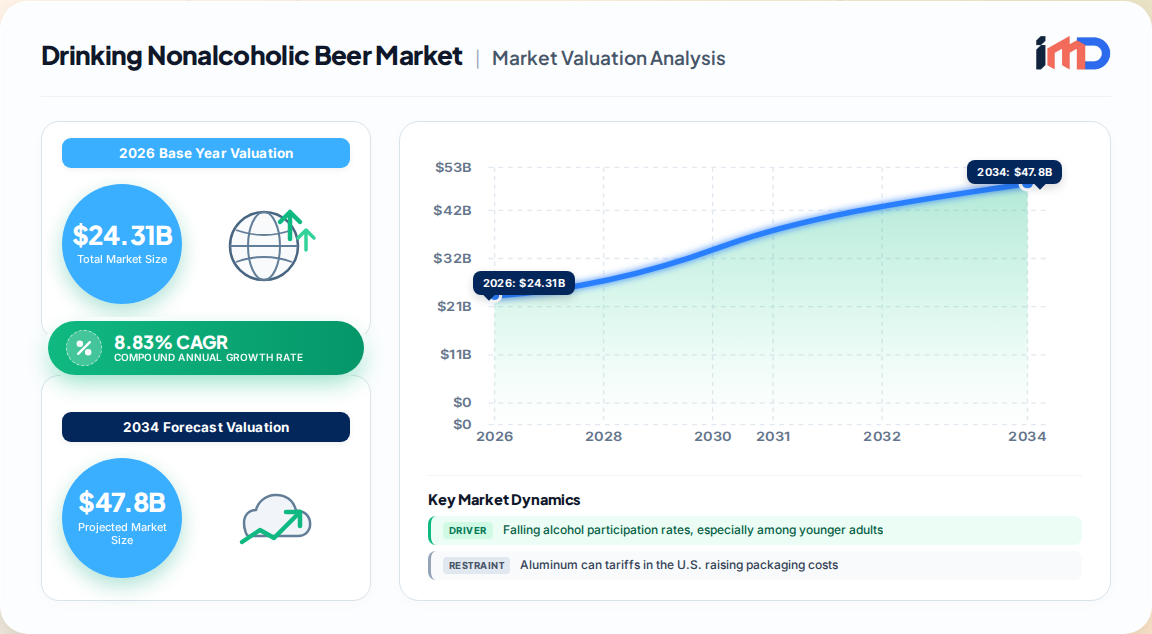
The global drinking nonalcoholic beer market has transitioned from a niche abstention product into a dynamic, premiumized beverage category. Our proprietary primary research estimates the market at USD 24.31 billion in 2026, rising to USD 52.04 billion by 2035 at a robust CAGR of 8.83%. This growth is not simply a byproduct of sober curiosity; it reflects a structural shift in consumer occasions, where moderation is a lifestyle choice rather than a temporary sacrifice.
In 2025, the market sold approximately 3,550 million liters, with revenue gains increasingly driven by mix enrichment—premium brands, flavored extensions, and draught serves—rather than pure volume expansion. The category's defining characteristic is that its core buyer is not leaving beer behind; they are reallocating specific occasions (weekday lunches, post-workout, designated driving) to a beer-tasting product that fits a modern, health-conscious routine. This keeps brewer brand equity, supermarket aisles, and bar taps firmly in play, creating a unique competitive dynamic where legacy brewers, craft specialists, and technology-driven newcomers all vie for shelf space.
The market is segmented by product type, material, category, and distribution channel, with each segment exhibiting distinct growth trajectories.
| Segment | Key Insight | 2030 Projection |
|---|---|---|
| By Product | Alcohol-free dominates, expected to reach $31.58 billion by 2030; lager holds 67.6% revenue share (2025). | $31.58 Billion |
| By Material | Malted grains represent the largest material segment, with an expected gain of $9.09 billion by 2030. | $24.34 Billion |
| By Category | Flavored variants are gaining traction, projected to reach $23.37 billion by 2030. | $23.37 Billion |
| By Distribution | Store-based retail leads, expected to reach $28.46 billion by 2030; on-premise is the fastest-growing format. | $28.46 Billion |
Lager remains the volume backbone, but ale and stout are gaining ground as craft producers bring innovation to the zero-alcohol space. Flavored nonalcoholic beer—incorporating fruit, botanical, and spice notes—is unlocking new drinking occasions, particularly among younger consumers who prioritize novel taste experiences.
Europe remains the largest market, accounting for 35.1% of global revenue in 2025, driven by mature no-alcohol beer cultures in Germany, the UK, and Spain. Germany alone holds the largest country-level share, supported by strong retail penetration and acceptance of nonalcoholic wheat beers.
Asia Pacific is the fastest-growing region, with a projected volume CAGR exceeding 18% in some submarkets. Urbanization, evolving beverage preferences, and investments by major brewers in local production are accelerating adoption. In 2024, South African Breweries introduced Corona Cero to South Africa, signaling the untapped potential of emerging markets.
North America remains a critical innovation hub, with the U.S. market forecast to grow at a 17% volume CAGR (2024-2028) for no-alcohol beer. The region's culture of craft experimentation and wellness-oriented consumers drives premiumization and product diversity.
The market is moderately consolidated, with the top five players—Anheuser-Busch InBev, Carlsberg Group, Kirin Holdings, Heineken N.V., and Boston Beer Company—collectively holding 7.94% market share in 2025. However, the competitive intensity is escalating as large brewers inject marketing dollars and craft specialists carve out loyal followings.
Recent developments underscore the strategic importance of the category: Corona Cero's Olympic sponsorship (2024) accelerated global distribution, while Firestone Walker's 8ZERO5 launch (2024) targeted health-conscious consumers with a 60-calorie option. In 2026, New Zealand Food Safety recalled a batch of Steinlager Ultra Low Carb due to mislabeling—a reminder of the regulatory risks that accompany product innovation.
The value chain for nonalcoholic beer is distinct from conventional brewing, requiring specialized dealcoholization technology (vacuum distillation, reverse osmosis) or tightly controlled low-alcohol fermentation. These processes add production complexity and cost, which often conflict with consumer expectations for lower prices.
Several underpenetrated opportunities warrant attention:
Global trade in nonalcoholic beer is growing, albeit from a small base. Europe is a net exporter, with Germany, the Netherlands, and Belgium shipping premium brands to North America and Asia. The U.S. is a net importer, with strong demand for European lagers and craft-style imports.
| Aspects | Details |
|---|---|
| Study Period | 2020-2034 |
| Base Year | 2026 |
| Estimated Year | 2026 |
| Forecast Period | 2026-2034 |
| Historical Period | 2020-2025 |
| Growth Rate | CAGR of 8.83% from 2020-2034 |
| Segmentation |
|
By Category
By Distribution Channel
| By Geography |
|
The global drinking nonalcoholic beer market is valued at USD 24.31 billion in 2026 and is projected to reach USD 52.04 billion by 2035, growing at a CAGR of 8.83%.
Europe is the largest market, accounting for 35.1% of global revenue in 2025, driven by strong demand in Germany, the UK, and Spain. Asia Pacific is the fastest-growing region.
Key players include Anheuser-Busch InBev (market leader with over 2.52% share), Carlsberg Group, Kirin Holdings, Heineken N.V., and Boston Beer Company, collectively holding 7.94% market share in 2025.
Drivers include falling alcohol participation (54% of U.S. adults drank alcohol in 2025, a record low), dedicated no-alcohol brewing capacity expansions, and dealcoholization technology enabling draught distribution in on-premise channels.
The market is expected to grow at a CAGR of 8.83% from 2026 to 2035, reaching USD 52.04 billion by 2035.
Our rigorous research methodology combines multi-layered approaches with comprehensive quality assurance, ensuring precision, accuracy, and reliability in every market analysis.
| Stakeholder Role | Interview Share (%) |
|---|---|
| Chief Brewing Officer | 25% |
| Head of No-Alcohol Division | 30% |
| Procurement Director | 25% |
| Retail Category Manager | 20% |
| Company Type | Representation (%) |
|---|---|
| No-Alcohol Brewing Specialists | 30% |
| Large Multinational Brewers | 25% |
| Dealcoholization Technology Providers | 15% |
| Ingredient Suppliers (Malt, Hops, Yeast) | 15% |
| Retail & On-Premise Buyers | 15% |
 Related Reports
