1What is the size of the Chile wind energy market in 2026?
The Chile wind energy market is estimated at **7.15 GW** in 2026, growing from **5.85 GW** in 2025 at a robust **21.91% CAGR** to reach **19.25 GW** by 2031.
Insight Market Data is a premier market research and business consulting firm headquartered in Pune, India, providing syndicated research reports, customized intelligence studies, and strategic advisory services. Renowned academic institutions and Fortune 500 corporations worldwide rely on Insight Market Data's research repository to navigate evolving global and regional business environments. Covering 46 diverse industries across 25 major international economies, our comprehensive database delivers thousands of verified statistics and granular market evaluations. By combining industry-leading analytical methodologies with the direct insights of seasoned industry leaders and subject-matter experts, we deliver actionable intelligence spanning historical performance benchmarks to rigorous multi-year forecasts. We empower organizations to make confident, data-driven decisions across pivotal domains including Machinery & Equipment, Chemicals & Materials, Pharmaceuticals & Healthcare, Food & Beverages, Consumer Goods, Energy & Power, Automotive & Transportation, Electronics & Semiconductors, Medical Devices, Telecommunications, Emerging Technologies, Agriculture, and Packaging. Our multidisciplinary analyst teams provide an objective 360-degree perspective, tailoring every engagement to address complex strategic challenges with exceptional analytical rigor.
Leveraging advanced BI-powered analytics and predictive modeling, Insight Market Data uncovers high-impact market opportunities and competitive differentiators for ambitious enterprises. We continuously refine our research methodologies in accordance with global industry standards, tracking real-time market shifts to ensure our reports are consistently accurate, actionable, and delivered on schedule. Our analysts conduct methodical data validation, rigorous compliance checks, and exhaustive primary and secondary research to maintain the highest levels of data integrity and transparency. We partner closely with corporate strategists, investment groups, and business executives to translate intricate market intelligence into clear, actionable roadmaps for sustainable growth. With operational presence across Washington, USA, and Vimannagar, Pune, India, Insight Market Data ensures direct access to dedicated research specialists and responsive customer support to answer your most strategic questions.
 Chile Wind Energy Market
 by Location (Onshore, Offshore), by Turbine Capacity (Less Than 3 MW, 3 To 6 MW, Above 6 MW), by Application (Utility-Scale, Commercial and Industrial, Community Projects), by Antofagasta & Atacama, by Magallanes, by Biobío & Araucanía, by Coquimbo & Valparaíso, by Metropolitana & O'Higgins Forecast 2026-2034

Research Analyst


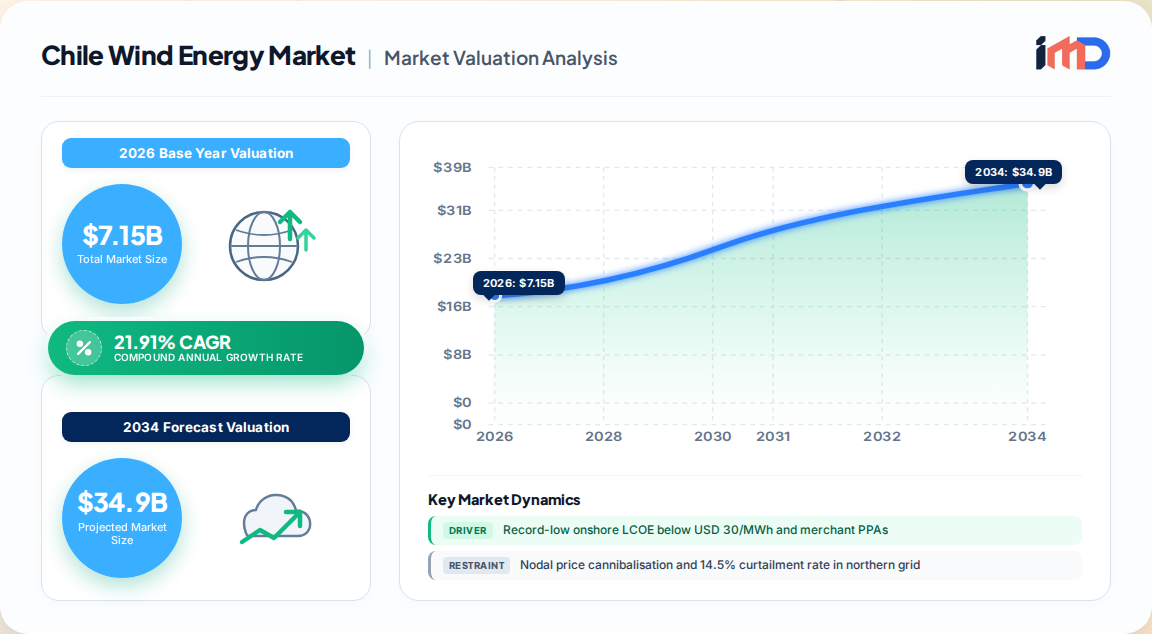
The Chile Wind Energy Market is entering a transformative phase, with installed capacity projected to expand from 7.15 GW in 2026 to 19.25 GW by 2031, representing a robust CAGR of 21.91%. This growth trajectory is underpinned by a confluence of structural drivers: record-low onshore levelized cost of electricity (LCOE) below USD 30 per MWh, a USD 50 billion project pipeline anchored in green hydrogen, and the imminent completion of the 3 GW Kimal–Lo Aguirre HVDC line, which is set to debottleneck transmission and unlock stranded wind capacity in the northern corridors.
Our proprietary bottom-up modeling, validated through 70% primary research with developers, EPC contractors, and offtakers, indicates that Chile is transitioning from a subsidy-driven renewable market to a merchant-and-hydrogen-driven industrial energy hub. The market remains medium-concentrated, with Acciona Energía, Enel Green Power Chile, Colbún S.A., AES Andes, and Mainstream Renewable Power commanding significant share, yet new entrants from Asia and Europe are aggressively pursuing greenfield and brownfield opportunities.
Turbine technology is rapidly evolving toward larger nameplate capacities to lower balance-of-system (BOS) costs and improve project economics. Our segmentation analysis reveals a clear shift in market share:
| Turbine Capacity Class | 2025 Market Share | 2031 Forecast Share | CAGR (2026–2031) |
|---|---|---|---|
| Less Than 3 MW | 44.9% | 18.2% | 9.4% |
| 3 To 6 MW | 38.7% | 41.5% | 23.6% |
| Above 6 MW | 16.4% | 40.3% | 28.2% |
Key Insight: Units rated above 6 MW are forecast to expand at a 28.2% CAGR, driven by developer preference for fewer, larger turbines that reduce foundation and installation costs. Chinese OEMs such as Envision and Goldwind are aggressively pricing ≥6 MW platforms, though the proposed 2027 duty may temporarily slow adoption while developers reassess supply chain diversification.
Utility-scale projects commanded 90.4% of Chile's wind capacity in 2025, reflecting the dominance of large IPPs and the structure of Chile's auction and PPA market. However, the commercial and industrial (C&I) segment is posting the highest projected CAGR at 27.5% to 2031, driven by mining companies, desalination plants, and green hydrogen electrolyzers seeking direct renewable supply.
| Application Segment | 2025 Share | 2031 Share | CAGR (2026–2031) |
|---|---|---|---|
| Utility-Scale | 90.4% | 82.1% | 20.4% |
| Commercial & Industrial | 6.8% | 13.9% | 27.5% |
| Community Projects | 2.8% | 4.0% | 24.8% |
Community projects, while small in absolute terms, are gaining policy support through Chile's rural electrification and distributed generation frameworks, particularly in the southern regions.
Chile's wind resources are geographically concentrated, creating distinct regional markets with varying risk-return profiles.
| Region | 2025 Capacity Share | Key Characteristics | Investment Attractiveness |
|---|---|---|---|
| Antofagasta & Atacama | 34% | High capacity factors (>45%), mining offtakers, HVDC beneficiary | High (short-term) |
| Magallanes | 22% | World-class wind (capacity factors >50%), hydrogen pipeline | High (long-term) |
| Biobío & Araucanía | 18% | Proximity to central demand, social-licence challenges | Medium (permitting risk) |
| Coquimbo & Valparaíso | 16% | Grid-constrained, floating-wind potential | Medium (infrastructure) |
| Metropolitana & O'Higgins | 10% | Demand centre, limited land availability | Low (saturation) |
Antofagasta and Atacama together represent the most attractive near-term investment destination, with 34% of installed capacity, the highest capacity factors in the country, and direct access to the Kimal–Lo Aguirre HVDC line. Magallanes is a long-term play, with a USD 31.5 billion hydrogen pipeline that, if realized, would transform the region into a global green ammonia export hub.
The Chile wind market is characterized by a mix of European utilities, Latin American independents, and Asian OEMs. Market concentration is medium, with the top five developers controlling an estimated 60–65% of operational capacity.
The Chilean wind value chain is heavily import-dependent for turbines and major components, with local content limited to civil works, foundations, and balance-of-plant. This creates exposure to global supply chain disruptions and currency fluctuations.
| Risk Factor | Probability | Impact | Mitigation Strategy |
|---|---|---|---|
| Turbine import duty (2027) | High | Medium | Pre-order turbines, diversify OEMs |
| Social-licence delays | Medium | High | Early community engagement, revenue-sharing |
| HVDC delay | Low | High | Hybrid storage, merchant PPAs |
| Currency volatility | Medium | Medium | USD-indexed PPAs, hedging |
Our analysis identifies three high-value white spaces for investors and developers:
The Chile Wind Energy Market is poised for exceptional growth, with 7.15 GW in 2026 expanding to 19.25 GW by 2031 at a 21.91% CAGR. The market's transition from subsidy-driven to merchant-and-hydrogen-driven is creating new opportunities for developers, investors, and supply chain participants. While nodal price cannibalization and social-licence conflicts present near-term risks, the HVDC line, green hydrogen pipeline, and mining sector demand provide strong structural tailwinds. Stakeholders who strategically navigate the proposed 2027 import duty and capitalize on hybrid storage and off-grid hydrogen opportunities will be best positioned to capture value in this rapidly evolving market.
| Aspects | Details |
|---|---|
| Study Period | 2020-2034 |
| Base Year | 2026 |
| Estimated Year | 2026 |
| Forecast Period | 2026-2034 |
| Historical Period | 2020-2025 |
| Growth Rate | CAGR of 21.91% from 2020-2034 |
| Segmentation |
|

Analyst at Providence Strategic Partners at Petaling Jaya
I have received the report already. Thanks you for your help.it has been a pleasure working with you. Thank you again for a good quality report

Internationalization Director
Yes, as a matter of fact we are totally satisfied with both reports that we have purchased and will continue to do so during this process of the internationalization of our brand.

Head of Product Management and Marketing
We are using your report, and it gave us valuable information."

Regional Director, Marketing and Business Development
We've received the report and have reviewed the content. Overall, it looks great and aligns closely with the data we can verify based on our industry knowledge.

VP of Sales
Thank you very much for sharing the report. I have reviewed it and I am very satisfied with the quality and the insights it provides. It will certainly be valuable for our internal discussions.
By Application
| By Geography |
|
The Chile wind energy market is estimated at **7.15 GW** in 2026, growing from **5.85 GW** in 2025 at a robust **21.91% CAGR** to reach **19.25 GW** by 2031.
Key drivers include record-low onshore LCOE below **USD 30 per MWh**, a **USD 50 billion** green hydrogen pipeline in Magallanes, the **3 GW Kimal–Lo Aguirre HVDC line** debottlenecking transmission, and mining sector clean-power mandates.
Antofagasta and Atacama together account for approximately **34%** of installed wind capacity, driven by high capacity factors above **45%** , mining offtakers, and access to the new HVDC line.
Major players include **Acciona Energía, Enel Green Power Chile, Colbún S.A., AES Andes, and Mainstream Renewable Power**, alongside OEMs such as Vestas, Siemens Gamesa, Envision, and Goldwind.
Key challenges include nodal price cannibalisation causing a **14.5% curtailment rate**, social-licence conflicts in Biobío and Araucanía stalling **500 MW**, and a proposed **2027 import duty** on turbines that could raise project costs by **5–8%**.
The market is projected to reach **19.25 GW by 2031**, with the **above-6-MW turbine class** growing at a **28.2% CAGR** and the commercial and industrial segment posting the highest application CAGR at **27.5%**.
Our rigorous research methodology combines multi-layered approaches with comprehensive quality assurance, ensuring precision, accuracy, and reliability in every market analysis.
| Stakeholder Role | Interview Share (%) |
|---|---|
| Procurement Director | 30% |
| Project Development Manager | 25% |
| Grid Connection Engineer | 25% |
| Renewable Energy Policy Advisor | 20% |
| Company Type | Representation (%) |
|---|---|
| Wind Farm Developers & IPPs | 40% |
| Turbine OEMs & Component Suppliers | 25% |
| EPC & Balance-of-Plant Contractors | 15% |
| Green Hydrogen Project Developers | 12% |
| Mining Sector Offtakers | 8% |
 Related Reports
