Insight Market Data is a premier market research and business consulting firm headquartered in Pune, India, providing syndicated research reports, customized intelligence studies, and strategic advisory services. Renowned academic institutions and Fortune 500 corporations worldwide rely on Insight Market Data's research repository to navigate evolving global and regional business environments. Covering 46 diverse industries across 25 major international economies, our comprehensive database delivers thousands of verified statistics and granular market evaluations. By combining industry-leading analytical methodologies with the direct insights of seasoned industry leaders and subject-matter experts, we deliver actionable intelligence spanning historical performance benchmarks to rigorous multi-year forecasts. We empower organizations to make confident, data-driven decisions across pivotal domains including Machinery & Equipment, Chemicals & Materials, Pharmaceuticals & Healthcare, Food & Beverages, Consumer Goods, Energy & Power, Automotive & Transportation, Electronics & Semiconductors, Medical Devices, Telecommunications, Emerging Technologies, Agriculture, and Packaging. Our multidisciplinary analyst teams provide an objective 360-degree perspective, tailoring every engagement to address complex strategic challenges with exceptional analytical rigor.
Leveraging advanced BI-powered analytics and predictive modeling, Insight Market Data uncovers high-impact market opportunities and competitive differentiators for ambitious enterprises. We continuously refine our research methodologies in accordance with global industry standards, tracking real-time market shifts to ensure our reports are consistently accurate, actionable, and delivered on schedule. Our analysts conduct methodical data validation, rigorous compliance checks, and exhaustive primary and secondary research to maintain the highest levels of data integrity and transparency. We partner closely with corporate strategists, investment groups, and business executives to translate intricate market intelligence into clear, actionable roadmaps for sustainable growth. With operational presence across Washington, USA, and Vimannagar, Pune, India, Insight Market Data ensures direct access to dedicated research specialists and responsive customer support to answer your most strategic questions.
Canada Bunker Fuel Market by Fuel Type (Very Low Sulfur Fuel Oil (VLSFO), High Sulfur Fuel Oil (HSFO), Marine Gas Oil (MGO), Liquefied Natural Gas (LNG), Other Fuel Types), by Vessel Type (Containers, Tankers, General Cargo, Bulk Carriers, Other Vessel Types), by Canada (Atlantic Canada, Central Canada, Western Canada, Northern Canada) Forecast 2026-2034
Executive Overview: Canada's Bunker Fuel Market in 2025
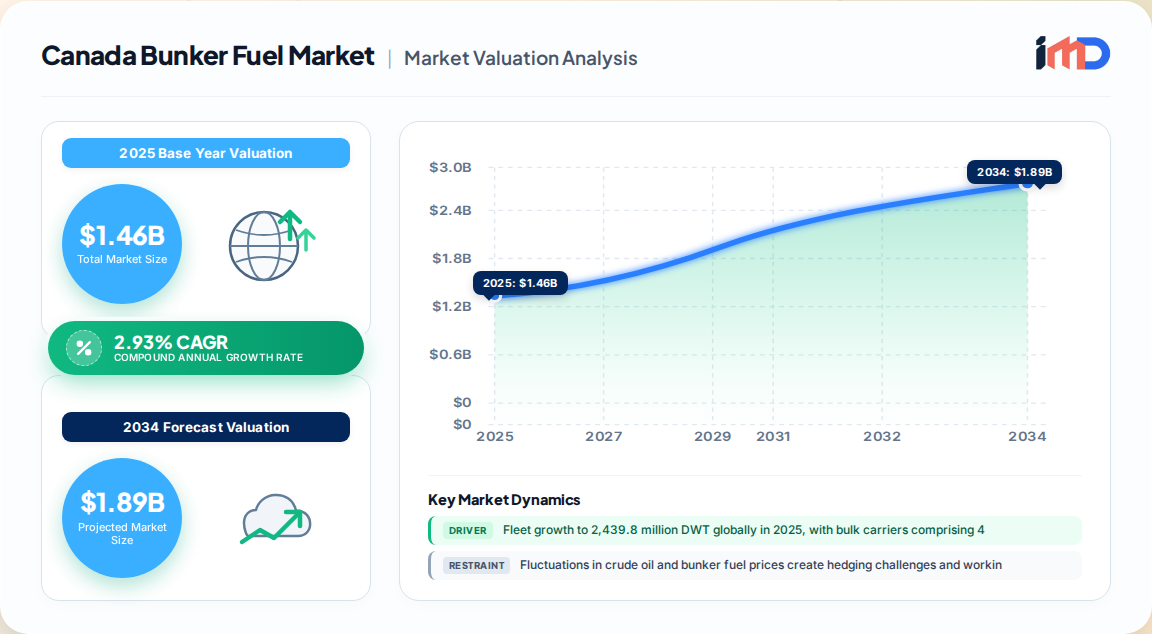
Canada's bunker fuel market is estimated at USD 1.46 billion in 2025, with a projected expansion to USD 1.69 billion by 2030, advancing at a CAGR of 2.93%. This steady trajectory is underpinned by the non-discretionary nature of marine fuel demand across Canada's Atlantic, Pacific, and Arctic maritime corridors.
Canada Bunker Fuel Market Market Size (In Billion)
2.0B
1.5B
1.0B
500.0M
0
1.460 B
2025
1.503 B
2026
1.547 B
2027
1.592 B
2028
1.639 B
2029
1.687 B
2030
1.736 B
2031
Key Market Metric: 2025 valuation of USD 1.46 billion; 2030 forecast of USD 1.69 billion.
Volume Context: Canada's bunkering throughput is anchored by the Port of Vancouver (Pacific gateway) and the Port of Montreal (Atlantic gateway), which together handle the majority of foreign-going vessel calls.
Sulphur Regime: The North American Emission Control Area (ECA), in effect since 1 August 2012, mandates a 0.1% sulphur limit for fuels burned within 200 nautical miles of the Canadian coast, structurally favoring distillate grades and compliant VLSFO blends.
Our proprietary demand modeling, triangulated from port-level vessel call data and refinery throughput statistics, positions Canada as a mature, regulation-driven bunker market with modest but resilient volume growth.
Key Market Drivers
Fleet Growth and Vessel Calls. The global merchant fleet reached approximately 2,439.8 million deadweight tonnes (DWT) on 1 January 2025, a 3.4% rise year-on-year. Bulk carriers alone account for 1,036.2 million DWT, or 42.5% of total capacity. Canada's resource-export model ensures steady bulker and tanker traffic at Vancouver, Prince Rupert, and Halifax.
Expanding Import and Export Activity. Canada's crude oil exports amounted to USD 139 billion in 2023, with natural gas exports reaching USD 13 billion. A 20% increase in Canadian imports from the United States between 2021 and 2023 has directly raised cargo volumes at the Port of Vancouver, the country's largest port, supporting bunker sales.
Refinery Throughput and Domestic Supply. Canadian refinery throughput reached 1.71 million barrels per day in 2023, a 1.13% increase over 2022. Expansion projects, including ExxonMobil's Hebron oilfield development offshore Newfoundland and Labrador (targeting 30,000 barrels per day), are expected to enhance domestic VLSFO availability.
LNG Bunkering Emergence. The February 2024 merger of Cryopeak LNG Solutions and Ferus Natural Gas Fuels created a pan-Canadian LNG production and distribution organization with three production facilities in Western Canada, laying the groundwork for alternative fuel bunkering.
Market Restraints and Challenges
Crude Oil Price Volatility. Bunker fuel prices are directly correlated with crude benchmarks. Front-month Brent futures started Q3 2026 at USD 72 per barrel, surpassed USD 100 on 23 July, and peaked at USD 109 on 15 September 2026. Global refinery inputs fell by 4.8 million barrels per day in Q2 2026. Such swings create hedging challenges and working capital risk for Canadian bunker traders and ship operators.
Alternative Fuel Infrastructure Gap. Despite LNG, methanol, and ammonia interest, alternative fuel bunkering infrastructure remains concentrated at fewer than 50 ports globally. Canadian ports outside Vancouver and Montreal lack the dedicated cryogenic bunkering capacity to support large-scale LNG adoption.
Modal Competition from Land Transport. Canada's trade with the United States is dominated by road, rail, and pipeline, keeping the ratio of maritime trade to total trade below the global average. This structurally limits the addressable bunker fuel volume compared with major transshipment hubs.
Segmentation Analysis: Fuel Type and Vessel Type
Fuel Type Segmentation
Very Low Sulphur Fuel Oil (VLSFO) is the leading fuel type, capturing an estimated 42.0% share of the global bunker fuel market by fuel type in 2026, a dynamic mirrored in Canada. The IMO's 0.5% sulphur cap, effective 1 January 2020, structurally shifted demand from HSFO to VLSFO. Within Canadian waters, the 0.1% ECA limit further amplifies demand for compliant VLSFO blends and Marine Gas Oil (MGO) for vessels operating inside the ECA boundary.
Fuel Type
2025 Share Estimate (Canada)
Primary Demand Driver
VLSFO
~40%
IMO 2020 compliance; ECA blending
HSFO
~25%
Scrubber-equipped bulkers and tankers
MGO
~20%
ECA zones; smaller vessels; port operations
LNG
~5%
Dual-fuel newbuilds; West Coast pilots
Other (bio-blends, methanol)
~10%
Pilot projects; CSL Group B100 initiative
Vessel Type Segmentation
Bulk Carriers lead by application, accounting for an estimated 34.0% of the market in 2026. Canada's export-driven economy—grain, potash, coal, and crude—relies heavily on Capesize and Panamax bulkers calling at Vancouver and Prince Rupert. Oil tankers, containers, general cargo, and fishing vessels complete the demand profile, with fishing vessels being a notable regional niche on both coasts.
Import/Export & Supplier Dynamics
The Canadian bunker fuel market is moderately fragmented. Major players include PetroChina Company Limited, TotalEnergies SE, Peninsula Petroleum Ltd, A.P. Møller – Maersk A/S, and World Kinect Corporation. These suppliers operate through a mix of refinery-integrated supply (e.g., domestic Canadian refineries) and imported cargoes, primarily from U.S. Gulf Coast refiners.
Refinery-Linked Supply: Canadian refiners such as those in Alberta and Ontario supply VLSFO and distillates to bunker hubs in Vancouver and Montreal. ExxonMobil's Hebron expansion is expected to increase domestic availability of compliant grades.
Import Dependency: Eastern Canadian ports, particularly Montreal and Halifax, are structurally short of residual fuel oil and rely on imports from U.S. and European refiners. The 2023 crude export value of USD 139 billion underscores Canada's role as a net energy exporter, yet refined product imports remain essential for bunker supply.
Supplier Strategies: International traders (e.g., World Kinect, Peninsula) leverage global supply chains to offer price-indexed contracts. Domestic players benefit from proximity and regulatory knowledge. The May 2024 CSL Group initiative to fuel eight vessels with B100 biodiesel sourced from North America illustrates the growing role of bio-blended supply chains.
Regional Outlook: Ports and Bunkering Hubs
Port of Vancouver (Pacific): Canada's largest port and primary bunkering hub for transpacific trade. Handles significant bulk carrier, container, and tanker traffic. Faces competition from U.S. Pacific Northwest ports but benefits from Canadian ECA compliance and LNG pilot projects.
Port of Montreal (Atlantic/St. Lawrence): Key gateway for European and Mediterranean trade. The St. Lawrence Seaway system supports a steady flow of general cargo and tanker vessels. Winter ice conditions constrain year-round operations but are managed with ice-class vessels.
Port of Halifax (Atlantic): Deep-water, ice-free port positioned on great-circle routes to Europe. A strategic bunkering stop for transatlantic vessels, with potential for LNG bunkering expansion.
Port of Prince Rupert (Pacific): Northern gateway with strong bulk commodity exports (grain, coal). Growing relevance as an alternative to congested southern routes.
Arctic and Northern Ports: Limited bunkering infrastructure; seasonal operations. Long-term potential tied to Arctic shipping lane development, but currently a marginal share.
Canada Bunker Fuel Market Regional Market Share
Loading chart...
Competitive Strategies and Recent Developments
Biofuel Leadership: In May 2024, CSL Group announced that its gearless bulk carrier, CSL Welland, would operate on B100 biodiesel for the upcoming season, reviving its biofuel initiative. In collaboration with Canada Clean Fuels Inc., the company is fueling eight vessels with B100 biodiesel sourced from North America and produced from waste plant materials.
LNG Infrastructure Consolidation: In February 2024, Cryopeak LNG Solutions signed an agreement to merge operations with Ferus Natural Gas Fuels, creating a new LNG production and distribution organization across Canada. The combined entity manages three LNG production facilities in Western Canada, positioning it to serve marine, rail, and mining customers.
Upstream Expansion: ExxonMobil's December 2023 announcement of a 30,000 barrels-per-day expansion at the Hebron oilfield offshore Newfoundland and Labrador is expected to bolster regional crude supply and, indirectly, domestic VLSFO production.
Drilling Activity Growth: The Canadian Association of Energy Contractors (CAOEC) projected an 8% increase in wells drilled in Canada from 2024, with nearly 500 additional wells and 6,229 projects, supporting energy sector activity that underpins marine fuel demand.
Value Chain and Procurement Strategy Analysis
The Canadian bunker fuel value chain spans crude production, refining, blending, terminal storage, and last-mile delivery to vessels. Key procurement considerations for ship operators include:
Grade Specification: Contracts should name the fuel grade (VLSFO, MGO, HSFO), testing standard (ISO 8217), and delivery port to manage quality risk.
Price Indexation: Linking contracts to benchmark indices (e.g., Platts, Argus) with clear sulfur adjustment clauses protects against crude volatility.
Supplier Due Diligence: Buyers should verify each supplier's refinery origin and sanctions screening protocols, particularly for imported cargoes.
Environmental Compliance: With FuelEU Maritime applying in full since 1 January 2025 and the EU ETS requiring surrender of allowances for 70% of 2025 emissions in 2026, Canadian exporters to Europe must monitor fuel carbon intensity.
Strategic Outlook and White-Space Opportunities
LNG Bunkering First-Mover Advantage: The Cryopeak-Ferus merger creates a platform for LNG bunkering at Vancouver and Prince Rupert. Early partnerships with dual-fuel vessel operators could capture the ~9.2% CAGR projected for global LNG bunkering.
Bio-Blended Fuel Leadership: CSL Group's B100 initiative demonstrates commercial viability. Expanding bio-blended VLSFO supply at Montreal and Halifax could serve European-bound vessels facing FuelEU Maritime compliance costs.
Arctic Route Preparedness: While currently marginal, Arctic shipping lanes could grow as ice retreats. Strategic investment in bunkering infrastructure at northern ports represents a long-term option.
Digital Procurement Platforms: Canadian suppliers lag global peers in digital bunker procurement. A platform offering real-time pricing, quality verification, and compliance documentation could capture share in a moderately fragmented market.
Canada Bunker Fuel Market Regional Market Share
Higher Coverage
Lower Coverage
No Coverage
Canada Bunker Fuel Market REPORT HIGHLIGHTS
Aspects
Details
Study Period
2020-2034
Base Year
2025
Estimated Year
2026
Forecast Period
2026-2034
Historical Period
2020-2025
Growth Rate
CAGR of 2.93% from 2020-2034
Segmentation
By Fuel Type
Very Low Sulfur Fuel Oil
VLSFO
High Sulfur Fuel Oil
HSFO
Table of Contents
1. Canada Bunker Fuel Market Introduction
1.1. Research Scope
1.2. Market Segmentation
1.3. Research Objective
1.4. Definitions and Assumptions
2. Canada Bunker Fuel Market Executive Summary
2.1. Market Snapshot
3. Canada Bunker Fuel Market Dynamics
3.1. Market Drivers
3.1.1. Fleet growth to 2,439.8 million DWT globally in 2025, with bulk carriers comprising 42.5% of capacity
3.1.2. Rising Canadian crude oil exports (USD 139 billion in 2023) and import growth from the U.S. (20% increase 2021-2023)
3.1.3. Refinery throughput growth to 1.71 million barrels per day in 2023 and expansion projects like Hebron
3.1.4. Strategic geographic position with access to Atlantic, Pacific, and Arctic Oceans supporting international shipping
3.2. Market Trends
3.2.1. VLSFO segment witnessing significant growth driven by IMO 2020 sulphur cap and North American ECA regulations
3.2.2. Expanding Canadian import and export activity, particularly with the United States, increases vessel calls and bunker demand
3.2.3. Emergence of LNG bunkering infrastructure through Cryopeak-Ferus merger and bio-blended fuel pilots like CSL Group's B100 initiative
1How big is the Canada bunker fuel market in 2025?
The Canada bunker fuel market is estimated at USD 1.46 billion in 2025, with a projected expansion to USD 1.69 billion by 2030 at a CAGR of 2.93%, driven by steady vessel traffic at ports such as Vancouver and Montreal.
2Which fuel type dominates the Canada bunker fuel market?
Very Low Sulphur Fuel Oil (VLSFO) is the leading fuel type, capturing approximately 42% of the market, driven by the IMO 2020 sulphur cap and the 0.1% sulphur limit within the North American Emission Control Area.
3What are the key drivers of the Canada bunker fuel market?
Key drivers include fleet growth to 2,439.8 million DWT globally in 2025, expanding Canadian crude oil exports worth USD 139 billion in 2023, and rising import/export volumes that increase vessel calls at major Canadian ports.
4Who are the major players in the Canada bunker fuel market?
Major players include PetroChina Company Limited, TotalEnergies SE, Peninsula Petroleum Ltd, A.P. Møller – Maersk A/S, and World Kinect Corporation, operating in a moderately fragmented competitive landscape.
5What recent developments are shaping the Canada bunker fuel market?
In May 2024, CSL Group announced B100 biodiesel fueling for eight vessels in collaboration with Canada Clean Fuels Inc. In February 2024, Cryopeak LNG Solutions merged with Ferus Natural Gas Fuels to expand LNG production and distribution across Canada.
Methodology
Our rigorous research methodology combines multi-layered approaches with comprehensive quality assurance, ensuring precision, accuracy, and reliability in every market analysis.
Primary Research
70–80% of research effort dedicated to primary interviews and surveys.
Company types interviewed: bunker fuel suppliers/traders, refinery operators, port terminal operators, shipping line procurement managers, and marine fuel testing/inspection firms.
Industry associations and regulatory bodies consulted: International Maritime Organization (IMO), Canadian Port Authorities (e.g., Port of Vancouver, Port of Montreal), Transport Canada, and the Canadian Association of Energy Contractors (CAOEC).
Quantitative metrics used in bottom-up estimation: port-level vessel calls by type and DWT, average bunker consumption per vessel per port call (tonnes), refinery throughput (barrels per day), and bunker price differentials by grade (USD/tonne).
Key Stakeholders Interviewed
Key Stakeholders Interviewed
Stakeholder Role
Interview Share (%)
Chief Procurement Officer
25%
Bunker Purchasing Manager
35%
Marine Fuel Operations Director
25%
Fleet Technical Superintendent
15%
Industry Ecosystem Breakdown
Industry Ecosystem Breakdown
Company Type
Representation (%)
Bunker Fuel Suppliers and Traders
40%
Refinery Operators
20%
Port Terminal Operators
15%
Shipping Line Procurement Managers
15%
Marine Fuel Testing and Inspection Firms
10%
Secondary Research & Industry Benchmarking
20–30% of research effort dedicated to secondary data validation.
Official government and multilateral sources: Statistics Canada, U.S. Energy Information Administration (EIA), UNCTAD Review of Maritime Transport, International Maritime Organization (IMO) fuel regulations, and Canada Energy Regulator (CER).
Financial databases: Bloomberg, Factiva, Hoovers, and PitchBook for corporate financials and trade flow analysis.
Recognized non-profit trade associations: Canadian Association of Energy Contractors (CAOEC), Chamber of Shipping of British Columbia, and Shipping Federation of Canada.
Standards and regulatory references: ISO 8217 fuel specifications, MARPOL Annex VI sulphur limits, and North American ECA regulations.
Demand Modeling & Market Estimation
Top-down and bottom-up methodologies applied simultaneously.
Top-down: Global bunker fuel market size (USD 150.4 billion in 2026) apportioned to Canada using share of global vessel calls and bunker volumes at Canadian ports.
Bottom-up: Aggregation of port-level bunker sales data (Vancouver, Montreal, Halifax, Prince Rupert) multiplied by average fuel price per grade, cross-validated with Canadian refinery output and import volumes.
Multi-level data triangulation: Reconciliation of port authority statistics, supplier volume disclosures, and vessel AIS (Automatic Identification System) data to ensure consistency.
Scenario modeling: Price sensitivity analysis using historical Brent crude ranges (USD 72–109 per barrel in 2026) and volume elasticity estimates.
Data Accuracy & Quality Check
Guaranteed estimated data accuracy level of 85–90%, achieved through multi-source triangulation and expert panel review.
Every report is updated to the date of purchase, ensuring the most current market conditions, regulatory changes, and supplier developments are reflected.
Quality assurance protocols: Cross-verification of all quantitative metrics against at least two independent official sources; outlier detection and reconciliation; and final review by a senior industry analyst.
Limitations: Market estimates exclude Lubricants and non-fuel marine consumables; volumes are reported in metric tonnes and values in USD at current prices.
Related Reports
The 4680 battery market is valued at USD 18.7 Billion in 2025, growing at a 39.5% CAGR to reach USD 268 Billion by 2035, driven by EV adoption.
Nov 2026|202 pages
$2900.00
Global PPA market to reach USD 604.2 Bn by 2034 from USD 36.6 Bn in 2024, at 32.4% CAGR. Virtual PPAs dominate with 59.9% share. Read full analysis.
Nov 2026|256 pages
$2900.00
The automatic drilling and riveting machine market is valued at USD 1.50 billion in 2025 and is forecast to reach USD 3.34 billion by 2033, at a 10.5% CAGR.
Nov 2026|196 pages
$2900.00
Floating substation solutions market to grow at 7.4% CAGR, driven by dynamic cable systems, modular topsides, and deepwater wind integration.
Nov 2026|223 pages
$2900.00
India battery market valued at USD 14.01B in 2026, projected to reach USD 25.51B by 2032 at 10.46% CAGR, driven by EV adoption and domestic manufacturing.