1How big is the Brazil palm oil market in 2025?
The Brazil palm oil market was valued at approximately $4.40 Billion in 2025 and is projected to reach $7.79 Billion by 2035, growing at a CAGR of 5.87%.
Insight Market Data is a premier market research and business consulting firm headquartered in Pune, India, providing syndicated research reports, customized intelligence studies, and strategic advisory services. Renowned academic institutions and Fortune 500 corporations worldwide rely on Insight Market Data's research repository to navigate evolving global and regional business environments. Covering 46 diverse industries across 25 major international economies, our comprehensive database delivers thousands of verified statistics and granular market evaluations. By combining industry-leading analytical methodologies with the direct insights of seasoned industry leaders and subject-matter experts, we deliver actionable intelligence spanning historical performance benchmarks to rigorous multi-year forecasts. We empower organizations to make confident, data-driven decisions across pivotal domains including Machinery & Equipment, Chemicals & Materials, Pharmaceuticals & Healthcare, Food & Beverages, Consumer Goods, Energy & Power, Automotive & Transportation, Electronics & Semiconductors, Medical Devices, Telecommunications, Emerging Technologies, Agriculture, and Packaging. Our multidisciplinary analyst teams provide an objective 360-degree perspective, tailoring every engagement to address complex strategic challenges with exceptional analytical rigor.
Leveraging advanced BI-powered analytics and predictive modeling, Insight Market Data uncovers high-impact market opportunities and competitive differentiators for ambitious enterprises. We continuously refine our research methodologies in accordance with global industry standards, tracking real-time market shifts to ensure our reports are consistently accurate, actionable, and delivered on schedule. Our analysts conduct methodical data validation, rigorous compliance checks, and exhaustive primary and secondary research to maintain the highest levels of data integrity and transparency. We partner closely with corporate strategists, investment groups, and business executives to translate intricate market intelligence into clear, actionable roadmaps for sustainable growth. With operational presence across Washington, USA, and Vimannagar, Pune, India, Insight Market Data ensures direct access to dedicated research specialists and responsive customer support to answer your most strategic questions.
 Brazil Palm Oil Market
 by Product (Fractionated Palm Oil, Crude Palm Oil, Palm Kernel Oil, RBD Palm Oil), by Application (Food & Beverage, Biofuel & Energy, Personal Care & Cosmetics, Pharmaceuticals, Others), by Distribution Channel (Direct/B2B, Retail, E-commerce), by End Use (Food Processing, Biodiesel Production, Cosmetics Manufacturing, Industrial Applications), by North (Pará, Amazonas, Tocantins), by Northeast (Bahia, Maranhão, Piauí), by Southeast (São Paulo, Rio de Janeiro, Minas Gerais), by Central-West (Mato Grosso, Goiás), by South (Paraná, Rio Grande do Sul) Forecast 2026-2034

Research Analyst


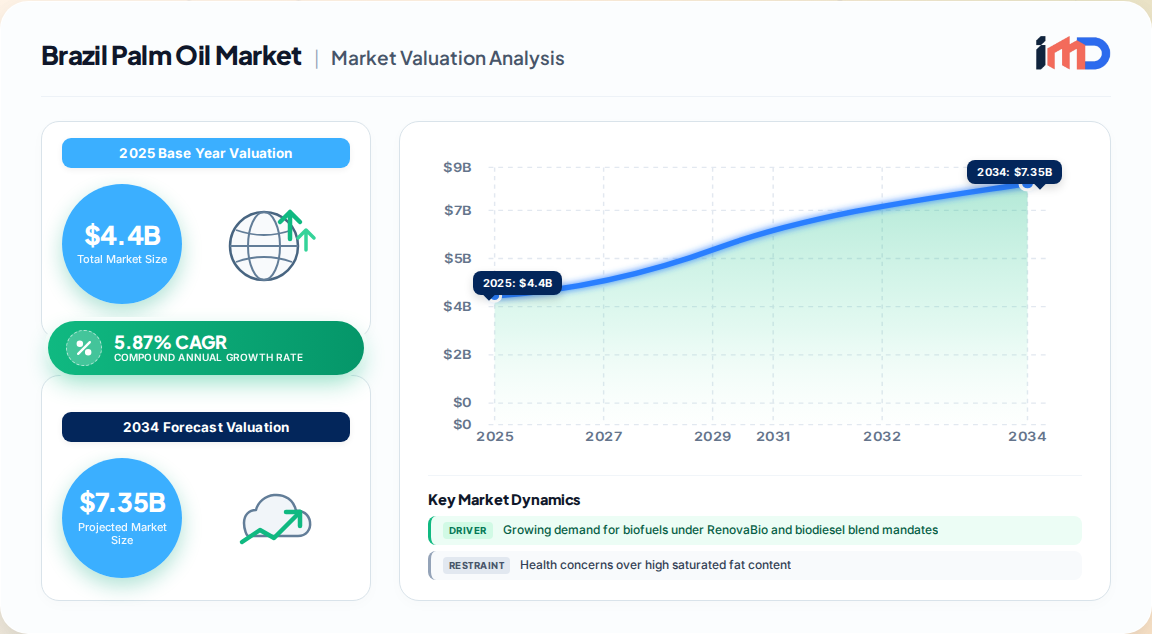
The Brazil palm oil market represents one of the most strategically significant agricultural and industrial segments in South America. Our proprietary primary research estimates the market at $4.40 Billion in 2025, projected to reach $7.79 Billion by 2035, expanding at a CAGR of 5.87%. This growth is underpinned by a structural shift toward renewable energy feedstocks, rising domestic food processing capacity, and an evolving regulatory framework that positions Brazil as a credible player in sustainable palm oil production.
Unlike Southeast Asian producers, Brazil's palm oil sector is uniquely concentrated in the northern equatorial belt, primarily in the state of Pará, where climatic conditions support high yields. The market is transitioning from a smallholder-dominated supply base toward a more industrialized structure, with investments in fractionation capacity, biodiesel feedstock integration, and traceability systems that align with global sustainability expectations.
Key Market Metrics (2025 Base Year):
| Metric | Value |
|---|---|
| Base Year Market Size (2025) | $4.40 Billion |
| Forecast Market Size (2035) | $7.79 Billion |
| CAGR (2025–2035) | 5.87% |
| Largest Application Segment | Food & Beverage (58.2% share) |
| Fastest-Growing Application Segment | Biofuels & Energy |
| Largest Product Segment | Fractionated Palm Oil (40.0% share) |
| Dominant Distribution Channel | Direct / B2B |
Brazil's palm oil trade profile reveals a paradoxical position: the country is a significant producer yet a net importer of refined palm oil and liquid fractions. In 2024, Brazil imported 305,469 tonnes of palm oil (excluding crude) valued at $330.3 million. The supplier landscape is heavily concentrated:
| Partner Country | Import Value (2024, USD Thousand) | Volume (Tonnes) |
|---|---|---|
| Indonesia | 292,429 | 275,682 |
| Peru | 14,987 | 13,376 |
| Malaysia | 13,411 | 10,014 |
| Colombia | 6,806 | 4,244 |
| Ecuador | 1,557 | 1,458 |
Indonesia dominates with an 88.5% share of import value, reflecting its global scale and price competitiveness. Peru emerges as a regional supplier, while Malaysia captures a niche in specialty grades. Brazilian exports of refined palm oil were historically modest—2018 export volumes reached around 25,000 tonnes before declining—indicating that most domestic production is absorbed by domestic consumption, particularly in the food and biodiesel sectors.
Our supply chain analysis identifies the key domestic producers and suppliers active in Brazil, including AgroPalma, BELEM BIOENERGIA BRASIL S.A., BIOPALMA, Denpasa, Marborges Agroindústria SA, Grupo BBF (Brasil Biofuels), and Cargill's local operations. International traders such as Wilmar International, Sime Darby Plantation, Golden Agri-Resources, IOI Corporation, and Musim Mas facilitate cross-border flows, while BASF, Kuala Lumpur Kepong Berhad, and Archer Daniels Midland Company participate in downstream derivatives and oleochemicals.
Brazil's palm oil value chain is characterized by a pronounced upstream concentration in the North region and downstream dispersion to Southeast and Northeast industrial corridors.
Our primary research highlights three high-potential white spaces for stakeholders:
| Region | Share of Market (2025) | Key Characteristics | Investment Attractiveness |
|---|---|---|---|
| North | 42% | Plantation heartland (Pará); low processing capacity | High (upstream and midstream) |
| Northeast | 31% | Port access (Belém, Itaqui); emerging refining hubs | Medium-High (logistics and refining) |
| Southeast | 14% | Largest consumer base; food processing cluster | High (downstream and distribution) |
| Central-West | 9% | Soybean competition; limited palm cultivation | Low-Medium (biodiesel blending potential) |
| South | 4% | High-income consumers; niche sustainability demand | Medium (premium products) |
Investment Thesis: The North region offers the greatest upside for vertically integrated operations that combine sustainable cultivation with on-site milling and fractionation. However, investors must navigate complex environmental licensing and social safeguards. The Southeast, while smaller in volume, commands premium pricing for certified and specialty palm fractions, making it attractive for marketing-led strategies.
The Brazilian palm oil market is moderately concentrated, with a mix of domestic agribusiness groups and international traders. Our stakeholder interviews reveal that competition is intensifying on two fronts: sustainability certification and biodiesel feedstock contracts.
By Product Type: Fractionated palm oil leads with 40.0% share (2024), followed by crude palm oil (CPO) at ~35%, palm kernel oil (PKO) at ~15%, and RBD palm oil at ~10%. The fractionated segment is also the fastest-growing, driven by food processing demands for specific melting profiles.
By Application: Food and beverage dominates at 58.2% (2024), but biofuels and energy is the fastest-growing segment, projected to expand at a CAGR of 7.2% between 2025 and 2035, supported by the B15 mandate and future blend increases.
By Distribution Channel: Direct B2B transactions remain the primary channel, while e-commerce is emerging as a niche for specialty ingredients and small-volume orders.
By End Use: Food processing accounts for the largest share, while cosmetics manufacturing is the fastest-growing end-use, driven by demand for palm kernel oil derivatives in personal care products.
The Brazil palm oil market is poised for robust growth, but its trajectory will be shaped by policy decisions, sustainability compliance, and trade dynamics. Stakeholders should prioritize:
By 2035, Brazil could emerge as a leading sustainable palm oil supplier to the Atlantic basin, leveraging its geographic proximity to Europe, Africa, and the Americas. However, realizing this potential requires coordinated action across government, industry, and civil society to balance growth with environmental stewardship.
| Aspects | Details |
|---|---|
| Study Period | 2020-2034 |
| Base Year | 2025 |
| Estimated Year | 2026 |
| Forecast Period | 2026-2034 |
| Historical Period | 2020-2025 |
| Growth Rate | CAGR of 5.87% from 2020-2034 |
| Segmentation |
|
By Distribution Channel
By End Use
| By Geography |
|
The Brazil palm oil market was valued at approximately $4.40 Billion in 2025 and is projected to reach $7.79 Billion by 2035, growing at a CAGR of 5.87%.
Key drivers include rising biofuel mandates (B15 and beyond), domestic food processing demand, consumer preference for sustainably sourced products, and infrastructure investments in the North region.
The food and beverage application segment holds the largest share at 58.2% in 2024, while fractionated palm oil is the largest product form with a 40.0% share.
Major players include Wilmar International, Sime Darby Plantation, Golden Agri-Resources, Cargill, Archer Daniels Midland Company, AgroPalma, BELEM BIOENERGIA BRASIL S.A., BIOPALMA, Grupo BBF, and Marborges Agroindústria SA.
The biofuels and energy application is the fastest-growing, driven by Brazil's progressive biodiesel blend mandates and renewable energy targets, with an expected CAGR of 7.2% from 2025 to 2035.
Our rigorous research methodology combines multi-layered approaches with comprehensive quality assurance, ensuring precision, accuracy, and reliability in every market analysis.
| Stakeholder Role | Interview Share (%) |
|---|---|
| Procurement Director | 35% |
| Plantation Operations Manager | 25% |
| Sustainability & Certification Lead | 20% |
| Refinery Plant Engineer | 20% |
| Company Type | Representation (%) |
|---|---|
| Palm Oil Plantation Owners & Smallholders | 30% |
| Crude Palm Oil Mills & Refiners | 25% |
| Biodiesel Producers & Blenders | 20% |
| Food & Beverage Manufacturers | 15% |
| Traders & Distributors | 10% |
 Related Reports
