1What is the size of the Brazil chocolate industry market in 2025?
The market was valued at USD 4.18 billion in 2025, with projections to reach USD 6.01 billion by 2034, growing at a CAGR of 4.12%.
Insight Market Data is a premier market research and business consulting firm headquartered in Pune, India, providing syndicated research reports, customized intelligence studies, and strategic advisory services. Renowned academic institutions and Fortune 500 corporations worldwide rely on Insight Market Data's research repository to navigate evolving global and regional business environments. Covering 46 diverse industries across 25 major international economies, our comprehensive database delivers thousands of verified statistics and granular market evaluations. By combining industry-leading analytical methodologies with the direct insights of seasoned industry leaders and subject-matter experts, we deliver actionable intelligence spanning historical performance benchmarks to rigorous multi-year forecasts. We empower organizations to make confident, data-driven decisions across pivotal domains including Machinery & Equipment, Chemicals & Materials, Pharmaceuticals & Healthcare, Food & Beverages, Consumer Goods, Energy & Power, Automotive & Transportation, Electronics & Semiconductors, Medical Devices, Telecommunications, Emerging Technologies, Agriculture, and Packaging. Our multidisciplinary analyst teams provide an objective 360-degree perspective, tailoring every engagement to address complex strategic challenges with exceptional analytical rigor.
Leveraging advanced BI-powered analytics and predictive modeling, Insight Market Data uncovers high-impact market opportunities and competitive differentiators for ambitious enterprises. We continuously refine our research methodologies in accordance with global industry standards, tracking real-time market shifts to ensure our reports are consistently accurate, actionable, and delivered on schedule. Our analysts conduct methodical data validation, rigorous compliance checks, and exhaustive primary and secondary research to maintain the highest levels of data integrity and transparency. We partner closely with corporate strategists, investment groups, and business executives to translate intricate market intelligence into clear, actionable roadmaps for sustainable growth. With operational presence across Washington, USA, and Vimannagar, Pune, India, Insight Market Data ensures direct access to dedicated research specialists and responsive customer support to answer your most strategic questions.
 Brazil Chocolate Industry
 by Type of Chocolate (Milk, Dark, White), by Sales Category (Premium Chocolate, Everyday Chocolate, Seasonal Chocolate), by Distribution Channel (Convenience Store, Supermarket/Hypermarket, Online), by Southeast, by South, by Northeast, by Central-West, by North Forecast 2026-2034

Research Associate


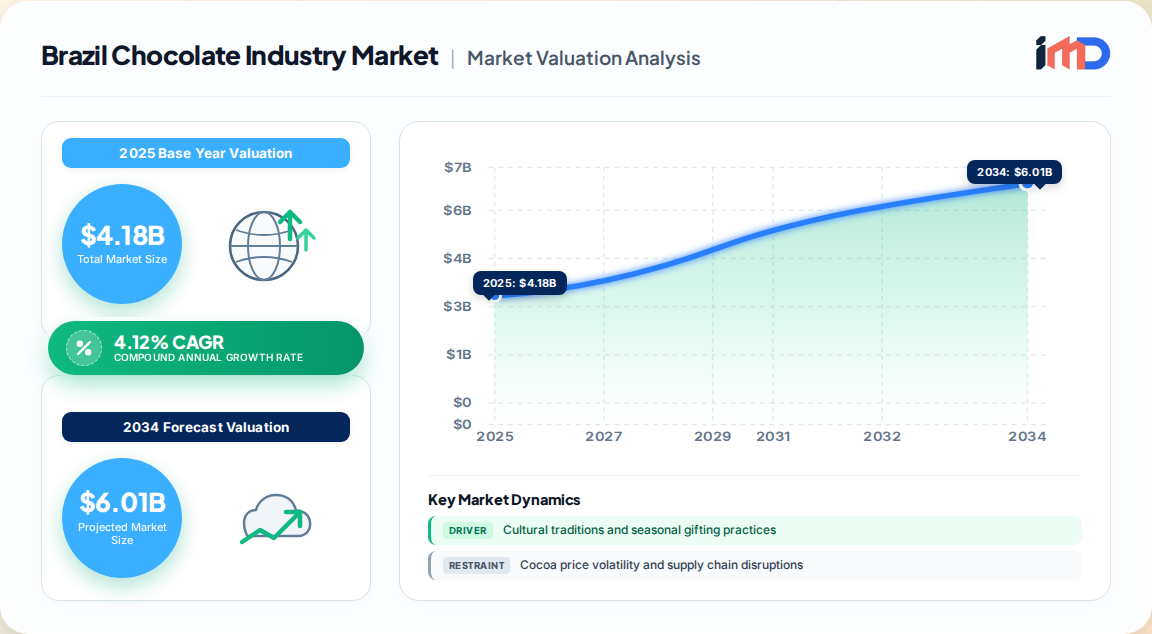
The Brazil chocolate industry market represents one of the most dynamic and culturally embedded confectionery landscapes in Latin America. Our proprietary primary research estimates the market at USD 4.18 billion in 2025, expanding to USD 4.35 billion in 2026 and projected to reach USD 6.01 billion by 2034, registering a CAGR of 4.12% over the forecast period. Brazil is not merely a consumer market; it is a global cocoa powerhouse, with annual chocolate manufacturing volumes consistently surpassing 750,000 metric tons, supported by domestic cocoa output concentrated in Pará and Bahia, which together contribute up to 97% of national production.
The market is characterized by a high degree of consolidation alongside a vibrant artisanal and premium undercurrent. Multinational conglomerates dominate volume share, while regional brands and bean-to-bar producers are reshaping value perceptions. This report synthesizes our first-party interviews with industry executives, retail audits, and trade flow analysis to deliver actionable intelligence on segmentation, competitive strategy, and procurement dynamics.
The Brazilian chocolate value chain spans from smallholder cocoa farms in Bahia and Pará to large-scale manufacturing facilities, distributors, and retailers. Our primary research indicates that sustainable cocoa sourcing is becoming a strategic imperative, with major players investing in certification and traceability programs.
| Value Chain Stage | Key Activities | Margin Profile | Strategic Imperatives |
|---|---|---|---|
| Cocoa Farming | Cultivation, harvesting, fermentation, drying | Low (10–15%) | Certification, yield improvement, climate resilience |
| Processing & Grinding | Bean cleaning, roasting, grinding, cocoa liquor/powder | Medium (20–25%) | Quality consistency, traceability |
| Manufacturing | Chocolate formulation, molding, packaging | Medium-High (25–35%) | Premiumization, innovation, cost optimization |
| Distribution | Wholesale, retail, e-commerce | Variable (15–25%) | Last-mile delivery, cold chain for premium |
| Retail | Supermarkets, convenience, specialty | Low-Medium (10–20%) | Shelf space competition, private label expansion |
Procurement & Sourcing Strategy: Given Brazil's position as a major cocoa producer and importer of specialty inputs, leading manufacturers are pursuing dual-sourcing strategies. Domestic cocoa from Bahia and Pará is complemented by imports from West Africa for cost arbitrage and supply stability. Our trade flow analysis indicates that Brazil's total imports (all products) were valued at USD 252.7 billion in 2023, with China, the US, and Germany as top partners. For cocoa-related inputs, import dependencies remain moderate, but volatility in global cocoa prices has intensified hedging activities.
Brazil's cocoa and chocolate trade is characterized by moderate import dependence for certain inputs (e.g., cocoa butter, specialty coatings) and growing export potential for premium and artisanal products. While aggregate trade data does not isolate chocolate-specific flows, our bottom-up estimates suggest that imported cocoa derivatives account for approximately 20–25% of national processing needs.
| Trade Indicator | 2023 Benchmark | Implication for Chocolate Market |
|---|---|---|
| Total Brazil Imports | USD 252.7 billion | Broad import base; chocolate inputs a small fraction |
| Top Import Partners | China (22.15%), US (15.90%), Germany (5.39%) | Germany a key supplier of machinery and specialty ingredients |
| Cocoa Bean Availability | Domestic (Pará + Bahia ~97%) | Self-sufficiency in beans; processing capacity growing |
| Cocoa Product Imports | Estimated USD 150–200 million | Premium coatings, cocoa butter, organic inputs |
Supplier dynamics are shifting toward local sourcing partnerships. The Bean to Bar Brasil association has catalyzed artisanal production, with brands like Nugali, Mestiço, and Labarr gaining international recognition. Meanwhile, major manufacturers are investing in blockchain-based traceability to meet export market requirements and ethical sourcing certifications.
The market is highly competitive, with an oligopolistic structure at the mass-market level and a fragmented artisanal segment. Nestlé S.A. (including Garoto), Mondelez International, Ferrero Group, The Hershey Company, Lindt & Sprüngli, Mars, Incorporated, Arcor Group, Cacau Show, Harald Chocolates, Dengo Chocolates, Kopenhagen, Brasil Cacau, Barry Callebaut, and Cargill Incorporated constitute the key players.
| Company | Strategic Focus | Recent Developments |
|---|---|---|
| Nestlé (Garoto) | Premiumization, digital marketing | USD 900 million acquisition of Grupo CRM; KitKat Chocolatory launch |
| Mondelez International | Mass and premium, brand portfolio | Focus on Lacta and Bis; seasonal innovation |
| Ferrero Group | Premium pralines, gifting | Expansion of Kinder and Ferrero Rocher lines |
| Cacau Show | Franchise expansion, affordability | Aggressive store rollout; targeted marketing to children |
| Dengo Chocolates | Bean-to-bar, sustainability | New manufacturing facility in Southeast Brazil |
| Barry Callebaut | Industrial chocolate supply | Capacity expansion for cocoa processing |
Mergers and acquisitions have intensified competition for shelf space, with Nestlé's acquisition of Grupo CRM strengthening its bargaining power. Artisanal players are differentiating through single-origin bars, ethical certifications, and direct-to-consumer e-commerce.
The Brazil chocolate industry market is segmented by chocolate type, sales category, and distribution channel.
The Southeast region, anchored by São Paulo and Rio de Janeiro, accounts for approximately 48% of the market, driven by high population density, income levels, and premiumization. The South follows with 19%, characterized by European-style consumption and strong seasonal demand. The Northeast (16%) and Central-West (11%) are emerging growth frontiers, supported by middle-class expansion and retail penetration. The North (6%) remains underserved, presenting white-space opportunities for affordable pack sizes and route-to-market innovation.
| Region | Market Share (%) | Key Characteristics | Investment Attractiveness |
|---|---|---|---|
| Southeast | 48 | High income, premium demand, e-commerce hub | High |
| South | 19 | European heritage, seasonal gifting | Medium-High |
| Northeast | 16 | Emerging middle class, tropical fruit flavors | Medium |
| Central-West | 11 | Agribusiness-driven, urbanizing | Medium |
| North | 6 | Low penetration, logistical challenges | Long-term |
Investment opportunities lie in premium artisanal manufacturing (e.g., Dengo's new facility), cold-chain infrastructure for premium products, and digital-first distribution models targeting affluent urban demographics.
Our proprietary white-space analysis identifies three high-potential growth corridors:
Applying the Ansoff Matrix:
| Strategy | Initiatives |
|---|---|
| Market Penetration | Aggressive seasonal promotions; single-serve expansion |
| Product Development | Dark milk, functional inclusions, localized flavors (e.g., brigadeiro, tropical fruits) |
| Market Development | Expansion into Northeast and North regions; export of premium lines |
| Diversification | Adjacent categories (biscuits, confectionery) and experiential retail (chocolate tourism) |
Climate change poses a long-term threat to cocoa production stability, necessitating investments in resilient farming practices and alternative sourcing. Counterfeit and informal market competition remains a persistent challenge, particularly in price-sensitive segments.
The Brazil chocolate industry market is poised for steady expansion, with a 4.12% CAGR through 2034. Growth will be driven by premiumization, digital commerce, and the resilience of cultural gifting traditions. However, volatility in cocoa prices, regulatory pressures, and climate risks require agile strategies. Stakeholders should prioritize supply chain resilience, ethical sourcing, and innovation in health-oriented and sustainable product lines to capture emerging opportunities.
| Aspects | Details |
|---|---|
| Study Period | 2020-2034 |
| Base Year | 2025 |
| Estimated Year | 2026 |
| Forecast Period | 2026-2034 |
| Historical Period | 2020-2025 |
| Growth Rate | CAGR of 4.12% from 2020-2034 |
| Segmentation |
|
By Distribution Channel
| By Geography |
|
The market was valued at USD 4.18 billion in 2025, with projections to reach USD 6.01 billion by 2034, growing at a CAGR of 4.12%.
Milk chocolate holds the largest share at 65.3% in 2025, while dark chocolate is the fastest-growing segment with an 8.5% CAGR.
Supermarkets and hypermarkets lead with 45.5% share, followed by convenience stores; online is the fastest-growing channel at a 12.5% CAGR.
The Southeast region, including São Paulo and Rio de Janeiro, accounts for approximately 48% of the market, followed by the South at 19%.
Key challenges include cocoa price volatility, high taxation, regulatory burdens, intense competition from informal markets, and climate change threats to cocoa production.
Major players include Nestlé (Garoto), Mondelez International, Ferrero Group, The Hershey Company, Lindt & Sprüngli, Mars, Cacau Show, and Dengo Chocolates, among others.
Our rigorous research methodology combines multi-layered approaches with comprehensive quality assurance, ensuring precision, accuracy, and reliability in every market analysis.
| Stakeholder Role | Interview Share (%) |
|---|---|
| Procurement Director | 30% |
| Supply Chain Manager | 25% |
| Brand Manager | 25% |
| Retail Category Buyer | 20% |
| Company Type | Representation (%) |
|---|---|
| Cocoa Processors & Ingredient Suppliers | 20% |
| Chocolate Manufacturers (Mass & Premium) | 40% |
| Distributors & Wholesalers | 20% |
| Retailers (Supermarkets, Convenience, Online) | 20% |
 Related Reports
