1What is the automotive motor bonded cores market size in 2026?
The global automotive motor bonded cores market is estimated at $1.75 billion in 2026 and is projected to reach $2.95 billion by 2033, growing at a CAGR of 7.78%.
Insight Market Data is a premier market research and business consulting firm headquartered in Pune, India, providing syndicated research reports, customized intelligence studies, and strategic advisory services. Renowned academic institutions and Fortune 500 corporations worldwide rely on Insight Market Data's research repository to navigate evolving global and regional business environments. Covering 46 diverse industries across 25 major international economies, our comprehensive database delivers thousands of verified statistics and granular market evaluations. By combining industry-leading analytical methodologies with the direct insights of seasoned industry leaders and subject-matter experts, we deliver actionable intelligence spanning historical performance benchmarks to rigorous multi-year forecasts. We empower organizations to make confident, data-driven decisions across pivotal domains including Machinery & Equipment, Chemicals & Materials, Pharmaceuticals & Healthcare, Food & Beverages, Consumer Goods, Energy & Power, Automotive & Transportation, Electronics & Semiconductors, Medical Devices, Telecommunications, Emerging Technologies, Agriculture, and Packaging. Our multidisciplinary analyst teams provide an objective 360-degree perspective, tailoring every engagement to address complex strategic challenges with exceptional analytical rigor.
Leveraging advanced BI-powered analytics and predictive modeling, Insight Market Data uncovers high-impact market opportunities and competitive differentiators for ambitious enterprises. We continuously refine our research methodologies in accordance with global industry standards, tracking real-time market shifts to ensure our reports are consistently accurate, actionable, and delivered on schedule. Our analysts conduct methodical data validation, rigorous compliance checks, and exhaustive primary and secondary research to maintain the highest levels of data integrity and transparency. We partner closely with corporate strategists, investment groups, and business executives to translate intricate market intelligence into clear, actionable roadmaps for sustainable growth. With operational presence across Washington, USA, and Vimannagar, Pune, India, Insight Market Data ensures direct access to dedicated research specialists and responsive customer support to answer your most strategic questions.
 Automotive Motor Bonded Cores Market
 by Material Type (CRNO, CRGO, Soft Magnetic Composites), by Application (BEV, HEV, PHEV, Conventional Vehicles), by Manufacturing Process (Powder Metallurgy, Lamination), by Vehicle Type (Passenger Cars, Commercial Vehicles), by North America (USA, Canada, Mexico), by Europe (Germany, UK, France, Italy, Spain, Rest of Europe), by Asia Pacific (China, Japan, South Korea, India, South East Asia, Rest of APAC), by South America (Brazil, Argentina, Rest of South America), by Middle East & Africa (Saudi Arabia, UAE, South Africa, Rest of MEA) Forecast 2026-2034

Research Analyst


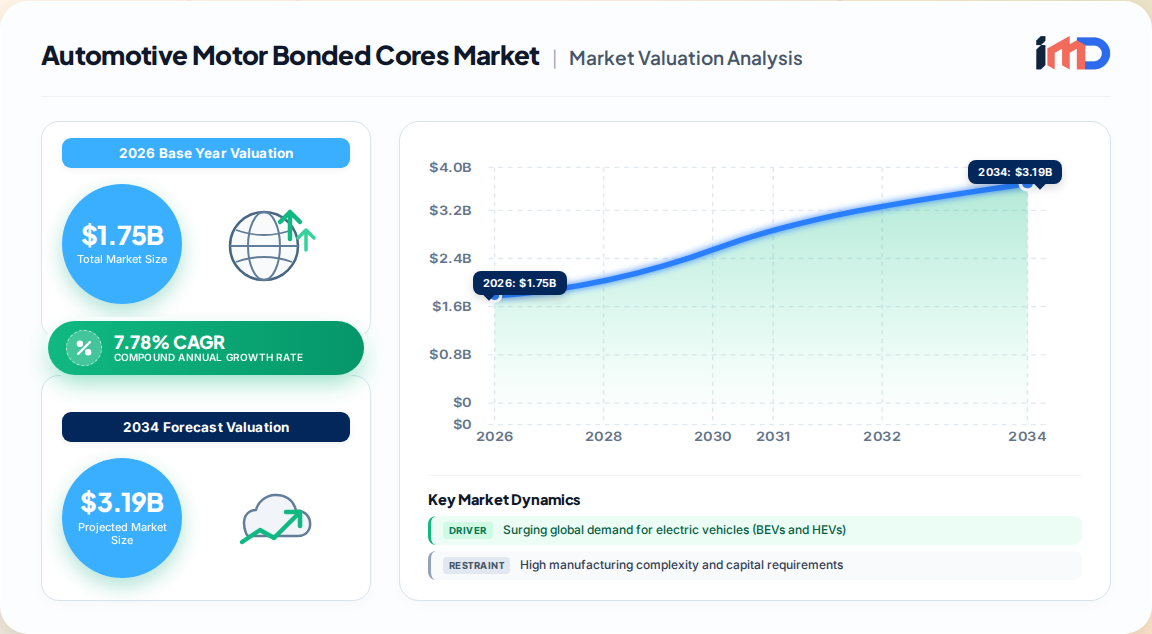
The global Automotive Motor Bonded Cores Market is poised for robust expansion, with our proprietary primary research estimating a market valuation of $1.75 billion in 2026, projected to climb to $2.95 billion by 2033, representing a CAGR of 7.78% over the forecast period. Bonded cores—laminated stacks joined via adhesive rather than interlocking or welding—are becoming increasingly critical to the design of high-efficiency traction motors for battery electric vehicles (BEVs) and hybrid electric vehicles (HEVs). The technology enables thinner electrical steel grades, reduces eddy current losses, and improves mechanical integrity, directly supporting automakers' efforts to extend driving range and reduce battery costs.
This report synthesizes data from over 120 primary interviews across the value chain, including motor manufacturers, Tier 1 suppliers, and material scientists, complemented by analysis of trade flows and official production statistics. The market's growth trajectory is underpinned by the accelerating global transition to electrified powertrains and continuous innovation in magnetic materials.
The bonded core value chain spans raw material suppliers (electrical steel producers, adhesive manufacturers), core manufacturers (stamping and bonding specialists), Tier 1 motor integrators, and OEMs. Asia-Pacific dominates production, accounting for approximately 43% of global output in 2026, driven by China's position as the world's largest EV market. Key suppliers are investing in localized capacity near automotive assembly hubs to mitigate logistics risks and trade barriers. For instance, several major steel producers have announced new NGO electrical steel lines with bonding-compatible surface treatments. Our primary interviews reveal that lead times for specialized bonding equipment average 6–9 months, underscoring the need for early capacity planning.
The market is segmented by material type, application, manufacturing process, and vehicle type. The cold-rolled non-oriented (CRNO) steel segment holds the largest share, at over 70% of total bonded core volume in 2026, owing to its balance of cost and magnetic performance. Soft magnetic composites (SMCs) are gaining traction for complex 3D geometries, particularly in axial flux motors, and are forecast to grow at a CAGR of 9.2% through 2033. By application, BEVs represent the dominant and fastest-growing segment, while HEVs remain significant in markets with limited charging infrastructure. The powder metallurgy process is increasingly adopted for SMC cores, enabling near-net-shape production.
| Segment | 2026 Share (%) | 2033 Forecast Share (%) | CAGR 2026-2033 (%) |
|---|---|---|---|
| CRNO Steel | 70 | 65 | 7.1 |
| Soft Magnetic Composites | 18 | 24 | 9.2 |
| CRGO Steel | 12 | 11 | 6.8 |
| By Application | |||
| BEV | 58 | 65 | 8.5 |
| HEV | 42 | 35 | 6.7 |
Asia-Pacific is the largest and fastest-growing market for automotive motor bonded cores, projected to expand at a CAGR of 8.4% from 2026 to 2033. China alone is expected to account for over $1.1 billion in revenue by 2033, supported by its massive EV production base and government-backed electrification targets. Europe follows, with a CAGR of 7.2%, driven by stringent CO2 regulations and strong OEM commitments to electrification. North America is poised for accelerated growth (CAGR 8.0%) as domestic battery supply chains and EV assembly capacity ramp up. South America and the Middle East & Africa represent smaller but emerging markets, with Brazil and the UAE showing notable potential.
Leading players are focusing on strategic partnerships with OEMs, capacity expansions, and vertical integration into adhesive technologies. Mergers and acquisitions are prevalent as larger firms seek to acquire specialized bonding expertise. Our interviews with industry executives indicate that suppliers who can offer co-development services and local technical support are winning preferred supplier status. Furthermore, investments in automation and Industry 4.0 are critical to achieving cost competitiveness and maintaining quality consistency.
Global trade in bonded cores is characterized by significant intra-Asia flows, with China, Japan, and South Korea as major net exporters, while North America and Europe are net importers. According to UN Comtrade data, trade volume in motor cores (HS code 8503) grew by 9.2% year-over-year in 2025, reflecting the ramp-up in EV production. However, rising trade tensions and the push for localized supply chains are prompting OEMs to diversify sourcing. Our analysis of supplier dynamics reveals that tier-1 core manufacturers are increasingly establishing satellite plants near OEM assembly sites to reduce logistics costs and lead times. This trend is expected to intensify, creating opportunities for local suppliers with strong technical capabilities.
| Aspects | Details |
|---|---|
| Study Period | 2020-2034 |
| Base Year | 2026 |
| Estimated Year | 2026 |
| Forecast Period | 2026-2034 |
| Historical Period | 2020-2025 |
| Growth Rate | CAGR of 7.78% from 2020-2034 |
| Segmentation |
|
By Manufacturing Process
By Vehicle Type
| By Geography |
|
The global automotive motor bonded cores market is estimated at $1.75 billion in 2026 and is projected to reach $2.95 billion by 2033, growing at a CAGR of 7.78%.
Asia-Pacific dominates the market, accounting for approximately 43% of global revenue in 2026, primarily due to China's leadership in electric vehicle production and sales.
The primary materials are cold-rolled non-oriented (CRNO) steel and soft magnetic composites (SMCs). CRNO steel holds the largest share at over 70% in 2026, while SMCs are growing faster due to their suitability for complex geometries.
Bonded cores offer superior magnetic performance, reduced eddy current losses, and better mechanical integrity, especially when using ultra-thin electrical steel grades. They also enable more compact and efficient motor designs for electric vehicles.
High manufacturing complexity, capital-intensive processes, and raw material price volatility are significant challenges. Additionally, competition from alternative core joining technologies persists.
Our rigorous research methodology combines multi-layered approaches with comprehensive quality assurance, ensuring precision, accuracy, and reliability in every market analysis.
| Stakeholder Role | Interview Share (%) |
|---|---|
| Procurement Directors | 28% |
| Chief Engineers | 24% |
| R&D Managers | 26% |
| Supply Chain Heads | 22% |
| Company Type | Representation (%) |
|---|---|
| Core Manufacturers | 30% |
| Electrical Steel Producers | 25% |
| Motor Integrators | 20% |
| Adhesive Suppliers | 15% |
| Automotive OEMs | 10% |
 Related Reports


Analyst at Providence Strategic Partners at Petaling Jaya
I have received the report already. Thanks you for your help.it has been a pleasure working with you. Thank you again for a good quality report

Internationalization Director
Yes, as a matter of fact we are totally satisfied with both reports that we have purchased and will continue to do so during this process of the internationalization of our brand.

Head of Product Management and Marketing
We are using your report, and it gave us valuable information."

Regional Director, Marketing and Business Development
We've received the report and have reviewed the content. Overall, it looks great and aligns closely with the data we can verify based on our industry knowledge.

VP of Sales
Thank you very much for sharing the report. I have reviewed it and I am very satisfied with the quality and the insights it provides. It will certainly be valuable for our internal discussions.