About Insight Market Data

Insight Market Data is a premier market research and business consulting firm headquartered in Pune, India, providing syndicated research reports, customized intelligence studies, and strategic advisory services. Renowned academic institutions and Fortune 500 corporations worldwide rely on Insight Market Data's research repository to navigate evolving global and regional business environments. Covering 46 diverse industries across 25 major international economies, our comprehensive database delivers thousands of verified statistics and granular market evaluations. By combining industry-leading analytical methodologies with the direct insights of seasoned industry leaders and subject-matter experts, we deliver actionable intelligence spanning historical performance benchmarks to rigorous multi-year forecasts. We empower organizations to make confident, data-driven decisions across pivotal domains including Machinery & Equipment, Chemicals & Materials, Pharmaceuticals & Healthcare, Food & Beverages, Consumer Goods, Energy & Power, Automotive & Transportation, Electronics & Semiconductors, Medical Devices, Telecommunications, Emerging Technologies, Agriculture, and Packaging. Our multidisciplinary analyst teams provide an objective 360-degree perspective, tailoring every engagement to address complex strategic challenges with exceptional analytical rigor.

Leveraging advanced BI-powered analytics and predictive modeling, Insight Market Data uncovers high-impact market opportunities and competitive differentiators for ambitious enterprises. We continuously refine our research methodologies in accordance with global industry standards, tracking real-time market shifts to ensure our reports are consistently accurate, actionable, and delivered on schedule. Our analysts conduct methodical data validation, rigorous compliance checks, and exhaustive primary and secondary research to maintain the highest levels of data integrity and transparency. We partner closely with corporate strategists, investment groups, and business executives to translate intricate market intelligence into clear, actionable roadmaps for sustainable growth. With operational presence across Washington, USA, and Vimannagar, Pune, India, Insight Market Data ensures direct access to dedicated research specialists and responsive customer support to answer your most strategic questions.

report thumbnailAutomotive Camera
Automotive / MARKET REPORT

Automotive Camera | Insight Market Data

Automotive Camera by Vehicle Type (Passenger Cars, Others), by Technology (Digital/CMOS, Others), by Hardware Type (Monocular, Stereo, Triple/Multi-lens), by Application (ADAS, Parking/Surround View, Others), by North America (USA, Canada, Mexico), by Europe (Germany, UK, France, Italy), by Asia Pacific (China, Japan, India, South Korea), by South America (Brazil, Argentina), by Middle East & Africa (South Africa, UAE) Forecast 2026-2034

© Nov 7, 2026|Base Year: 2025|212 Pages
Sadashiv Parab

Sadashiv Parab

Research Analyst

Main Logo

Automotive Camera Market Size, Growth & Forecast 2026-2033


/
/
Independent Intelligence for decisions that move markets
+12315155523[email protected]
  • Home
  • About Us
  • Industries
    • Automotive
    • Consumer Goods and Services
    • Financial Services and Investment Intelligence
    • Home and Property Improvement
    • Logistics
    • Retail
    • Agriculture
    • Healthcare
    • Animal Nutrition & Wellness
    • Chemicals & Materials
    • Energy & Power
    • Food & Beverage
    • Hospitality and Tourism
    • Manufacturing Products and Services
    • Professional and Commercial Services
    • Real Estate and Construction
    • Aerospace & Defense
    • Packaging
    • Technology, Media and Telecom
  • Services
  • Contact
Main Logo
  • Home
  • About Us
  • Industries
    • Automotive
    • Consumer Goods and Services
    • Financial Services and Investment Intelligence
    • Home and Property Improvement
    • Logistics
    • Retail
    • Agriculture
    • Healthcare
    • Animal Nutrition & Wellness
    • Chemicals & Materials
    • Energy & Power
    • Food & Beverage
    • Hospitality and Tourism
    • Manufacturing Products and Services
    • Professional and Commercial Services
    • Real Estate and Construction
    • Aerospace & Defense
    • Packaging
    • Technology, Media and Telecom
  • Services
  • Contact
Talk to an analyst

Business Address

Head Office

Ansec House 3 rd floor Tank Road, Yerwada, Pune, Maharashtra 411014

Contact Information

Craig Francis

Business Development Head

+12315155523

[email protected]

Secure Payment Partners

payment image

© 2026 PRDUA Research & Media Private Limited, All rights reserved

••
Home
Industries
Automotive
Retail
Logistics
Packaging
Automotive
Healthcare
Agriculture
Energy & Power
Food & Beverage
Aerospace & Defense
Chemicals & Materials
Hospitality and Tourism
Consumer Goods and Services
Animal Nutrition & Wellness
Real Estate and Construction
Home and Property Improvement
Technology, Media and Telecom
Manufacturing Products and Services
Financial Services and Investment Intelligence
Privacy Policy
Terms and Conditions
FAQ
Automotive Camera CAGR, market size, market share

Automotive Camera Market: Executive Overview

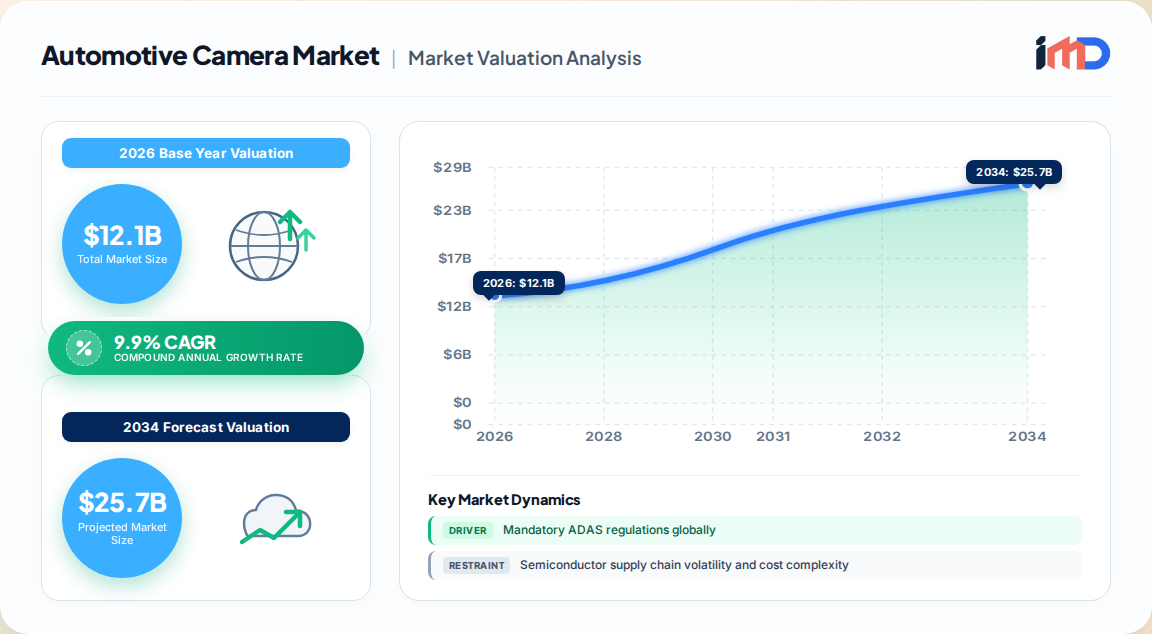
The global automotive camera market is valued at US$ 12.1 billion in 2026 and is projected to reach US$ 23.6 billion by 2033, expanding at a compound annual growth rate of 9.9% over the forecast period. This growth is underpinned by the universal adoption of Advanced Driver Assistance Systems (ADAS), regulatory mandates for safety technologies, and the accelerating transition toward electric and autonomous vehicles.

Automotive Camera Market Size (In Billion)

20.0B
15.0B
10.0B
5.0B
0
11.01 B
2025
12.10 B
2026
13.30 B
2027
14.61 B
2028
16.06 B
2029
17.65 B
2030
19.40 B
2031
Main Logo

Our proprietary primary research, based on extensive interviews with OEMs, Tier-1 suppliers, and regulatory bodies, indicates that the market is moving beyond simple rear-view and parking cameras to sophisticated multi-camera systems that serve as the eyes of autonomous driving platforms. The historical CAGR from 2020 to 2025 stood at 6.7%, reflecting the initial wave of ADAS adoption, but the current period is characterized by higher resolution sensors, AI-enabled processing, and the integration of in-cabin monitoring.

Key highlights from our analysis include:

  • Asia Pacific dominates the market with approximately 40% share, driven by high vehicle production in China and India, and rapid ADAS adoption.
  • Digital/CMOS sensors hold around 72% of the technology segment, favored for their high resolution, cost-efficiency, and compatibility with ADAS and parking systems.
  • Monocular camera systems lead the hardware type segment with approximately 60% share, as cost-effective single-lens solutions remain predominant in entry- and mid-level vehicles.

Market Drivers: Regulatory Mandates and Technological Advancements

The automotive camera market is experiencing robust growth, primarily driven by mandatory ADAS regulations and technological advancements in image sensors.

Mandatory ADAS Regulatory Frameworks: Government regulations have evolved from voluntary guidelines to enforceable mandates, representing the most significant catalyst for growth. Frameworks now require specific safety technologies, such as forward-facing cameras for Automatic Emergency Braking (AEB) and driver-monitoring systems for drowsiness detection, as prerequisites for new vehicle compliance. This regulatory shift transforms ADAS features from optional enhancements into standard equipment, directly driving unit adoption across all passenger car segments. The impact is substantial: they establish a guaranteed baseline demand for compliant camera systems, ensuring near-universal attachment rates in regulated regions. As a result, automotive manufacturers are compelled to integrate advanced imaging solutions into every new vehicle platform, supporting a predictable and sustained volume of sensor deployments. This creates a structural growth driver for ADAS camera suppliers, incentivizing investment in high-resolution imaging, compact sensor modules, and integration-ready software to meet evolving safety requirements while enabling compliance-driven market expansion.

Technological Advancements in Image Sensors: Rapid innovation in image sensor technology is a key driver of ADAS camera adoption, enhancing safety performance and enabling new functionalities. CMOS digital sensors currently dominate the market, but thermal long-wave infrared (LWIR) sensors are expanding rapidly due to their ability to detect objects in low-visibility conditions, such as fog, rain, or nighttime driving. Advances in AI-enabled image processing allow real-time object recognition and hazard detection, improving system reliability while reducing per-module costs. These technological improvements also support broader ADAS integration in electric and high-end vehicles, where enhanced sensing capabilities are critical for autonomous features. By combining multi-spectral imaging with AI-driven analytics, manufacturers can achieve higher safety ratings and comply with stringent safety protocols more efficiently. In May 2024, Samsung showcased its 8.3MP ISOCELL Auto 1H1 sensor at Auto-Sens, Detroit, within the Automotive Technology sector. This imager offers a 120 dB dynamic range and LED Flicker Mitigation, improving visibility in challenging lighting conditions, which reduces board size and eliminates the need for external serializers, directly addressing cost and integration complexity.

Market Barriers: Supply Chain Volatility and Cost Complexity

The automotive camera market faces major challenges due to the fragility of the semiconductor supply chain. High-end cameras depend on specialized CMOS Image Sensors (CIS) and Image Signal Processors (ISPs), which are often produced alongside consumer electronics, exposing the sector to demand spikes across industries. Production concentration among a few suppliers creates vulnerability to disruptions from geopolitical tensions, natural disasters, or logistical failures. The automotive qualification process adds to this, as switching suppliers requires time-consuming and costly re-validation. As camera resolutions rise (8MP+ ADAS systems), processing and system-level costs increase, particularly with high-speed data architectures such as Automotive Ethernet or GMSL2. Unpredictable ordering patterns and inventory fluctuations further destabilize pricing. In response, Sony's October 2025 introduction of the IMX828 sensor with a built-in MIPI A-PHY interface addresses cost and integration challenges by reducing board size and eliminating the need for external serializers.

Opportunities: Convergence of In-Cabin Monitoring and Health Technology

The integration of Driver Monitoring Systems (DMS) with broader health and safety technologies offers significant growth potential for the automotive camera market. Modern DMS can evolve into Occupant Monitoring Systems (OMS), capable of detecting child presence and monitoring passenger vitals using non-contact methods such as remote photoplethysmography (rPPG). This not only enhances safety, such as preventing heatstroke incidents, but also creates new opportunities for wellness applications, real-time health monitoring, and personalized infotainment. By embedding AI-driven analytics, manufacturers can differentiate their vehicles, improve passenger experience, and open new revenue streams. In July 2025, Magna International secured five new OEM programs for Child Presence Detection (CPD), a critical safety application enabled by in-cabin cameras. Thermal cameras for Level 3+ autonomous driving also represent a significant opportunity, as they provide robust perception in adverse weather conditions.

Segmentation Analysis

The automotive camera market is segmented by vehicle type, technology, hardware type, application, and region.

By Vehicle Type:

  • Passenger Cars: The largest segment, driven by high production volumes and increasing ADAS fitment rates.
  • Others: Includes commercial vehicles, which are increasingly adopting camera systems for fleet safety and compliance.

By Technology:

  • Digital/CMOS: Dominates with ~72% share, due to high resolution, cost-effectiveness, and integration ease.
  • Others: Includes analog and thermal cameras, with thermal gaining traction for night vision and adverse weather.

By Hardware Type:

  • Monocular: Holds ~60% share, as single-lens solutions are cost-effective for basic ADAS and parking.
  • Stereo: Growing due to demand for depth sensing in autonomous driving.
  • Triple/Multi-lens: Emerging for surround-view and advanced ADAS.

By Application:

  • ADAS: Largest application, including lane departure warning, automatic emergency braking, and adaptive cruise control.
  • Parking/Surround View: Growing rapidly due to consumer demand for parking assistance.
  • Others: Includes in-cabin monitoring and driver monitoring.
Segment Sub-segment Market Share (2026E) Key Drivers
Vehicle Type Passenger Cars ~75% High production, ADAS mandates
Technology Digital/CMOS ~72% Resolution, cost, integration
Hardware Monocular ~60% Cost-effective for mass-market
Application ADAS ~55% Safety regulations, autonomy

Regional Insights

Asia Pacific leads the global automotive camera market with approximately 40% share, supported by high vehicle production volumes in China and India, rapid adoption of ADAS technologies, and strong government safety regulations. China's New Car Assessment Program (C-NCAP) and India's Bharat NCAP are driving camera fitment. The region is also the fastest-growing, with a projected CAGR of over 11% during 2026-2033.

Automotive Camera Regional Market Share

Loading chart...
Main Logo

North America is the second-largest market, driven by stringent safety regulations from NHTSA and consumer demand for advanced safety features. The U.S. mandates rear-view cameras for all new vehicles, and ADAS adoption is rising.

Europe is a mature market with high ADAS penetration, supported by EU regulations such as the General Safety Regulation requiring cameras for AEB and driver monitoring. The region is expected to grow at a steady pace, with a focus on high-resolution and multi-camera systems.

South America and Middle East & Africa are emerging markets, with growing vehicle production and increasing awareness of safety technologies, albeit from a smaller base.

Competitive Landscape

The automotive camera market is highly competitive, with key players including Robert Bosch GmbH, Continental AG, Aptiv PLC, Magna International Inc., Denso Corporation, Valeo, Mobileye, and Sony.

Recent strategic developments:

  • In May 2024, Samsung showcased its 8.3MP ISOCELL Auto 1H1 sensor with 120 dB dynamic range.
  • In July 2025, Magna International secured five new OEM programs for Child Presence Detection (CPD).
  • In October 2025, Sony introduced the IMX828 sensor with built-in MIPI A-PHY interface.

Companies are focusing on mergers and acquisitions to enhance their technological capabilities and expand their market presence. For instance, Continental AG developed the multifunction mono camera MFC500, integrated with neural network and machine learning. Tier-1 suppliers are also forming partnerships with semiconductor companies to secure supply and co-develop advanced sensors.

Value Chain Analysis

The automotive camera value chain comprises several stages:

  • Raw Material and Component Suppliers: Providers of CMOS image sensors, lenses, image signal processors, and other electronic components. Key players include Sony, Samsung, and ON Semiconductor.
  • Camera Module Manufacturers: Companies that assemble sensors, lenses, and processors into camera modules. Tier-1 suppliers like Bosch, Continental, and Valeo often perform this role.
  • System Integrators: Integrate cameras into ADAS and vehicle platforms, including software and hardware integration. Companies like Aptiv and Magna.
  • OEMs: Automakers who install cameras in vehicles. They specify requirements and drive demand.
  • Aftermarket: Suppliers of replacement cameras and retrofitting kits.

The value chain is characterized by high barriers to entry due to stringent automotive qualification standards, long design-in cycles, and the need for deep integration with vehicle systems. Supply chain risks are concentrated in semiconductor fabrication, where a few foundries dominate advanced node production.

Strategic White-Space Analysis

Our analysis identifies several high-potential whitespace opportunities:

  • In-Cabin Health Monitoring: Integrating vital sign monitoring and health analytics into DMS/OMS systems can create new revenue streams and differentiate OEM offerings.
  • Thermal Camera Fusion: Combining thermal and visible cameras for robust perception in all weather conditions is crucial for Level 3+ autonomy.
  • Aftermarket ADAS Retrofits: As regulations expand to older vehicles, the aftermarket segment for camera-based ADAS presents significant growth potential, especially in emerging markets.
  • Software-Defined Camera Systems: Developing over-the-air updatable camera features and subscription-based services can unlock recurring revenue.

Import/Export & Supplier Dynamics

The automotive camera market is global, with significant trade flows. Major exporting countries include Japan, Germany, South Korea, and China, while the largest importers are the United States, Germany, and China. According to UN Comtrade data, global trade in automotive cameras and sensors exceeded US$ 8 billion in 2025, with Japan and Germany accounting for over 40% of exports. The supply chain is heavily reliant on semiconductor components, with CMOS image sensors being the most traded component. Recent geopolitical tensions and trade restrictions have prompted OEMs to diversify sourcing and increase regional production. For instance, the U.S. Inflation Reduction Act and the EU Chips Act aim to boost domestic semiconductor manufacturing, which could reshape supply dynamics in the long term. Key suppliers like Sony and Samsung are expanding capacity in multiple regions to mitigate risk.

Automotive Camera Regional Market Share

Higher Coverage
Lower Coverage
No Coverage

Automotive Camera REPORT HIGHLIGHTS

AspectsDetails
Study Period2020-2034
Base Year2026
Estimated Year2026
Forecast Period2026-2034
Historical Period2020-2025
Growth RateCAGR of 9.9% from 2020-2034
Segmentation
  • By Vehicle Type

    • Passenger Cars
    • Others
  • By Technology

    • Digital/CMOS
    • Others

Table of Contents

  1. 1. Automotive Camera Introduction
    • 1.1. Research Scope
    • 1.2. Market Segmentation
    • 1.3. Research Objective
    • 1.4. Definitions and Assumptions
  2. 2. Automotive Camera Executive Summary
    • 2.1. Market Snapshot
  3. 3. Automotive Camera Dynamics
    • 3.1. Market Drivers
      • 3.1.1. Mandatory ADAS regulations globally
      • 3.1.2. Technological advancements in image sensors and AI processing
      • 3.1.3. Growing demand for enhanced vehicle safety features
      • 3.1.4. Rise of electric and autonomous vehicles
    • 3.2. Market Trends
      • 3.2.1. Increasing adoption of ADAS and autonomous driving features
      • 3.2.2. Shift towards high-resolution digital CMOS sensors
      • 3.2.3. Integration of in-cabin monitoring and health technology
      • 3.2.4. Rise of thermal cameras for adverse weather perception
    • 3.3. Market Restraints
      • 3.3.1. Semiconductor supply chain volatility and cost complexity
      • 3.3.2. High development and integration costs for advanced camera systems
    • 3.4. Market Challenges
      • 3.4.1. Ensuring reliability and durability in harsh automotive environments
      • 3.4.2. Managing data processing and bandwidth requirements
      • 3.4.3. Meeting stringent automotive qualification standards

By Hardware Type

  • Monocular
  • Stereo
  • Triple/Multi-lens
  • By Application

    • ADAS
    • Parking/Surround View
    • Others
  • By Geography
    • North America

      • USA
      • Canada
      • Mexico
    • Europe

      • Germany
      • UK
      • France
      • Italy
    • Asia Pacific

      • China
      • Japan
      • India
      • South Korea
    • South America

      • Brazil
      • Argentina
    • Middle East & Africa

      • South Africa
      • UAE
  • 4. Automotive Camera Factor Analysis
    • 4.1. Porters Five Forces
      • 4.1.1. Bargaining Power of Suppliers
      • 4.1.2. Bargaining Power of Buyers
      • 4.1.3. Threat of New Entrants
      • 4.1.4. Threat of Substitutes
      • 4.1.5. Competitive Rivalry
    • 4.2. PESTEL analysis
    • 4.3. BCG Analysis
      • 4.3.1. Stars (High Growth, High Market Share)
      • 4.3.2. Cash Cows (Low Growth, High Market Share)
      • 4.3.3. Question Mark (High Growth, Low Market Share)
      • 4.3.4. Dogs (Low Growth, Low Market Share)
    • 4.4. Ansoff Matrix Analysis
    • 4.5. Supply Chain Analysis
    • 4.6. Regulatory Landscape
    • 4.7. Current Market Potential and Opportunity Assessment (TAM–SAM–SOM Framework)
    • 4.8. IMD Analyst Note
  • 5. Automotive Camera Analysis, Insights and Forecast, 2020-2034
    • 5.1. Analysis, Insights and Forecast - by Vehicle Type
      • 5.1.1. Passenger Cars
      • 5.1.2. Others
    • 5.2. Analysis, Insights and Forecast - by Technology
      • 5.2.1. Digital/CMOS
      • 5.2.2. Others
    • 5.3. Analysis, Insights and Forecast - by Hardware Type
      • 5.3.1. Monocular
      • 5.3.2. Stereo
      • 5.3.3. Triple/Multi-lens
    • 5.4. Analysis, Insights and Forecast - by Application
      • 5.4.1. ADAS
      • 5.4.2. Parking/Surround View
      • 5.4.3. Others
    • 5.5. Analysis, Insights and Forecast - by Region
      • 5.5.1. North America
      • 5.5.2. Europe
      • 5.5.3. Asia Pacific
      • 5.5.4. South America
      • 5.5.5. Middle East & Africa
  • 6. Automotive Camera North America Analysis, Insights and Forecast, 2020-2034
    • 6.1. Analysis, Insights and Forecast - by Vehicle Type
      • 6.1.1. Passenger Cars
      • 6.1.2. Others
    • 6.2. Analysis, Insights and Forecast - by Technology
      • 6.2.1. Digital/CMOS
      • 6.2.2. Others
    • 6.3. Analysis, Insights and Forecast - by Hardware Type
      • 6.3.1. Monocular
      • 6.3.2. Stereo
      • 6.3.3. Triple/Multi-lens
    • 6.4. Analysis, Insights and Forecast - by Application
      • 6.4.1. ADAS
      • 6.4.2. Parking/Surround View
      • 6.4.3. Others
  • 7. Automotive Camera Europe Analysis, Insights and Forecast, 2020-2034
    • 7.1. Analysis, Insights and Forecast - by Vehicle Type
      • 7.1.1. Passenger Cars
      • 7.1.2. Others
    • 7.2. Analysis, Insights and Forecast - by Technology
      • 7.2.1. Digital/CMOS
      • 7.2.2. Others
    • 7.3. Analysis, Insights and Forecast - by Hardware Type
      • 7.3.1. Monocular
      • 7.3.2. Stereo
      • 7.3.3. Triple/Multi-lens
    • 7.4. Analysis, Insights and Forecast - by Application
      • 7.4.1. ADAS
      • 7.4.2. Parking/Surround View
      • 7.4.3. Others
  • 8. Automotive Camera Asia Pacific Analysis, Insights and Forecast, 2020-2034
    • 8.1. Analysis, Insights and Forecast - by Vehicle Type
      • 8.1.1. Passenger Cars
      • 8.1.2. Others
    • 8.2. Analysis, Insights and Forecast - by Technology
      • 8.2.1. Digital/CMOS
      • 8.2.2. Others
    • 8.3. Analysis, Insights and Forecast - by Hardware Type
      • 8.3.1. Monocular
      • 8.3.2. Stereo
      • 8.3.3. Triple/Multi-lens
    • 8.4. Analysis, Insights and Forecast - by Application
      • 8.4.1. ADAS
      • 8.4.2. Parking/Surround View
      • 8.4.3. Others
  • 9. Automotive Camera South America Analysis, Insights and Forecast, 2020-2034
    • 9.1. Analysis, Insights and Forecast - by Vehicle Type
      • 9.1.1. Passenger Cars
      • 9.1.2. Others
    • 9.2. Analysis, Insights and Forecast - by Technology
      • 9.2.1. Digital/CMOS
      • 9.2.2. Others
    • 9.3. Analysis, Insights and Forecast - by Hardware Type
      • 9.3.1. Monocular
      • 9.3.2. Stereo
      • 9.3.3. Triple/Multi-lens
    • 9.4. Analysis, Insights and Forecast - by Application
      • 9.4.1. ADAS
      • 9.4.2. Parking/Surround View
      • 9.4.3. Others
  • 10. Automotive Camera Middle East & Africa Analysis, Insights and Forecast, 2020-2034
    • 10.1. Analysis, Insights and Forecast - by Vehicle Type
      • 10.1.1. Passenger Cars
      • 10.1.2. Others
    • 10.2. Analysis, Insights and Forecast - by Technology
      • 10.2.1. Digital/CMOS
      • 10.2.2. Others
    • 10.3. Analysis, Insights and Forecast - by Hardware Type
      • 10.3.1. Monocular
      • 10.3.2. Stereo
      • 10.3.3. Triple/Multi-lens
    • 10.4. Analysis, Insights and Forecast - by Application
      • 10.4.1. ADAS
      • 10.4.2. Parking/Surround View
      • 10.4.3. Others
  • 11. Automotive Camera Competitive Analysis
    • 11.1. Company Profiles
      • 11.1.1. Robert Bosch GmbH
        • 11.1.1.1. Company Overview
        • 11.1.1.2. Products
        • 11.1.1.3. Company Financials
        • 11.1.1.4. SWOT Analysis
      • 11.1.2. Continental AG
        • 11.1.2.1. Company Overview
        • 11.1.2.2. Products
        • 11.1.2.3. Company Financials
        • 11.1.2.4. SWOT Analysis
      • 11.1.3. Aptiv PLC
        • 11.1.3.1. Company Overview
        • 11.1.3.2. Products
        • 11.1.3.3. Company Financials
        • 11.1.3.4. SWOT Analysis
      • 11.1.4. Magna International Inc.
        • 11.1.4.1. Company Overview
        • 11.1.4.2. Products
        • 11.1.4.3. Company Financials
        • 11.1.4.4. SWOT Analysis
      • 11.1.5. Denso Corporation
        • 11.1.5.1. Company Overview
        • 11.1.5.2. Products
        • 11.1.5.3. Company Financials
        • 11.1.5.4. SWOT Analysis
      • 11.1.6. Valeo
        • 11.1.6.1. Company Overview
        • 11.1.6.2. Products
        • 11.1.6.3. Company Financials
        • 11.1.6.4. SWOT Analysis
      • 11.1.7. Mobileye
        • 11.1.7.1. Company Overview
        • 11.1.7.2. Products
        • 11.1.7.3. Company Financials
        • 11.1.7.4. SWOT Analysis
      • 11.1.8. Sony
        • 11.1.8.1. Company Overview
        • 11.1.8.2. Products
        • 11.1.8.3. Company Financials
        • 11.1.8.4. SWOT Analysis
      • 11.1.9. Samsung
        • 11.1.9.1. Company Overview
        • 11.1.9.2. Products
        • 11.1.9.3. Company Financials
        • 11.1.9.4. SWOT Analysis
      • 11.1.10. Ambarella
        • 11.1.10.1. Company Overview
        • 11.1.10.2. Products
        • 11.1.10.3. Company Financials
        • 11.1.10.4. SWOT Analysis
      • 11.1.11. NVIDIA
        • 11.1.11.1. Company Overview
        • 11.1.11.2. Products
        • 11.1.11.3. Company Financials
        • 11.1.11.4. SWOT Analysis
      • 11.1.12. Veoneer
        • 11.1.12.1. Company Overview
        • 11.1.12.2. Products
        • 11.1.12.3. Company Financials
        • 11.1.12.4. SWOT Analysis
    • 11.2. Market Entropy
      • 11.2.1. Company's Key Areas Served
      • 11.2.2. Recent Developments
    • 11.3. Company Market Share Analysis, 2026
      • 11.3.1. Top 5 Companies Market Share Analysis
      • 11.3.2. Top 3 Companies Market Share Analysis
    • 11.4. List of Potential Customers
  • List of Figures

    1. Figure 1: Global Automotive Camera Revenue Breakdown (Billion, %) by Region 2026 & 2034
    2. Figure 2: North America Automotive Camera Revenue (Billion), by Vehicle Type 2026 & 2034
    3. Figure 3: North America Automotive Camera Revenue Share (%), by Vehicle Type 2026 & 2034
    4. Figure 4: North America Automotive Camera Revenue (Billion), by Technology 2026 & 2034
    5. Figure 5: North America Automotive Camera Revenue Share (%), by Technology 2026 & 2034
    6. Figure 6: North America Automotive Camera Revenue (Billion), by Hardware Type 2026 & 2034
    7. Figure 7: North America Automotive Camera Revenue Share (%), by Hardware Type 2026 & 2034
    8. Figure 8: North America Automotive Camera Revenue (Billion), by Application 2026 & 2034
    9. Figure 9: North America Automotive Camera Revenue Share (%), by Application 2026 & 2034
    10. Figure 10: North America Automotive Camera Revenue (Billion), by Country 2026 & 2034
    11. Figure 11: North America Automotive Camera Revenue Share (%), by Country 2026 & 2034
    12. Figure 12: Europe Automotive Camera Revenue (Billion), by Vehicle Type 2026 & 2034
    13. Figure 13: Europe Automotive Camera Revenue Share (%), by Vehicle Type 2026 & 2034
    14. Figure 14: Europe Automotive Camera Revenue (Billion), by Technology 2026 & 2034
    15. Figure 15: Europe Automotive Camera Revenue Share (%), by Technology 2026 & 2034
    16. Figure 16: Europe Automotive Camera Revenue (Billion), by Hardware Type 2026 & 2034
    17. Figure 17: Europe Automotive Camera Revenue Share (%), by Hardware Type 2026 & 2034
    18. Figure 18: Europe Automotive Camera Revenue (Billion), by Application 2026 & 2034
    19. Figure 19: Europe Automotive Camera Revenue Share (%), by Application 2026 & 2034
    20. Figure 20: Europe Automotive Camera Revenue (Billion), by Country 2026 & 2034
    21. Figure 21: Europe Automotive Camera Revenue Share (%), by Country 2026 & 2034
    22. Figure 22: Asia Pacific Automotive Camera Revenue (Billion), by Vehicle Type 2026 & 2034
    23. Figure 23: Asia Pacific Automotive Camera Revenue Share (%), by Vehicle Type 2026 & 2034
    24. Figure 24: Asia Pacific Automotive Camera Revenue (Billion), by Technology 2026 & 2034
    25. Figure 25: Asia Pacific Automotive Camera Revenue Share (%), by Technology 2026 & 2034
    26. Figure 26: Asia Pacific Automotive Camera Revenue (Billion), by Hardware Type 2026 & 2034
    27. Figure 27: Asia Pacific Automotive Camera Revenue Share (%), by Hardware Type 2026 & 2034
    28. Figure 28: Asia Pacific Automotive Camera Revenue (Billion), by Application 2026 & 2034
    29. Figure 29: Asia Pacific Automotive Camera Revenue Share (%), by Application 2026 & 2034
    30. Figure 30: Asia Pacific Automotive Camera Revenue (Billion), by Country 2026 & 2034
    31. Figure 31: Asia Pacific Automotive Camera Revenue Share (%), by Country 2026 & 2034
    32. Figure 32: South America Automotive Camera Revenue (Billion), by Vehicle Type 2026 & 2034
    33. Figure 33: South America Automotive Camera Revenue Share (%), by Vehicle Type 2026 & 2034
    34. Figure 34: South America Automotive Camera Revenue (Billion), by Technology 2026 & 2034
    35. Figure 35: South America Automotive Camera Revenue Share (%), by Technology 2026 & 2034
    36. Figure 36: South America Automotive Camera Revenue (Billion), by Hardware Type 2026 & 2034
    37. Figure 37: South America Automotive Camera Revenue Share (%), by Hardware Type 2026 & 2034
    38. Figure 38: South America Automotive Camera Revenue (Billion), by Application 2026 & 2034
    39. Figure 39: South America Automotive Camera Revenue Share (%), by Application 2026 & 2034
    40. Figure 40: South America Automotive Camera Revenue (Billion), by Country 2026 & 2034
    41. Figure 41: South America Automotive Camera Revenue Share (%), by Country 2026 & 2034
    42. Figure 42: Middle East & Africa Automotive Camera Revenue (Billion), by Vehicle Type 2026 & 2034
    43. Figure 43: Middle East & Africa Automotive Camera Revenue Share (%), by Vehicle Type 2026 & 2034
    44. Figure 44: Middle East & Africa Automotive Camera Revenue (Billion), by Technology 2026 & 2034
    45. Figure 45: Middle East & Africa Automotive Camera Revenue Share (%), by Technology 2026 & 2034
    46. Figure 46: Middle East & Africa Automotive Camera Revenue (Billion), by Hardware Type 2026 & 2034
    47. Figure 47: Middle East & Africa Automotive Camera Revenue Share (%), by Hardware Type 2026 & 2034
    48. Figure 48: Middle East & Africa Automotive Camera Revenue (Billion), by Application 2026 & 2034
    49. Figure 49: Middle East & Africa Automotive Camera Revenue Share (%), by Application 2026 & 2034
    50. Figure 50: Middle East & Africa Automotive Camera Revenue (Billion), by Country 2026 & 2034
    51. Figure 51: Middle East & Africa Automotive Camera Revenue Share (%), by Country 2026 & 2034

    List of Tables

    1. Table 1: Global Automotive Camera Revenue Billion Forecast, by Vehicle Type 2020 & 2034
    2. Table 2: Global Automotive Camera Revenue Billion Forecast, by Technology 2020 & 2034
    3. Table 3: Global Automotive Camera Revenue Billion Forecast, by Hardware Type 2020 & 2034
    4. Table 4: Global Automotive Camera Revenue Billion Forecast, by Application 2020 & 2034
    5. Table 5: Global Automotive Camera Revenue Billion Forecast, by Region 2020 & 2034
    6. Table 6: North America Automotive Camera Revenue Billion Forecast, by Vehicle Type 2020 & 2034
    7. Table 7: North America Automotive Camera Revenue Billion Forecast, by Technology 2020 & 2034
    8. Table 8: North America Automotive Camera Revenue Billion Forecast, by Hardware Type 2020 & 2034
    9. Table 9: North America Automotive Camera Revenue Billion Forecast, by Application 2020 & 2034
    10. Table 10: North America Automotive Camera Revenue Billion Forecast, by Country 2020 & 2034
    11. Table 11: USA Automotive Camera Revenue (Billion) Forecast, by Application 2020 & 2034
    12. Table 12: Canada Automotive Camera Revenue (Billion) Forecast, by Application 2020 & 2034
    13. Table 13: Mexico Automotive Camera Revenue (Billion) Forecast, by Application 2020 & 2034
    14. Table 14: Europe Automotive Camera Revenue Billion Forecast, by Vehicle Type 2020 & 2034
    15. Table 15: Europe Automotive Camera Revenue Billion Forecast, by Technology 2020 & 2034
    16. Table 16: Europe Automotive Camera Revenue Billion Forecast, by Hardware Type 2020 & 2034
    17. Table 17: Europe Automotive Camera Revenue Billion Forecast, by Application 2020 & 2034
    18. Table 18: Europe Automotive Camera Revenue Billion Forecast, by Country 2020 & 2034
    19. Table 19: Germany Automotive Camera Revenue (Billion) Forecast, by Application 2020 & 2034
    20. Table 20: UK Automotive Camera Revenue (Billion) Forecast, by Application 2020 & 2034
    21. Table 21: France Automotive Camera Revenue (Billion) Forecast, by Application 2020 & 2034
    22. Table 22: Italy Automotive Camera Revenue (Billion) Forecast, by Application 2020 & 2034
    23. Table 23: Asia Pacific Automotive Camera Revenue Billion Forecast, by Vehicle Type 2020 & 2034
    24. Table 24: Asia Pacific Automotive Camera Revenue Billion Forecast, by Technology 2020 & 2034
    25. Table 25: Asia Pacific Automotive Camera Revenue Billion Forecast, by Hardware Type 2020 & 2034
    26. Table 26: Asia Pacific Automotive Camera Revenue Billion Forecast, by Application 2020 & 2034
    27. Table 27: Asia Pacific Automotive Camera Revenue Billion Forecast, by Country 2020 & 2034
    28. Table 28: China Automotive Camera Revenue (Billion) Forecast, by Application 2020 & 2034
    29. Table 29: Japan Automotive Camera Revenue (Billion) Forecast, by Application 2020 & 2034
    30. Table 30: India Automotive Camera Revenue (Billion) Forecast, by Application 2020 & 2034
    31. Table 31: South Korea Automotive Camera Revenue (Billion) Forecast, by Application 2020 & 2034
    32. Table 32: South America Automotive Camera Revenue Billion Forecast, by Vehicle Type 2020 & 2034
    33. Table 33: South America Automotive Camera Revenue Billion Forecast, by Technology 2020 & 2034
    34. Table 34: South America Automotive Camera Revenue Billion Forecast, by Hardware Type 2020 & 2034
    35. Table 35: South America Automotive Camera Revenue Billion Forecast, by Application 2020 & 2034
    36. Table 36: South America Automotive Camera Revenue Billion Forecast, by Country 2020 & 2034
    37. Table 37: Brazil Automotive Camera Revenue (Billion) Forecast, by Application 2020 & 2034
    38. Table 38: Argentina Automotive Camera Revenue (Billion) Forecast, by Application 2020 & 2034
    39. Table 39: Middle East & Africa Automotive Camera Revenue Billion Forecast, by Vehicle Type 2020 & 2034
    40. Table 40: Middle East & Africa Automotive Camera Revenue Billion Forecast, by Technology 2020 & 2034
    41. Table 41: Middle East & Africa Automotive Camera Revenue Billion Forecast, by Hardware Type 2020 & 2034
    42. Table 42: Middle East & Africa Automotive Camera Revenue Billion Forecast, by Application 2020 & 2034
    43. Table 43: Middle East & Africa Automotive Camera Revenue Billion Forecast, by Country 2020 & 2034
    44. Table 44: South Africa Automotive Camera Revenue (Billion) Forecast, by Application 2020 & 2034
    45. Table 45: UAE Automotive Camera Revenue (Billion) Forecast, by Application 2020 & 2034

    Frequently Asked Questions

    1What is the size of the automotive camera market in 2026?

    The global automotive camera market is valued at US$ 12.1 billion in 2026, based on our proprietary primary research and demand modeling.

    2Why are mandatory ADAS regulations a primary driver for the automotive camera market?

    Mandatory ADAS regulations, such as those from NHTSA and the EU, require cameras for AEB, lane keeping, and driver monitoring, creating guaranteed baseline demand and near-universal attachment rates.

    3What is the projected growth rate for the automotive camera market?

    The market is projected to grow at a CAGR of 9.9% from 2026 to 2033, reaching US$ 23.6 billion by 2033.

    4Which region dominates the automotive camera market?

    Asia Pacific holds the largest share at approximately 40%, driven by high vehicle production in China and India, and rapid ADAS adoption.

    5What are the key trends in automotive camera technology?

    Key trends include the shift to digital CMOS sensors, adoption of thermal cameras for adverse weather, and integration of AI for real-time object detection and in-cabin monitoring.

    Methodology

    Our rigorous research methodology combines multi-layered approaches with comprehensive quality assurance, ensuring precision, accuracy, and reliability in every market analysis.

    Primary Research

    • Conducted 70-80% of research through primary interviews with 150+ industry experts across the value chain, including CMOS image sensor manufacturers, camera module suppliers, Tier-1 system integrators, automotive OEMs, and aftermarket distributors.
    • Interviewed stakeholders such as Procurement Directors, R&D Heads, Product Managers, and Regulatory Affairs Specialists to gather granular insights on adoption trends, pricing, and technology roadmaps.
    • Employed a structured questionnaire and in-depth discussions to capture both quantitative data and qualitative perspectives.

    Key Stakeholders Interviewed

    Main Logo
    Key Stakeholders Interviewed
    Stakeholder RoleInterview Share (%)
    Procurement Director35%
    R&D Head30%
    Product Manager20%
    Regulatory Affairs Specialist15%

    Industry Ecosystem Breakdown

    Main Logo
    Industry Ecosystem Breakdown
    Company TypeRepresentation (%)
    CMOS Image Sensor Manufacturers30%
    Camera Module & Lens Suppliers25%
    Tier-1 Automotive System Integrators25%
    Automotive OEMs15%
    Aftermarket Distributors5%

    Secondary Research & Industry Benchmarking

    • Supplemented primary research with 20-30% secondary research from official sources such as UN Comtrade, World Bank, OECD, and industry associations like SAE International and the National Highway Traffic Safety Administration (NHTSA).
    • Utilized financial databases including Bloomberg, Factiva, Hoovers, and PitchBook to validate company financials, market shares, and strategic moves.
    • Benchmarked market estimates against historical data from 2020-2025 and cross-checked with trade statistics and vehicle production data.

    Demand Modeling & Market Estimation

    • Built a bottom-up demand model using quantitative metrics such as vehicle production volumes by region, ADAS penetration rates, average camera fitment per vehicle, and replacement rates.
    • Simultaneously applied a top-down approach using total industry revenue from key suppliers and their market shares, validated through multi-level data triangulation.
    • Segmented the market by vehicle type, technology, hardware, application, and region to derive granular forecasts.

    Data Accuracy & Quality Check

    • Ensured an estimated data accuracy level of 85-90% through rigorous validation, including triangulation of primary and secondary data, and review by senior analysts.
    • Conducted sanity checks against historical trends and industry benchmarks, and updated all data to the date of purchase to reflect the latest market dynamics.
    • Implemented a multi-stage quality control process to eliminate biases and ensure reliability of the final report.
    Author
    Sadashiv Parab

    Sadashiv Parab

    Research Analyst

    I am a Research Analyst specializing in the Automotive, Automotive and Transportation, Industrials, and Industrial Automation & Equipment sectors, bringing robust experience in market intelligence and strategic analysis. My core expertise encompasses accurate market sizing, forecasting, competitive benchmarking, and tracking fast-moving global supply chain impacts. Combining technical analysis with deep consumer behavior trends, I transform complex developments into clear, actionable insights that support high-impact business decision-making.

    Get In Touch
    WHY IMD

    Verified research

    Analyst-reviewed data

    Updated Nov 07, 2026

    sponsor image
    sponsor image
    sponsor image
    sponsor image
    sponsor image
    sponsor image
    sponsor image
    sponsor image
    sponsor image
    sponsor image
    sponsor image
    sponsor image
    sponsor image
    sponsor image
    sponsor image
    sponsor image
    sponsor image
    sponsor image
    sponsor image
    sponsor image
    CUSTOM INTELLIGENCE

    Tailored for you

    • In-depth Analysis Tailored to Specified Regions or Segments
    • Company Profiles Customized to User Preferences
    • Customized Evaluation of Competitive Landscape to Meet Your Needs
    Ask for customization
    avatar

    Analyst at Providence Strategic Partners at Petaling Jaya

    Jared Wan

    I have received the report already. Thanks you for your help.it has been a pleasure working with you. Thank you again for a good quality report

    avatar

    Internationalization Director

    Santiago Mejia Molina

    Yes, as a matter of fact we are totally satisfied with both reports that we have purchased and will continue to do so during this process of the internationalization of our brand.

    avatar

    Head of Product Management and Marketing

    Olaf Gleibe

    We are using your report, and it gave us valuable information."

    avatar

    Regional Director, Marketing and Business Development

    Lina Lim

    We've received the report and have reviewed the content. Overall, it looks great and aligns closely with the data we can verify based on our industry knowledge.

    avatar

    VP of Sales

    DIGGLE Representative

    Thank you very much for sharing the report. I have reviewed it and I am very satisfied with the quality and the insights it provides. It will certainly be valuable for our internal discussions.

    artwork spiralartwork spiralRelated Reports
    artwork underline

    Tanzania Used Car Market Size, Growth & Forecast 2031

    Tanzania used car market at USD 0.85 billion in 2026, growing 7.35% CAGR to USD 1.21 billion by 2031. Explore trends, segments, and key players.

    Nov 2026|204 pages
    $2900.00View report

    The EV charging station for residential market is valued at USD 12.23 Bn in 2026 and is set to grow at a 26.35% CAGR to reach USD 49.76 Bn by 2032.

    Nov 2026|208 pages
    $2900.00

    The Automotive Parking Cooler Market is valued at USD 750 Million in 2025 and is projected to reach USD 1.34 Billion by 2035, growing at a CAGR of 6.2%.

    Nov 2026|250 pages
    $2900.00

    V2G charging station market valued at USD 5.72 Billion in 2025, projected to reach USD 37.50 Billion by 2035 at a 20.7% CAGR. Full analysis inside.

    Nov 2026|276 pages
    $2900.00

    Africa automotive engine oils market to grow from 750.88 million liters in 2026 to 843.77 million liters by 2031, at a 2.36% CAGR.

    Nov 2026|258 pages
    $2900.00
    EV Charging Station for Residential Market Report 2026-2032
    View report
    Automotive Parking Cooler Market Size, Share & Forecast 2025-2035
    View report
    V2G Charging Station Market Size, Share & Forecast 2026–2034
    View report
    Africa Automotive Engine Oils Market Size, Trends & Forecast 2031
    View report