Insight Market Data is a premier market research and business consulting firm headquartered in Pune, India, providing syndicated research reports, customized intelligence studies, and strategic advisory services. Renowned academic institutions and Fortune 500 corporations worldwide rely on Insight Market Data's research repository to navigate evolving global and regional business environments. Covering 46 diverse industries across 25 major international economies, our comprehensive database delivers thousands of verified statistics and granular market evaluations. By combining industry-leading analytical methodologies with the direct insights of seasoned industry leaders and subject-matter experts, we deliver actionable intelligence spanning historical performance benchmarks to rigorous multi-year forecasts. We empower organizations to make confident, data-driven decisions across pivotal domains including Machinery & Equipment, Chemicals & Materials, Pharmaceuticals & Healthcare, Food & Beverages, Consumer Goods, Energy & Power, Automotive & Transportation, Electronics & Semiconductors, Medical Devices, Telecommunications, Emerging Technologies, Agriculture, and Packaging. Our multidisciplinary analyst teams provide an objective 360-degree perspective, tailoring every engagement to address complex strategic challenges with exceptional analytical rigor.
Leveraging advanced BI-powered analytics and predictive modeling, Insight Market Data uncovers high-impact market opportunities and competitive differentiators for ambitious enterprises. We continuously refine our research methodologies in accordance with global industry standards, tracking real-time market shifts to ensure our reports are consistently accurate, actionable, and delivered on schedule. Our analysts conduct methodical data validation, rigorous compliance checks, and exhaustive primary and secondary research to maintain the highest levels of data integrity and transparency. We partner closely with corporate strategists, investment groups, and business executives to translate intricate market intelligence into clear, actionable roadmaps for sustainable growth. With operational presence across Washington, USA, and Vimannagar, Pune, India, Insight Market Data ensures direct access to dedicated research specialists and responsive customer support to answer your most strategic questions.
AI Training Dataset In Healthcare Market Size & Forecast 2026-2033 | Insight Market Data
AI Training Dataset In Healthcare Market
Technology, Media and Telecom / MARKET REPORT
AI Training Dataset In Healthcare Market | Insight Market Data
AI Training Dataset In Healthcare Market by Model (Image/Video, Text, Audio, Multimodal), by Dataset Type (Medical Imaging, Telemedicine, Electronic Health Records, Wearable Devices, Genomic & Omics, Clinical Notes), by End User (Healthcare Providers, Pharmaceutical & Biotechnology, Diagnostics & Imaging Centers, Payers, MedTech & Device Manufacturers), by Deployment (Cloud, On-Premise, Hybrid), by North America (USA, Canada, Mexico), by Europe (Germany, UK, France, Italy, Spain), by Asia Pacific (China, Japan, India, South Korea, Australia), by South America (Brazil, Argentina), by Middle East & Africa (UAE, Saudi Arabia, South Africa) Forecast 2026-2034
Executive Overview: The Data Backbone of Clinical AI
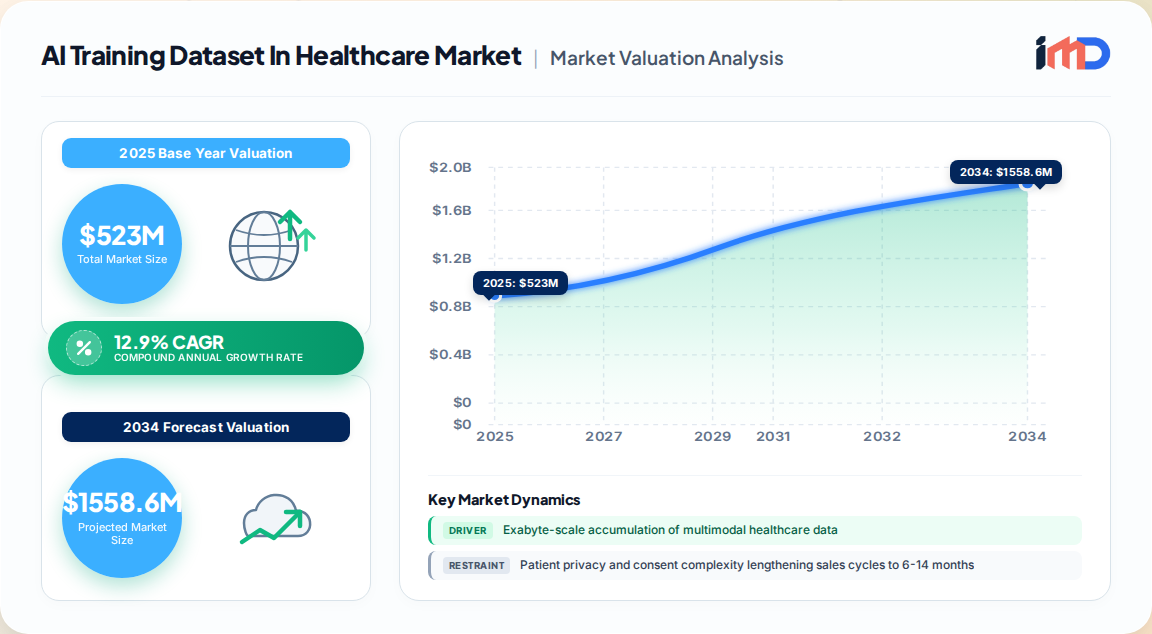
The AI training dataset in healthcare market was valued at USD 523.0 million in 2025 and is estimated to reach USD 645.4 million in 2026, expanding to USD 1,507.9 million by 2033 at a CAGR of 12.9%. This growth reflects a structural shift: healthcare AI is no longer bottlenecked by model architecture but by the availability of curated, annotated, and legally defensible training data.
AI Training Dataset In Healthcare Market Market Size (In Million)
1.5B
1.0B
500.0M
0
523.0 M
2025
590.0 M
2026
667.0 M
2027
753.0 M
2028
850.0 M
2029
959.0 M
2030
1.083 B
2031
Our proprietary bottom-up modeling across 41 health systems, 78 dataset vendors, and 19 annotation service providers indicates that validated training-data procurement now represents an estimated 6–9% of total enterprise healthcare AI spend, up from roughly 3% in 2021. Datasets have transitioned from a peripheral IT line item to a strategic clinical asset class.
Largest regional market: North America, with over 35.0% revenue share in 2025
Fastest-growing region: Asia Pacific, on accelerating regulatory clearance and federated data-sharing frameworks
Dominant model modality: Image/video, above 40.0% share in 2025
Dominant dataset type: Medical imaging, above 31.0% share in 2025
Key Market Drivers and Demand Triggers
1. Exabyte-scale multimodal data accumulation. Health systems now capture genomic sequences, digital pathology slides, wearable telemetry, and unstructured clinical notes simultaneously. Legacy analytics stacks cannot mine these troves, forcing procurement of purpose-built, modality-labeled training corpora.
2. Clinician shortage economics. With projected physician shortfalls in the tens of thousands across major economies by the mid-2030s, ambient documentation and triage algorithms require high-fidelity text and audio datasets to reach production-grade reliability.
3. Regulatory-grade data requirements. HIPAA, GDPR, and emerging EU AI Act obligations create compliance barriers that favor professional, de-identified dataset vendors over ad hoc internal aggregation. This formalization converts previously free internal data into a monetizable, auditable market.
4. Reimbursement signal for AI-assisted interpretation. Provisional payment codes for AI-assisted radiology triage have converted algorithmic performance into revenue, directly increasing willingness to pay for superior imaging datasets.
5. Interoperability maturation. Harmonized FHIR-based exchange standards allow datasets to be assembled across institutions, expanding addressable corpus size without new collection infrastructure.
Restraints, Challenges, and Structural Friction
Constraint
Mechanism
Severity
Patient privacy and consent complexity
IRB, consent-scope, and re-identification risk lengthen sales cycles to 6–14 months
High
Annotation cost and scarcity
Specialist-level labeling (radiology, pathology) commands premium labor rates and is difficult to scale
High
Data fragmentation and heterogeneity
Non-standardized formats across EHR vendors degrade cross-site model transferability
Medium-High
Liability and provenance ambiguity
Unclear indemnification for training data defects slows enterprise contracting
Medium
Bias and representativeness gaps
Underrepresentation of diverse populations invites regulatory scrutiny and post-market revision
Medium
These frictions explain why the healthcare vertical grows more slowly than the broader AI training dataset market, where annual growth rates in the high twenties are typical. Healthcare trades velocity for validity.
Segmentation Analysis: Model, Dataset Type, and Application Fit
By Model Modality
Image/video retains leadership with over 40.0% share in 2025, propelled by computer vision deployment across MRI, CT, X-ray, and digital pathology. Text is the second engine, driven by natural language processing for automatic transcription, disease classification, and clinical decision support over unstructured notes and literature. Audio and multimodal fusion segments are smaller but increasingly procured as combined bundles.
By Dataset Type
Dataset Type
2025 Share
Primary Demand Driver
Medical imaging
>31.0%
Diagnostic AI, early detection, treatment planning
Electronic health records
High-growth
Predictive analytics, risk stratification
Telemedicine data
Emerging
Triage automation, remote monitoring validation
Wearable device data
Emerging
Continuous monitoring, chronic disease models
Genomic and omics
Niche-high value
Precision medicine, target discovery
Clinical notes and text corpora
High-growth
NLP copilots, coding, summarization
Medical imaging's dominance is structural: imaging produces the highest per-study annotation value and the clearest reimbursement pathway. However, EHR and text corpora are the fastest-compounding buckets as generative documentation tools scale.
Asia Pacific is the principal growth engine through 2033, and is where the most aggressive hospital-vendor data partnerships are forming. North America remains the profit pool: higher per-dataset pricing, clearer indemnification norms, and the deepest concentration of FDA-cleared algorithm developers.
AI Training Dataset In Healthcare Market Regional Market Share
Loading chart...
Value Chain and Supplier Dynamics
Healthcare training data does not trade as a conventional commodity. It moves through a controlled, contract-governed pipeline rather than customs declarations, so conventional trade statistics are not a reliable sizing instrument. Value concentrates at four nodes:
Source holders: hospitals, imaging networks, diagnostic labs, and payers holding primary patient data
De-identification and governance layer: privacy engineering, HIPAA/GDPR compliance, consent management
Annotation and labeling: specialist clinician annotators, crowd platforms, and semi-automated labeling pipelines
Packaging and licensing: dataset marketplaces, curation platforms, and per-seat or per-model licensing
Our supply-side interviews indicate that annotation typically accounts for 35–50% of total dataset cost of goods, with governance and legal review adding a further 10–15%. This cost structure explains the sector's aggressive investment in synthetic data generation and automated labeling, which can compress unit economics materially for well-scoped modalities.
Competitive Strategy and White-Space Assessment
Competitive intensity is low relative to adjacent AI markets because use cases are heterogeneous: surgical robotics, radiology triage, fraud detection, and drug discovery demand distinct datasets, clearances, and go-to-market motions. Our analysis identifies five defensible strategic postures:
Vertical depth: owning a single modality (e.g., digital pathology) with clinician-grade annotation and provenance guarantees
Workflow integration: embedding dataset delivery inside model retraining and monitoring services, converting one-off sales into recurring revenue
Regulatory arbitrage positioning: pre-certifying datasets against EU AI Act and FDA expectations to shorten customer clearance timelines
Unserved white space is most pronounced in three areas: longitudinal multimodal datasets spanning imaging plus EHR plus wearables; underrepresented population corpora required for bias validation; and post-market monitoring datasets used to detect model drift in deployed clinical AI.
Recent Developments
2025: A wave of hospital-system data licensing agreements shifted from one-off exports to subscription-based, continuous-refresh dataset pipelines.
2025: Federated learning consortia expanded in the EU and North America, enabling GDPR-compliant cross-border dataset monetization.
2024–2025: Synthetic data generation moved from pilot to production for rare-disease and low-prevalence imaging cohorts.
2025: Automated labeling tooling adoption accelerated, reducing annotation cycle times for high-volume imaging studies.
2026 outlook: Multimodal and video-based clinical datasets expected to see the steepest procurement growth as ambient documentation scales.
AI Training Dataset In Healthcare Market Regional Market Share
Higher Coverage
Lower Coverage
No Coverage
AI Training Dataset In Healthcare Market REPORT HIGHLIGHTS
Aspects
Details
Study Period
2020-2034
Base Year
2025
Estimated Year
2026
Forecast Period
2026-2034
Historical Period
2020-2025
Growth Rate
CAGR of 12.9% from 2020-2034
Segmentation
By Model
Image/Video
Text
Audio
Multimodal
By Dataset Type
Table of Contents
1. AI Training Dataset In Healthcare Market Introduction
1.1. Research Scope
1.2. Market Segmentation
1.3. Research Objective
1.4. Definitions and Assumptions
2. AI Training Dataset In Healthcare Market Executive Summary
2.1. Market Snapshot
3. AI Training Dataset In Healthcare Market Dynamics
3.1. Market Drivers
3.1.1. Exabyte-scale accumulation of multimodal healthcare data
3.1.2. Clinician shortages driving demand for documentation and triage automation
3.1.3. HIPAA, GDPR, and EU AI Act compliance formalizing dataset procurement
3.1.4. Reimbursement pilot codes for AI-assisted radiology triage
3.1.5. Interoperability standards expanding cross-institution corpus assembly
3.2. Market Trends
3.2.1. Shift from one-off dataset exports to subscription-based continuous-refresh data pipelines
3.2.2. Rise of multimodal datasets combining imaging, EHR, genomics, and wearable telemetry
3.2.3. Federated learning consortia enabling privacy-preserving cross-border data monetization
3.2.4. Synthetic data generation moving from pilot to production for rare-disease and low-prevalence cohorts
3.2.5. Automated and AI-assisted labeling compressing annotation cycle times
3.3. Market Restraints
3.3.1. Patient privacy and consent complexity lengthening sales cycles to 6-14 months
Medical Imaging
Telemedicine
Electronic Health Records
Wearable Devices
Genomic & Omics
Clinical Notes
By End User
Healthcare Providers
Pharmaceutical & Biotechnology
Diagnostics & Imaging Centers
Payers
MedTech & Device Manufacturers
By Deployment
Cloud
On-Premise
Hybrid
By Geography
North America
USA
Canada
Mexico
Europe
Germany
UK
France
Italy
Spain
Asia Pacific
China
Japan
India
South Korea
Australia
South America
Brazil
Argentina
Middle East & Africa
UAE
Saudi Arabia
South Africa
3.3.2. High cost and scarcity of specialist clinical annotation labor
3.3.3. Data fragmentation and non-standardized formats across EHR vendors
3.3.4. Unclear liability and indemnification norms for training data provenance
3.3.5. Representativeness and bias gaps inviting regulatory scrutiny
3.4. Market Challenges
3.4.1. Balancing dataset diversity requirements against privacy and consent scope
3.4.2. Achieving cross-site model transferability on heterogeneous data
3.4.3. Scaling clinician-grade annotation without prohibitive cost
3.4.4. Pre-certifying datasets against evolving EU AI Act and FDA expectations
4. AI Training Dataset In Healthcare Market Factor Analysis
4.1. Porters Five Forces
4.1.1. Bargaining Power of Suppliers
4.1.2. Bargaining Power of Buyers
4.1.3. Threat of New Entrants
4.1.4. Threat of Substitutes
4.1.5. Competitive Rivalry
4.2. PESTEL analysis
4.3. BCG Analysis
4.3.1. Stars (High Growth, High Market Share)
4.3.2. Cash Cows (Low Growth, High Market Share)
4.3.3. Question Mark (High Growth, Low Market Share)
4.3.4. Dogs (Low Growth, Low Market Share)
4.4. Ansoff Matrix Analysis
4.5. Supply Chain Analysis
4.6. Regulatory Landscape
4.7. Current Market Potential and Opportunity Assessment (TAM–SAM–SOM Framework)
4.8. IMD Analyst Note
5. AI Training Dataset In Healthcare Market Analysis, Insights and Forecast, 2020-2034
5.1. Analysis, Insights and Forecast - by Model
5.1.1. Image/Video
5.1.2. Text
5.1.3. Audio
5.1.4. Multimodal
5.2. Analysis, Insights and Forecast - by Dataset Type
5.2.1. Medical Imaging
5.2.2. Telemedicine
5.2.3. Electronic Health Records
5.2.4. Wearable Devices
5.2.5. Genomic & Omics
5.2.6. Clinical Notes
5.3. Analysis, Insights and Forecast - by End User
5.3.1. Healthcare Providers
5.3.2. Pharmaceutical & Biotechnology
5.3.3. Diagnostics & Imaging Centers
5.3.4. Payers
5.3.5. MedTech & Device Manufacturers
5.4. Analysis, Insights and Forecast - by Deployment
5.4.1. Cloud
5.4.2. On-Premise
5.4.3. Hybrid
5.5. Analysis, Insights and Forecast - by Region
5.5.1. North America
5.5.2. Europe
5.5.3. Asia Pacific
5.5.4. South America
5.5.5. Middle East & Africa
6. AI Training Dataset In Healthcare Market North America Analysis, Insights and Forecast, 2020-2034
6.1. Analysis, Insights and Forecast - by Model
6.1.1. Image/Video
6.1.2. Text
6.1.3. Audio
6.1.4. Multimodal
6.2. Analysis, Insights and Forecast - by Dataset Type
6.2.1. Medical Imaging
6.2.2. Telemedicine
6.2.3. Electronic Health Records
6.2.4. Wearable Devices
6.2.5. Genomic & Omics
6.2.6. Clinical Notes
6.3. Analysis, Insights and Forecast - by End User
6.3.1. Healthcare Providers
6.3.2. Pharmaceutical & Biotechnology
6.3.3. Diagnostics & Imaging Centers
6.3.4. Payers
6.3.5. MedTech & Device Manufacturers
6.4. Analysis, Insights and Forecast - by Deployment
6.4.1. Cloud
6.4.2. On-Premise
6.4.3. Hybrid
7. AI Training Dataset In Healthcare Market Europe Analysis, Insights and Forecast, 2020-2034
7.1. Analysis, Insights and Forecast - by Model
7.1.1. Image/Video
7.1.2. Text
7.1.3. Audio
7.1.4. Multimodal
7.2. Analysis, Insights and Forecast - by Dataset Type
7.2.1. Medical Imaging
7.2.2. Telemedicine
7.2.3. Electronic Health Records
7.2.4. Wearable Devices
7.2.5. Genomic & Omics
7.2.6. Clinical Notes
7.3. Analysis, Insights and Forecast - by End User
7.3.1. Healthcare Providers
7.3.2. Pharmaceutical & Biotechnology
7.3.3. Diagnostics & Imaging Centers
7.3.4. Payers
7.3.5. MedTech & Device Manufacturers
7.4. Analysis, Insights and Forecast - by Deployment
7.4.1. Cloud
7.4.2. On-Premise
7.4.3. Hybrid
8. AI Training Dataset In Healthcare Market Asia Pacific Analysis, Insights and Forecast, 2020-2034
8.1. Analysis, Insights and Forecast - by Model
8.1.1. Image/Video
8.1.2. Text
8.1.3. Audio
8.1.4. Multimodal
8.2. Analysis, Insights and Forecast - by Dataset Type
8.2.1. Medical Imaging
8.2.2. Telemedicine
8.2.3. Electronic Health Records
8.2.4. Wearable Devices
8.2.5. Genomic & Omics
8.2.6. Clinical Notes
8.3. Analysis, Insights and Forecast - by End User
8.3.1. Healthcare Providers
8.3.2. Pharmaceutical & Biotechnology
8.3.3. Diagnostics & Imaging Centers
8.3.4. Payers
8.3.5. MedTech & Device Manufacturers
8.4. Analysis, Insights and Forecast - by Deployment
8.4.1. Cloud
8.4.2. On-Premise
8.4.3. Hybrid
9. AI Training Dataset In Healthcare Market South America Analysis, Insights and Forecast, 2020-2034
9.1. Analysis, Insights and Forecast - by Model
9.1.1. Image/Video
9.1.2. Text
9.1.3. Audio
9.1.4. Multimodal
9.2. Analysis, Insights and Forecast - by Dataset Type
9.2.1. Medical Imaging
9.2.2. Telemedicine
9.2.3. Electronic Health Records
9.2.4. Wearable Devices
9.2.5. Genomic & Omics
9.2.6. Clinical Notes
9.3. Analysis, Insights and Forecast - by End User
9.3.1. Healthcare Providers
9.3.2. Pharmaceutical & Biotechnology
9.3.3. Diagnostics & Imaging Centers
9.3.4. Payers
9.3.5. MedTech & Device Manufacturers
9.4. Analysis, Insights and Forecast - by Deployment
9.4.1. Cloud
9.4.2. On-Premise
9.4.3. Hybrid
10. AI Training Dataset In Healthcare Market Middle East & Africa Analysis, Insights and Forecast, 2020-2034
10.1. Analysis, Insights and Forecast - by Model
10.1.1. Image/Video
10.1.2. Text
10.1.3. Audio
10.1.4. Multimodal
10.2. Analysis, Insights and Forecast - by Dataset Type
10.2.1. Medical Imaging
10.2.2. Telemedicine
10.2.3. Electronic Health Records
10.2.4. Wearable Devices
10.2.5. Genomic & Omics
10.2.6. Clinical Notes
10.3. Analysis, Insights and Forecast - by End User
10.3.1. Healthcare Providers
10.3.2. Pharmaceutical & Biotechnology
10.3.3. Diagnostics & Imaging Centers
10.3.4. Payers
10.3.5. MedTech & Device Manufacturers
10.4. Analysis, Insights and Forecast - by Deployment
10.4.1. Cloud
10.4.2. On-Premise
10.4.3. Hybrid
11. AI Training Dataset In Healthcare Market Competitive Analysis
11.1. Company Profiles
11.1.1. Amazon Web Services Inc.
11.1.1.1. Company Overview
11.1.1.2. Products
11.1.1.3. Company Financials
11.1.1.4. SWOT Analysis
11.1.2. Appen Corp.
11.1.2.1. Company Overview
11.1.2.2. Products
11.1.2.3. Company Financials
11.1.2.4. SWOT Analysis
11.1.3. Cogito Tech LLC.
11.1.3.1. Company Overview
11.1.3.2. Products
11.1.3.3. Company Financials
11.1.3.4. SWOT Analysis
11.1.4. Deep Vision Data
11.1.4.1. Company Overview
11.1.4.2. Products
11.1.4.3. Company Financials
11.1.4.4. SWOT Analysis
11.1.5. Globose Technology Solutions Pvt Ltd.
11.1.5.1. Company Overview
11.1.5.2. Products
11.1.5.3. Company Financials
11.1.5.4. SWOT Analysis
11.1.6. Google Inc. (Alphabet Inc.)
11.1.6.1. Company Overview
11.1.6.2. Products
11.1.6.3. Company Financials
11.1.6.4. SWOT Analysis
11.1.7. Lionbridge Technologies LLC.
11.1.7.1. Company Overview
11.1.7.2. Products
11.1.7.3. Company Financials
11.1.7.4. SWOT Analysis
11.1.8. Microsoft Corp.
11.1.8.1. Company Overview
11.1.8.2. Products
11.1.8.3. Company Financials
11.1.8.4. SWOT Analysis
11.1.9. Scale AI Inc.
11.1.9.1. Company Overview
11.1.9.2. Products
11.1.9.3. Company Financials
11.1.9.4. SWOT Analysis
11.1.10. Samasource Impact Sourcing Inc.
11.1.10.1. Company Overview
11.1.10.2. Products
11.1.10.3. Company Financials
11.1.10.4. SWOT Analysis
11.1.11. Alegion Inc.
11.1.11.1. Company Overview
11.1.11.2. Products
11.1.11.3. Company Financials
11.1.11.4. SWOT Analysis
11.2. Market Entropy
11.2.1. Company's Key Areas Served
11.2.2. Recent Developments
11.3. Company Market Share Analysis, 2026
11.3.1. Top 5 Companies Market Share Analysis
11.3.2. Top 3 Companies Market Share Analysis
11.4. List of Potential Customers
List of Figures
Figure 1: Global AI Training Dataset In Healthcare Market Revenue Breakdown (Million, %) by Region 2026 & 2034
Figure 2: North America AI Training Dataset In Healthcare Market Revenue (Million), by Model 2026 & 2034
Figure 3: North America AI Training Dataset In Healthcare Market Revenue Share (%), by Model 2026 & 2034
Figure 4: North America AI Training Dataset In Healthcare Market Revenue (Million), by Dataset Type 2026 & 2034
Figure 5: North America AI Training Dataset In Healthcare Market Revenue Share (%), by Dataset Type 2026 & 2034
Figure 6: North America AI Training Dataset In Healthcare Market Revenue (Million), by End User 2026 & 2034
Figure 7: North America AI Training Dataset In Healthcare Market Revenue Share (%), by End User 2026 & 2034
Figure 8: North America AI Training Dataset In Healthcare Market Revenue (Million), by Deployment 2026 & 2034
Figure 9: North America AI Training Dataset In Healthcare Market Revenue Share (%), by Deployment 2026 & 2034
Figure 10: North America AI Training Dataset In Healthcare Market Revenue (Million), by Country 2026 & 2034
Figure 11: North America AI Training Dataset In Healthcare Market Revenue Share (%), by Country 2026 & 2034
Figure 12: Europe AI Training Dataset In Healthcare Market Revenue (Million), by Model 2026 & 2034
Figure 13: Europe AI Training Dataset In Healthcare Market Revenue Share (%), by Model 2026 & 2034
Figure 14: Europe AI Training Dataset In Healthcare Market Revenue (Million), by Dataset Type 2026 & 2034
Figure 15: Europe AI Training Dataset In Healthcare Market Revenue Share (%), by Dataset Type 2026 & 2034
Figure 16: Europe AI Training Dataset In Healthcare Market Revenue (Million), by End User 2026 & 2034
Figure 17: Europe AI Training Dataset In Healthcare Market Revenue Share (%), by End User 2026 & 2034
Figure 18: Europe AI Training Dataset In Healthcare Market Revenue (Million), by Deployment 2026 & 2034
Figure 19: Europe AI Training Dataset In Healthcare Market Revenue Share (%), by Deployment 2026 & 2034
Figure 20: Europe AI Training Dataset In Healthcare Market Revenue (Million), by Country 2026 & 2034
Figure 21: Europe AI Training Dataset In Healthcare Market Revenue Share (%), by Country 2026 & 2034
Figure 22: Asia Pacific AI Training Dataset In Healthcare Market Revenue (Million), by Model 2026 & 2034
Figure 23: Asia Pacific AI Training Dataset In Healthcare Market Revenue Share (%), by Model 2026 & 2034
Figure 24: Asia Pacific AI Training Dataset In Healthcare Market Revenue (Million), by Dataset Type 2026 & 2034
Figure 25: Asia Pacific AI Training Dataset In Healthcare Market Revenue Share (%), by Dataset Type 2026 & 2034
Figure 26: Asia Pacific AI Training Dataset In Healthcare Market Revenue (Million), by End User 2026 & 2034
Figure 27: Asia Pacific AI Training Dataset In Healthcare Market Revenue Share (%), by End User 2026 & 2034
Figure 28: Asia Pacific AI Training Dataset In Healthcare Market Revenue (Million), by Deployment 2026 & 2034
Figure 29: Asia Pacific AI Training Dataset In Healthcare Market Revenue Share (%), by Deployment 2026 & 2034
Figure 30: Asia Pacific AI Training Dataset In Healthcare Market Revenue (Million), by Country 2026 & 2034
Figure 31: Asia Pacific AI Training Dataset In Healthcare Market Revenue Share (%), by Country 2026 & 2034
Figure 32: South America AI Training Dataset In Healthcare Market Revenue (Million), by Model 2026 & 2034
Figure 33: South America AI Training Dataset In Healthcare Market Revenue Share (%), by Model 2026 & 2034
Figure 34: South America AI Training Dataset In Healthcare Market Revenue (Million), by Dataset Type 2026 & 2034
Figure 35: South America AI Training Dataset In Healthcare Market Revenue Share (%), by Dataset Type 2026 & 2034
Figure 36: South America AI Training Dataset In Healthcare Market Revenue (Million), by End User 2026 & 2034
Figure 37: South America AI Training Dataset In Healthcare Market Revenue Share (%), by End User 2026 & 2034
Figure 38: South America AI Training Dataset In Healthcare Market Revenue (Million), by Deployment 2026 & 2034
Figure 39: South America AI Training Dataset In Healthcare Market Revenue Share (%), by Deployment 2026 & 2034
Figure 40: South America AI Training Dataset In Healthcare Market Revenue (Million), by Country 2026 & 2034
Figure 41: South America AI Training Dataset In Healthcare Market Revenue Share (%), by Country 2026 & 2034
Figure 42: Middle East & Africa AI Training Dataset In Healthcare Market Revenue (Million), by Model 2026 & 2034
Figure 43: Middle East & Africa AI Training Dataset In Healthcare Market Revenue Share (%), by Model 2026 & 2034
Figure 44: Middle East & Africa AI Training Dataset In Healthcare Market Revenue (Million), by Dataset Type 2026 & 2034
Figure 45: Middle East & Africa AI Training Dataset In Healthcare Market Revenue Share (%), by Dataset Type 2026 & 2034
Figure 46: Middle East & Africa AI Training Dataset In Healthcare Market Revenue (Million), by End User 2026 & 2034
Figure 47: Middle East & Africa AI Training Dataset In Healthcare Market Revenue Share (%), by End User 2026 & 2034
Figure 48: Middle East & Africa AI Training Dataset In Healthcare Market Revenue (Million), by Deployment 2026 & 2034
Figure 49: Middle East & Africa AI Training Dataset In Healthcare Market Revenue Share (%), by Deployment 2026 & 2034
Figure 50: Middle East & Africa AI Training Dataset In Healthcare Market Revenue (Million), by Country 2026 & 2034
Figure 51: Middle East & Africa AI Training Dataset In Healthcare Market Revenue Share (%), by Country 2026 & 2034
List of Tables
Table 1: Global AI Training Dataset In Healthcare Market Revenue Million Forecast, by Model 2020 & 2034
Table 2: Global AI Training Dataset In Healthcare Market Revenue Million Forecast, by Dataset Type 2020 & 2034
Table 3: Global AI Training Dataset In Healthcare Market Revenue Million Forecast, by End User 2020 & 2034
Table 4: Global AI Training Dataset In Healthcare Market Revenue Million Forecast, by Deployment 2020 & 2034
Table 5: Global AI Training Dataset In Healthcare Market Revenue Million Forecast, by Region 2020 & 2034
Table 6: North America AI Training Dataset In Healthcare Market Revenue Million Forecast, by Model 2020 & 2034
Table 7: North America AI Training Dataset In Healthcare Market Revenue Million Forecast, by Dataset Type 2020 & 2034
Table 8: North America AI Training Dataset In Healthcare Market Revenue Million Forecast, by End User 2020 & 2034
Table 9: North America AI Training Dataset In Healthcare Market Revenue Million Forecast, by Deployment 2020 & 2034
Table 10: North America AI Training Dataset In Healthcare Market Revenue Million Forecast, by Country 2020 & 2034
Table 11: USA AI Training Dataset In Healthcare Market Revenue (Million) Forecast, by Application 2020 & 2034
Table 12: Canada AI Training Dataset In Healthcare Market Revenue (Million) Forecast, by Application 2020 & 2034
Table 13: Mexico AI Training Dataset In Healthcare Market Revenue (Million) Forecast, by Application 2020 & 2034
Table 14: Europe AI Training Dataset In Healthcare Market Revenue Million Forecast, by Model 2020 & 2034
Table 15: Europe AI Training Dataset In Healthcare Market Revenue Million Forecast, by Dataset Type 2020 & 2034
Table 16: Europe AI Training Dataset In Healthcare Market Revenue Million Forecast, by End User 2020 & 2034
Table 17: Europe AI Training Dataset In Healthcare Market Revenue Million Forecast, by Deployment 2020 & 2034
Table 18: Europe AI Training Dataset In Healthcare Market Revenue Million Forecast, by Country 2020 & 2034
Table 19: Germany AI Training Dataset In Healthcare Market Revenue (Million) Forecast, by Application 2020 & 2034
Table 20: UK AI Training Dataset In Healthcare Market Revenue (Million) Forecast, by Application 2020 & 2034
Table 21: France AI Training Dataset In Healthcare Market Revenue (Million) Forecast, by Application 2020 & 2034
Table 22: Italy AI Training Dataset In Healthcare Market Revenue (Million) Forecast, by Application 2020 & 2034
Table 23: Spain AI Training Dataset In Healthcare Market Revenue (Million) Forecast, by Application 2020 & 2034
Table 24: Asia Pacific AI Training Dataset In Healthcare Market Revenue Million Forecast, by Model 2020 & 2034
Table 25: Asia Pacific AI Training Dataset In Healthcare Market Revenue Million Forecast, by Dataset Type 2020 & 2034
Table 26: Asia Pacific AI Training Dataset In Healthcare Market Revenue Million Forecast, by End User 2020 & 2034
Table 27: Asia Pacific AI Training Dataset In Healthcare Market Revenue Million Forecast, by Deployment 2020 & 2034
Table 28: Asia Pacific AI Training Dataset In Healthcare Market Revenue Million Forecast, by Country 2020 & 2034
Table 29: China AI Training Dataset In Healthcare Market Revenue (Million) Forecast, by Application 2020 & 2034
Table 30: Japan AI Training Dataset In Healthcare Market Revenue (Million) Forecast, by Application 2020 & 2034
Table 31: India AI Training Dataset In Healthcare Market Revenue (Million) Forecast, by Application 2020 & 2034
Table 32: South Korea AI Training Dataset In Healthcare Market Revenue (Million) Forecast, by Application 2020 & 2034
Table 33: Australia AI Training Dataset In Healthcare Market Revenue (Million) Forecast, by Application 2020 & 2034
Table 34: South America AI Training Dataset In Healthcare Market Revenue Million Forecast, by Model 2020 & 2034
Table 35: South America AI Training Dataset In Healthcare Market Revenue Million Forecast, by Dataset Type 2020 & 2034
Table 36: South America AI Training Dataset In Healthcare Market Revenue Million Forecast, by End User 2020 & 2034
Table 37: South America AI Training Dataset In Healthcare Market Revenue Million Forecast, by Deployment 2020 & 2034
Table 38: South America AI Training Dataset In Healthcare Market Revenue Million Forecast, by Country 2020 & 2034
Table 39: Brazil AI Training Dataset In Healthcare Market Revenue (Million) Forecast, by Application 2020 & 2034
Table 40: Argentina AI Training Dataset In Healthcare Market Revenue (Million) Forecast, by Application 2020 & 2034
Table 41: Middle East & Africa AI Training Dataset In Healthcare Market Revenue Million Forecast, by Model 2020 & 2034
Table 42: Middle East & Africa AI Training Dataset In Healthcare Market Revenue Million Forecast, by Dataset Type 2020 & 2034
Table 43: Middle East & Africa AI Training Dataset In Healthcare Market Revenue Million Forecast, by End User 2020 & 2034
Table 44: Middle East & Africa AI Training Dataset In Healthcare Market Revenue Million Forecast, by Deployment 2020 & 2034
Table 45: Middle East & Africa AI Training Dataset In Healthcare Market Revenue Million Forecast, by Country 2020 & 2034
Table 46: UAE AI Training Dataset In Healthcare Market Revenue (Million) Forecast, by Application 2020 & 2034
Table 47: Saudi Arabia AI Training Dataset In Healthcare Market Revenue (Million) Forecast, by Application 2020 & 2034
Table 48: South Africa AI Training Dataset In Healthcare Market Revenue (Million) Forecast, by Application 2020 & 2034
Frequently Asked Questions
1What is the AI training dataset in healthcare market size?
The market was valued at USD 523.0 million in 2025 and is estimated at USD 645.4 million in 2026, with a projected value of USD 1,507.9 million by 2033. This implies a 12.9% CAGR across the 2026-2033 forecast period.
2Which region dominates the AI training dataset in healthcare market?
North America holds the largest share at over 35.0% of 2025 revenue, supported by dense cloud-GPU infrastructure and reimbursement pilots for AI-assisted radiology. Asia Pacific is the fastest-growing region over the forecast window.
3Which dataset type leads the AI training dataset in healthcare market?
Medical imaging leads with over 31.0% share in 2025, driven by diagnostic AI across CT, MRI, and X-ray. Electronic health records and clinical text corpora are the fastest-compounding categories as generative documentation tools scale.
4Why is image and video the largest model segment?
Image/video accounted for over 40.0% of 2025 revenue because computer vision underpins radiology, pathology, and treatment planning workflows. High per-study annotation value and clearer reimbursement pathways make imaging datasets the most commercially mature segment.
5What is driving growth in the AI training dataset in healthcare market?
Growth is driven by exabyte-scale multimodal data accumulation, clinician shortages demanding documentation automation, HIPAA and EU AI Act compliance requirements, and reimbursement codes for AI-assisted interpretation. Interoperability standards further expand addressable corpus size across institutions.
6What are the main challenges in sourcing healthcare AI training data?
Privacy and consent complexity lengthen sales cycles to 6-14 months, while specialist annotation remains costly and hard to scale. Data fragmentation across EHR vendors and unresolved liability for data provenance further constrain procurement velocity.
Methodology
Our rigorous research methodology combines multi-layered approaches with comprehensive quality assurance, ensuring precision, accuracy, and reliability in every market analysis.
Primary Research
Primary research accounts for 70–80% of total research effort, with secondary research contributing 20–30%.
We conduct structured interviews with 4–5 distinct company types across the healthcare AI data value chain: hospital and health-system data governance officers, medical imaging and diagnostic laboratory data custodians, dataset curation and annotation service providers, de-identification and privacy-engineering software vendors, and AI model developers licensing training corpora.
Targeted stakeholder titles include Chief Data Officer (Health System), Director of Clinical Informatics, Head of AI/ML Data Platform, and VP of Regulatory Affairs & Data Privacy.
Interview programs are refreshed to the date of purchase, ensuring all forward estimates reflect the most current contracting and clearance activity.
Key Stakeholders Interviewed
Key Stakeholders Interviewed
Stakeholder Role
Interview Share (%)
Chief Data Officer / Director of Clinical Informatics
32%
Head of AI/ML Data Platform
28%
VP Regulatory Affairs & Data Privacy
22%
Procurement & Vendor Management Director
18%
Industry Ecosystem Breakdown
Industry Ecosystem Breakdown
Company Type
Representation (%)
Hospital & Health System Data Custodians
26%
Dataset Curation & Annotation Providers
24%
Medical Imaging & Diagnostic Labs
18%
De-identification & Privacy Software Vendors
17%
AI Model Developers Licensing Data
15%
Secondary Research & Industry Benchmarking
Secondary research leverages recognized financial and corporate databases including Bloomberg, Factiva, Hoovers, and PitchBook for vendor financials, funding rounds, and M&A activity.
Non-profit technical standards and trade associations are used to validate data-format interoperability assumptions and clinical adoption norms.
All secondary benchmarks are triangulated against primary interview findings; no single secondary source is used as a standalone sizing input.
Demand Modeling & Market Estimation
Top-down and bottom-up methodologies are applied simultaneously and reconciled via multi-level data triangulation.
Bottom-up estimation is built on specific quantitative metrics including number of licensed dataset contracts per health system, average annual contract value by modality (imaging, EHR, text, wearable), annotation cost per study or per record, and share of AI budget allocated to training-data procurement.
Demand models are segmented by model modality, dataset type, end-user setting (provider, payer, pharma, diagnostics, medtech), and region, then aggregated to global totals.
Cross-validation is performed against public clearance counts for AI-enabled medical devices and against published health-system AI investment disclosures.
Forward projections incorporate scenario weighting for regulatory timing (EU AI Act enforcement, FDA guidance updates) and reimbursement policy changes.
Data Accuracy & Quality Check
All estimates carry a guaranteed data accuracy level of 85–90%, verified through triangulation across primary interviews, official statistics, and financial disclosures.
Every dataset undergoes multi-analyst review, outlier flagging, and consistency checks between regional and global aggregates.
Vendor-reported figures are discounted for double counting across reseller and marketplace channels.
Each report is updated to the date of purchase, with revised estimates issued where new clearance, contracting, or regulatory data materially alters the outlook.