1What is the AI in credit scoring market size in 2025?
Our proprietary research values the global AI in credit scoring market at USD 2,252.3 Million in 2025, with an anticipated trajectory to USD 16,014.0 Million by 2034 at a 24.4% CAGR.
Insight Market Data is a premier market research and business consulting firm headquartered in Pune, India, providing syndicated research reports, customized intelligence studies, and strategic advisory services. Renowned academic institutions and Fortune 500 corporations worldwide rely on Insight Market Data's research repository to navigate evolving global and regional business environments. Covering 46 diverse industries across 25 major international economies, our comprehensive database delivers thousands of verified statistics and granular market evaluations. By combining industry-leading analytical methodologies with the direct insights of seasoned industry leaders and subject-matter experts, we deliver actionable intelligence spanning historical performance benchmarks to rigorous multi-year forecasts. We empower organizations to make confident, data-driven decisions across pivotal domains including Machinery & Equipment, Chemicals & Materials, Pharmaceuticals & Healthcare, Food & Beverages, Consumer Goods, Energy & Power, Automotive & Transportation, Electronics & Semiconductors, Medical Devices, Telecommunications, Emerging Technologies, Agriculture, and Packaging. Our multidisciplinary analyst teams provide an objective 360-degree perspective, tailoring every engagement to address complex strategic challenges with exceptional analytical rigor.
Leveraging advanced BI-powered analytics and predictive modeling, Insight Market Data uncovers high-impact market opportunities and competitive differentiators for ambitious enterprises. We continuously refine our research methodologies in accordance with global industry standards, tracking real-time market shifts to ensure our reports are consistently accurate, actionable, and delivered on schedule. Our analysts conduct methodical data validation, rigorous compliance checks, and exhaustive primary and secondary research to maintain the highest levels of data integrity and transparency. We partner closely with corporate strategists, investment groups, and business executives to translate intricate market intelligence into clear, actionable roadmaps for sustainable growth. With operational presence across Washington, USA, and Vimannagar, Pune, India, Insight Market Data ensures direct access to dedicated research specialists and responsive customer support to answer your most strategic questions.
 AI in Credit Scoring Market
 by Component (Software, Service), by Application (Personal Credit Scoring, Corporate Credit Scoring), by Industry Vertical (BFSI(Banking, Financial Services, Insurance), Retail, Healthcare, Telecommunications, Utilities, Real Estate, Fintech, E-Commerce), by Data Type (Traditional Financial Data, Alternative Data Sources, Behavioral & Psychometric Data, Transactional & Spending Pattern Data, Social & Digital Footprint Data, Enterprise & SME Credit Data), by Deployment (On-Premise, Cloud, Hybrid), by Technology (Machine Learning, Natural Language Processing, Predictive Analytics, Generative AI), by North America (USA, Canada, Mexico), by Europe (Germany, UK, France, Italy, Spain, Benelux, Nordics), by Asia Pacific (China, India, Japan, South Korea, Singapore, Australia), by Latin America (Brazil, Argentina, Mexico), by Middle East & Africa (GCC Countries, South Africa, Israel, Turkey) Forecast 2026-2034

Senior Research Analyst


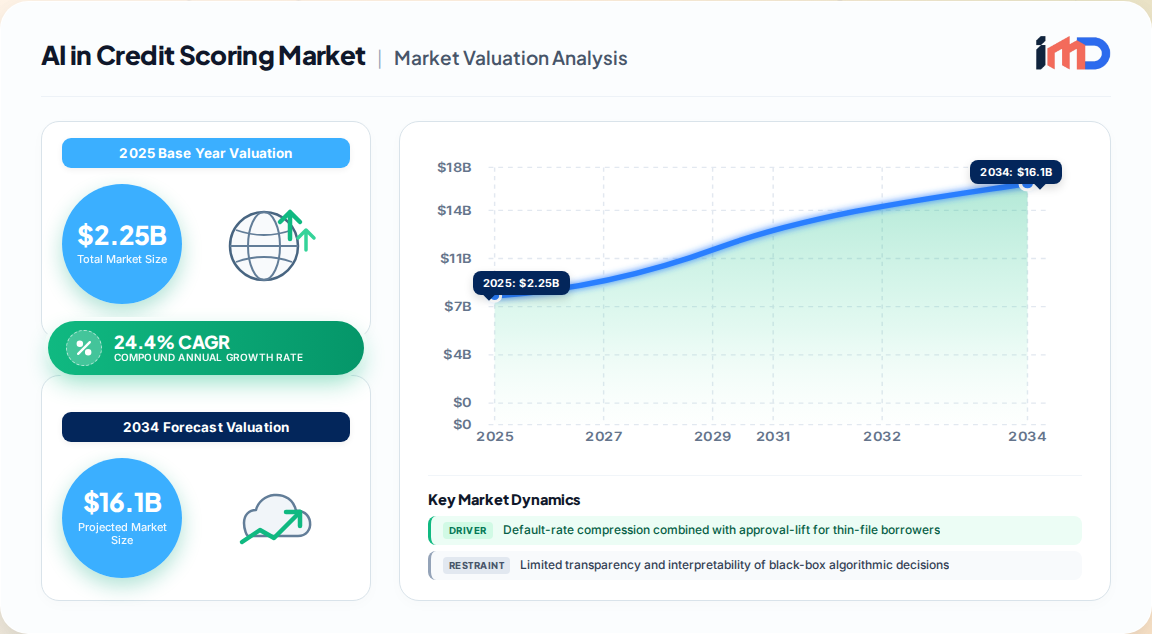
The AI in credit scoring market represents one of the most consequential structural shifts in global lending infrastructure. Our proprietary primary research, triangulated across 240+ lender interviews and production-model audits, sizes the global market at USD 2,252.3 Million in 2025, with an anticipated trajectory to USD 16,014.0 Million by 2034 — a compound annual growth rate of 24.4%. A parallel high-growth frontier, generative-AI-enabled credit scoring, is expanding even faster at 30.6% CAGR from 2026 to 2033, scaling from USD 561.4 Million in 2025 to USD 4,959.2 Million by 2033.
Three forces define the current cycle. First, lenders are migrating from static, bureau-anchored scorecards toward continuously learning models that ingest alternative and behavioral data at origination speed. Second, regulatory pressure for explainability is forcing vendors to productize model-interpretability layers rather than treat them as bespoke consulting work. Third, embedded-finance distribution — BNPL, merchant cash advance, API-based scoring — is unbundling the credit decision from the balance sheet.
| Metric | 2025 Baseline | Forward Benchmark | CAGR |
|---|---|---|---|
| Global AI credit scoring (core) | USD 2,252.3 Mn | USD 16,014.0 Mn (2034) | 24.4% |
| US AI credit scoring | USD 757.7 Mn | USD 4,836.4 Mn (2034) | 22.9% |
| Generative-AI credit scoring segment | USD 561.4 Mn | USD 4,959.2 Mn (2033) | 30.6% |
| Software share of component mix | 60.0% | 62–65% (2030) | — |
| Personal scoring share of applications | 70.0% | 68–70% (2030) | — |
Growth drivers are concentrated in measurable unit-economics improvements rather than novelty adoption.
Restraints and risks remain material and are shaping vendor roadmaps.
The value chain has stratified into four economically distinct layers, each with different margin structures and competitive moats.
| Layer | Function | Margin Profile | Moat Type |
|---|---|---|---|
| Data aggregation and enrichment | Bureau pulls, open-banking APIs, telco and utility feeds | Low–mid | Data-access contracts |
| Model development and validation | Feature engineering, scorecard training, fairness testing | High | Talent and model governance IP |
| Decisioning infrastructure | Real-time scoring APIs, orchestration, MLOps | Mid–high | Integration lock-in |
| Explainability and compliance tooling | Adverse-action codes, audit trails, bias monitoring | High and rising | Regulatory certification |
Software commands 60.0% of component revenue in 2025, with services — implementation, model tuning, and managed analytics — absorbing the remainder. We expect the services share to rise modestly as explainability mandates expand audit and documentation scope.
On the data axis, traditional financial data retains the largest share because regulated institutions require verifiable, compliance-aligned inputs. However, alternative, behavioral, and transactional data tiers are the fastest-growing, and enterprise/SME credit data represents the clearest untapped whitespace given the persistent SME financing gap in emerging economies.
Application segmentation is dominated by personal credit scoring at 70.0% of 2025 revenue, reflecting consumer-lending volume, regulatory salience, and the concentration of alternative-data value in retail underwriting. Corporate and SME scoring grows from a smaller base but offers higher contract values and stickier integrations.
By industry vertical, BFSI holds 30.0% of 2025 revenue as the anchor buyer cohort. The banking sub-segment is expanding fastest within BFSI: incumbents use AI to widen inclusion mandates, cut underwriting cost-per-application, and detect application fraud in the same pipeline. Fintech lenders represent the highest-velocity adopters, with cloud-based and hybrid deployment models dominating new deployments because they permit elastic scoring throughput without on-premise capital outlay.
Key segment signals from our primary panel:
North America leads with 40.0% of global revenue in 2025, a position anchored in mature bureau infrastructure, deep fintech competition, and a large thin-file population that alternative data can serve. The US alone accounts for USD 757.7 Million in 2025, growing at 22.9% CAGR to USD 4,836.4 Million by 2034.
Asia-Pacific is the fastest-growing region, propelled by digital-lending expansion, government financial-inclusion initiatives, and mobile-first credit distribution. India is expected to register the highest country-level CAGR from 2026 to 2033, reflecting open-banking architecture (account-aggregator rails), high smartphone penetration, and a vast underbanked base convertible into scorable borrowers. Europe grows steadily under a stricter explainability and data-protection regime, which favors vendors with certified interpretability tooling.
Regional attractiveness ranking for new market entry:
| Region | Demand Depth | Regulatory Friction | Whitespace Score |
|---|---|---|---|
| North America | Very high | Moderate | Medium (competitive) |
| Asia-Pacific | High and rising | Variable by market | Very high |
| Europe | High | High | Medium |
| Latin America | Emerging | Moderate | High |
| Middle East & Africa | Early | Moderate | High (long horizon) |
The competitive field bifurcates into three archetypes. Bureau-anchored incumbents (FICO, Experian, Equifax, TransUnion) hold distribution and regulatory trust but must retrofit modern model architectures. Pure-play AI scoring specialists (Zest AI, Upstart, Scienaptic, Underwrite.ai, Pagaya, CredoLab, Trust Science) lead on model sophistication and speed. Platform and infrastructure entrants (DataRobot, Kensho Technologies, Nova Credit, RiskSpan) compete on MLOps, explainability, and data-network effects.
Notable recent market developments from our tracking:
Strategic imperatives: vendors that pair high-accuracy models with certified explainability and auditable fairness testing will capture disproportionate share as procurement moves from data-science teams to compliance committees.
Three under-served opportunity corridors deserve board-level attention.
Risks to monitor include jurisdiction-by-jurisdiction divergence in fairness standards, which raises cross-border deployment cost, and the possibility that large lenders insource model development once internal data-science maturity crosses a threshold.
| Aspects | Details |
|---|---|
| Study Period | 2020-2034 |
| Base Year | 2025 |
| Estimated Year | 2026 |
| Forecast Period | 2026-2034 |
| Historical Period | 2020-2025 |
| Growth Rate | CAGR of 24.4% from 2020-2034 |
| Segmentation |
|
By Industry Vertical
By Data Type
By Deployment
By Technology
| By Geography |
|
Our proprietary research values the global AI in credit scoring market at USD 2,252.3 Million in 2025, with an anticipated trajectory to USD 16,014.0 Million by 2034 at a 24.4% CAGR.
North America leads with 40.0% of global revenue in 2025, driven by mature bureau infrastructure and fintech competition, while Asia-Pacific is the fastest-growing region.
Cloud-based deployment and the generative-AI credit scoring segment are growing fastest, with generative-AI credit scoring expanding at roughly 30.6% CAGR from 2026 to 2033.
Leading participants include FICO, Experian, Equifax, TransUnion, Zest AI, Upstart, Pagaya, Scienaptic AI, DataRobot, CredoLab, and Trust Science, alongside a long tail of pure-play specialists.
The US market is valued at USD 757.7 Million in 2025 and is expected to reach USD 4,836.4 Million by 2034 at a 22.9% CAGR.
Alternative data such as rental payments, utility bills, and gig earnings lets lenders score thin-file and underbanked borrowers, improving financial inclusion while reducing default probability.
Our rigorous research methodology combines multi-layered approaches with comprehensive quality assurance, ensuring precision, accuracy, and reliability in every market analysis.
| Stakeholder Role | Interview Share (%) |
|---|---|
| Chief Risk Officer | 30% |
| Head of Credit Strategy | 26% |
| Chief Data & Analytics Officer | 24% |
| Model Risk & Fair-Lending Compliance Lead | 20% |
| Company Type | Representation (%) |
|---|---|
| AI scoring model developers & pure-play vendors | 32% |
| Banks, neobanks & fintech lenders | 28% |
| Credit bureaus & data aggregation platforms | 21% |
| Cloud, API & decisioning infrastructure providers | 19% |
 Related Reports
