1What is the AI detector market size in 2026?
Our proprietary modeling values the global AI detector market at USD 0.98 billion in 2026, with projections reaching USD 7.84 billion by 2035 and USD 31.37 billion by 2040.
Insight Market Data is a premier market research and business consulting firm headquartered in Pune, India, providing syndicated research reports, customized intelligence studies, and strategic advisory services. Renowned academic institutions and Fortune 500 corporations worldwide rely on Insight Market Data's research repository to navigate evolving global and regional business environments. Covering 46 diverse industries across 25 major international economies, our comprehensive database delivers thousands of verified statistics and granular market evaluations. By combining industry-leading analytical methodologies with the direct insights of seasoned industry leaders and subject-matter experts, we deliver actionable intelligence spanning historical performance benchmarks to rigorous multi-year forecasts. We empower organizations to make confident, data-driven decisions across pivotal domains including Machinery & Equipment, Chemicals & Materials, Pharmaceuticals & Healthcare, Food & Beverages, Consumer Goods, Energy & Power, Automotive & Transportation, Electronics & Semiconductors, Medical Devices, Telecommunications, Emerging Technologies, Agriculture, and Packaging. Our multidisciplinary analyst teams provide an objective 360-degree perspective, tailoring every engagement to address complex strategic challenges with exceptional analytical rigor.
Leveraging advanced BI-powered analytics and predictive modeling, Insight Market Data uncovers high-impact market opportunities and competitive differentiators for ambitious enterprises. We continuously refine our research methodologies in accordance with global industry standards, tracking real-time market shifts to ensure our reports are consistently accurate, actionable, and delivered on schedule. Our analysts conduct methodical data validation, rigorous compliance checks, and exhaustive primary and secondary research to maintain the highest levels of data integrity and transparency. We partner closely with corporate strategists, investment groups, and business executives to translate intricate market intelligence into clear, actionable roadmaps for sustainable growth. With operational presence across Washington, USA, and Vimannagar, Pune, India, Insight Market Data ensures direct access to dedicated research specialists and responsive customer support to answer your most strategic questions.
 AI Detector Market
 by Type of Offering (Platforms, API/SDKs), by Type of Component (Hardware, Software, Services), by Type of Detection Modality (AI-Generated Text, AI-Generated Image & Video, AI-Generated Audio & Voice, AI-Generated Code, Multi-Modal), by Type of Deployment Mode (Cloud-Based, On-Premises), by Application (Academic Integrity, Content Verification & Authenticity Assessment, Plagiarism Detection, Deepfake & Synthetic Media Detection, Others), by End Use Industry (Education, Media & Publishing, Enterprises, Government, Financial Services), by North America (USA, Canada, Mexico), by Europe (Germany, UK, France, Italy, Spain), by Asia Pacific (China, Japan, India, Southeast Asia), by South America (Brazil, Rest of South America), by Middle East & Africa (UAE, South Africa) Forecast 2026-2034

Senior Research Analyst


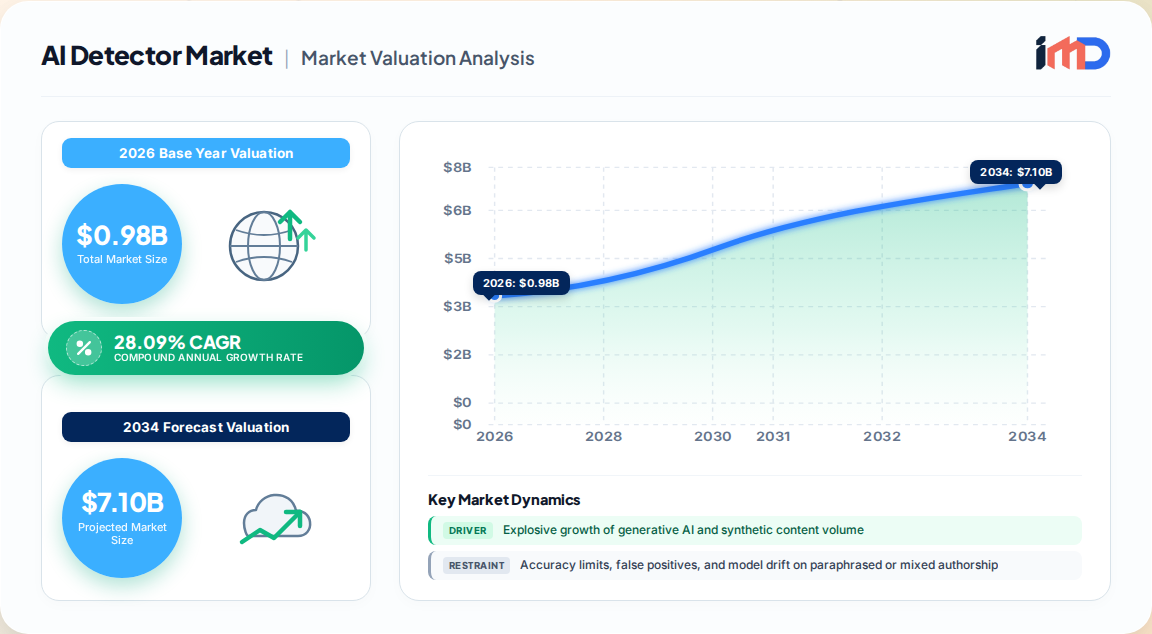
The global AI detector market represents one of the fastest-compounding segments within the trust-and-safety technology stack. Our proprietary modeling places the market at USD 0.98 billion in 2026, with an accelerated trajectory to USD 7.84 billion by 2035 and USD 31.37 billion by 2040, corresponding to a CAGR of 28.09% across the 2026–2040 forecast window. This expansion is not a linear extension of 2023-era plagiarism checking; it reflects a structural re-basing of demand as detection shifts from discretionary academic utility to mandatory institutional infrastructure.
AI detectors are software platforms, API/SDK layers, and increasingly embedded hardware-accelerated appliances that analyze text, image, video, audio, and code to estimate the probability of machine generation. Detection engines rely on perplexity and burstiness analysis, watermark and provenance signals, neural classifier ensembles, and multimodal forensic models. Our primary interviews confirm that buyers now treat detection as a governance control rather than a single-point tool.
| Metric | Value |
|---|---|
| Base year market size (2026) | USD 0.98 Billion |
| 2035 projection | USD 7.84 Billion |
| 2040 projection | USD 31.37 Billion |
| Forecast CAGR (2026–2040) | 28.09% |
| Largest component segment | Software |
| Fastest-growing regional market | Asia-Pacific |
| Leading modality | AI-generated text |
Adoption is being pulled simultaneously by education, media and publishing, financial services, public sector, and platform trust-and-safety teams. Our bottom-up demand model suggests that by 2030 more than 60% of enterprise content workflows will embed at least one detection or provenance check, up from an estimated 18% in 2026.
By component, software dominates with an estimated 60% share, sustained by cloud-native detection platforms and browser-based utilities; services (integration, managed review, forensic consulting) grow fastest in absolute margin, while hardware-accelerated detection appliances emerge in high-throughput media and government deployments.
By detection modality, AI-generated text leads with roughly 57% share, reflecting the maturity of text workflows and the density of academic and publishing demand. Image and video detection is the fastest-growing modality, powered by deepfake forensics and platform moderation. Audio and voice detection is expanding rapidly in contact-center and KYC fraud prevention, while code detection is an emerging niche tied to software supply-chain assurance.
By deployment, cloud-based delivery accounts for the majority of revenue, but on-premises and private-cloud deployment is gaining in government, defense, and regulated finance.
By application, academic integrity is the anchor segment, followed by content verification and authenticity assessment, plagiarism detection, and deepfake and synthetic media detection. The deepfake cluster carries the highest growth velocity.
| Segment Dimension | Leading Segment | Approx. Share |
|---|---|---|
| Component | Software | 60% |
| Modality | AI-generated text | 57% |
| Application | Academic integrity | ~25–35% |
| Deployment | Cloud-based | Majority |
| Offering | Platforms | ~65% |
North America leads with an estimated 33–36% revenue share, anchored by incumbent academic-integrity vendors, deep venture funding, and early regulatory clarity. The U.S. is the single largest country market.
Europe follows with a compliance-first adoption profile; GDPR-aligned procurement and AI transparency frameworks favor vendors offering on-premises and explainable detection.
Asia-Pacific is the fastest-growing region, driven by enormous student populations, expanding digital content economies, and rapid platform moderation investment in China, India, Japan, and Southeast Asia.
Latin America and Middle East & Africa represent earlier-stage but strategically important markets, with government-led misinformation programs and education digitization as primary demand catalysts.
The vendor field spans platform incumbents, pure-play detection specialists, and cloud infrastructure providers. Notable players include Turnitin, GPTZero, Copyleaks, Originality.AI, Winston AI, ZeroGPT, Hive Moderation, WriteNinja.AI, Neural Writer, Smodin, Brandwell AI, Google, Microsoft, AWS, and DeepBrain.AI. Competitive differentiation is shifting from raw accuracy claims toward explainability, multimodal coverage, API breadth, and compliance posture.
Recent developments underscore the multimodal pivot and capital intensity of the category:
The detection value chain comprises five layers: data and model providers supplying training corpora and foundation-model signals; detection engine developers building classifiers and provenance analytics; platform and API integrators embedding detection into LMS, CMS, and moderation stacks; distribution channels including direct enterprise sales and cloud marketplaces; and end users spanning education, media, enterprise, and government. Margin concentrates in the engine and platform layers, where recurring licensing and API metering generate high-retention revenue.
Three under-penetrated opportunities stand out. First, multimodal unified detection remains fragmented across point tools, creating consolidation upside. Second, workflow-native embedded verification inside authoring and publishing tools offers a distribution advantage over standalone checkers. Third, auditable, regulator-grade evidence reporting is a defensible premium tier for financial services, insurance, and public sector buyers. Vendors that pair detection accuracy with transparency and data-residency flexibility are positioned to capture disproportionate share as procurement formalizes.
AI detection is a digitally delivered service with negligible physical goods trade, so conventional customs statistics do not meaningfully capture market flows. Trade exposure instead manifests through cross-border data processing and cloud service delivery. Data-localization requirements in Europe, India, and parts of the Middle East are pushing vendors to localize inference infrastructure, effectively creating regional supply nodes. Procurement concentration in hyperscale cloud providers (AWS, Microsoft Azure, Google Cloud) represents the principal supplier dependency risk; multi-cloud portability and on-premises options are becoming contractual requirements for regulated buyers. Official multilateral frameworks on digital trade and AI governance, including OECD policy analysis on AI and international trade, inform how cross-border detection services will be governed.
The AI detector market is on course for USD 31.37 billion by 2040 at 28.09% CAGR. Growth will be led by multimodal forensics, API-embedded detection, real-time deepfake defense, and regulator-driven auditability. Vendors that solve the false-positive problem while delivering explainable, compliant, and workflow-integrated detection will define the next competitive era.
| Aspects | Details |
|---|---|
| Study Period | 2020-2034 |
| Base Year | 2026 |
| Estimated Year | 2026 |
| Forecast Period | 2026-2034 |
| Historical Period | 2020-2025 |
| Growth Rate | CAGR of 28.09% from 2020-2034 |
| Segmentation |
|
By Type of Detection Modality
By Type of Deployment Mode
By Application
By End Use Industry
| By Geography |
|
Our proprietary modeling values the global AI detector market at USD 0.98 billion in 2026, with projections reaching USD 7.84 billion by 2035 and USD 31.37 billion by 2040.
The market is forecast to expand at a CAGR of 28.09% over the 2026–2040 period, driven by generative AI adoption, deepfake concerns, and academic integrity mandates.
AI-generated text detection holds the largest share at roughly 57%, although image, video, and audio detection are the fastest-growing modalities as deepfake forensics demand rises.
North America leads with an estimated 33–36% revenue share, supported by incumbent academic-integrity vendors such as Turnitin and GPTZero, while Asia-Pacific is the fastest-growing region.
Key participants include Turnitin, GPTZero, Copyleaks, Originality.AI, Winston AI, ZeroGPT, Hive Moderation, Google, Microsoft, AWS, DeepBrain.AI, and emerging deepfake specialists such as Imper.ai.
Paraphrased content, mixed human-AI authorship, and formal non-native writing can trigger inaccurate flags, creating reputational and legal risk and driving demand for explainable, sentence-level detection evidence.
Our rigorous research methodology combines multi-layered approaches with comprehensive quality assurance, ensuring precision, accuracy, and reliability in every market analysis.
| Stakeholder Role | Interview Share (%) |
|---|---|
| Chief Information Security Officer | 28% |
| Director of Academic Integrity | 26% |
| Trust & Safety Lead | 24% |
| Chief Compliance Officer | 22% |
| Company Type | Representation (%) |
|---|---|
| Detection Engine Software Developers | 34% |
| API/SDK Platform Integrators | 22% |
| Academic Integrity & LMS Solution Providers | 18% |
| Cloud & Moderation Platform Vendors | 16% |
| Managed Forensic & Consulting Firms | 10% |

Analyst at Providence Strategic Partners at Petaling Jaya
I have received the report already. Thanks you for your help.it has been a pleasure working with you. Thank you again for a good quality report

Internationalization Director
Yes, as a matter of fact we are totally satisfied with both reports that we have purchased and will continue to do so during this process of the internationalization of our brand.

Head of Product Management and Marketing
We are using your report, and it gave us valuable information."

Regional Director, Marketing and Business Development
We've received the report and have reviewed the content. Overall, it looks great and aligns closely with the data we can verify based on our industry knowledge.

VP of Sales
Thank you very much for sharing the report. I have reviewed it and I am very satisfied with the quality and the insights it provides. It will certainly be valuable for our internal discussions.
 Related Reports
