1What is the size of the 2.5D silicon interposer market in 2025?
The global 2.5D silicon interposer market was valued at USD 4.00 Billion in 2025 and is projected to reach USD 14.04 Billion by 2035, expanding at a 13.38% CAGR.
Insight Market Data is a premier market research and business consulting firm headquartered in Pune, India, providing syndicated research reports, customized intelligence studies, and strategic advisory services. Renowned academic institutions and Fortune 500 corporations worldwide rely on Insight Market Data's research repository to navigate evolving global and regional business environments. Covering 46 diverse industries across 25 major international economies, our comprehensive database delivers thousands of verified statistics and granular market evaluations. By combining industry-leading analytical methodologies with the direct insights of seasoned industry leaders and subject-matter experts, we deliver actionable intelligence spanning historical performance benchmarks to rigorous multi-year forecasts. We empower organizations to make confident, data-driven decisions across pivotal domains including Machinery & Equipment, Chemicals & Materials, Pharmaceuticals & Healthcare, Food & Beverages, Consumer Goods, Energy & Power, Automotive & Transportation, Electronics & Semiconductors, Medical Devices, Telecommunications, Emerging Technologies, Agriculture, and Packaging. Our multidisciplinary analyst teams provide an objective 360-degree perspective, tailoring every engagement to address complex strategic challenges with exceptional analytical rigor.
Leveraging advanced BI-powered analytics and predictive modeling, Insight Market Data uncovers high-impact market opportunities and competitive differentiators for ambitious enterprises. We continuously refine our research methodologies in accordance with global industry standards, tracking real-time market shifts to ensure our reports are consistently accurate, actionable, and delivered on schedule. Our analysts conduct methodical data validation, rigorous compliance checks, and exhaustive primary and secondary research to maintain the highest levels of data integrity and transparency. We partner closely with corporate strategists, investment groups, and business executives to translate intricate market intelligence into clear, actionable roadmaps for sustainable growth. With operational presence across Washington, USA, and Vimannagar, Pune, India, Insight Market Data ensures direct access to dedicated research specialists and responsive customer support to answer your most strategic questions.
 2.5D Silicon Interposer Market
 by Interposer Type (2D Silicon Interposer, 2.5D Silicon Interposer, 3D Silicon Interposer), by Packaging Technology (2.5D Packaging, 3D Packaging, Fan-Out on Substrate), by Application (High Performance Computing, AI Accelerators, Memory HBM and 3D NAND, RF and Photonics, Networking, Consumer Electronics, Automotive ADAS), by End User (Semiconductor Manufacturers, Data Center Companies, Telecommunications Companies, Automotive Manufacturers, Consumer Electronics Companies), by Substrate Type (Organic Build-Up, Glass-Core Substrates), by North America (USA, Canada, Mexico), by Europe (Germany, UK, France), by Asia Pacific (China, Taiwan, South Korea, Japan, India), by Middle East & Africa (GCC Countries, South Africa), by Latin America (Brazil, Argentina) Forecast 2026-2034

Senior Research Analyst

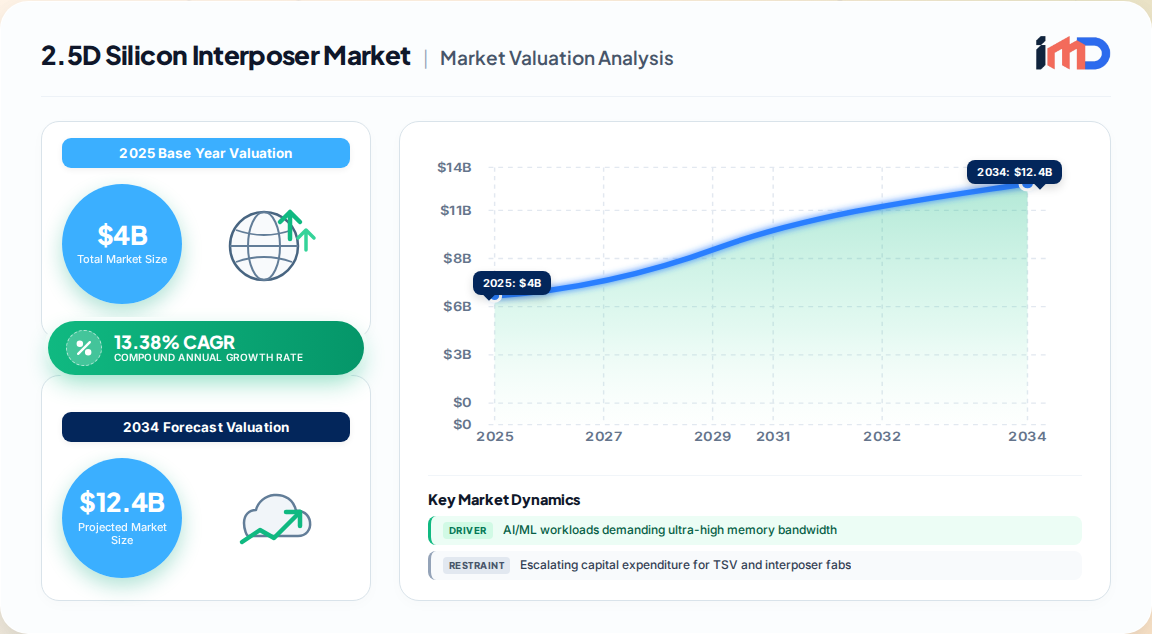
The global 2.5D silicon interposer market was valued at USD 4.00 Billion in 2025 and is projected to reach USD 14.04 Billion by 2035, expanding at a 13.38% CAGR across 2026–2035. Our proprietary bottom-up modeling, triangulated against foundry-capacity disclosures and package-unit shipment data, indicates that 2.5D silicon interposers alone accounted for 58.00% of total interposer-type revenue in 2025 and will remain both the largest and fastest-growing interposer category, posting a 13.75% CAGR through the forecast window.
The technology has transitioned from a niche advanced-packaging enabler to the structural backbone of heterogeneous integration. As transistor-level scaling yields diminishing returns below the 3nm node, the industry's performance-per-watt roadmap increasingly depends on packaging innovation—placing multiple chiplets side-by-side on a fine-line silicon routing medium at sub-2-micron pitch, which organic laminates cannot replicate.
| Market Metric | 2025 Value | 2035 Projection | CAGR (2026–2035) |
|---|---|---|---|
| Global market size | USD 4.00 Billion | USD 14.04 Billion | 13.38% |
| 2.5D silicon interposer segment share | 58.00% | Dominant | 13.75% |
| U.S. market size | USD 1.84 Billion | USD 3.62 Billion | 12.01% |
| Leading region | North America | North America | — |
| Fastest-growing region | — | Asia Pacific | ~14%+ |
The 2.5D silicon interposer value chain is unusually concentrated and capital-intensive:
| Stage | Activity | Representative Participants |
|---|---|---|
| Upstream materials | Interposer-grade silicon wafers, ABF build-up film, copper, underfill | Specialty wafer and material suppliers |
| Interposer fabrication | TSV etch, fine-line RDL patterning, wafer thinning | TSMC, Samsung, Intel, GlobalFoundries |
| Assembly and test | CoWoS-style chip-on-wafer, OSAT packaging | ASE Technology, Amkor Technology, SPIL |
| System integration | Multi-chiplet, HBM co-packaging, substrate attach | Foundries and OSATs jointly with fabless designers |
| End demand | AI accelerators, HPC, networking, automotive | Hyperscalers, GPU vendors, OEMs |
A critical structural insight: interposer fabrication capacity—not wafer lithography—has become the binding constraint on global AI accelerator supply. New CoWoS-class facilities require 18 to 24 months to bring online, creating a multi-year lag between demand signals and supply response. This dynamic shifts bargaining power decisively toward foundries with captive interposer lines and toward OSATs holding qualified CoWoS-alternative flows.
By interposer type, 2.5D silicon interposers commanded 58.00% share in 2025, driven by HPC, AI accelerators, GPUs, FPGAs, and HBM applications. Within the broader 2.5D and 3D packaging market, 2.5D interposer and fan-out-on-substrate solutions led with 45.72% share in 2025; panel-level fan-out is advancing at a 13.83% CAGR to 2031.
By packaging technology, 2.5D packaging held 54.00% share in 2025 on the strength of maturity, manufacturing scalability, and an optimal balance of performance, thermal headroom, and economics. 3D packaging is the fastest-growing technology at 17.86% CAGR, propelled by high-density vertical stacking for next-generation AI processors.
By application, high-performance computing led with 29.00% share in 2025, while AI accelerators are forecast to register the fastest CAGR at 17.88%. Within adjacent packaging markets, memory captured 47.91% share in 2025, with RF and photonics expanding at 13.96% CAGR.
By end user, semiconductor manufacturers dominated with 43.00% share in 2025, whereas data center companies are projected to grow fastest at a 16.26% CAGR—a clear signal that demand gravity is shifting downstream toward hyperscale buyers co-designing their own silicon.
North America remains the largest market, anchored by USD 1.84 Billion in 2025 U.S. revenue and a 12.01% CAGR to 2035. The region concentrates fabless AI-hardware designers, hyperscale cloud operators, defense-electronics programs, and domestically funded packaging expansion.
Asia Pacific is the fastest-growing region, projected to expand at over 14% annually through 2031, with the region commanding roughly 51.93% of the broader 2.5D/3D packaging market in 2025. Taiwan's CoWoS capacity, South Korean foundry and memory integration, and Chinese and Japanese 5G and automotive investment form the growth core.
Europe contributes steady, innovation-led demand—particularly German and UK automotive ADAS, sensor-fusion, and 5G infrastructure programs—though at a smaller scale. Latin America, the Middle East, and Africa remain emerging, with Gulf 5G and smart-city initiatives representing the most credible near-term upside.
The market is moderately concentrated, with foundry-integrated players controlling the highest-value interposer capacity and OSATs competing aggressively on cost-effective CoWoS-alternative and fan-out flows.
Three priority opportunity zones emerge from our scenario modeling. First, capacity expansion for AI accelerator and HBM co-packaging remains the single largest addressable upside, with demand structurally exceeding supply. Second, organic redistribution-layer interposers open a lower-cost 2.5D path for networking and mid-range compute. Third, domestic 2.5D packaging investment in North America and Europe creates greenfield supplier opportunities as governments fund supply-chain resilience.
For procurement leaders, the strategic imperative is multi-sourcing: qualifying at least two interposer assembly flows, securing multi-year capacity reservations with foundries, and designing for interposer-area efficiency to hedge against the ongoing silicon-ingot and CoWoS-capacity constraints.
| Aspects | Details |
|---|---|
| Study Period | 2020-2034 |
| Base Year | 2025 |
| Estimated Year | 2026 |
| Forecast Period | 2026-2034 |
| Historical Period | 2020-2025 |
| Growth Rate | CAGR of 13.38% from 2020-2034 |
| Segmentation |
|
By Application
By End User
By Substrate Type
| By Geography |
|
The global 2.5D silicon interposer market was valued at USD 4.00 Billion in 2025 and is projected to reach USD 14.04 Billion by 2035, expanding at a 13.38% CAGR.
2.5D silicon interposers held 58.00% share in 2025 and are growing at 13.75% CAGR because they enable chiplet integration with sub-2-micron redistribution-layer pitch, which organic substrates cannot match. This makes them essential for AI accelerators and high-bandwidth memory co-packaging.
North America is the largest market, with the U.S. alone accounting for USD 1.84 Billion in 2025 and a projected USD 3.62 Billion by 2035. Asia Pacific is the fastest-growing region at over 14% annual growth, driven by Taiwanese and South Korean foundry capacity.
TSMC, Samsung, Intel, ASE Technology, Amkor Technology, and GlobalFoundries lead the market. Foundry-integrated players control high-value interposer capacity while OSATs compete on cost-effective CoWoS-alternative and fan-out assembly flows.
High capital expenditure is the primary restraint—a single 300mm through-silicon-via line exceeding USD 500 million in investment. Design-for-test complexity, silicon-ingot supply tightness, and thermal-reliability limits further constrain near-term expansion.
Our rigorous research methodology combines multi-layered approaches with comprehensive quality assurance, ensuring precision, accuracy, and reliability in every market analysis.
| Stakeholder Role | Interview Share (%) |
|---|---|
| Advanced Packaging Engineering Director | 35% |
| VP Supply Chain / Procurement Head | 28% |
| Foundry Capacity Planning Manager | 22% |
| Chief Technology Officer (Fabless) | 15% |
| Company Type | Representation (%) |
|---|---|
| Interposer Foundries & IDMs | 30% |
| OSAT & Advanced Packaging Providers | 25% |
| Fabless AI/HPC Chip Designers | 20% |
| HBM & Memory Suppliers | 15% |
| Substrate & Materials Vendors | 10% |

 Related Reports
